


Who was fattened by a meme spree? How can Pump.fun and GMGN turn transactions into money printers?
Source | Odaily Planet Daily
Author | Asher
Original title | Disassembling the revenue structure of meme shovels sellers: How do Pump.fun and GMGN earn tens of millions of dollars a month?
If you think it's a bear market, you're not looking in the right direction.
Core ideas:
Despite the decline in the popularity of the meme coin market and fewer opportunities to become rich, token issuance platforms and trading tools have maintained strong profitability. According to the data in the article, leading platforms such as Pump.fun have earned more than 34 million US dollars in the past 30 days, and GMGN and Axiom have also reached nearly 20 million and 14 million US dollars respectively. The revenue mainly comes from transaction fees and issuance fees.
Key elements:
1. Pump.fun has earned US$34.68 million in the past 30 days, with a transaction volume of US$1,718 million. The revenue comes from Bonding Curve transaction fees (1.25%, of which 0.95% is the agreement) and token graduation fees.
2. Flap's revenue in the past 30 days was 5.58 million US dollars. More than 90% came from BNB Chain. Benefiting from the boom in the stock MEME coin MarsCoin, the basic agreement rate was 1%.
3. Pons was once the leading distribution platform for Robinhood Chain. The revenue from the recent 30-day agreement was about US$4.99 million. After the launch of V2, its revenue sources expanded to include issuance fees, transaction fees, and processing fees after graduation into Uniswap V4.
4. GMGN's revenue in the past 30 days was about US$1.81 million, and Robinhood Chain contributed US$11.67 million (accounting for the largest share). The platform made a profit by charging a 1% handling fee for each transaction.
5. Axiom's revenue in the past 30 days is about US$14.67 million, almost all of which comes from Solana on-chain transactions. The base rate is 1%, the actual net rate is about 0.75%-0.95%, and there is a transaction volume rebate mechanism.
6. Fomo's revenue in the past 30 days is about US$8.79 million, mainly from Solana spot transactions (US$8.64 million), with a minimum handling fee of 0.5% per transaction and a minimum fee of $0.95.
Since this year, the overall performance of the crypto market has been sluggish, and altcoins have spread far and wide.The enthusiasm for discussion in the second-level Alpha community and airdrop community, which was previously active, has declined markedly.But memes are one of the few exceptions。
Compared to the previous bull market, this year it is rare for a meme to have a market capitalization exceeding 50 million US dollars in a short time after being issued.
Even the “Express Express”, which costs hundreds of millions of dollars, the myth of getting rich is gradually becoming an unfamiliar term. However, new hot spots are still emerging from time to time in the meme market.
From CASHCAT, which became popular on Robinhood Chain, to MarsCoin, a recent stock meme on BNB Chain, it is still attracting the attention of many communities.
The hot topic is still there, and naturally people continue to use platforms and wallets around meme creation, trading, etc.
So, when “Young P” has fewer and fewer opportunities to become rich with memes, how much money can these platforms make by relying on users to continue to issue and trade coins?
This article will start from the two dimensions of token distribution platforms and meme trading tools, and break down the revenue sources of the current meme circuit's main platforms.
And the revenue situation for the past 30 days. (The data below is all from DeFilLama.)
Pump.fun guys, take on the first round of the SGD transaction demand
Pump.fun: Revenue exceeds $34 million in nearly 30 days
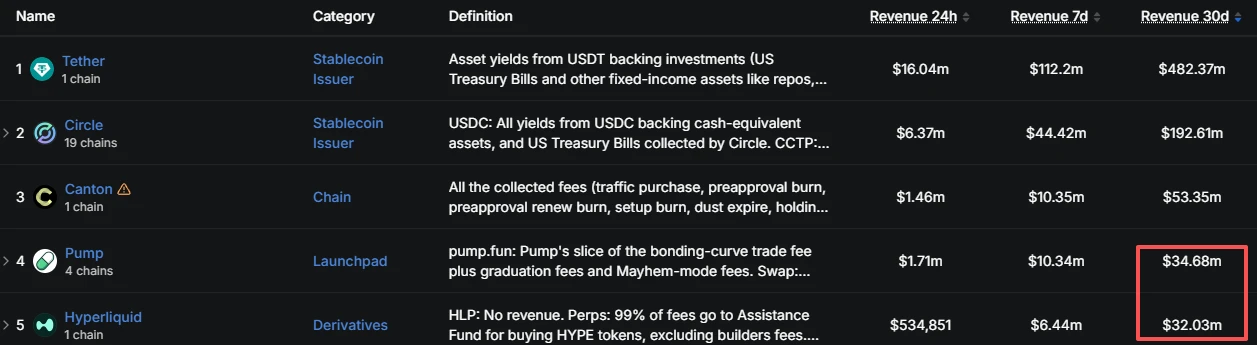
Although the meme market is far less than the bull market,But Pump.fun can still earn more than $30 million a month,The ability to make money even surpasses Hyperliqud.
As of August 11, Pump.fun's revenue for nearly 30 days was $34.68 million. Over the same period, the platform's trading volume was $17.18 billion.
 The core of Pump.fun's revenue comes from continuous trading of SGD on the platform. Currently, users are free to create tokens themselves.
However, trading at the Bonding Curve stage requires transaction fees.
According to Pump.fun's latest rates,Bonding Curve has a total rate of 1.25% per transaction, of which 0.95% goes to the agreement and 0.30% is distributed to the token creator.
Additionally, when tokens graduate from Pump.fun and enter PumpSwap, a graduation fee of 0.015 SOL will be charged.
Flap: Revenue surpassed $5.5 million in the past 30 days, 90% from BNB Chain
The recent BNB Chain stock meme boom has also given Flap a wave of dividends.
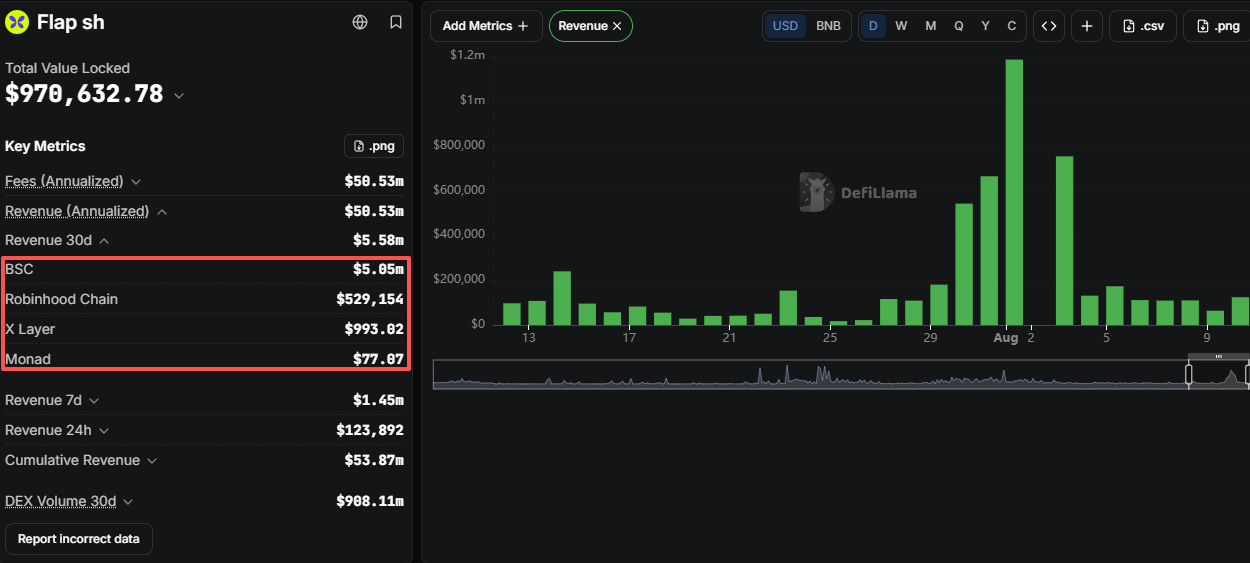
As of August 11,Flap's revenue in the past 30 days was 5.58 million US dollars, of which 5.05 million dollars came from BNB Chain, accounting for more than 90%;
Robinhood Chain contributed $52.9 million.Over the same period, the platform's trading volume was $908 million.
Similar to Pump.fun, Flap also uses the Bonding Curve mechanism. Newly issued tokens migrate to DEX after completing the curve phase.
The difference is that in addition to ordinary tokens, Flap also supports issuing Tax Tokens, and creators can set transaction tax rates for tokens.
MarsCoin, the stock meme coin that has recently become popular,This is the Tax Token issued through Flap
(Note: DeFilLama's revenue includes only the agreed rate portion, and the transaction tax set by Tax Token itself is not included).
In terms of revenue, Flap's most direct revenue source is still the transaction fee generated by the new coin during the Bonding Curve phase.
Currently, the basic agreement rate on BNB Chain, Robinhood Chain, X Layer, and Monad is 1%.
Every time a user buys and sells tokens on the Bonding Curve, the platform charges a fee.
Pons: Earning nearly $5 million in nearly 30 days, was once the leading Robinhood Chain token issuance platform
After meme popularity on Robinhood Chain exploded, Pons soon became one of the major meme distribution platforms in the ecosystem.
On July 15, Pons issued more than 15,000 tokens in a single day, rising to the top of the Robinhood Chain token distribution platform for the first time.
After that, it remained in the lead for about half a month, and was only overtaken by Pool.trade and Flap in recent days(In the image below, green is Pons; pink is Pool.trade; purple is Flap).
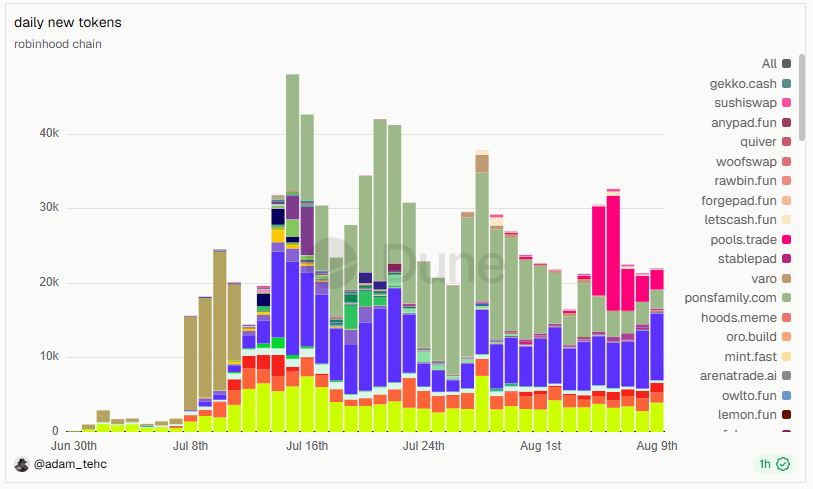
The rapid growth in token circulation has also directly converted into platform revenue. As of August 11,The Pons platform generated $18.76 million in processing fees in the past 30 days.
Of this, revenue attributable to the agreement was approximately $4.99 million.Based on a rough reversal of its V1 phase 1% transaction fee, the total trading volume of the platform is approximately $1.8 billion.
Pons is a native token issuance platform on Robinhood Chain where users can directly create and trade meme coins.
Recently, the platform has launched V2. The new coin first completed early transactions through the Bonding Curve, and then entered Uniswap V4 after meeting the graduation requirements.
Fees for subsequent transactions are still distributed according to the rules set by Pons.
Pons' revenue mainly comes from the two processes of issuing coins and trading. In V1, you need to pay 0.0005 ETH for each token created,
Transactions that issue tokens on the platform are charged a 1% handling fee. Not all fees are owned by Pons; about 70% is distributed to token creators.
The agreement reserves approximately 30%.After the launch of V2, the revenue sources further covered issuance fees and transaction fees at the Bonding Curve stage.
Also, transaction fees generated after the token graduated and entered Uniswap V4 (also using the distribution ratio of about 70% from the creator and about 30% of the agreement).
It is worth mentioning that Pons will use a portion of the revenue from the agreement for PONS buyback and destruction.
According to official documentation, it is currently planned to80% of the agreement fee is used to buy back and destroy PONS, and the remaining 20% is used for infrastructure and team operations.
GMGN guys rely on efficient trading tools to earn “Captain P” handling fees
GMGN: Nearly $20 million in revenue in the past 30 days, the main contribution comes from Robinhood Chain
Compared to token distribution platforms, GMGN does not participate in token creation.
Instead, it provides quotes, monitoring, and order placement tools around meme transactions, and earns revenue from user transactions.
As of August 11,GMGN's trading volume in the past 30 days was US$2,584 million, and the Communist Party generated US$23.87 million in processing fees.
After deducting referral rebates, the final revenue attributable to GMGN was approximately $1.81 million.
Among them, Robinhood Chain contributed $11.67 million in revenue, and BNB Chain and Solana contributed $4.93 million and $2.41 million, respectively.
Robinhood Chain has become GMGN's biggest revenue stream today.
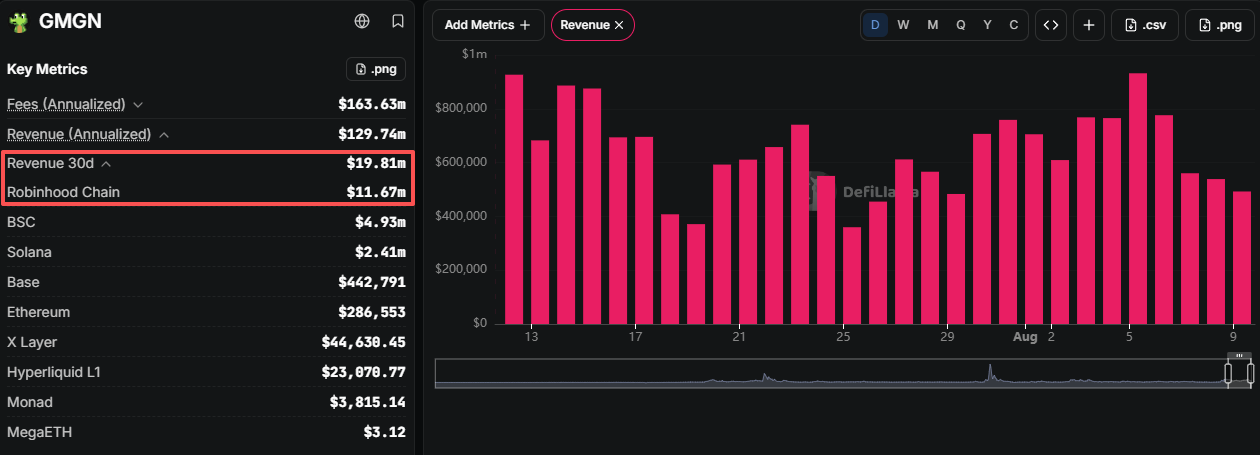
GMGN's way of making money is also more direct than a coin issuing platform —Every time a user completes a transaction through GMGN,
The platform charges a processing fee of 1% of the transaction amount(Some fees will be reallocated to users by inviting rebates, etc.)
For example, if you buy a meme coin worth 1 SOL, GMGN will charge 0.01 SOL; copy transactions are also charged according to this standard.
Axiom: Revenue surpassed $14 million in the past 30 days, and the revenue came almost entirely from the Solana chain
Similar to GMGN, Axiom is also an on-chain trading tool commonly used by meme players.
It provides functions such as token discovery, market analysis, wallet tracking, X monitoring, and one-click trading, and the core market is still Solana.
As of August 11,Axiom's transaction volume in the past 30 days was approximately US$1,337 million, generating US$23.91 million in processing fees.
After deducting referral rebates and user transaction rebates, the final revenue was approximately $14.67 million.
Of this, $23.84 million in processing fees came from Solana, and BNB Chain contributed only about $66,000, and revenue came almost entirely from Solana's on-chain transactions.
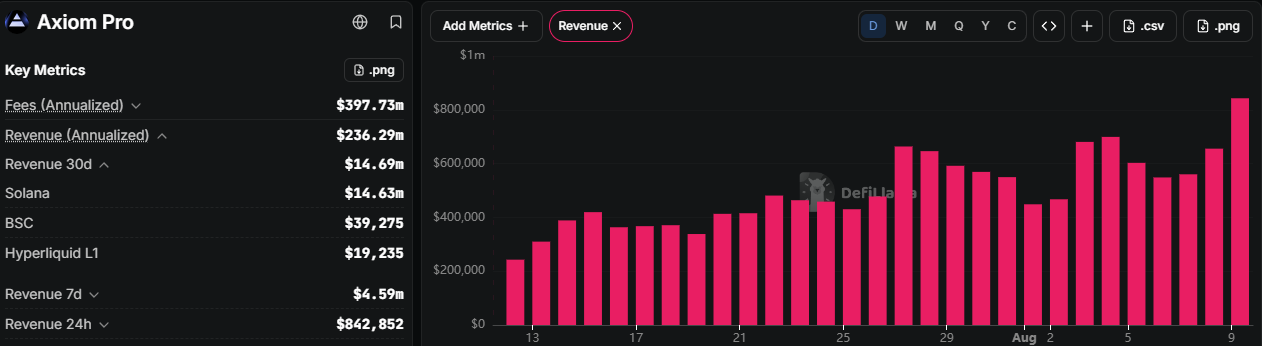
Axiom's revenue stream mainly derives processing fees from every transaction completed by users through the platform.
Axiom's basic transaction rate is 1%, and a cashback mechanism linked to transaction volume has been set up. The higher the user's transaction level,
The higher the refund rate. Currently, the actual net rate is around 0.75% to 0.95%.Additionally, Axiom will pay part of the processing fee to the inviter.
fomo: Nearly $8.8 million in revenue in the last 30 days, derived from Solana spot trading
Last weekend, a gossip about “Pump.fun invests huge sums of money to dig up competitors' fomo walls” went viral in overseas meme communities
(See related content: $20,000 contract fee+$30,000 monthly salary, behind Pump.fun digging into FOMO's corner).
As of August 11,Fomo generated $9.48 million in processing fees in the past 30 days, of which revenue attributable to the agreement was approximately $8.79 million;
The volume of spot trading during the same period was approximately$6.17 billionIn addition, there is a perpetual contract trading volume of approximately $360 million.
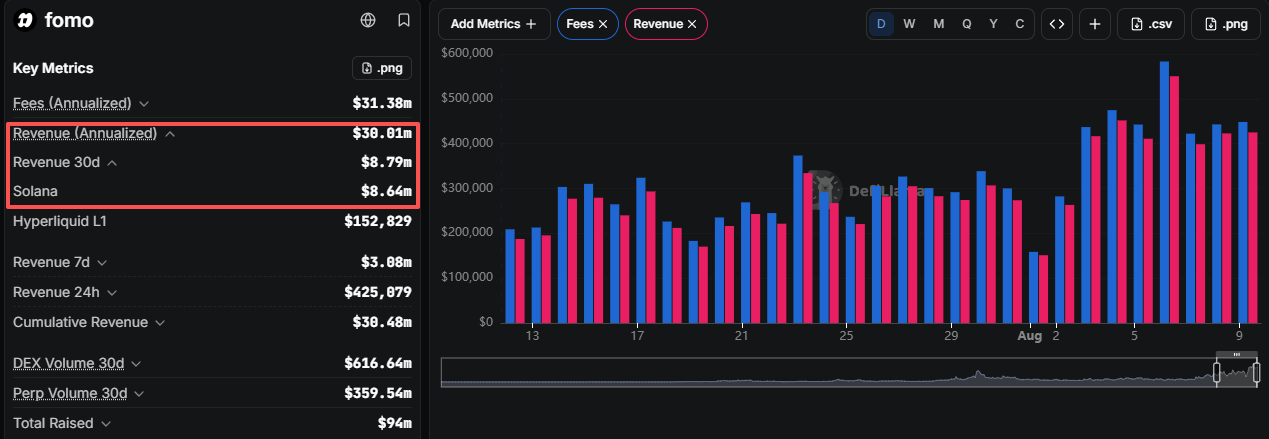
Unlike GMGN and Axiom, which prefer professional on-chain trading terminals, fomo places more emphasis on social trading.
Users can view other traders' operations, rankings, and real-time trading trends within the platform, and directly complete the trading and tracking of tokens such as memes.
Currently, its spot trading is mainly focused on Solana. In the past 30 days, about $8.64 million in revenue comes from Solana spot trading.
The Hyperliquid perpetual contract contributed approximately $153,000.
fomo's revenue also mainly comes from trading credits.
According to the platform's latest terms of service,Spot trading is charged at a minimum of 0.5% of each transaction amount, and a minimum handling fee of $0.95 per transaction is set;
Perpetual contract transactions are subject to an additional 0.05% platform fee.
Since Meme players often make small to medium and high-frequency transactions, the minimum fee of $0.95 per transaction also forms an important source of fomo revenue.
Twitter:https://twitter.com/BitpushNewsCN
Compare the TG exchange group:https://t.me/BitPushCommunity
Compare TG subscriptions:https://t.me/bitpush
