


Take a deep dive into stablecoin cards: replacing Visa, or just a form of self-indulgence?

Author: Vaidik Mandloi
Compiled and organized by: bitPushNews
Crypto card spending surpassed $759 million in July, covering 9 million purchases — almost two and a half times the same period last year. However, more than 90% of the transaction volume still runs on the Visa network.
And each of these cards will tell you the same story: we put payments on the stablecoin track, cut off the card network fees, and return the savings to the merchant. This is the same idea we discussed earlier when discussing how Stripe can build its own stablecoin cross-border payment chain.
So if we actually try to get rid of the card network, what exactly will happen? Can avoiding Visa or Mastercard really save merchants money? Which layer do stablecoins replace in the payment stack?
After thorough research, the answers were completely unexpected to me.
How the payment stack works
To answer these questions, you first need to figure out where the money actually goes when someone swipes a credit card.
The first thing I realized was that most people, including those in the cryptocurrency industry, thought card networks like Visa had taken the biggest chunk.
Wrong! When a merchant accepts a $100 purchase made with your rewards credit card, they pay the so-called Merchant Discount Rate (Merchant Discount Rate), which is approximately 2.2%, or $2.20. But the interesting thing is: this $2.20 didn't go into Visa's pocket; instead, it was distributed to three different participants, and the distribution ratio was very uneven.
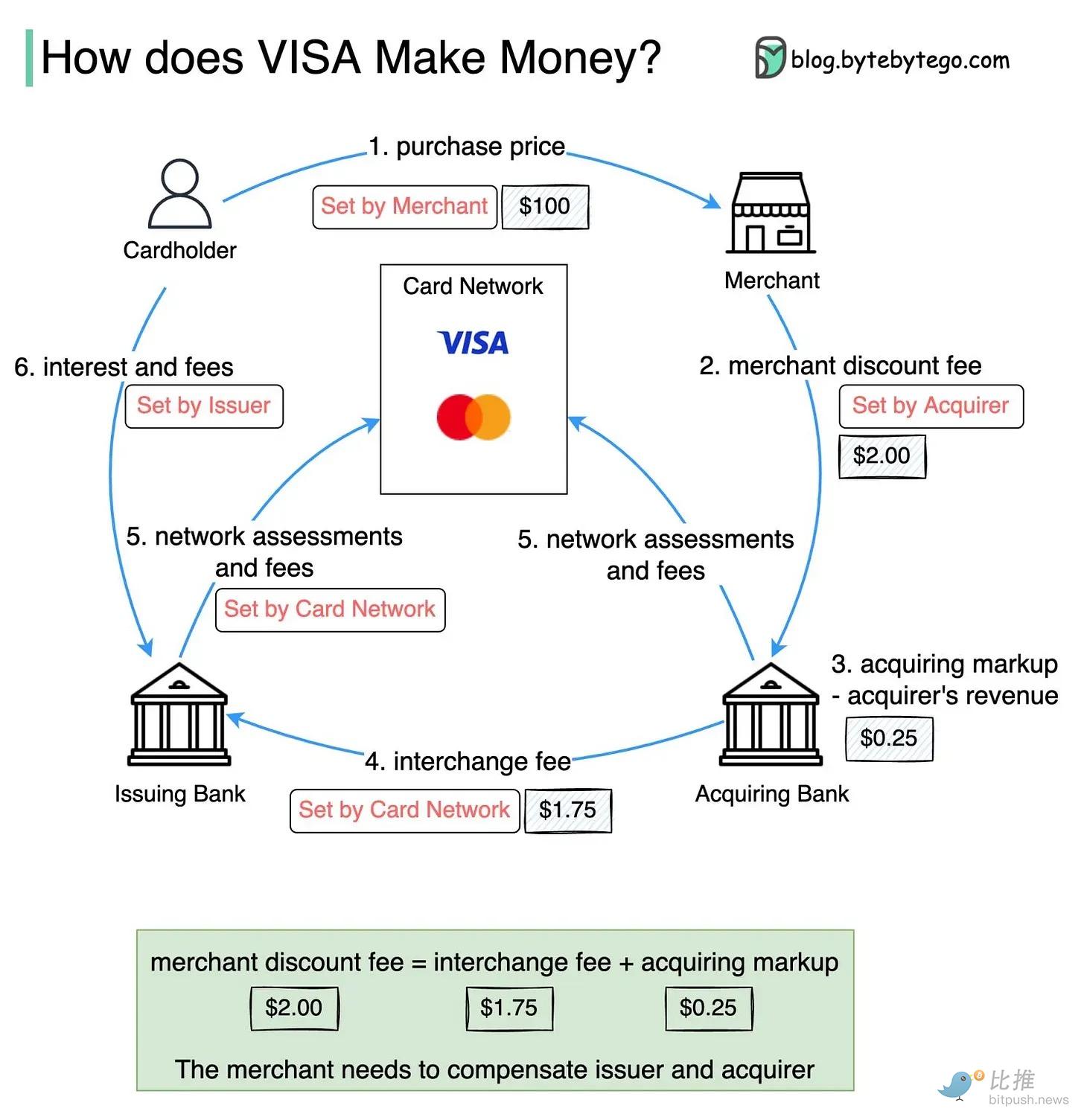
The largest chunk, about $1.75, went to the issuing bank (Credit Bank), which is the bank that issues credit cards to consumers. This fee is known as an interchange fee (Interchange), and it accounts for 70-80% of the entire merchant's processing fee. Next, the merchant's payment processor, also known as the acquirer (Acquirer), took about $0.30 to $0.70 as its markup. Finally, there is Visa or Mastercard, a real card network that everyone in the cryptocurrency industry wants to disrupt. It only takes an assessment fee (Assessment Fee) of about 0.13 to 0.18 dollars. This is only about 7-9% of the total cost paid by the merchant.
So if you remove Visa from this equation, you're just removing the smallest item in the entire stack, and there's a reason why Visa's fees are so low.
You see, Visa doesn't lend money to anyone, so it doesn't have to deal with all credit risk, chargebacks, or fraud disputes. In fact, Visa doesn't even transfer money. It's just a messaging network (Messaging Network) that only activates when you swipe in a store. Visa's job is to send authorization information from the merchant terminal to the card issuer and then back, and it establishes operating conditions that everyone in the system must abide by. However, it is the card issuer that actually takes on most of the heavy lifting. It is the card issuer that provides credit to the consumer and assumes the risk that the consumer may never repay. The card issuer is also responsible for floating funds (Float) between the purchase of the product and the date of payment of the bill, and uses exchange fees to fund reward programs that entice consumers to use the card.
That's why Visa's business model is so fascinating. In 2025, Visa processed $14.2 trillion in payments, covering 257.5 billion transactions, generating net revenue of $40 billion and a net profit margin of nearly 50%. It earns an average of around 0.13 cents per transaction, which is its entire business model. Visa is one of the most valuable companies on the planet not because it charges a high fee per card, but because it processes a quarter of a trillion transactions a year, with almost zero marginal costs and zero credit risk.
Now let's talk about the part where the situation is starting to make stablecoin cards really uncomfortable.
The harsh reality of the stablecoin card economy
Every stablecoin card is a debit card product. The money was already in the user's wallet in the form of USDC or USDT before the purchase occurred. Also, there is no floating deposit (Float) and no revolving balance (Revolving Balance) to generate interest income on the side. This puts these cards in a completely different economic category.
Also, in 2010, the US Congress passed the “Durbin Amendment” (Durbin Amendment), which limits the debit card exchange fee for banks with assets over $10 billion to $0.21 plus 5 basis points (0.05%) per transaction. Most stablecoin card projects bypass this cap by cooperating with a small sponsor bank (usually a new bank) with assets below the $10 billion threshold, which makes them exempt from the Durbin Amendment. And this is the fundamental reason why there is a sponsored banking model in the fintech sector.
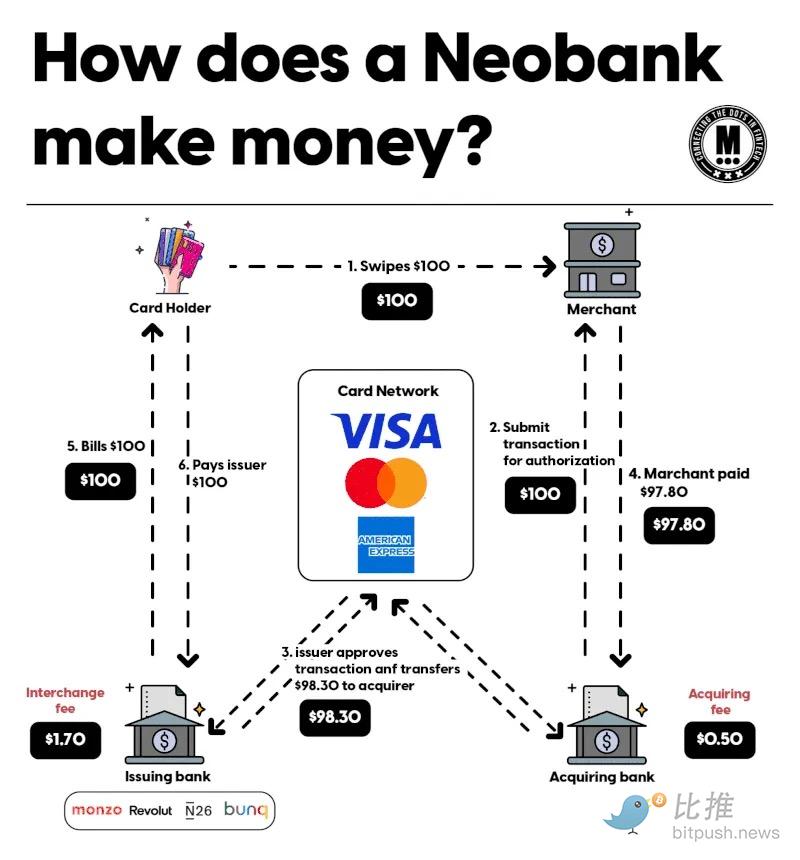
Meanwhile, on Dual-Message Networks (Dual-Message Networks), debit card exchange fees that are not subject to the Durbin Amendment currently average about 0.62 cents per transaction. So here's the thing: a rewards credit card has a total gross margin of about $2.20 for a $100 transaction. However, the total gross profit of a stablecoin debit card is still only 0.62 cents, even when calculated at a higher exempt fee rate. And for these 62 cents, the project party still has to pay network fees, processor fees, sponsor bank fees, and cover its own fraud losses and operating costs before leaving anything to the merchant.
So, what exactly has been replaced?
So, the point is that the savings by removing Visa are minimal, and operating a stablecoin card on top of the debit card exchange fee is extremely tight. But perhaps the real value of stablecoins in the field of payments does not lie in saving those few cents on network fees. Perhaps it's about replacing something more important in the payment stack.
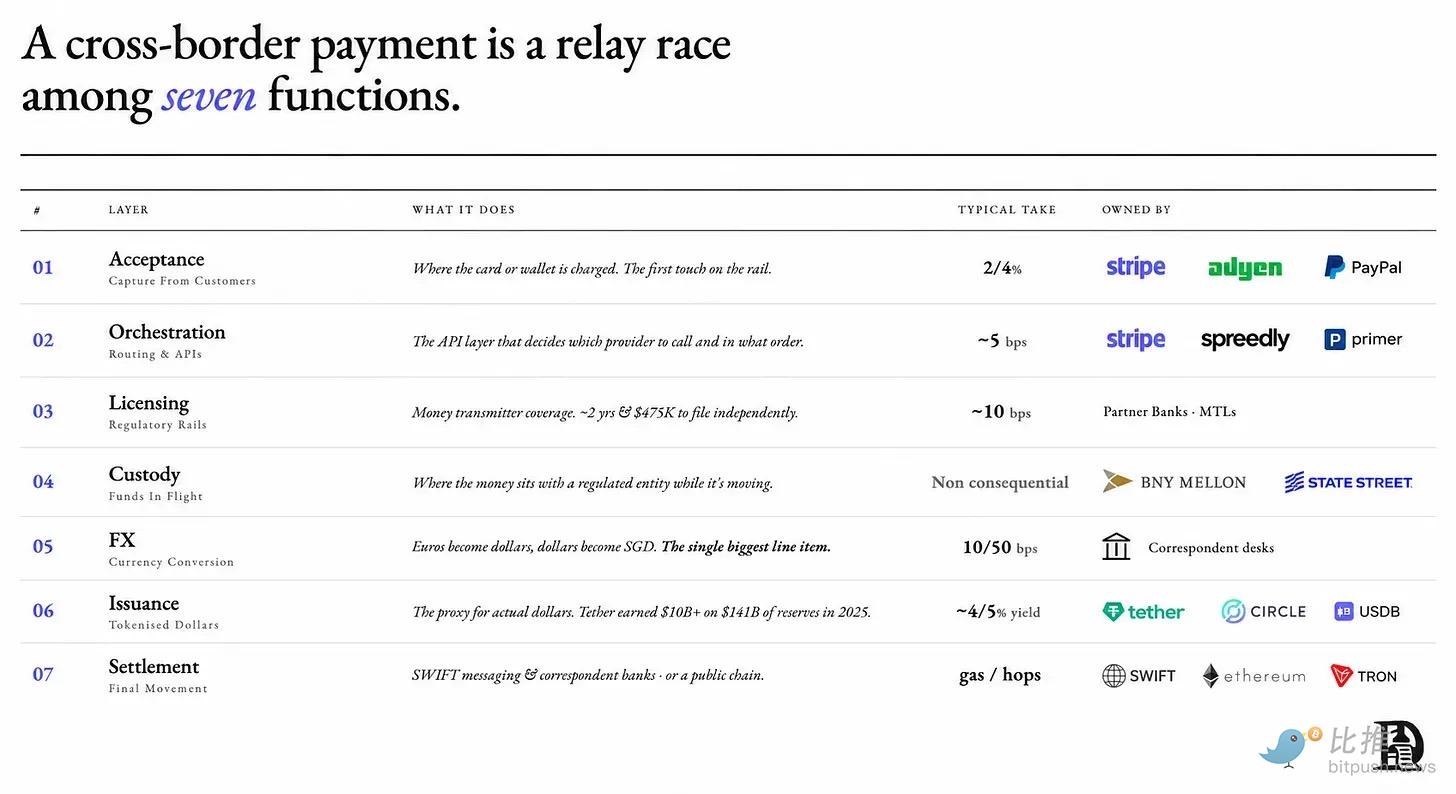
To figure this out, we can break down a cross-border payment into seven functional layers that charge “toll fees”: Acceptance (Acceptance), Orchestration (Orchestration), Licensing (Custody), Foreign Exchange (FX), Issuance (Settlement), and Settlement (Settlement). I want to map a domestic credit card payment to these same seven layers to see what changes have actually taken place.
So, if we look at it from the merchant's point of view: acceptance, that is, the place where the transaction begins, is completely untouched. The meaning is that the process is still the same: the merchant has a terminal, the customer hands in their card, and they still pay the same merchant discount rate to the receiving bank.
The merchant didn't even know that the source of funding behind this card was USDC. For their part, a Visa transaction appears in their batch settlement just like any other transaction. Similarly, the orchestration layer is still routed through Visa or Mastercard, and issuance is still carried out through BIN (bank identification numbers) under the sponsoring bank and card network brands. Fintech companies have been doing this long before stablecoins appeared, and nothing has changed here.
What really starts to change is in the background, and that part of the numbers will blow your mind.
Settlement is the only layer where stablecoins have fundamentally changed. Traditionally, when a card transaction is settled between the issuer and the network, there is a T+2 cycle, plus weekend delays and batch processing. To solve this problem, companies like Rain provide daily payments in stablecoins for Visa, and Mastercard has also begun settling in stablecoins such as USDC, PYUSD, and RLUSD, providing intraday settlement (intraday settlement) cycles. This reduced T+2 settlement time to a level closer to real time and freed up working capital — otherwise these funds would be locked in settlement floating deposits.
However, the benefits of working capital went entirely to the card issuer, and due to faster settlement, the merchant's discount rate did not change. Consumers or merchants don't feel any difference at all when they check out.
The only ones that benefit from T+0 stablecoin settlement are programme operators (Programme Operators), who no longer need to fund the two-day fund deposit. The real innovation that stablecoins have achieved here is improving treasury improvement (Treasury Improvement) for card issuers. This is of great value in terms of scale, but it has not brought any marginal benefits to merchants or customers. This also did not give Visa any reason to lower its fees, since Visa was not the party that funded the settlement of floating deposits from the beginning; it was the issuer that was responsible. Therefore, even if the card issuer's working capital cost falls due to stablecoin settlement, Visa's own costs have not changed at all, and the merchant's discount rate has not changed.
Then you should also note that Visa and Mastercard are not fighting stablecoin settlements. Instead, they're actively building it into their own networks. Visa has been settling in USDC on Ethereum and Solana since 2021, and currently has an annual operating rate of 7 billion US dollars. Mastercard also acquired BVNK a few months ago to expand its own stablecoin infrastructure. They even stated, “I don't think stablecoins will disrupt the current payment landscape; on the contrary, they reinforce it.”
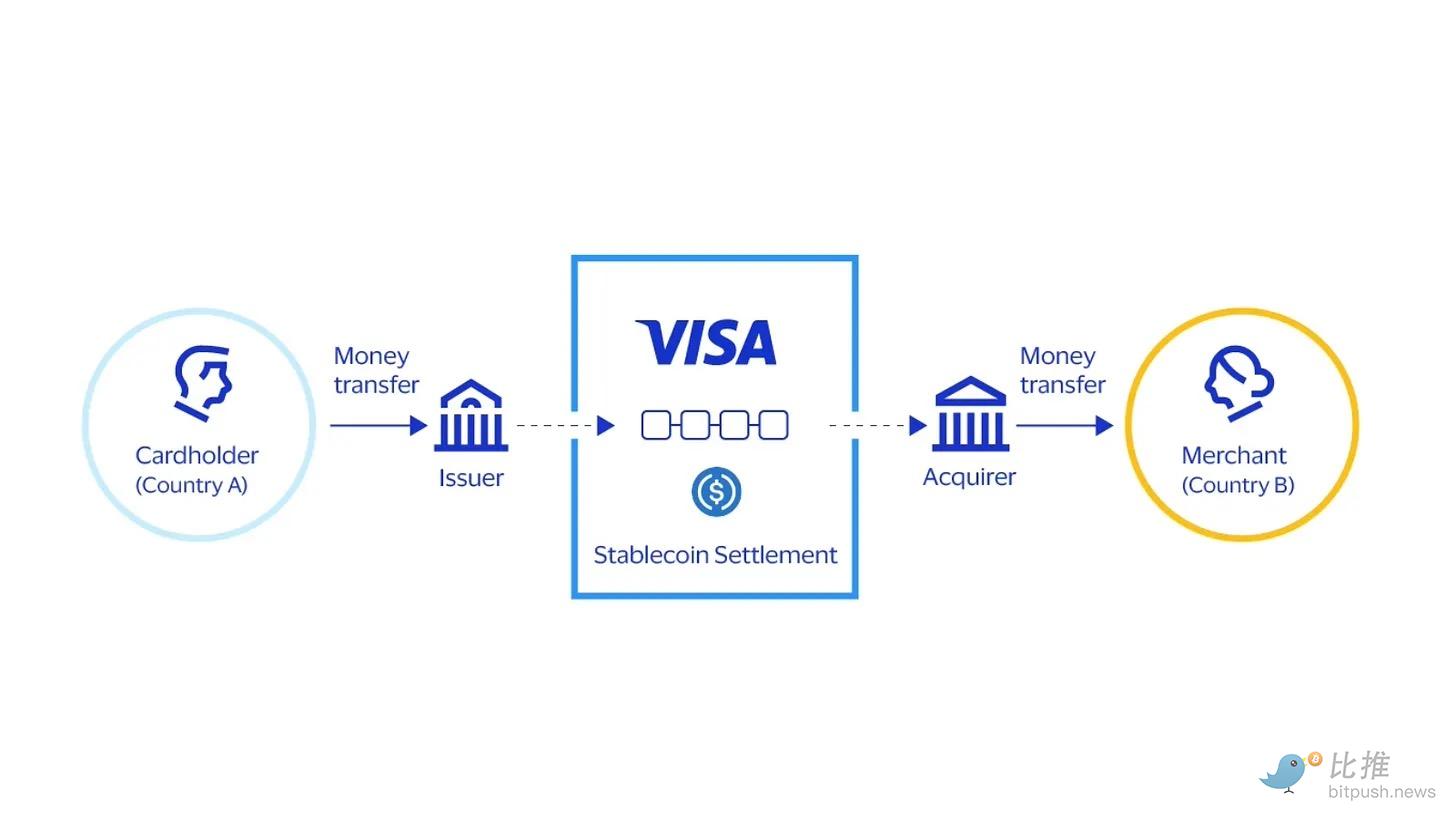
The network is not being disrupted or replaced by stablecoins; instead, the network is absorbing stablecoins as an upgrade to its own settlement layer. Every stablecoin card running on Visa adds transaction volume to Visa's own network and pays Visa an assessment fee, while ironically claiming to disrupt it.
I would also like to mention that we have indeed demonstrated that stablecoins are actually attacking the cost of cross-border payments because they have completely removed the intermediary banking chain. This statement is not misleading.
However, the difference between the two is that one is a cross-border foreign exchange issue, and the other is a domestic network fee issue. The industry took away reasonable insight into cross-border payments (stablecoins do save money) and then forcibly applied it to domestic consumer spending — and the economic logic here is completely different.
The argument for cross-border payments is strong, but the domestic argument is untenable if you look at where the costs actually come from.
So, what exactly are stablecoins disrupting?
To be honest, the answer is settlement and cross-border remittance. What was specifically disrupted, however, was the channel behind the deal. However, domestic credit card payment channels have never really been a place to make money.
Twitter:https://twitter.com/BitpushNewsCN
Compare the TG exchange group:https://t.me/BitPushCommunity
Compare TG subscriptions:https://t.me/bitpush
