


With weekly revenue of 3.2 million US dollars, FOMO is so popular that Pump.fun starts to rob people

If you just look at the name, Fomo looks like yet another popular crypto trading app. But over the past two months, its growth rate has begun to be hard to ignore.
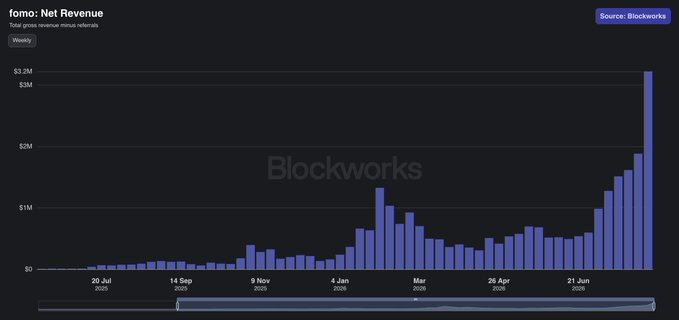
Fomo co-founder Paul Erlanger revealed that the platform's weekly revenue reached a record $3.2 million, growing for the 8th week in a row, 70% higher than the previous week's record.
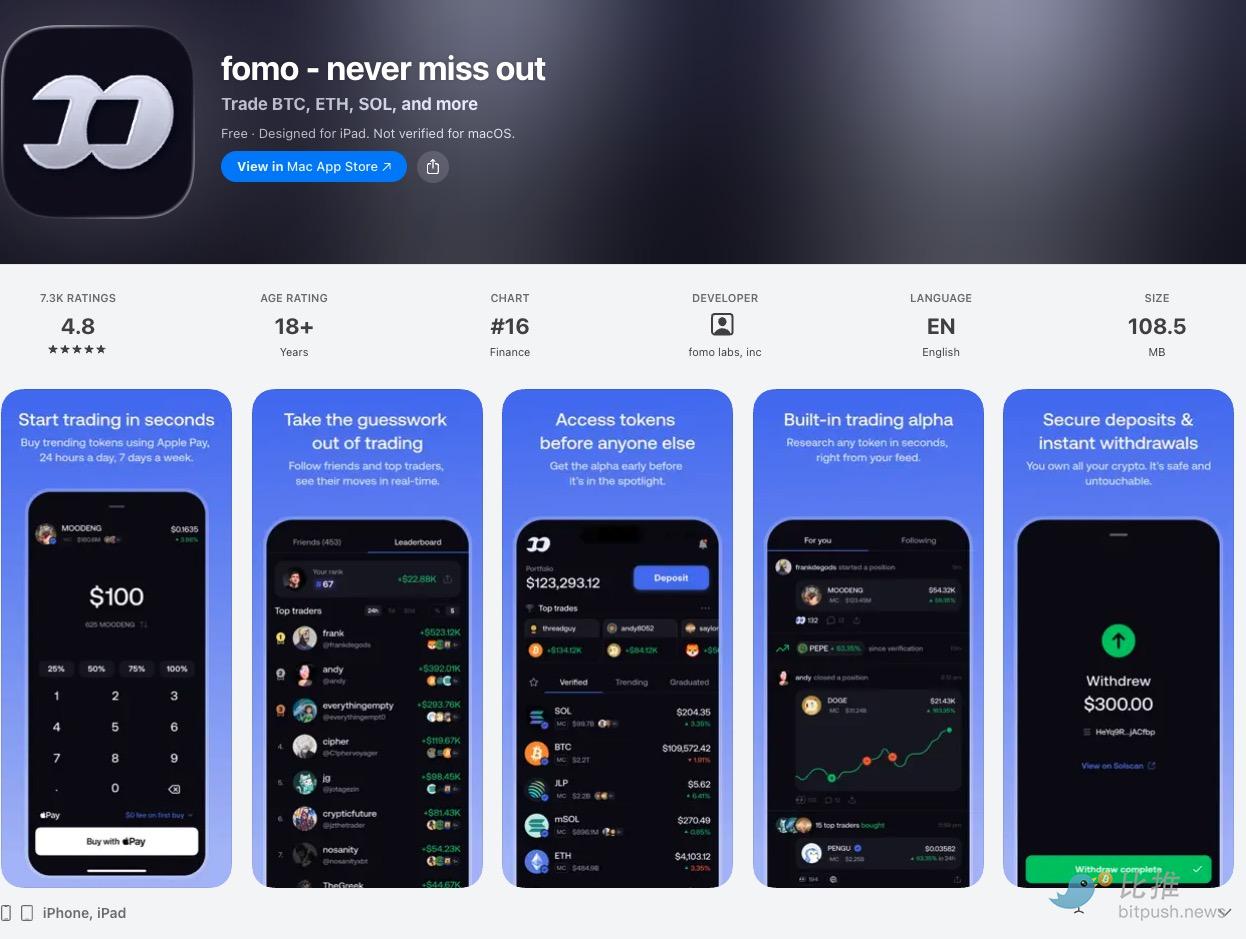
As of August 11, Fomo ranked 16th in the financial category on the US App Store, with about 7,300 ratings and 4.8 ratings. The ranking was previously in the top ten.
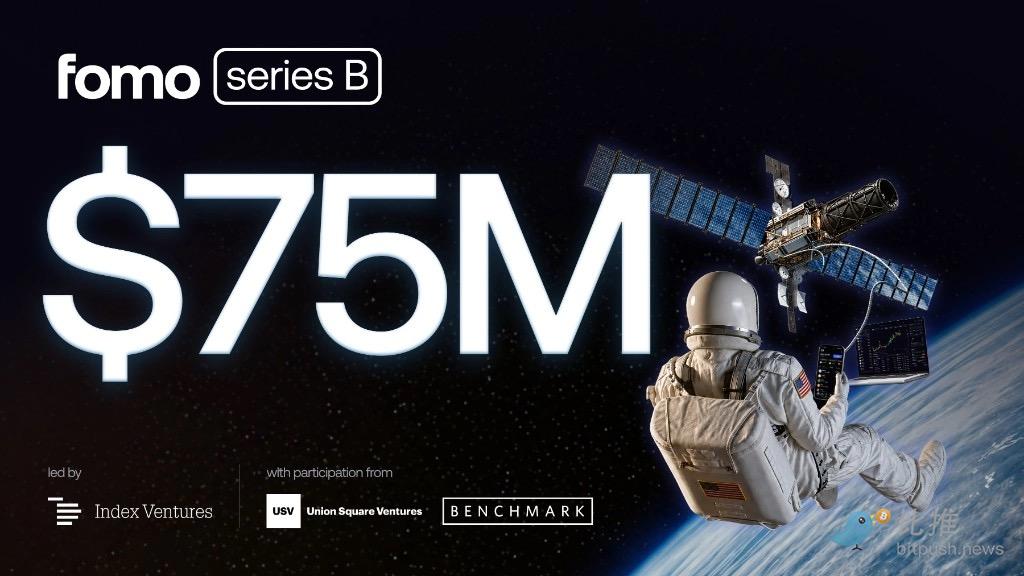
In June of this year, Fomo just completed Series B financing of 75 million US dollars, led by Index Ventures.
According to official data, one year after launch, Fomo has more than 625,000 users, a cumulative transaction volume of more than 4 billion US dollars, and generated more than 110 million social interactions. Of these, 68,000 users purchased Crypto for the first time through Apple Pay in Fomo, with a cumulative amount of about 25 million US dollars.
In other words, Fomo is doing what many Crypto products have always wanted to do, but which is not easy to do: bring ordinary users who are not familiar with wallets, Gas, and on-chain transactions directly into the market.
And this is the real reason why Fomo is suddenly in the spotlight recently.
Why is Fomo running so fast?
Fomo did not create new financial products; it mainly reworked users' transaction paths.
Traditional on-chain transactions are often: first see a token on X, Telegram, or Reddit, then check the market, find a contract, open a wallet, prepare gas, and finally trade. Fomo pushes these links into a feed: users first follow people, see what friends or leading traders have bought, and then directly complete the transaction; complicated steps such as Apple Pay, cross-chain, and Gas are hidden in the background as much as possible.
As a result, Fomo is more like a “social product with transaction features” rather than a “wallet with social features.”
Galaxy Research analyst Will Owens studied this trend and said: The transaction interface is changingShifting around “charts” around “people.”In the past, users first found an asset and then studied it; now they may first focus on the trader and then discover the asset from his behavior.
Fomo isn't the only company seeing this opportunity, though.
Robinhood has launched a beta version of Robinhood Social this year, where users can follow other investors, view real and verified trades and returns, and trade stocks, options, crypto, and prediction markets directly from the feed.
Coinbase's Base App has also put social feeds, transactions, payments, and app discovery into the same product. Users can follow traders and copy transactions.
Phantom, on the other hand, relies on the stock advantage of more than 20 million users and is adding features such as Trending Tokens, Top Traders, perpetual contracts, and prediction markets.
Everyone is starting to do the same thing, which shows that “social+trading” is becoming the direction of joint competition for retail trading products.
Pump is in a hurry and is starting to target Fomo users?
Originally, the two were not direct rivals. Recently, however, a “rigging agreement” has been circulating in the community:
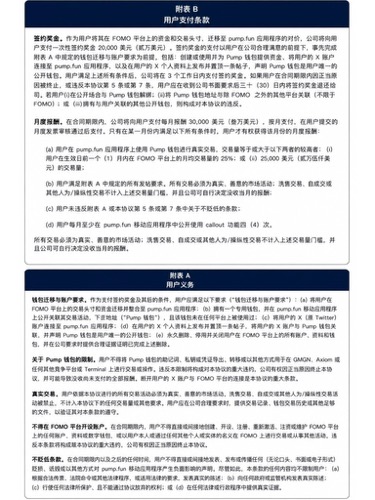
FOMO community user CLR announced a user migration agreement allegedly from Pump.fun. Allegedly, eligible Fomo traders can receive a one-time signing bonus of 20,000 US dollars and a fixed monthly remuneration of 30,000 US dollars, but they need to transfer funds and positions, use an exclusive wallet, bind an X account, and close the Fomo account while meeting the minimum transaction volume requirements.
Currently, Pump.fun has not publicly confirmed this agreement. If the agreement is true, one detail is worth noting: According to the disclosure, the minimum monthly transaction volume requirement for subscribers is only $25,000, or 25% of the previous average monthly trading volume of Fomo. If you only calculate the minimum threshold, the monthly remuneration of 30,000 US dollars clearly cannot be covered by the processing fee generated by this user himself.
This means that what Pump is really willing to spend money on is probably not the individual trading volume, but the public identity, followers, and subsequent transactions behind the trader.
The two projects actually do different things. Fomo starts with “people and content”: first establishing relationships with feeds and traders, then directing traffic to assets; Pump starts with issuing tokens and then expands to swap and trading terminals. One is more biased towards demand and distribution, and the other is more focused on asset supply and trading infrastructure.
But as both sides began extending towards the entrance to the deal, the border blurred.
According to DeIllama's data as of August, Pump's revenue over the past 7 days was about 10.49 million US dollars, and Fomo was about 3.05 million US dollars. Currently, Pump is still more than 3 times that of the latter. It should be noted that this is not exactly the same caliber comparison: Pump's data includes multiple businesses such as Launchpad, Swap, and Terminal, while Fomo is mainly trading app revenue, so it is more suitable for observing commercial volume rather than directly comparing product efficiency.
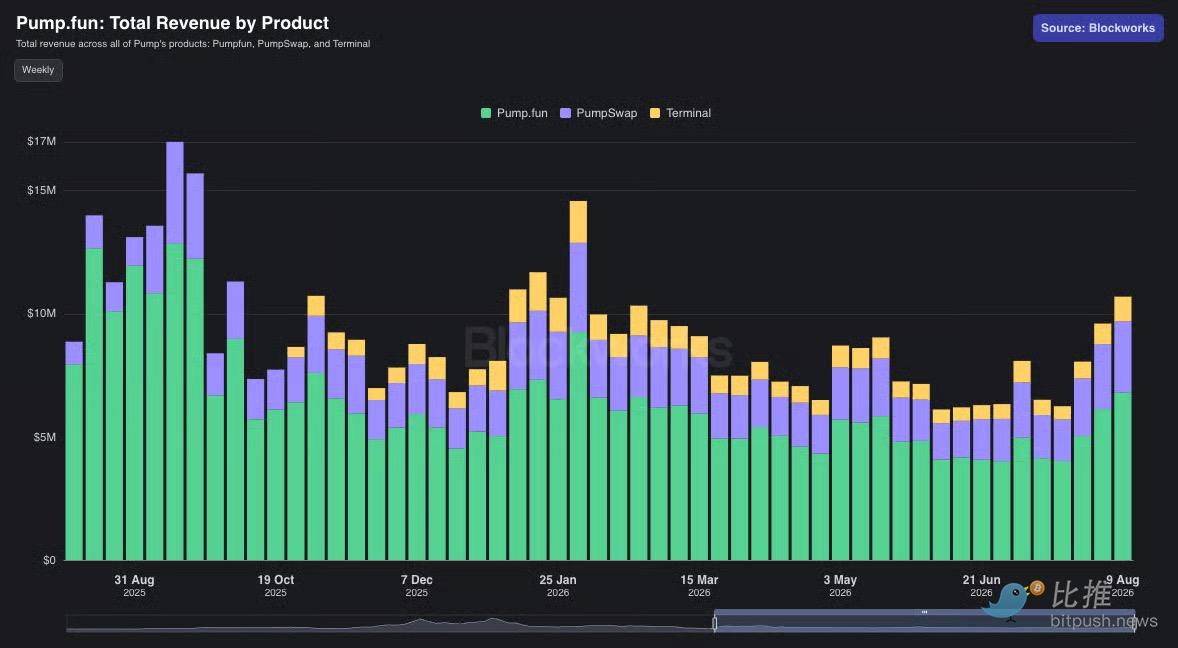
What's more special about Fomo is that it's trying to grasp a higher level: why the user is generating this transaction.
If Pump can attract active traders on Fomo, it will not only take away the trading volume of these people, but also the followers and copy funds behind them. Compared to simply advertising, it is obviously more effective to directly grab high-value traders.
In addition, Pump also has something that Fomo doesn't have at the moment: PUMP can directly handle platform revenue. Pump will currently use 50% of the revenue to buy back PUMP and destroy it, so the more the platform earns, the more direct support for PUMP in theory.

The real competition is just beginning
Fomo's growth shows that on-chain transactions don't necessarily have to be based on wallets, gas, and cross-chain knowledge. As long as the product is simple enough, ordinary users can also enter directly.
But rapid growth does not mean that barriers have been formed. The trading function is easy to replicate, and subsidies can also be exchanged for users in the short term. What is really difficult is to keep high-quality traders active and make users willing to stay in this social network for a long time. At the same time, copy orders and social trading can also amplify the flock effect, and the information gap between leading traders and ordinary users is also worth being wary of.
So what's more worth watching next is not only how long Fomo's revenue can go up, but whether these new users will stay, and whether platforms such as Pump and Robinhood will further join this user competition.
In the past, trading platforms were more concerned about “where to place orders”, but now competition is moving one step further: who can influence what users buy next.
This is probably why this round of social trading is receiving renewed attention.
Author: Bootly
Twitter:https://twitter.com/BitpushNewsCN
Compare the TG exchange group:https://t.me/BitPushCommunity
Compare TG subscriptions:https://t.me/bitpush
