


Manus and Lin Junyang are back
Source:Tencent Technology
Author: Joanne
Editor: Su Yang
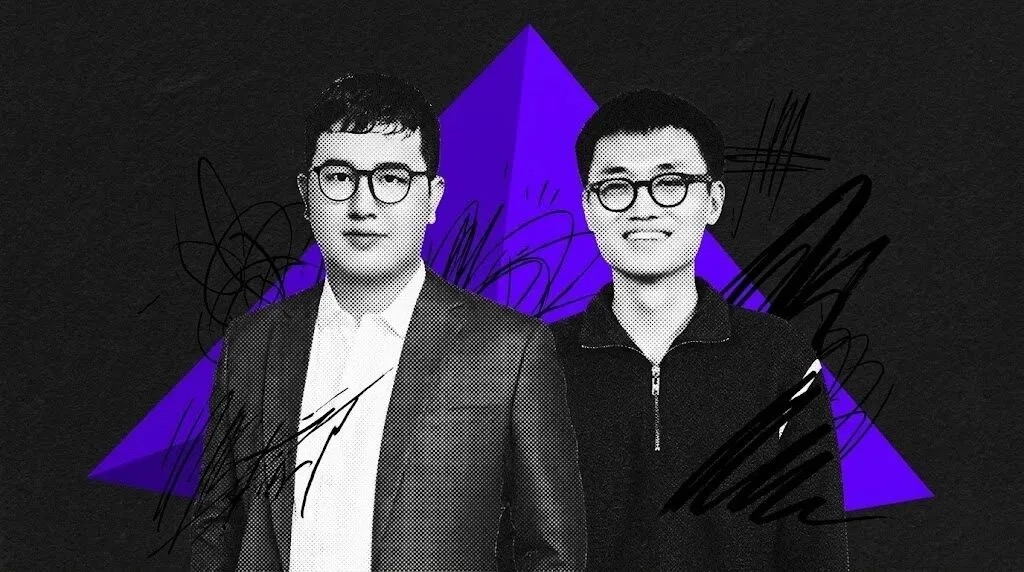
On August 12, two star projects and characters that had received a lot of attention in the AI community announced their return.
On August 11, local time in the US, AI startup Manus issued a notice to users stating that the company will “soon resume operating as an independent company.” As part of the separation from Meta, data generated by some users on or after December 29, 2025 will be removed in accordance with regulatory requirements.
According to the company's notice, affected users are required to complete data backup by 7:59 Singapore time on August 23. From August 23 to August 24, the relevant data will be deleted and affected accounts will be temporarily inaccessible. Starting at 8 o'clock Singapore time on August 25, users can restore previously backed up data and re-use the service.
Manus said the adjustments were not due to data breaches or security incidents, but rather measures taken to meet regulatory requirements in specific jurisdictions as the company resumed independent operations. Unaffected users can continue to use the service normally without taking any action.
A few hours later, another important return news came from Lin Junyang. The former technical leader of Alibaba's Qwen project announced the establishment of an AI lab Pragmatik (p7k) Labs (pragmatic technology) in Shanghai to focus on research on next-generation intelligence in the digital and physical worlds.
Both are intelligent projects, involving the return of a company and the restarting of a technology leader, but they all point to the same change: AI competition is extending from the model's ability itself to how the model can use tools, adapt to the environment, and complete actual tasks.
Meta takeover deal enters the cancellation phase
Manus's deal with Meta began on December 29, 2025.
On the same day, Meta announced plans to buy Manus. The company was founded in 2022 and initially developed in China before moving to Singapore, where it mainly develops AI smart products.
The two sides did not announce the amount of the deal at the time, but previous reports indicated that the deal was about US$2 billion, and the total potential value, including employee retention arrangements, could reach US$2.5 billion.
Following the completion of the acquisition, Meta plans to apply Manus' AI agent technology to its consumer and enterprise products to enhance AI business capabilities.
However, the deal subsequently received regulatory attention.
On April 28, CCTV news reported that the Manus merger and acquisition case, which has received much attention from all parties, has landed, and the China Foreign Investment Safety Review Working Mechanism Office (National Development and Reform Commission) made a decision prohibiting foreign investment in the acquisition of the Manus project according to law and regulations, requiring the parties to cancel the acquisition transaction.
Since then, Manus and Meta have begun to push ahead with the separation of operations and stopped sharing data between the two sides.
According to previous information, the two sides completed the separation at the operational level in May. Currently, Manus is completing the final stages of data processing and preparations for independent operation.
This data adjustment mainly relates to data generated on and after December 29, 2025.
Manus said the relevant data was deleted to meet regulatory requirements. The company has launched data backup and recovery tools to help affected users keep task records.
Affected users can back up multiple times during the backup window. If users continue to generate new task data after completing the first backup, they need to back up again to ensure that the latest data is saved.
Manus said affected users will not be charged during the backup period. Once the account is reinstated, the company will also provide a return bonus.
For users registered with an Apple ID or Facebook account, since Manus may not have a corresponding email address, the company reminds users to pay attention to in-app notifications.
Manus Founding Team and Product Route
The company behind Manus is Butterfly Effect, which was founded in 2022.
Founder Xiao Hong previously worked in enterprise software development for a long time. According to data, he studied software engineering at Huazhong University of Science and Technology. After graduating in 2015, he founded Wuhan Nightingale Technology. Its WeChat tools “Yipan Assistant” and “WeChat Assistant” serve more than 2 million commercial users.
Butterfly Effect then launched Monica, an AI assistant product that integrates the capabilities of multiple language models. Manus is further expanding AI capabilities into the field of task execution.
Manus is positioned as a general AI intelligence platform. Users can use natural language instructions to enable the system to complete tasks such as information search, report writing, file processing, and code development.
Co-founder and chief scientist Ji Yichao previously developed the iPhone browser and founded Peak Labs, which focuses on information extraction and search technology. Co-founder Zhang Tao was previously responsible for product-related work outside of ByteDance and Lightyear.
On March 6, 2025, Manus was officially released publicly.
Rapid growth before the acquisition, future equity is still uncertain
Prior to being acquired by Meta, Manus had completed multiple funding rounds and grew rapidly.
In early 2025, the company received $75 million in financing from Benchmark, and the post-investment valuation was reported to be around $500 million.
In December 2025, Manus said that eight months after the product was launched, the annualized recurring revenue exceeded $100 million, and the total revenue operating rate reached 125 million US dollars.
The company also revealed that the platform has cumulatively processed more than 147 trillion tokens and created more than 80 million virtual computers.
When Meta bought Manus, the two sides wanted to further expand the AI intelligence business. However, with the cancellation of the deal, Manus' future shareholding structure and financing arrangements have yet to be announced.
According to previous reports, during the cancellation of the deal, the founding team explored raising about $1 billion to buy back the company's shares.
Some early investors also participated in related discussions, including institutions such as Zhenge Fund and Hongyi Investment.
Manus said that after resuming independent operations, the company will continue to serve users around the world and plans to launch new product features. AI agent capabilities will be further enhanced in the future, but no specific product routes have been announced.
In terms of data storage, Manus said user data will continue to be stored in the US and Singapore after independent operation.
From training models to building smart bodies, Lam Chun-yang embarks on a new exploration
Manus's return to independent operations means that the startup, which is centered around general intelligence, will regain the space to independently adjust products and financing arrangements. On the same day, Lin Junyang, another important technical director who had led the development of large models in China, also set the direction of entrepreneurship on smart devices.
Lin Junyang announced his resignation from Alibaba on March 3, 2026. Previously, he participated in the development of large models for a long time, and focused on issues of reasoning ability, agent training, and interaction between models and environments in the development of the Qwen series of models.
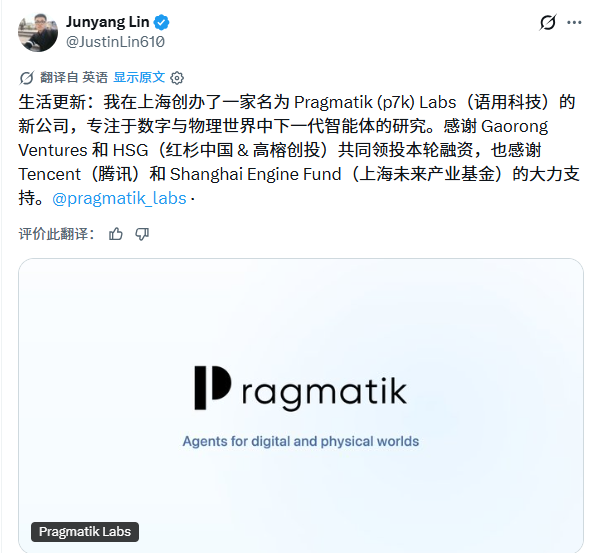
Moving from inference models to intelligent systems means that the focus of AI competition is changing. Future technological breakthroughs will come not only from the model itself, but also from how the model integrates with tools, environments, and real-world tasks.
Lin Junyang's new research direction is focusing on intelligent systems. The name Pragmatik Labs comes from “pragmatics” (Pragmatics) in linguistics. Lam Chun-yang explained that he first studied linguistics because a friend recommended pragmatics and then switched to computational linguistics and natural language processing. “Pragmatik” represents returning to where things happened, and also reflects the team's understanding of pragmatism, that is, in the end, AGI needs to solve real problems in the real world.
Pragmatik Labs focuses its research on both digital and physical agents.
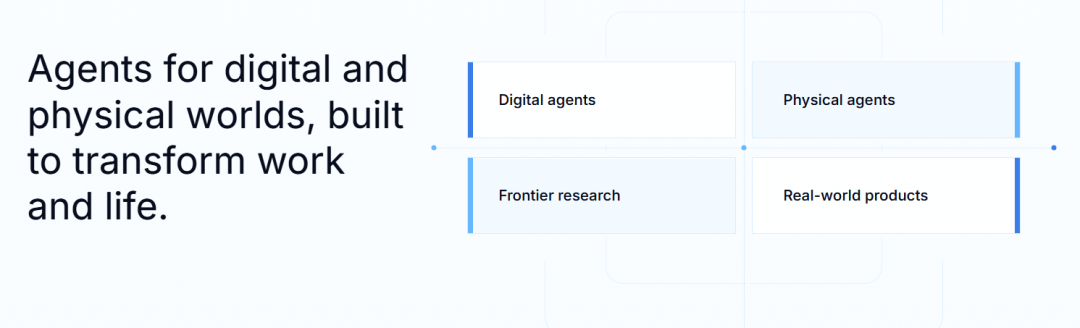
In the digital world, the company wanted to build general intelligence for knowledge work, business operations, and industry processes, so that AI could handle more complex work tasks. In the field of physics, the company explores embodied intelligent systems that can enter real environments, adapt to changes, and perform long-term tasks.
Pragmatik Labs explains on its website that the next generation of intelligence requires the ability to reason, use tools, learn from feedback, and coordinate actions. Unlike traditional models that mainly complete information generation, agents need to operate continuously in the environment, adjust strategies based on results, and achieve long-term goals.
This direction is consistent with the “training model → training intelligence” view previously proposed by Lam Chun-yang. In his view, inference models solve how to make the model perform more effective internal calculations before answering, while the agent system focuses on how to make the model act in a real environment. Future AI systems will need to handle issues such as tool selection, task planning, environmental feedback, failure correction, and multi-round task collaboration.
Pragmatik Labs is currently developing a layout in this direction, hoping to further extend AI capabilities from digital information processing to real-world tasks.
Twitter:https://twitter.com/BitpushNewsCN
Compare the TG exchange group:https://t.me/BitPushCommunity
Compare TG subscriptions:https://t.me/bitpush
