


From 4 models to more than 500, OpenRouter was acquired after growing 30,000 times in three years

author:Menlo Ventures
Compiled by Jia Huan, ChainCatcher
Original title: Early investors behind OpenRouter revisited the beginning and end of the investment
Today, OpenRouter announced that it has reached an acquisition agreement with Stripe. OpenRouter was launched in 2023, just over three years ago.
OpenRouter was initially launched as a “unified interface for LLM” and only supported 4 models at the time: GPT-3.5, GPT-4, GPT NeoXt and Cohere xlarge by Together.
The company was founded on two core judgments: first, AI will eventually be used on a large scale and penetrate various fields; second, there will be many different models on the market, each with trade-offs, and users will choose different models according to different needs.
As it turned out, both judgments far exceeded expectations at the time.
Since its launch, the number of tokens processed by the OpenRouter platform has increased by about 30,000 times. Currently, it has exceeded 4,500 trillion tokens on an annualized basis, and the scale of expenditure on the platform has reached a very impressive level. Meanwhile, the number of models supported by OpenRouter has grown from the original 4 to over 500.
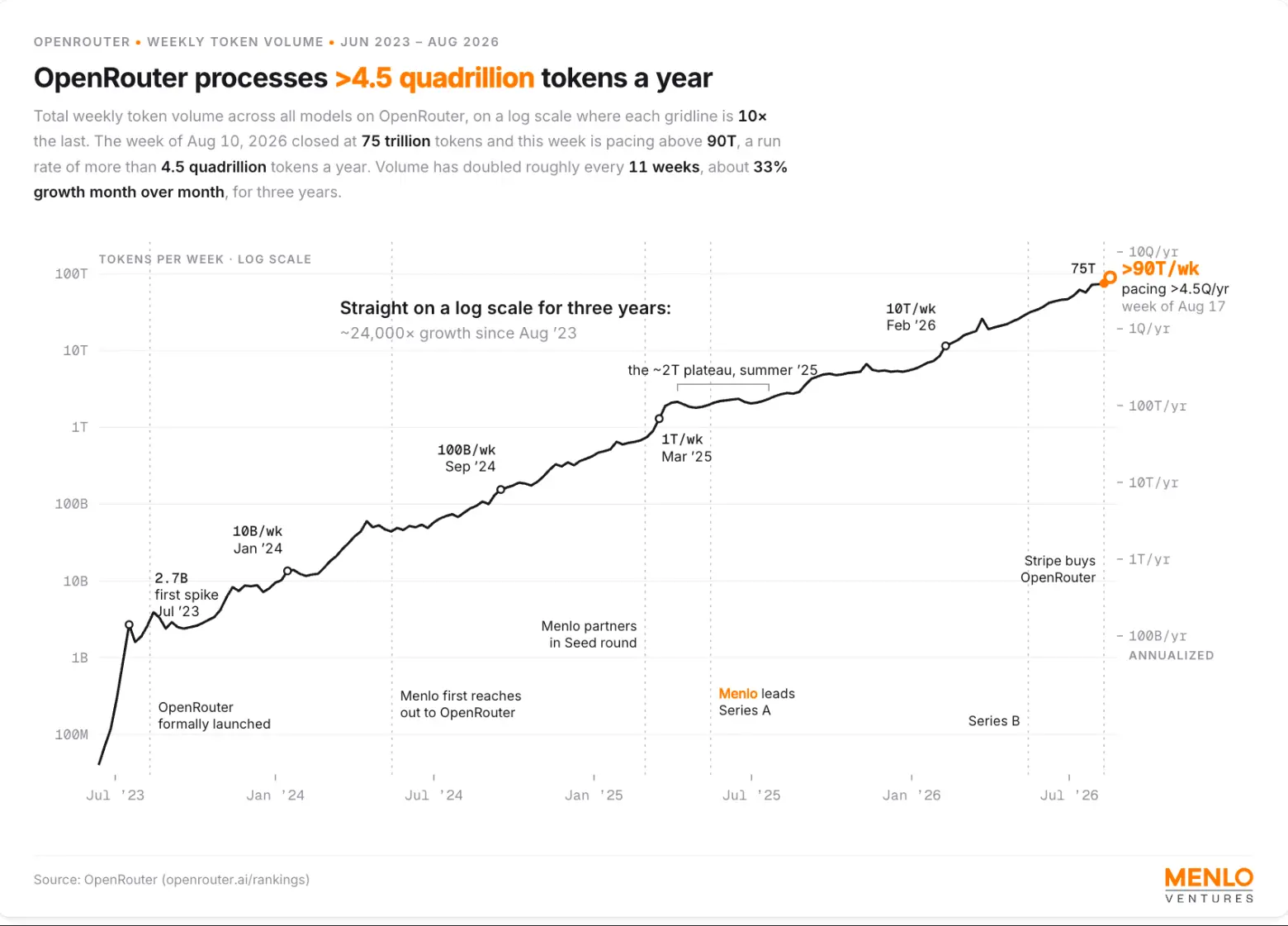
Figure: Growth in OpenRouter Token usage from inception to acquisition
Menlo Ventures is fortunate to be part of this journey. In March 2025, we participated in OpenRouter's seed funding round through the Anthology Fund set up in partnership with Anthropic.
OpenRouter founder and CEO Alex Atallah previously founded OpenSea, which was once valued at $13.3 billion. His co-founders include tech guru Louis Vichy, whom he met on Discord, and highly executive COO Chris Clark.
In May 2025, we led OpenRouter's Series A funding round, with Matt joining the company's board of directors, and Deedy as a board observer. Earlier this year, after seeing OpenRouter's rapid growth in customer numbers and revenue, and the company built a product route with stronger “model intelligence” capabilities around model selection and evaluation, we continued to step up Series B financing.
In the tech industry, it often takes years for an idea to change from the judgment of a few people to industry consensus.
And just a few weeks ago, this happened: from Ramp to Cursor, more than 10 companies launched their own model routing products almost simultaneously. In just a few years, OpenRouter has become one of the most important companies in the AI era.

Picture: Group photo when deciding to lead OpenRouter Round A
At first glance, Stripe doesn't seem like the most natural buyer of OpenRouter, but the two companies are actually strikingly similar.
Both use an API that can be directly accessed to simplify the otherwise complicated transaction process and charge a certain percentage of the fee. It's just that OpenRouter deals with AI models.
As Stripe has always said, the two companies combined and are still doing the same thing: increasing “Internet GDP.”
In fact, over a year ago, OpenRouter called itself the “Stripe of LLM.”
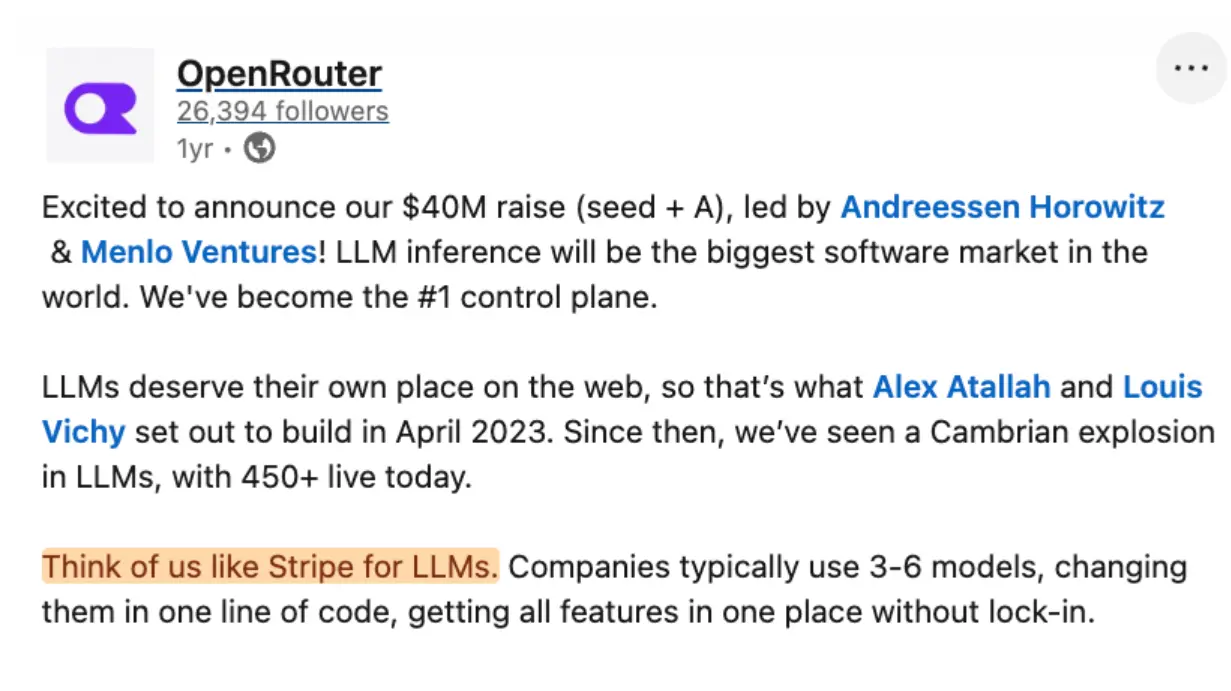
OpenRouter's core values
OpenRouter was one of the first companies Deedy came into contact with after joining Menlo in 2024. This company is almost right at the heart of our AI infrastructure investment logic.
Menlo in2024 Enterprise AI Report” proposes two judgments that must be established to invest in OpenRouter: AI spending will increase dramatically, and developers will not only use one model, but will use multiple models at the same time.
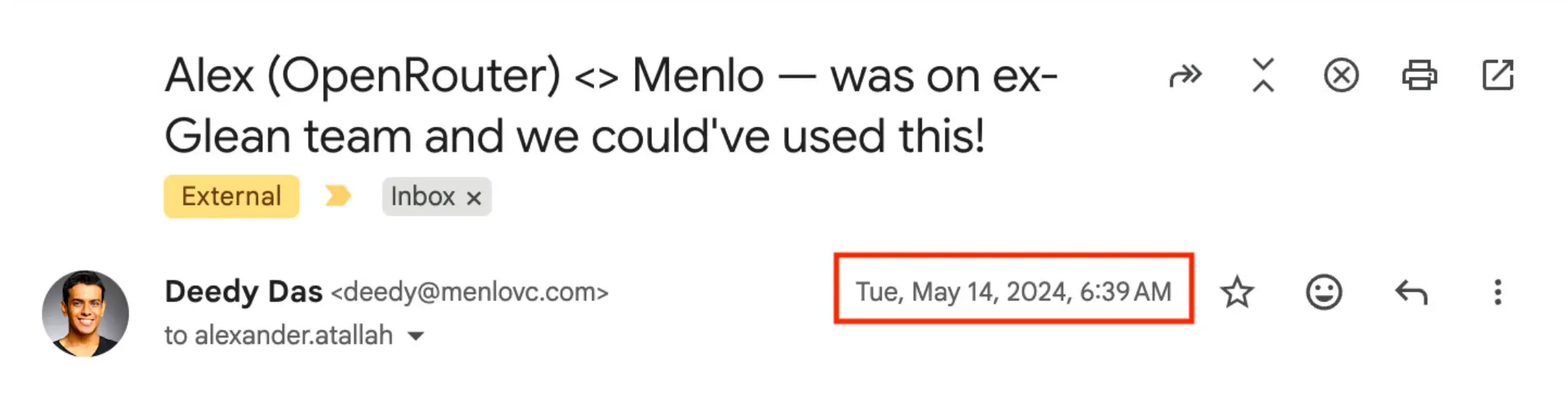
Figure: Menlo's initial contact email to OpenRouter
As people who also write code and actually use these models, we have long been aware that there are very clear differences in cost, latency, and performance between the different models.
For example, when you're just doing a simple NLP task to identify entities from text, you don't necessarily need to invoke cutting-edge and powerful models like Fable.
However, the problem is that if users need to go to each model company's official website themselves, register an account, create an API key, keep the key properly, adapt to each company's slightly different API interface specifications, and finally manage all the models themselves, the whole process will be very complicated.
A unified model gateway might sound simple, but in reality, it's a far more difficult infrastructure issue than it might seem on the surface. Few people really want to build and maintain this system on their own for a long time.
The venture capital industry often discusses “moats,” and technical barriers are usually the first thing that comes to mind. But OpenRouter has a very typical moat of scale.
The more users, the more OpenRouter can predict model requirements and handle larger loads; it is also easier to sign larger contracts with model labs to obtain more stable token supply and demand.
Ultimately, this will create a cycle: new model labs will also want to log in to OpenRouter first in order to get distribution channels.
We've also observed another trend.
With the popularity of vibe coding, the number of software startups has increased rapidly. For products that want to enter the corporate market, the ones that can actually be purchased by the company in the end are often those that have won the approval of the company's internal developers first.
Anthropic, OpenAI, xAI, Cursor, Cognition, ElevenLabs, Lovable, and Fireworks are all like this: they win developers first, then enter the enterprise market.
The same goes for OpenRouter.
Since we invested:
The number of tokens currently processed by OpenRouter has reached 30,000 times that of the initial launch. Over the past three years, it has maintained monthly growth of about 33%, doubling every 11 weeks on average.
The model market is also expanding rapidly. Excellent open source models such as DeepSeek, GLM, and Kimi have appeared in China, in addition to models from companies such as Grok, Meta, and Thinking Machines. Currently, OpenRouter has connected more than 500 models from more than 80 model providers, serving approximately 10 million users.
Many important new models will have priority access to OpenRouter, including models from OpenAI, X, and Meta. Mark Zuckerberg, who usually doesn't tweet or speak out for other products, also specifically announced the launch of Muse Spark on OpenRouter, as did Elon Musk. OpenAI will also offer exclusive discounts on models such as Terra and Luna through OpenRouter.
OpenRouter's product-driven growth model has also successfully transformed into the enterprise market. Its corporate product sales cycle is the fastest batch we've ever seen. With this product, enterprises can unify the allocation of model resources, control access rights, and manage internal AI budgets.
Because OpenRouter can uniformly negotiate contracts with different model providers, it can provide extremely high service availability even in the face of cutting-edge models.
How did OpenRouter get to today?
Anyone who has been a startup for a long time will tell you that finding product market fit, or PMF, is never a straight line.
The same goes for OpenRouter.
Its story actually starts on April 5, 2023. At the time, the team launched a Chrome extension called Window, which allows users to call multiple models simultaneously in different chat apps on the internet.
The problem they initially wanted to solve was to prevent users from being locked down by a certain model manufacturer, and at the same time, they didn't need to hand over their own API keys to different applications in order to use different models.
The design of this product was inspired by a crypto wallet, which is also related to Alex's previous experience in founding OpenSea. At the time, Window supported a total of 4 models.
On April 24, 2023, the name “OpenRouter” first appeared in Window's GitHub codebase.
After about a month, they connected to the first batch of Anthropic v1 models and began automatically assigning requests to the right models based on Prompt. At the same time, they also created a ranking of models that later became widely known, and began using the name OpenRouter.
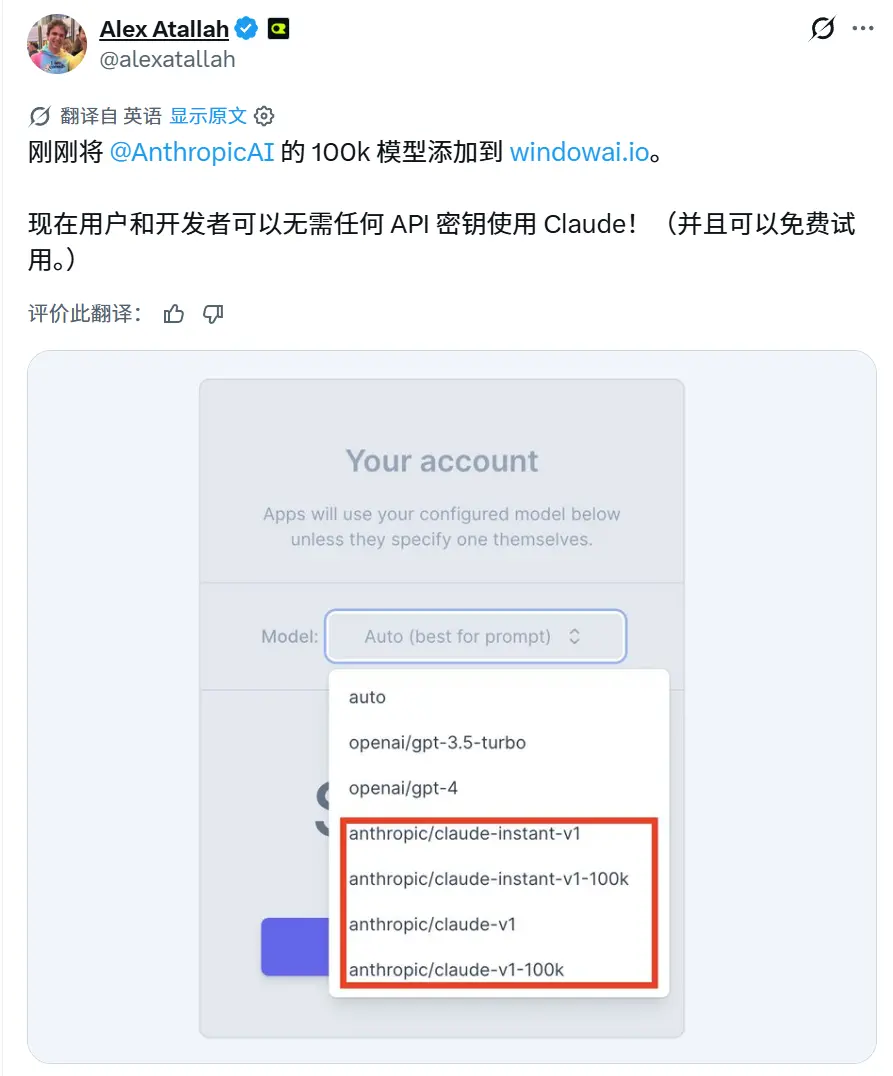
On August 10, 2023, the team officially renamed the product OpenRouter with the slogan “A unified interface for LLMS”, or “unified interface for LLM”.
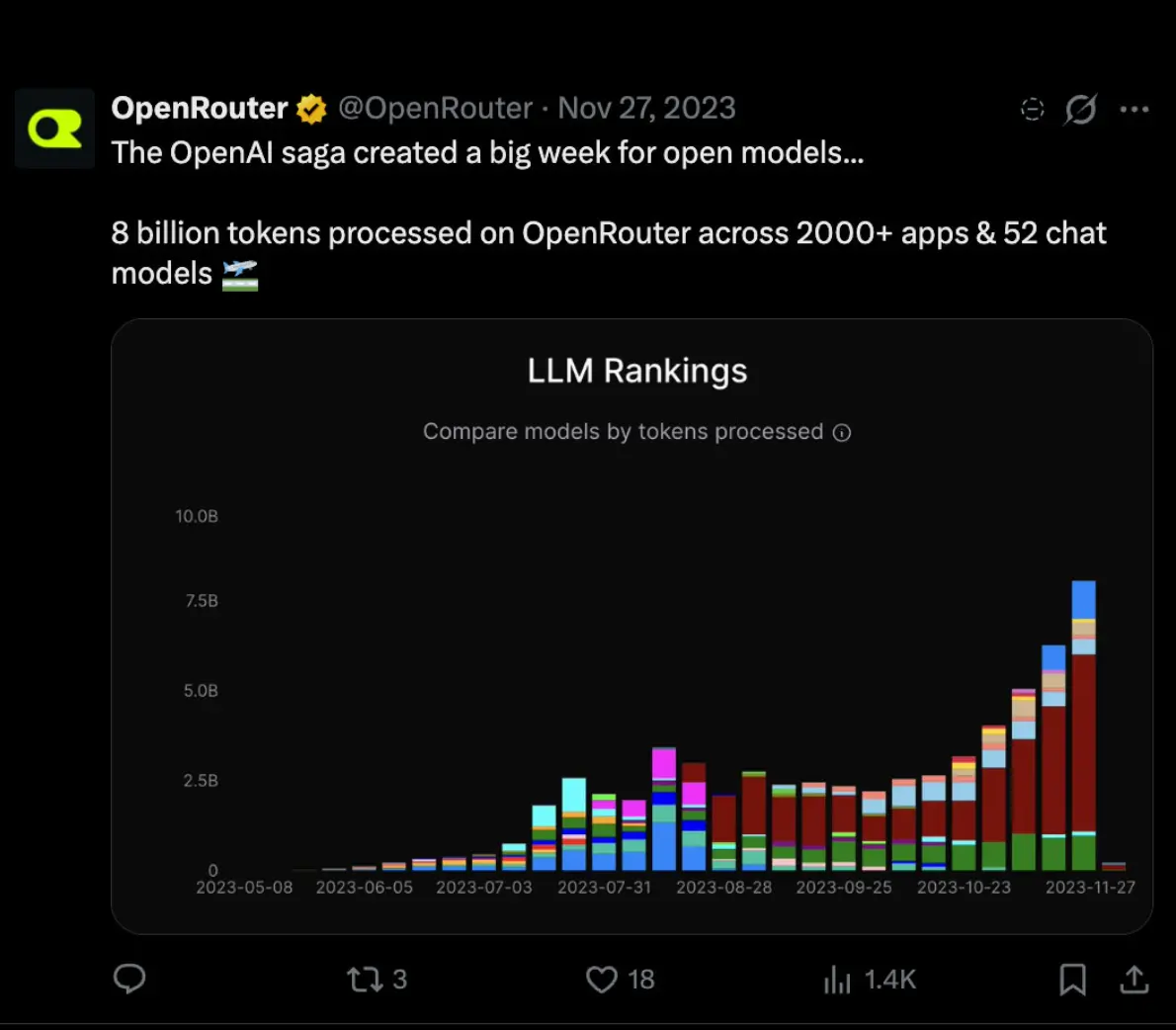
At the time, OpenRouter processed around 3 billion tokens per week. The models on the leaderboard back then were completely different from the models everyone is familiar with today.
The team then launched Playground, which allows users to get answers from multiple models at the same time through a single chat interface.
By November of that year, OpenRouter had supported 52 models, connected to more than 2,000 applications, and processed about 8 billion tokens every week.
At this point, they actually found PMF.
The future of model routing
Contrary to what many people understand, OpenRouter's core product is not simply to “help users route tokens,” but it is the best AI gateway to use.
OpenRouter does provide Auto Router, which can automatically select models, but most developers use OpenRouter mainly to access different models through one portal and then decide how to route the model according to their own needs.
Recently, the rapid increase in corporate spending on LLM has become a real problem for companies such as Uber, Coinbase, and Microsoft.
Therefore, a “model router” sounds very tempting as a cost reduction solution.
Since an AI Agent performs tasks that are split into many different subtasks, why use the most expensive model for each task? Simple tasks can simply be left to the lower-cost model to handle.
Over the past few weeks, the entire industry seemed to suddenly be aware of this at the same time. From Ramp to Cursor, over 10 companies have launched their own model routers.
But the problem is that choosing a model based on Prompt itself alone isn't a particularly effective method.
In the Agent scenario, a task may take a long time to run. Determining which model a request should go to requires understanding a great deal of context.
For example, a simple command: “Find this file in the codebase.”
It may only require a cheap, simple LLM, or it may have to invoke cutting-edge models. This depends on how big the codebase really is and what kind of context the previous tasks have accumulated.
In a multi-step agent task, once the router selects the wrong model at one step, the cost of this error will continue to increase along the next steps, eventually causing the quality of the results of the entire task to drop significantly.
Therefore, a model routing product with the ability to truly differentiate itself is not based on a simple “model selection algorithm”, but an excellent unified API and a sufficiently large real user scale.
It was these users that made OpenRouter gradually accumulate an extremely large data set with little notice from the outside world, including what Prompts the user submitted, what model these Prompts ended up using, what context the task was run in, and what kind of results were achieved in the end.
This is where model routing really matters.
In a real production environment, OpenRouter can help enterprises control costs through more reasonable model routing while maintaining results as much as possible.
In the future, developers will not need to build complex evaluation systems themselves, or continuously modify Prompt for different models.
You might just need to log in to the backend and see this prompt: “There are some scenes in your codebase that are mainly used for summaries. If you replace GPT 5.6 Sol with Muse Spark, you can save $100,000 a year. We've automatically completed the relevant reviews for you.”
This is the real future of model routing.
From payment infrastructure to AI infrastructure
Stripe and OpenRouter have a very similar development trajectory. Both companies first won over developers and then gradually entered the large enterprise market. The product design language for both is also very simple and straightforward.
Andrej Karpathy once referred to OpenRouter as a “transfer switch” for AI. What Stripe does is essentially similar: it becomes that “switch” in the payment processing system.
This acquisition is also one of the first major deals to occur in the AI era infrastructure sector, and it won't be the last. The infrastructure for managing models, costs, and computing power has gradually taken shape. This infrastructure is enabling a new generation of giant companies to form faster than in the past.
Twitter:https://twitter.com/BitpushNewsCN
Compare the TG exchange group:https://t.me/BitPushCommunity
Compare TG subscriptions:https://t.me/bitpush
