


US Stock Value Investing Is Heading Into Another Trap
Source: Deep Wave TechFlow
Original title: (Opinion: Value investment in US stocks is not equal to fundamental investment)
When “fundamentals are dead” becomes a consensus, investors who blindly assemble giants will eventually experience astonishing capital destruction.
Guide:When the market shouts “fundamentals are dead” and the capital is crazy to group tech giants,
The author used an astronomical discovery to unravel the logical loopholes behind this narrative. This article starts with the composition of valuation multiples,
Reminding investors to differentiate between the true quality of an enterprise and the premium that the market is willing to pay is particularly cautionary for the long-term allocation in the crypto and technology sector.
I promise this introduction won't be as long as the last one on the weather.But please give me 90 seconds.
Over a hundred years ago, a woman named Henrietta Levitt was doing tedious work:
Measure the brightness of thousands of stars on photographic film (the way film was imaged before film appeared).
She noticed one characteristic of a class of pulsating stars: the slower they pulsate, the brighter they themselves are. ¹
This might just seem a little interesting today, like “OK, that's pretty cool.”
But at the time, astronomers couldn't tell the difference between a dark star very close to Earth and a very bright star far away.
For them, the two left the same stain on the photographic film.
Visual brightness is a messy mix of these two variables: how bright the thing itself is, and how far away it is from us.
Henrietta's work unravels these two things: if you can observe the rate of pulsation, you can know its true luminosity;
If you know its true brightness, you can reverse the distance based on how dark it looks. Astronomers call it “standard candlelight.”
A few years later, a man named Edwin Hubble discovered one of the pulsating stars and applied Levitt's mathematical method.
He discovered what he had always thought was a cloud of gas within our Milky Way. It was actually an entire independent galaxy, one million light years away.
So in simple terms, the observable universe has grown about a trillion times larger,
Just because one person has figured out how to tell the difference between what something looks like and how it actually is.
That in itself is obviously pretty cool.
But another interesting thing is that around the same time, two other astronomers each drew a scatterplot independently.
One axis is true luminosity, and the other axis is temperature. They discovered that stars are not randomly distributed in this space.
Instead, they gather into different families. The meaning behind this is: Seen stars with exactly the same brightness,
Probably and does belong to a completely different family, with a completely different past, and most importantly, a completely different future...
So, what is written in the stars?
Over the past few years, there has been much discussion about markets, narratives, capital, company building, and financial nihilism.
This feeling seems to have reached a feverish climax as the tech and financial world begins to face a very different future from previous decades.
What is particularly clear is that separating progress from asset prices has become more noisy and in many ways more repulsive.
But as an investor who makes a living by buying assets that are (hopeful) to outperform, a simple framework is:
The forward return is approximately equal to the increase in fundamentals multiplied by the change in valuation multiples (and multiplied by the dividends you have collected along the way).
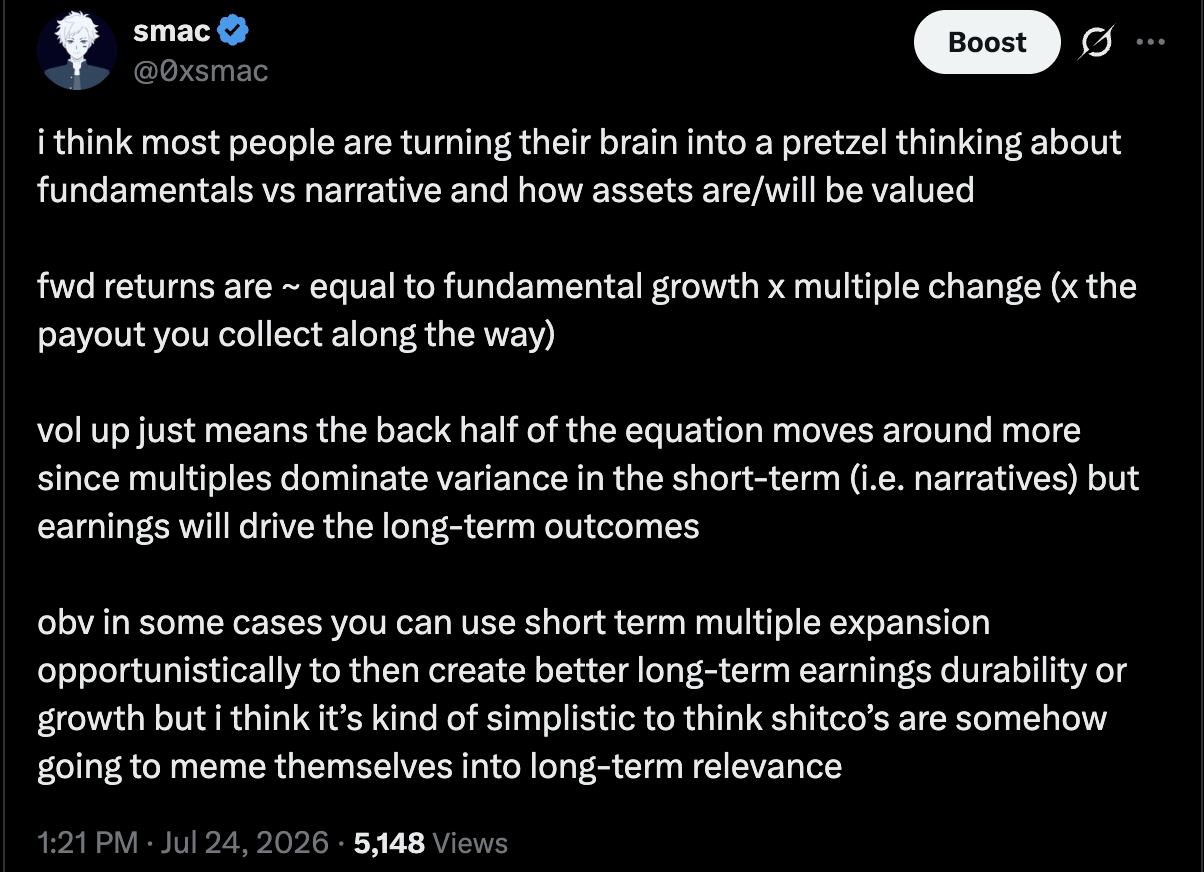
In this case, the valuation multiplier can very cleanly correspond to the smudges on the photographic film. It's an observable data point,
However, it entangles two things that the market cannot directly see: how good this company actually is,
And how far (or how long) its future cash flow is now.
I think most of the money that can be made comes from investors who are most capable of unraveling these two variables earlier than others (that is, “perception of differences”).
And we will continue to see the astonishing capital destruction of investors who treat their stains as stars.
Value investing is not equal to fundamental investing
I think there's a misunderstood view: fundamental investing has historically dominated the creation of excess returns.
Most of these legends come from the Graham, Buffett, and Tiger Foundation lineage, as well as numerous narratives built around this group of people.
People believe that by some point in the 2000s, this method was no longer effective, and anyone investing in this way was passive,
The trend and “direct buying tech giants” overwhelm it. The conclusion was (and still is?) It's “fundamentals are dead.” ²
The modern version of “fundamentals don't matter” itself isn't stupid. It's rooted in a lot of ideas that many of us on the Compound team have written before.
The biggest companies get the most mechanical purchases, and the software industry has a winner-take-all economic law.
AI means that giants can transform scale into moats faster than challengers,
There are also reasons why the market's microstructure embeds momentum more deeply into our market infrastructure.
These are all real. But similarly, the reason why the Big Seven (Mag 7), as we know it today, outperformed
This is because the compound growth rate of their actual profits has proven over and over again that their valuation multiples are reasonable.
Today, in August 2026, there is at least one opinion that we are/are entering a new era of AI acceleration,
In this era, those laboratories and hyperscale cloud vendors with large-scale capital purchases and computing power will irreversibly close the gap.
Don't worry about doing valuation analysis, don't worry about asking how much growth has already been overdrafted in advance,
There is no need to ask how big the economy will have to be to support everyone's expectations.
As long as you have a few names, you can get on the ride of the new technology paradigm.
Because fundamentals are just a role-play for those who miss the old world.
 I even think that even though people have been creating fears, the concentration at the top of the stock market has become so high,
However, there is still plenty of room for this concentration to grow. So,
Let me first refute myself here: I don't think “it's already at the peak level of the power law distribution” itself is such a powerful argument.
Nevertheless, the conclusion I listed above — holding these giants,
Watching them grow from a $1 to $4 trillion company to a $10 to $20 trillion company—there are plenty of deep-seated flaws in themselves.
First, this kind of argument has been tried countless times, and the past performance has clearly been poor. Critics will say “you don't understand,”
“This is the first time we've solved an intelligence problem”, “AGI”, “Computer Emperor”, “Do you think Hwang In-hoon, Musk, and Ultraman are all wrong?
And you know business and the world better than they do?” This is a Pandora's box for later discussion.
But, by definition, any truly disruptive technology would trigger such exaggerated predictions.
Today, it is also fueled by a huge social media engine.
Also, I generally agree that most jobs are made up by humans, and we will continue to invent new jobs. ¹ ⁄
The market is becoming more inefficient
 We've always seen that even these huge, constantly analyzed and studied companies can be grossly mispriced.
Meta is one of the companies with the highest global coverage. It has a de facto oligopoly position in almost every market in which it operates.
However, in the second half of 2022, it traded at a forward price-earnings ratio of about 8 times. It was priced like a melting block of ice.
It then skyrocketed more than 8 times in front of people's eyes. The whole process was a valuation event. There are huge differences on the fundamentals of this unknown company.
Perhaps the sharpest point is that this increasingly popular underlying belief itself is a layout.
I've been brushing up on quite a few ideas recently, but in short, Silicon Valley's growing influence on financial markets has distorted how it works and how participants act.
Too many people are now flocking to the other side of the boat. ¹ ¹

Alpha comes from someone else's mistake or misjudgment. “Fundamentals are dead” has become a consensus.
I think most investors have only recently understood the extent to which narratives influence securities pricing.
But as the Silicon Valley complex takes a prominent place in the broader financial market, this view is no longer new.
Now even the dumbest people you know will learn to say “everything is a meme” to show that they are smart.
Many fundamental long and short fund managers have been eliminated. They were replaced by people who bought QQQ 15 years ago, or systematic pod-shops.
At least it's worth considering: when the market consensus is that any reverse perception is a waste of time, reverse betting may be the right time.
Off-topic: I love listening to Gavin Becker's podcast, but the recent one made me feel a bit stunned. He said everyone he met during his trip was more visible than him.
It's not that I don't trust him. In fact, this is consistent with my experience and that of many people visiting that city.
But when he claims that none of the data points are not bullish, there is a clear disconnect here.
And this happened after memory stocks plummeted 50%.
That's exactly what I'm saying: many things can be true at once. He may see strong demand for a long time,
The company trades at a “relatively cheap” forward price-earnings ratio.
At the same time, however, many companies' valuation multiples may also be compressed by the market's early overdraft expectations.
I'd be naive (arrogant) to say that market pricing is usually wrong. I tend to believe that there are plenty of signals in the price.
It is my responsibility (or any investor) to falsify this baseline. Incidentally, I do also think the short-term market is becoming more inefficient.
But most of the time, “cheap” companies are cheap for a reason. Most companies that become expensive often fail to deliver on those long-term expectations.
As a result, this tension always exists when evaluating forward returns at any point in time. ¹ ²
Cognitive matrices
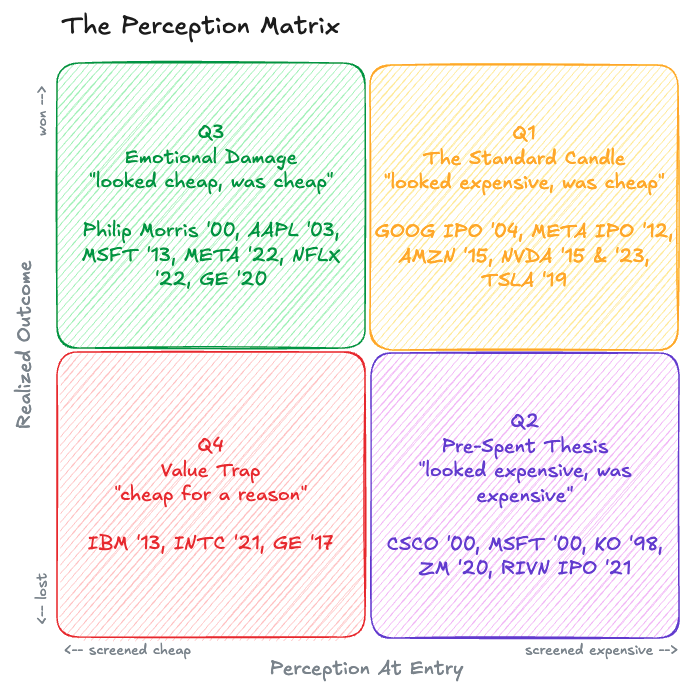
Quadrant 1 (Q1): Seemed expensive at the time, but in hindsight it was actually cheap.
Quadrant 2 (Q2): Seemed expensive at the time, but it was actually expensive in hindsight.
Quadrant 3 (Q3): What seemed cheap at the time was actually really too cheap.
Quadrant 4 (Q4): Seems cheap, and there's a reason it's cheap. The quintessential value trap.
Perhaps the most interesting thing about this broad framework is that companies can be time-stamped.
I mean, you can put the same businesses into this matrix (we'll do that later).
Depending on the point in time, they fall into different quadrants. It's inspiring to see how these companies move between quadrants.
Microsoft 60 times in December 1999 and Microsoft 10 times in 2013 clearly have the same stock code, but they should never be placed in the same quadrant.
Another obvious point is that the results axis measures what you pay. This is completely different from the company's execution.
Many people in the crypto community should be familiar with this by now (hopefully).
These quadrants express the gap between built-in expectations and actual future deliveries. ¹ ³
We'll get back to that later.
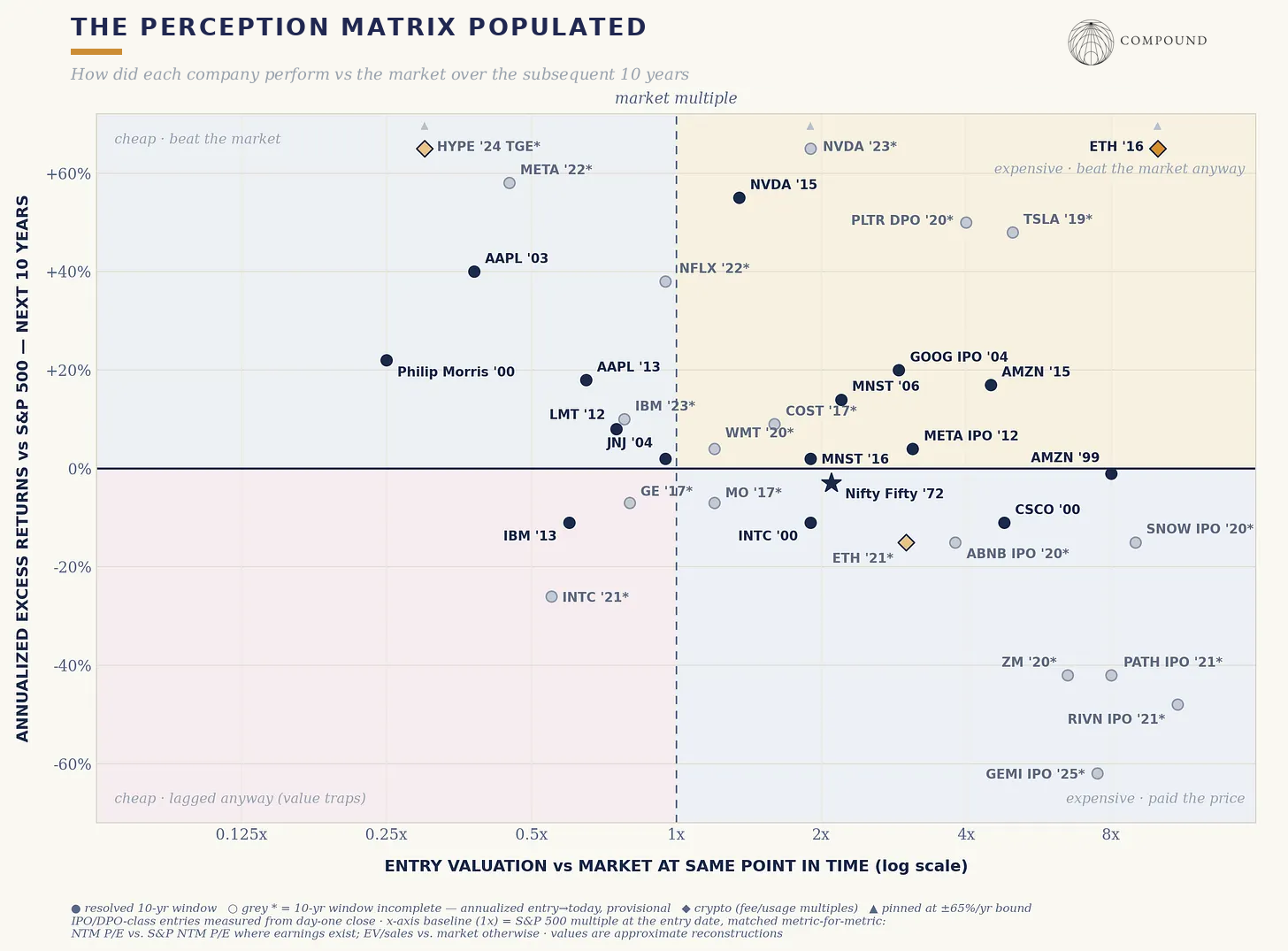
This picture is worth taking a moment to familiarize yourself with what it shows, and also to form your first impression.
I chose a sample of companies across industries, clearly biased towards technology. But I also designed a little game,
You can see a wider range of companies in history there.
We can sit here all day and observe the comparison of companies gathered in similar locations.
Both Cisco in 2000 and Amazon in 2015 were at the far end of the expensive right tail.
One was a 25-year round trip, and the other outperformed the (historic bull market) market by about 8 percentage points each year.
Nvidia in 2015 and Intel in 2000 were near the valuation multiples of the mainstream market at the time.
The former outperformed the market by about 50% each year for 10 years, while the latter cost investors about 60% over the next 10 years.
What's in the quadrant
Let's quickly break down each quadrant...
Q1: It looked expensive at the time, but in hindsight it was actually cheap
This is a popular quadrant right now. Every VC wants you to believe that their most important companies are in this quadrant.
Of course, some are true; we'll see which ones together in the future.
But Silicon Valley's growing influence means we should examine what this means for asset pricing structures.
If 15 to 20 years ago, tech optimists had a much smaller voice, could there be a huge opportunity,
Benefit from holding assets that are falsely priced based on undervalued growth?
If we were in the process of transitioning from atoms to bits at the time, predicting the rapid spread of software before consensus was a huge advantage.
However, as this belief system spreads, more capital allocators are shifting to a “stronger growth than you think” attitude.
Expectations will become too high at some point. Or at least, requiring immediate observation of those growth expectations would become unreasonable.
My opinion is that there will be fewer companies in this particular quadrant than in the past, and there will be more companies in the corresponding second quadrant.
This space is so fascinating because all the best companies in history are gathered here.
Often this seems to happen when a company fundamentally changes its state of affairs.
Amazon in 2015. Tesla in mid-2019. Nvidia until May 2023. 106,1.3
There are also some very special companies. Their signature characteristic is that they have always looked expensive for over 10 years, but in hindsight they have always been extremely cheap.
HEICO - sells replacement jet parts.
Valuations over the past two decades have ranged between 25-40 times profit, and this ratio is usually only given to ultra-fast growing companies.
However, over the past few decades, the compound growth rate has been about 20% or more
Old Dominion — trucking company, the valuation is 25-30 times, while peers are close to 10-14 times.
ODFL has increased almost 20 times since 2012 as profit margins and network density continue to improve
Constellation software——Apparently it has recently been hit hard by the software sell-off.
But the company has grown 200x in the open market and has been trading 30-40 times free cash flow for the past ten years
Monster beverage——In my opinion, it is probably the best stock in modern timesThe consistent theme here is that for companies with long-term reinvestment opportunities and high incremental returns,
Consensus often systematically applies a priori assumption of mean regression to valuation multiples (that is, compressed from 35 times to 25 times),
This leaves them forever behind the underlying profit compound interest (provided, of course, that the reinvestment machine continues to transform).
Second quadrant: It looked expensive at the time, but it was really expensive
Intuitively, as AI destroys certain companies' previously protected profit margins, many companies will slide this way.
Cisco is a prime example. The Internet argument is right, and Cisco has executed it very well: revenue grew from about $12.5 billion to $57 billion.
Net profit surpassed the 1999 high in 2003, and the compound annual growth rate of profit throughout the 2000s was about 14%.
However, the stock price did not recover from the March 2000 high until December 2025. 106,10
This region is often full of arguments in the right direction; however, the associated stock prices have already realized much of the future reality ahead of schedule.
Microsoft in 2000 was a moderate version of Cisco, but the 60-fold valuation was reduced to more than ten times.
Shareholders lost a full decade of returns as a result. Coca-Cola is a non-tech version of the same story.
This group of companies in 2020-2021 is this kind of carnival.
Snowflake, Zoom,Beyond Meat, Peloton, and many others.
To sum it up a bit, the common mistake here is that the entire chain of correlation is not being tortured.
We are easily swayed by the pace or size of the market and its future.
“The internet will be big” (correct) — not the same as “Cisco is worth buying when it is 130 times the expected profit”
“Remote work will be permanent” (partly true) — not the same as “Zoom is worth buying at 60x”
“Perpetual contracts eat away at CEX trading volume” (correct) — not equal to dydx would win this category
At least there is a sign here: if the bullish logic mainly revolves around category theory, and the valuation defense vaguely points to the overall potential market,
That's far from an analytical point of view. Someone in the room always has to ask: what is implied by the current price.
Third quadrant: Seemingly cheap at the time, and it really was too cheap.
To be honest, this is probably the least interesting for most readers.
But strangely enough, now that cigarettes are back, it's relevant again.
From the inception of the S&P 500 Index (1957) to 2003, the best-performing stock was Philip Morris.
However, the best time to buy came at the peak of hatred during the lawsuit disaster.
At the time, the company fell to about 6-7 times its profit (while the dividend yield was about 9%). It's basically priced to die.
This position is difficult to play because many of these types of companies are either boring — the cash flow is generally stable, and the arithmetic return on capital is quite impressive.
But you need to be extremely precise about what catalysts will drive marginal buyers into the market.
Apple in 2013 — about 10 times more profitable (not counting cash reserves).
Because people assume iPhone is part of the hardware cycle, it is doomed to commercialization.
Einhorn (then Icahn) made what now seems obvious: retention and ecological lock-up, and balance sheets can buy back large amounts of tradable shares.
Microsoft in 2013 — for a while people thought it would be the next IBM
Exxon in 2020 — Kicked out of the Dow (laughs), and was priced at the time as some kind of scenario of speeding into an eventual recession.
Since then, it's nearly 5x higher than the company that replaced it (Salesforce)
2022 Meta — already mentioned a few
I think the company that ended up here might have another shape, and that has to do with some kind of hopelessness.
Philip Morris probably fits (when “smoking is harmful” sentiment is at its peak),
But others like AMD, Domino's, Carvana.
Solana at the end of 2022 is another example. Even Hyperliquid's valuation at TGE seemed very cheap.
For this group, consensus errors seem to tend to suggest that the market extrapolates temporary emotional states to some new fundamental reality.
It could be a variety of situations, but among those examples are aversion (tobacco, oil) and trauma (FTX explosion, Meta all of 2022).
In a sense, it is also probably the most affected by occupational risks;
If holding these makes you feel humiliated in front of others, that's probably some kind of sign.
Fourth quadrant: Seems cheap, and there's a reason it's cheap.
There are many such cases. IBM in 2013 is a modern example.
Revenue declined year after year. Brutally, it attracted many investors' buybacks; in hindsight, only management used shareholders' money against gravity.
Intel in 2021 was pretty much the same. Countless articles have been written about this dynamic, so I won't say much.
Disassemble it all
This goes back to the previous formula:
Expected return 139 fundamental growth × change in valuation multiples (× dividends earned along the way)
Every entry in the matrix is some kind of tension between the first two.
In a shorter period, valuation multiples dominated the variance, which is why these markets feel purely narrative driven.
But when we extend the span of time, the fundamentals take over.
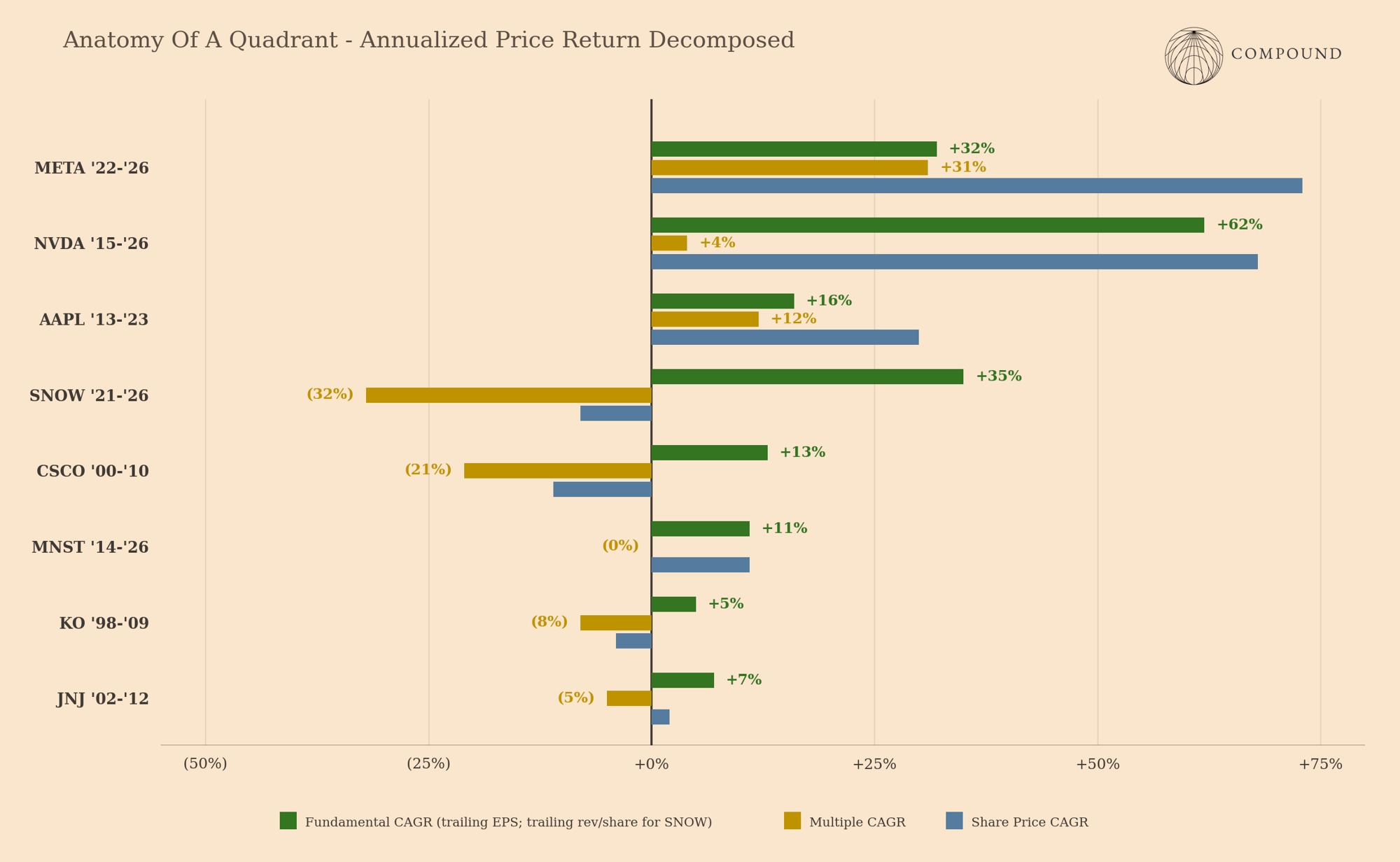
Some observations:
I don't think pure multiple victim clusters (like Cisco and Microsoft around 2000, Snowflake and Zoom around 2021) are a coincidence
——The basic pillar is positive, but the multiple contraction is extremely serious, which only indicates that the entry price has already been cashed out ahead of schedule and even more.
NVDA '15 is the purest profit story on this picture
Double kills occur when you make excessive profits (Apple '13, Microsoft '13, Meta '22), profit growth plus valuation revaluation
Coca Cola and Johnson & Johnson were quite ruthless players. At the time, the combined growth rate of the stock market was much higher than their
However, it is worth pointing out that even if the valuation multiples continue to be compressed,
As long as fundamental long-term earnings growth continues to pay “devaluation” tolls, assets may still win.
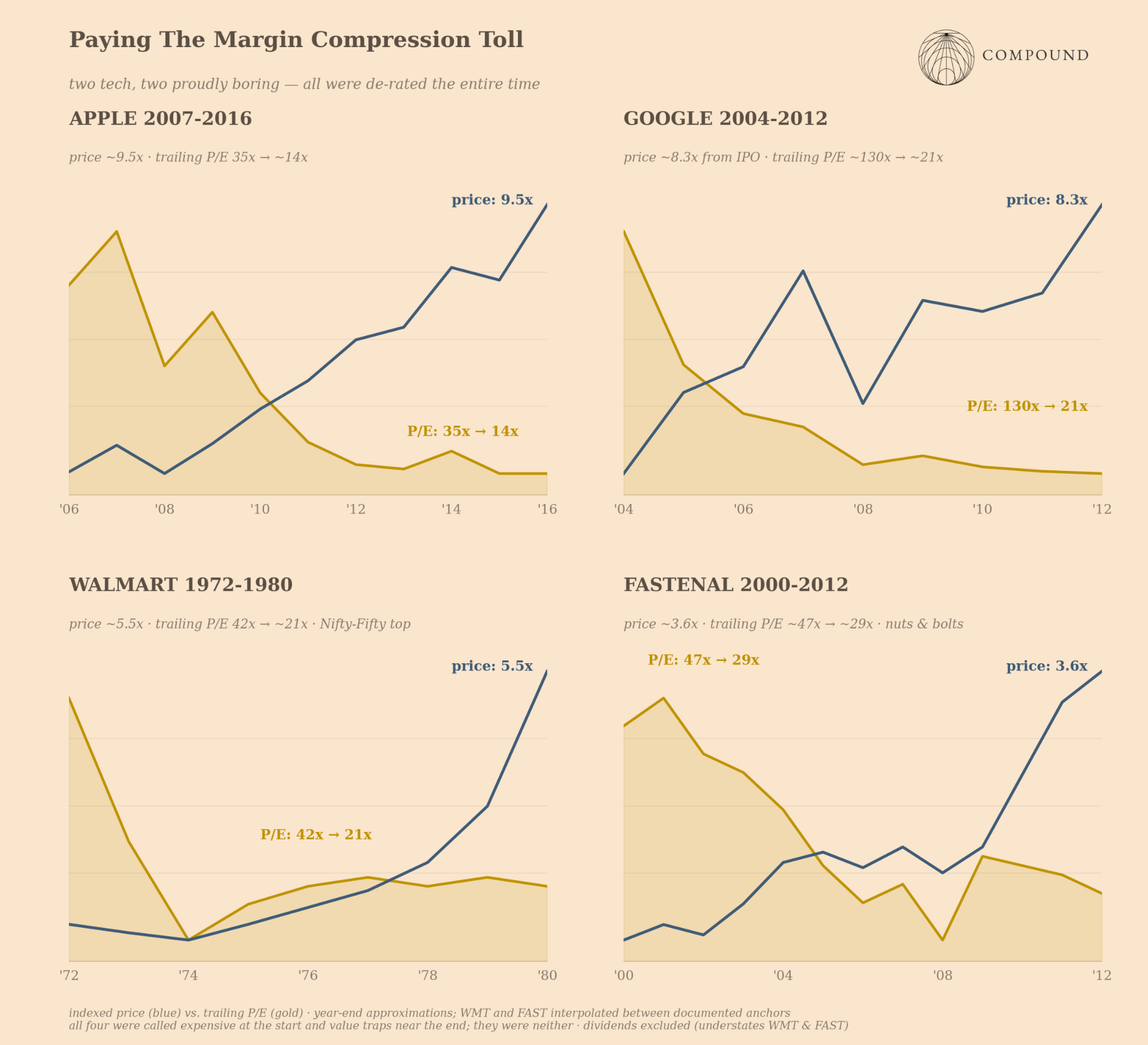
Finally, it is worth repeating that the common mistake of every type of person is not being able to deconstruct the two variables in the multiple, only in a different form.
There are two categories of people who have made mistakes in opposite directions over a long period of time, that is, underestimating long-term runways or long-term decline.
There are also two categories of people who have made mistakes in opposite directions when it comes to quality attribution.
Examples include assigning category quality to wrong assets, or putting an emotional stain on “clean” assets.
Will this continue?
I actually think this will speed it up. There is an opinion that as fewer people make decisions,
Coupled with our almost limitless access to data, the market is becoming more efficient. But I don't believe it.
If anything has changed, it's that the market has become more ineffective and the world has become more volatile.
This deviation from perception and reality is not a legacy of past market times.
I'd be surprised if this gap doesn't widen in the next 5 to 10 years.
The market structure has shifted to companies whose fundamentals and growth are more vague than ever before.
Small commodity factories are very different from the business model we see now (and will see in the future).
Today, due to the concentration of heads, even the index itself naturally lasts longer.
The convection systems I've written about before almost manufacture these Q2 and Q3 companies on an industrial scale.
The rotating narrative means that whoever is under the current storm is likely to overtune in both directions.
As each module matures, it will spawn a number of new companies of this type.
AI is also killing cheap versions of jobs and driving up the price of “real” or more difficult versions.
Everything that can be filtered (multiples, comparable companies, documents, phone calls, etc.) has been commercialized.
The window to obtain alpha through data-driven methods is rapidly shrinking every time.
But if we hypothetically think that everyone has the same perfect readability layer,
Well, all the benefits come from decisions and judgments surrounding the unreadable layer.
The private market is absorbing a larger share of some of these companies' most extreme cases.
This stuff isn't continuously priced, so the multiples debate is temporarily hidden.
There are plenty of reasons why this is a unique moment. But even when I'm writing this,
I tend to say, “In today's world, the biggest risk is that we think these companies may seem expensive, but they will grow to exceed current expectations.”
But I'm not sure if this actually happened.
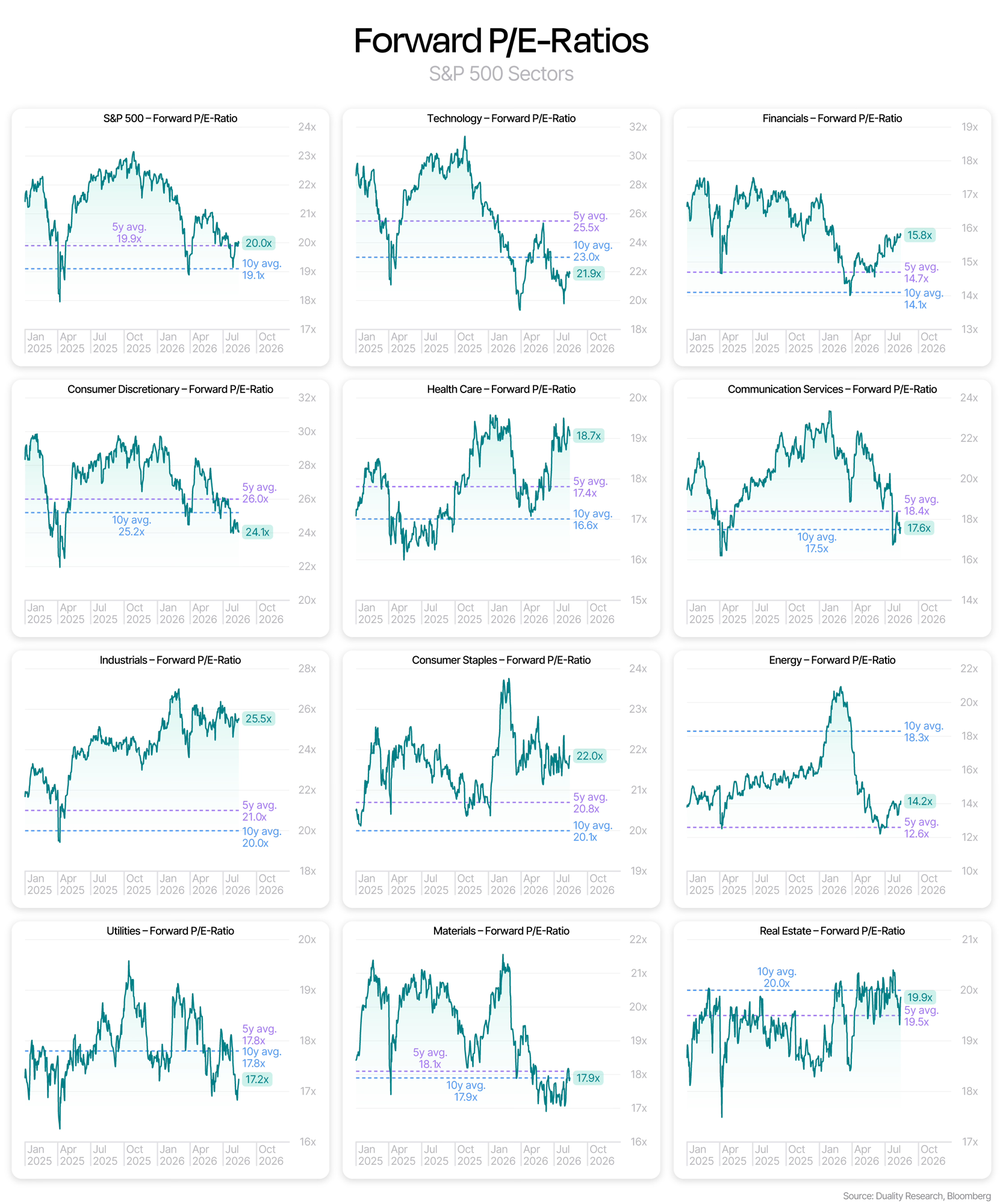
Mainly because, at least in the open market, the valuations of these companies have historically not been expensive.
¹ The profits of these companies are growing at an almost unimaginable rate,
So we're actually seeing the multiples go down. ¹ This is good news.
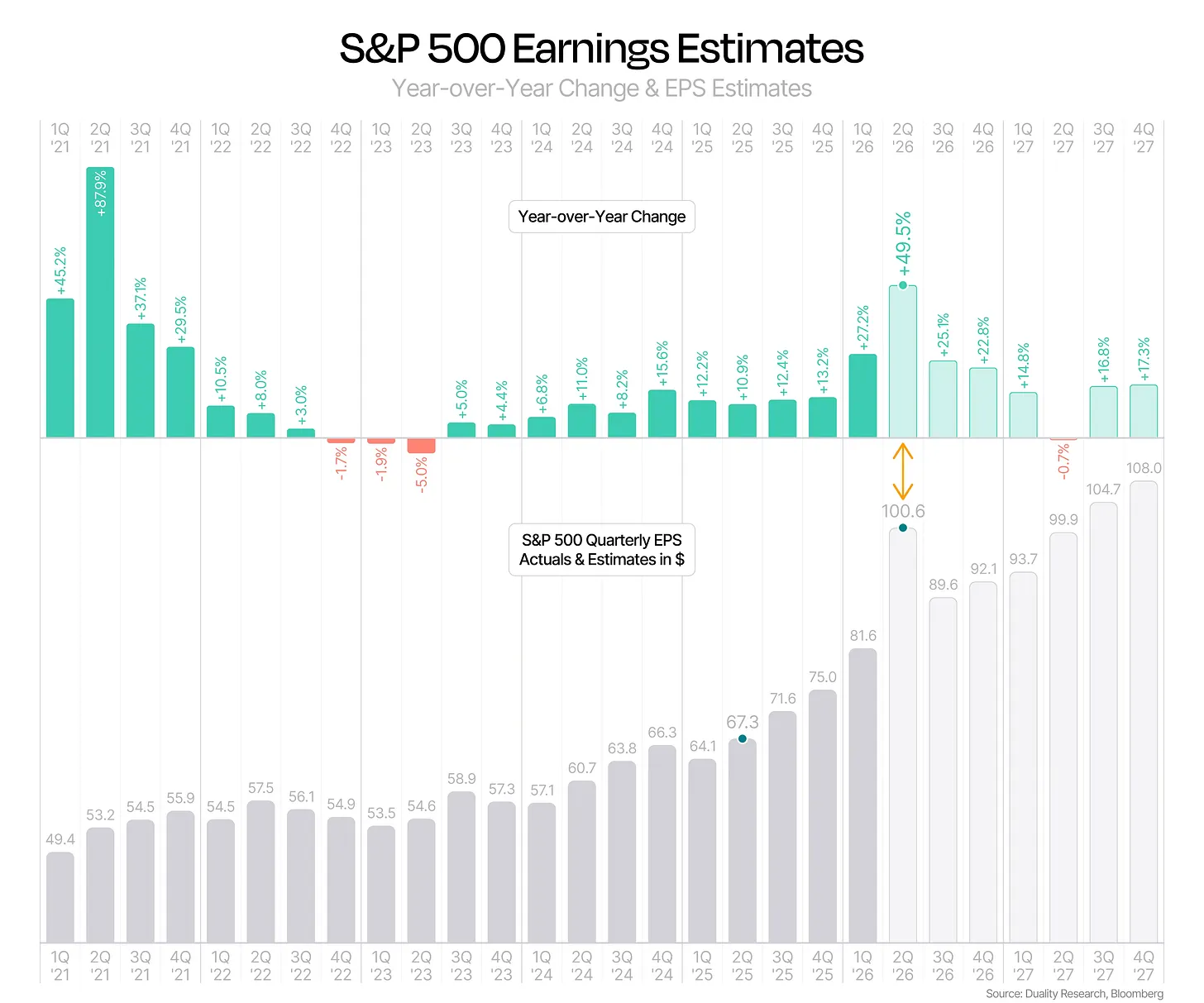 The bad news is, what happens if we're past the peak of growth? In a world where growth is slowing, would you expect multiple expansion?
Do you really believe we are on the verge of continuing 8% GDP growth?
Do you know when was the last time this happened in American history? Will this time be different?
I'm here to be deliberately provocative because the reality is that the world is complicated, and I think it will continue to be that way.
Other than AI, there's a lot more going on.
 Every high-profile founder, investor, media brand, and philosopher is motivated to continue a narrative: taking valuation risk (or Q1) is a necessary part of today's new games.
This keeps the money flowing. It allows people to say things like “We're democratizing intelligence.”
It raised the stakes for the ultimate coward game. But it also makes the board lean towards momentum investing.
It's a much more fragile game when we're talking about physical world constraints and supply chains rather than SaaS businesses.
A large amount of leverage and a large number of long-term assumptions are embedded in this complex system.
Even a slight pause in timing or scale can have a significant impact on the entire chain.
It is possible that everything will work out. That would be the ideal situation. But whether we are ushering in euphoria or dystopia,
The path-dependent nature of the market means that looking back in 5 or 10 years, we'll almost certainly laugh at [some] company's appearance on [some] long-term multiple.
The only question is what kind of laugh it would be...
Disclaimer:
The content of this website is for educational and informational purposes only.
Nothing above constitutes an offer or solicitation to sell or buy securities or interests.
It is no substitute for professional advice. Investing involves risk, including possible loss of principal.
1. Essentially brighter means they are actually brighter, no matter how you look at them from Earth.
2. I'm exaggerating a bit because the fundamentals of most big tech companies have always been excellent.
3. Established in the US and 12 of 13 broad international markets.
4.Ken French database
5. The most famous are Ben Graham and Warren Buffett. Buffett famously pioneered the tradition of investors making an annual pilgrimage to Oklahoma to listen to Oz.
6. When asked about moats in this emerging world,
It's no coincidence that Sam started with an idea of scale: “Great intelligence can migrate from any product to anything else.
The network effect still has a competitive advantage. The scale of the economy and the ability to manufacture the cheapest computing clusters remain competitive.”
7. One caveat is that there is a tipping point where, despite growth, the market will still discount multiples of these giant companies due to the law of large numbers.
I think we've seen this already at NVDA.
8. It's a bit out of date now.
9. What's funny is that people generally agree with the 80/20 rule.
But we haven't seen companies lay off more than 50% of their employees every year.
10. Here are two related tweets that I found relevant to this broader discussion.
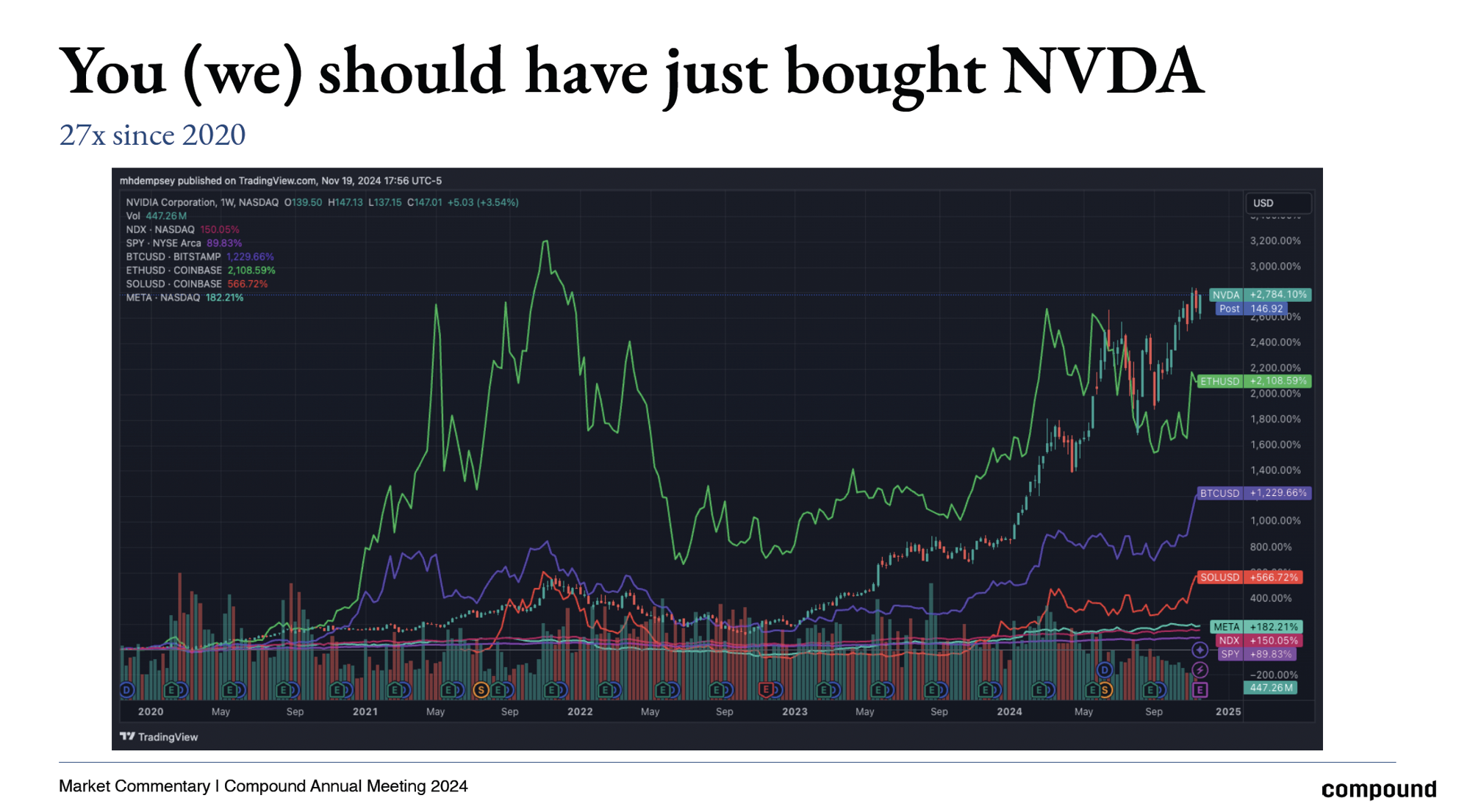
11. Now it's certainly easy to say that you should have only held NVDA for the past 15 years, but that's the point. After 15 years, people will say “you should have only held ____.”
12. This is why we see that the top is often formed near the “good” message and the bottom is formed near the “bad” message.
13. After it first gave guidance on exploding data centers, the stock price doubled, and the static multiplier looked crazy.
14. Even then, the market capitalization was around 40% of the bubble's peak.
15. I'm summarizing.
16. NVDA traded roughly sideways for two years from July 2024 to last month, although the execution was as good as anyone expected.
Twitter:https://twitter.com/BitpushNewsCN
Compare the TG exchange group:https://t.me/BitPushCommunity
Compare TG subscriptions:https://t.me/bitpush
