
扩容 · 2029

A new wave of chip price increases has arrived, and semiconductor companies are intensively announcing price increases

Comparative news, according to 21 financial reports, the “siphon effect” of AI on the semiconductor industry chain continues to ferment. Entering the second half of 2026, a new wave of chip price increases swept through with wider coverage and greater intensity. RF chip leader Zhuosheng Wei issued a price adjustment letter announcing that it will implement new prices for a full range of RF products starting September 1. The next day, National Technology followed up and raised the prices of some MCU products by 10% to 20%. For major international manufacturers, ST will complete the third price adjustment of the year on August 23, and Adano (ADI) will also implement the second round of new prices starting September 13. From memory chips to MCUs, from RF front ends to power semiconductors, from analog chips to passive components, price increases are being implemented intensively. Compared with the wave of price increases in the first half of the year, the more prominent feature of this round is that the explosion in AI computing power demand has a “siphon effect” on mature process production capacity, compounding rising supply and demand tightening, and the expansion of domestic replacement demand, and jointly driving the semiconductor industry into an upward cycle of sharp increases in volume and price.

2d ago
Yao Shunyu reorganizes Tencent's multi-modal route: closer to Liang Wenfeng and away from Li Feifei

Yao Shunyu reorganizes Tencent's multi-modal route: closer to Liang Wenfeng and away from Li Feifei

Text | Miao Zheng Editor | Wang Jing Source | Letter AI Tencent's mixed element multi-modal team has undergone another personnel change. According to media reports, Lin Xudong, who was responsible for xAI's multi-modal understanding, has left xAI and joined Tencent's mixed element as the head of the multi-modal content generation algorithm. The reason this personnel news is worth paying attention to is that it takes place in the context of continuous adjustments of mixed and multi-modal teams. Over the past period of time, news of the departure of the person in charge, the transfer of researchers, and the addition of new members came out one after another within the mixed yuan. Hu Han, the former head of multimodal understanding, left his career to start a business, and Tian Yonglong and others joined Tencent. The reporting relationship between the original multi-modal team also changed with the integration of the big language model department and the multimodal model department. However, does this mean that Tencent's multi-modal team is “changing the dynasty” is currently unable to draw a direct conclusion. What can be confirmed by public information is that mixed forces have indeed experienced personnel movements and organizational restructuring. The rumor of Lin Xudong's addition is more like a new signal in this adjustment: Tencent is recombining the two routes of multimodal understanding and content generation. So the question is, what exactly did Lin Xudong come from, and what abilities can he add to Tencent? And is Tencent's multi-modal approach shifting from “generating content” to Yao Shunyu's more biased “understanding context and acting in the world”? What is Lin Xudong's origin and what can he do after joining Tencent? According to public information, Lin Xudong graduated from Tsinghua University in 2018 and then went to Columbia University to study for his doctorate. While studying at the blog, his research interests included embedded learning, video analysis, and generative models. He also participated in the Vx2Text project in collaboration with Columbia University and Facebook AI. V indicates video, x indicates unknown, can be sound, voice, or even ambient sound. 2 represents TO, and Text represents subtitles. Its logic is to first convert different modes such as video and sound into vectors similar to “language tokens”, then uniformly feed the language model for fusion, and finally generate open text by an autoregressive decoder. Transformer can only understand tokens, so AI essentially doesn't understand video and audio file formats, making it even less likely to convert them into text. For example, if a dog jumps into the water next to a swimming pool, Vx2Text's video recognizer (V) will output keywords: dog, jump, pool; sound reader (x) will output: sound of water, fluttering. Although the product function of Vx2Text is “generation,” the core difficulty of the product is “understanding.” Of course, Vx2Text doesn't simply “translate” a screen into a few sentences. Models need to recognize people, objects, movements, and events from videos, understand how these things change over time, and finally organize visual information into language. After graduating from his PhD, Lin Xudong joined DeepMind and participated in Gemini-related multi-modal pre-training and post-training work. In 2025, he also joined xAI. According to public information, it is responsible for the direction of multimodal understanding and participating in the training of multimodal content understanding and generation models. Now that he has joined Tencent Hybrid, he will be responsible for the hybrid multi-modal content generation algorithm. Lin Xudong was added not so much to improve the performance of mixed-element multi-modal generation, but rather to solve a problem that plagues all multimodals — understanding. The previous generation model was more like a picture maker. Give it a hint, and it can generate an image or a video. But as long as users make more complex requests, the model just can't keep up. For example, the characters change in the long video, the shape of the object is not consistent before and after, the camera movement does not match the spatial relationship, etc. It's not because the model doesn't generate, but because it doesn't remember and understand the world steadily. Therefore, putting Lin Xudong in the position of multi-modal content generation is probably because he “translated” multi-modality into something AI can understand. Lin Xudong's addition can only be clearly seen in a larger context. That is, now Tencent's mixed element is reorganizing its multi-modal route. In January 2025, Tencent Outstanding Scientist (Tencent Distinguished Scientist) Hu Han succeeded Liu Wei, who had previously left his job, and was fully responsible for the research and development of mixed-element multi-modal models, and also served as Tencent's mixed-element big model Tech Lead. Tencent's internal organization was adjusted in the second half of 2025. He transferred from the Multimodal Model Department to the “Frontier” Frontier Technology Research Group under the Big Language Model Department. The title was changed to Head of the Multimodal Understanding Direction, and the reporting line was also changed to report to Yao Shunyu. The actual position changed from “the head of an independent department” to a “big language model...

2d ago字母AI#AI #Li Feifei #Liang Wenfeng #Tencent
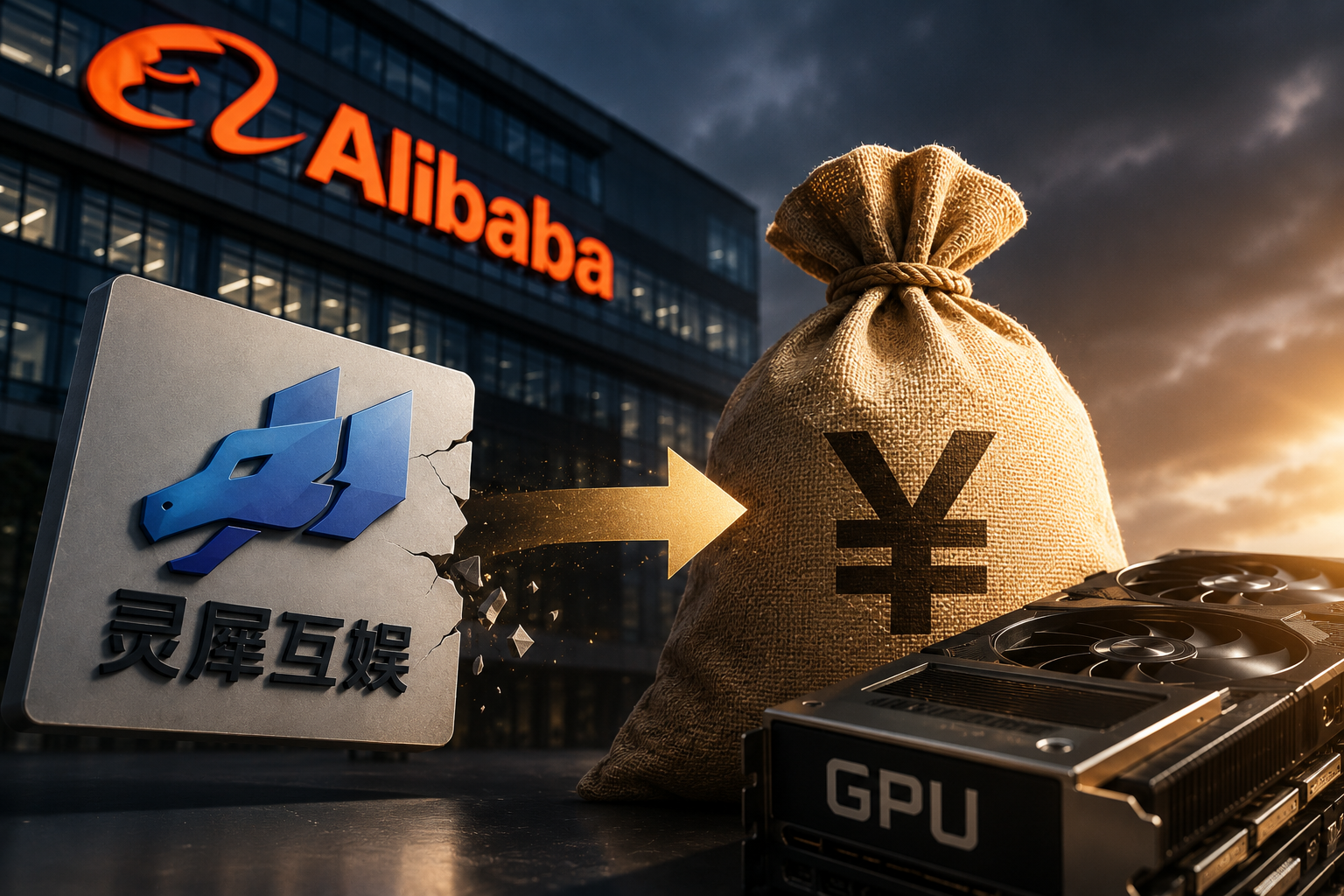
Ali sells his “son” who earns 2 billion dollars a year: All in AI to buy GPUs in exchange for money

Ali sells his “son” who earns 2 billion dollars a year: All in AI to buy GPUs in exchange for money

Source | Pencil Dao Author | Huang Xiaogui Original title: Ali sells his son who earns 2 billion dollars a year: In exchange for 10.1 billion yuan to buy a GPU, Alibaba sold a “chicken that can lay eggs.” On August 17, Zhou Bingshu, CEO of Lingxi Mutual Entertainment, issued an internal letter stating that Alibaba will sell its shares in Lingxi Mutual Entertainment, Xinchen Capital will become the new shareholder, and the original management team will continue to be responsible for the company's operations. According to the 21st Century Economic Report, Alibaba sold Lingxi Mutual Entertainment for at least 1.5 billion US dollars (about 10.1 billion yuan). Currently, Alibaba and Xinchen Capital have not officially disclosed the transaction amount. Lingxi Mutual Entertainment is a high-quality asset, with an annual net profit of 1.5 billion to 2 billion yuan; with “Three Kingdoms Strategy Edition”, a stable cash cow, the number of global users surpassed 100 million. “Exchange money to buy a card (GPU).” Huang Wei (pseudonym), a person familiar with Alibaba, told Pencil that the sale at this time was to concentrate resources and invest in computing power, and Ali, who is all in AI, has already entered a state of “full agent and model development, and scene access.” - 01 - Sold cash cow and invested in AI Lingxi Mutual Entertainment in Guangzhou. Its predecessor, Jian Yue Technology, was founded by Zhan Zhonghui, a former NetEase executive. In 2017, Ali acquired Jianyue Technology at a valuation of about 1 billion yuan and became a subsidiary. In September 2020, it officially launched the “Lingxi Interactive Entertainment” brand. What really gave this company a foothold in the Chinese game industry was “Three Kingdoms: Strategy Edition”, which was launched in 2019. According to Sensor Tower's previous data, the game's revenue in the first two years of its launch was over 1 billion US dollars. In recent years, Lingxi Mutual Entertainment's annual revenue is about 3 billion yuan to 4 billion yuan, which is roughly equivalent to the revenue scale of game manufacturers in central China. Also, according to industry media estimates such as “Game Grapes”, Lingxi Mutual Entertainment's profit in 2025 will be about 1.5 billion to 2 billion yuan. Ali sells a profitable business to invest in a direction that is still burning money — AI. In fiscal year 2026, Ali's capital expenditure reached 126.063 billion yuan, a record high. Most of this is AI computing power infrastructure and data center expansion. This input is directly reflected in the financial statements. In fiscal year 2026, Ali's revenue reached 1.02 trillion yuan, up 3% year on year, but operating profit fell 64%; adjusted EBITA fell 56%. Free cash flow declined from positive 73.9 billion yuan to negative 466 billion yuan. But this isn't a gamble without a future. Ali CEO Wu Yongming revealed, “(Ali) almost none of the cards are empty.” As of the end of March this year, Alibaba Cloud's revenue reached 41.6 billion yuan, an increase of 38% over the previous year, of which external commercialization revenue increased 40%; revenue from AI-related products was close to 9 billion yuan in a single quarter, accounting for about 30% of external revenue, and has maintained three-digit growth for 11 consecutive quarters. Ali predicts that in about a year, AI-related revenue may account for more than half of cloud business revenue. Today, growth is limited by supply, not demand. The ceiling of demand is far from being reached, but the ceiling of supply is just around the corner. At a time when cash is in high demand, but computing power continues to be exchanged for income, it's like “the family has an emergency, lacks money, and sells something for the family.” Huang Wei described Ali's sale of Lingxi Mutual Entertainment in this way. Lingxi Mutual Entertainment's annual profit is 1.5 to 2 billion yuan. It is a good asset, but it is not a core asset. The game business has a limited strategic relationship with AI, cloud, and e-commerce. Retaining it makes more than 1 billion dollars in profits; selling it will take back more than 10 billion dollars in cash at once and invest in AI. And this isn't the first time. In fiscal year 2026, Ali has successively disposed of many assets such as Gaoxin Retail, Yintai Department Store, and Trendyol Local Lifestyle Services. Each of these businesses has its own situation, but the underlying logic is the same: shrink non-core and concentrate resources on the main line of AI. Lingxi Mutual Entertainment sold 10.1 billion yuan, which is a bit higher than the 7 billion to 9 billion yuan expected by the market. Xinchen Capital's premium bid shows that in the eyes of buyers, this is a high-quality asset. For Ali, being able to sell at a high level is also considered a good time to sell. - 02 - Give me some more cards, I can make more money. The whole industry is buying cards. Overall, the 2026 GPU procurement budget of leading domestic manufacturers was raised from 160 billion yuan at the beginning of the year to about 230 billion yuan, a sharp increase of 44% within half a year. The industry's outlook for 2027 is more aggressive — GPU-related investment is likely to double to 500 billion yuan. The world is more exaggerated. According to data from Jibang Consulting, the total capital expenditure of the world's nine largest cloud vendors will exceed 886.7 billion US dollars in 2026, an increase of nearly 90% over the previous year. Amazon $220 billion, Google...

4d ago铅笔道#AI #GPU #Alibaba
[Comparative Daily News Picks] Yushu Technology will be listed on the Science and Technology Innovation Board on August 19; Anthropic's annualized revenue exceeded 65 billion US dollars before the IPO; Ethereum developers plan to upgrade Hegotá's priority promotion of private transaction proposals in 2027, and FOCIL has confirmed inclusion; the US-Iran situation has added another variable, and the yield on 30-year US bonds hit a new high in 19 years

[Comparative Daily News Picks] Yushu Technology will be listed on the Science and Technology Innovation Board on August 19; Anthropic's annualized revenue exceeded 65 billion US dollars before the IPO; Ethereum developers plan to upgrade Hegotá's priority promotion of private transaction proposals in 2027, and FOCIL has confirmed inclusion; the US-Iran situation has added another variable, and the yield on 30-year US bonds hit a new high in 19 years

Daily AI · Crypto · Macro · Market News, Bitpush helps you set priorities ↓ AI · News [Yushu Technology will be listed on the Science and Technology Innovation Board on August 19]. Comparing news, Yushu Technology announced that the company's shares will be listed on the Science and Technology Innovation Board of the Shanghai Stock Exchange on August 19, 2026. [Anthropic's annualized revenue surpassed 65 billion US dollars before the IPO] In comparison, according to people familiar with the matter, Anthropic's current performance means that the company's annualized revenue is expected to exceed 65 billion US dollars, an increase of more than seven times from the level at the end of last year. As of the end of July, Anthropic's annual recurring revenue (ARR) had reached $65 billion, according to people familiar with the matter. One of the people familiar with the matter said that Anthropic shared this data when regularly updating investors on the company's situation. The sharp acceleration in revenue has further strengthened Anthropic's confidence in advancing its listing plan. Both Anthropic and OpenAI have secretly submitted documents related to the listing. Anthropic is expected to land on Wall Street as soon as this fall, possibly earlier than OpenAI. [OpenAI Super Data Center officially launched, Nvidia covered up to 105 billion US dollars] Comparing news, OpenAI's Ohio Super Data Center officially signed a contract. This project was previously revealed. At the time, OpenAI was still discussing a long-term lease with SB Energy, and Nvidia was only considering providing a guarantee. Now that the first 4.25 GW has been officially launched, Nvidia can continue to lock in the remaining 3.75 GW. Previously, the two sides discussed guarantees of up to 250 billion US dollars, and in the end, the initial liability was limited to 105 billion US dollars. This isn't money given directly to OpenAI. Only if OpenAI goes bankrupt or doesn't pay rent, and there is still a gap after the project is re-leased or sold, will Nvidia need to make up the difference. After that, OpenAI will also have to pay back the money actually advanced by Nvidia. Nvidia will also invest $1.5 billion in developer SB Energy, and the park will mainly use Nvidia's AI computing power. Hwang In-hoon estimates that each generation of systems deployed here may correspond to about 1.5 million GPUs and 150 billion to 200 billion US dollars in revenue. Until now, outsiders have been questioning that this model is circular financing: Nvidia backs up the customer's infrastructure, and the customer then uses the money to buy Nvidia chips. Hwang In-hoon also specifically responded this time, stressing that Nvidia only bears specific rent, electricity, and asset residual value risks; it is not responsible for the entire project on behalf of OpenAI. Crypto · Market [Ethereum developers plan to prioritize private transaction proposals in the 2027 Hegotá upgrade, FOCIL has confirmed inclusion] In comparison, Ethereum Foundation researcher Toni Wahrstätter said that the protocol architecture team hopes to prioritize Frame Transactions (EIP-8141) and FOCIL (EIP-7805) in the Hegotá upgrade planned for 2027. Frame Transactions can collaborate with Keyed Nonces and Recent Roots (EIP-8272) and Transaction Assertions (EIP-7906) to enable the privacy pool to pay transaction fees and let the wallet set execution conditions after transaction submission. FOCIL can provide agreement layer inclusion guarantees for eligible transactions. Currently, FOCIL is the only proposal that Hegotá has confirmed inclusion, and the Frame Transactions related scheme is one of 66 proposals currently being evaluated. Other candidate solutions include transaction pricing, status growth, block access lists, and optional zkEVM certification for the main network. Vitalik Buterin previously proposed improving Ethereum's privacy, resisting quantum security, and reducing reliance on second-layer networks. Hegotá will follow Glamsterdam, and the developers plan to complete Glamsterdam by the end of 2026. [CleanSpark, BitFufu, and Canan Technology's Bitcoin production in July fell by about 5%, 10%, and 28%, respectively] In comparison news, according to The Block, Bitcoin mining companies CleanSpark, BitF...

4d agoBitpushNews#Compare Daily Picks

Morgan Stanley is optimistic about Amazon's AI growth potential: AWS may become a trillion-dollar business

Comparing news, Morgan Stanley said that if the growth of the Amazon (Amazon) cloud computing business of AWS accelerates further, the company's stock price may reach $500 by the end of 2027, which is close to double the current level. Morgan Stanley's optimistic scenario is based on how AWS is expected to grow into a $1 trillion business with annual revenue in the future. The main drivers include growing demand for artificial intelligence computing power and data center expansion. As competition for AI infrastructure heats up, Amazon is drastically increasing AI-related investment. The company recently raised its AI capital expenditure forecast for 2026 to $220 billion, focusing on expanding cloud computing infrastructure, AI computing power, and data center capabilities. Morgan Stanley believes that AWS will continue to play a central role in the AI wave, and as enterprises accelerate their adoption of generative AI services, demand for cloud computing and inference computing power may further drive AWS revenue growth. However, Morgan Stanley currently maintains a benchmark price target of $335 for Amazon, which is about 28% higher than the current stock price. The $500 target is a more optimistic scenario, depending on whether AWS can achieve faster growth and fully seize AI infrastructure market opportunities.

5d ago

The People's Bank of China adds 8 new digital yuan business operators

Comparatively, in order to implement the decisions and arrangements of the “15th Five-Year Plan” on “the steady development of digital yuan”, further enhance the inclusiveness of digital yuan services, and continuously respond to the public's demand for safe, convenient and efficient digital yuan services, the People's Bank of China added Ping An Bank, Hang Fung Bank, Bohai Bank, Bank of Shanghai, Bank of Hangzhou, Huishang Bank, Bank of Changsha, and Guangxi Beibu Bay Bank to become bank-type digital yuan business operators and connected to the central bank-side digital yuan system. The new institutions will launch the digital yuan business after completing business and technical preparations. Currently, the number of digital yuan business operators has been expanded to 30. In the next step, the People's Bank of China will promote the expansion of operating institutions in an orderly manner in accordance with the principles of marketization and rule of law, further stimulate the enthusiasm and creativity of market players, and build an open, inclusive, and fair competitive digital yuan development environment.

5d ago

Ethlabs Releases Hegotá Upgrade Priority Suggestions: Strengthening Censorship Resistance, Accelerating Block Generation, and Native Account Abstraction

Comparing news, Ethlabs, a non-profit Ethereum R&D lab, published an article outlining its priority recommendations for Ethereum's next network upgrade, Hegotá. Ethlabs prioritizes the following directions as the highest priority: strengthening censorship resistance (EIP-7805 FOCIL has been confirmed as the number one proposal); making Ethereum faster (adding EIP-8198 Quick Slots is recommended to reduce slot time to improve confirmation speed and finality); native account abstraction (recommends EIP-8141 Frame Transactions, which supports Passkey wallets, ERC20 gas payments, batch transactions and privacy, etc.); and continuing L1 Scaling up (EIP-8131 and EIP-8279 are recommended to improve capacity and predictability).

5d ago

Vitalik: The Bitcoin community is worthy of recognition for UTXO innovation, and the expansion of Ethereum will incorporate the advantages of various state models

Comparing news, Ethereum co-founder Vitalik Buterin posted an article on the X platform saying that the Bitcoin community is worthy of recognition for promoting the development of related technical ideas, including UTXO (unspent transaction output) state optimization solutions such as Utreexo. The expansion route currently being explored by Ethereum is integrating the advantages of different blockchain state models in practice. Vitalik Buterin pointed out that Ethereum hopes to have the advantages of both UTXO mode state, dynamic state, and solutions between the two, so that the vast majority of network activities can achieve “hyperscale” (hyperscale) without sacrificing decentralization, ease of node operation, and censorship resistance. Vitalik Buterin said that future Ethereum expansion is not simply a copy of a certain architecture, but rather hopes to maintain network openness and security while improving throughput capacity by combining different design concepts. Among them, Utreexo is a state compression scheme proposed by the Bitcoin ecosystem. By introducing accumulator technology, it reduces the storage burden on nodes, makes full node operation more lightweight, and is thought to help improve Bitcoin's long-term scalability.

6d ago

Ethereum's Next Upgrade 'Hegotá' Enters Planning Phase, 66 EIPs Competing for 2027 Hard Fork

In comparison, Ethereum developer Toni Wahrstätter said in an article on the X platform that Ethereum core developers are planning the next annual upgrade “Hegotá”, and 66 Ethereum Improvement Proposals (EIPs) are currently on the shortlist. The next few core developer meetings will screen these proposals to finalize the upgrade content that can complete implementation, development network testing, testnet deployment, and launch in 2027. Proposals that fail to enter Hegotá will be postponed until the next hard fork, so the current screening process will have an important impact on the future direction of Ethereum. Currently, FOCIL (Fork-Choice Inclusion Lists) has been identified as one of Hegotá's key upgrades. The developers believe that a combination of framework transactions (EIP-8141), cryptographic nonce (EIP-8250), and root references (EIP-8272) will help build native privacy capabilities, so that privacy applications can run without relying on third-party intermediaries. Furthermore, improving the ability to expand is an important direction for Hegotá. The developers proposed that it is necessary to prepare for a further increase in the gas limit to 600 million in the future by repricing data resources (EIP-8131, EIP-8279) and state growth costs (EIP-8368). Although these improvements aren't as intuitive as the privacy features, they are considered a key part of driving Ethereum's expansion in the short term. Other candidate upgrades include shorter block times (EIP-8198), issuance mechanism adjustments (EIP-8363), anti-correlation penalty mechanisms (EIP-7716), EVM optimization and simplification, and discussions on the first batch of EIPs related to zkEVM and anti-quantum cryptography. According to reports, it is impossible for Hegotá to include all the features expected by the community. The core team needs to make a trade-off between “future vision” and “recent deliverable upgrades,” and most candidate EIPs may not be able to enter this upgrade in the end. Currently, Ethereum is 256 days away from the launch of the current Glamsterdam upgrade, and the goal is to complete deployment by the end of this year. Hegotá is scheduled to go live in 2027, and the core developers and community will discuss the priorities of each EIP in the coming months. Community input will still play a part in the screening process, and participants who support or oppose the entry of an EIP into Hegotá can submit their views to the core development team through open discussions.

6d ago#On-chain dynamics

Musk switches to natural gas power supply, SpaceX lays out its own energy system for AI infrastructure

Comparatively, as demand for AI computing power grows rapidly, Elon Musk's SpaceX is increasingly using natural gas energy to power its large-scale AI infrastructure. According to reports, SpaceX plans to support the construction of a gas power plant for a chip manufacturing facility located in Texas with an investment of 16.8 billion US dollars. Meanwhile, the company's data centers in Tennessee and Mississippi have deployed dozens of gas turbines to meet AI computing needs. Musk expects the SpaceX data center's computing power capacity to reach 10GW to 15GW by 2027, when the company may become one of the largest AI data center operators in the US. Against the backdrop of bursting demand for AI computing power and difficulties in matching the speed of power grid expansion, SpaceX is exploring an “off-grid power” (off-grid power) model to quickly obtain stable electricity through self-built natural gas power generation facilities to support the expansion of AI chips, data centers, and future computing infrastructure. This strategy also reflects the expansion of competition in the AI industry from chips and models to energy and power infrastructure. As large technology companies compete for computing power resources, being able to quickly secure power supply is becoming a key competitive factor in AI infrastructure construction.

9d ago