杰夫·贝索斯 · 43

Bezos: Amazon plans to launch next AI chip Trainium4 in 2027

Comparing news, Amazon founder Jeff Bezos said in an interview with “Fortune” that the chip business will become the next long-term pillar after Marketplace, Prime, and AWS. Amazon plans to launch a next-generation chip, Trainium4, in 2027. Amazon's chip business is mainly based on Annapurna Labs, which was acquired by Amazon in 2015 and is currently responsible for designing AI chips. Earlier, Amazon CEO Andy Jassy said during an earnings call for the second quarter of 2026 that the AI chip and self-developed chip business have both exceeded 25 billion US dollars in annual revenue, and related businesses hold more than 225 billion US dollars of customer commitments over a period of more than 225 billion US dollars. (TheStreet)

13d ago

Bezos plans to sell $4.1 billion worth of Amazon shares, closing down more than 2%

According to the news, Amazon founder Jeff Bezos (Jeff Bezos) submitted documents to the US Securities and Exchange Commission (SEC) and plans to sell about 15 million Amazon shares, with a total value of about $4.1 billion based on Monday's closing price. According to the documents, the sale plan was based on the 10b5-1 pre-set transaction plan adopted by Bezos on November 14, 2025, and executed through Morgan Stanley. The relevant shares were initially acquired in 1994 in the form of founder shares. Before the announcement of this holdings reduction plan, Amazon's stock price just hit a record high on Monday. Driven by last week's quarterly earnings report, the company's market capitalization surpassed $3 trillion. The cloud computing business performed strongly in the second quarter, and the market believes that its AI investment is being transformed into a higher growth engine. Amazon shares closed down more than 2% on Tuesday due to news of Bezos' holdings reduction. Since this year, Amazon's stock price has increased by about 20%, outperforming the S&P 500 index, which rose by about 12% during the same period. Bezos has continued to sell Amazon shares through pre-set trading plans in recent years, but it is still one of the company's major shareholders. Documents show that in May of this year, Bezos also donated 220,200 Amazon shares to non-profit organizations.

17d ago
New York Times Long Article | 81-year-old Allison All In AI bet on Oracle and kidnapped the entire United States

New York Times Long Article | 81-year-old Allison All In AI bet on Oracle and kidnapped the entire United States

Source: The New York Times Authors: Jonathan Mahler, Jim Rutenberg, Kirsten Grind Original title: Larry Ellison Bet It All on the A.I. Boom. Will He Be the Face of the A.I. Bubble? Editor and collation: BitPushNewsBitPush Note: Through long-term in-depth research, the New York Times reporter interviewed dozens of people familiar with Larry Ellison (Larry Ellison) and Oracle (Oracle) in Silicon Valley, San Francisco, Hawaii, and New York, and reviewed numerous financial documents, analytical reports, and court records. The article focuses on Larry Ellison's bets on the aggressive transformation of artificial intelligence, revealing how Oracle (Oracle) relies on huge debt to expand AI infrastructure, and the profound risks this gamble may bring to companies, capital markets, and even the US economy. Here's the text: January 21, 2025 — the first full working day since Trump's second administration took office — Larry Ellison woke up in his 33-bedroom, 34-bathroom beachfront mansion in Florida, boarded his private jet, and flew to Washington. Ellison, who was 80 years old at the time, had a net worth of about 200 billion US dollars and wanted to go to the White House for an appointment. He was too lazy to even bring his driver's license — got to the door and call a staff member close to the president to guarantee his identity — but at 2 p.m., he was already standing next to Donald Trump in Roosevelt Hall. The president announced the launch of “the largest artificial intelligence infrastructure project in history to date,” and told the world that his friend Larry Ellison was the right person to complete this task. “He's kind of like the CEO of everything,” Trump said. “He's an amazing person and an amazing businessman.” Ellison first thanked Trump. “Of course we wouldn't be able to do this without you,” he said. “It just wouldn't be possible.” He then drew up this ambitious plan. Ellison's database software and cloud computing company Oracle, and its partners — most notably OpenAI — will invest up to $500 billion over the next four years to build a number of giant data centers. Each data center covers an area of 500,000 square feet and will generate a total of 10 gigawatts of computing power, consuming enough electricity to power up to 10 million homes. The name of the project “Stargate” is taken from the 1994 sci-fi movie of the same name: in the film, Kurt Russell walks through a wormhole and finds himself inside a pyramid on an alien planet. In reality, this “Stargate” will be the entrance to lead humans from the post-industrial era to the era of artificial intelligence. Ellison sided with Trump long before many other tech leaders turned to support him. After the 2020 election, he attended a strategic conference call with Trump's cronies to discuss how to reverse the election results; in 2024, he also donated tens of millions of dollars to support Trump's campaign. However, OpenAI CEO Sam Altman, who was also present at the White House on the same day, was a Democratic Party donor and Trump critic. To facilitate this event, Ellison helped arrange a call between the two. As far as Ellison is concerned, this White House appearance is a work of him running frantically for two years trying to transform Oracle into an AI giant to the top. The effort began in late 2022: ChatGPT came out of nowhere, shocking the world and starting a battle of contention — everyone wanted to master and control the most disruptive new technology since the birth of the internet. As one of the founders of Silicon Valley and the last person still on the table in that generation, Ellison desperately didn't want to be left behind. He acted quickly and harshly — some would even say almost reckless — to try to turn Oracle into a “hyperscale cloud service provider,” one of the few companies that can provide critical infrastructure and power the AI boom. These efforts have at times brought Ellison into conflict with the Biden administration. The latter has taken a more cautious approach to artificial intelligence and introduced a series of regulatory measures, hoping that the government can take some control over its development process. The Biden team believes that if the US wants to stay ahead in the AI competition, the best way is to control the ability of US companies to provide computing power to foreign countries such as China and the Persian Gulf authoritarian regime. Picture: On January 21, 2025, after announcing the “Stargate” project, President Trump met SoftBank CEO Masayoshi Son, Larry...

21d agoWendy#AI #Larry Ellison #datacenter #lather #depths #Oracle #viewpoints

World model startup General Intuition is in talks to raise around $300 million

Comparatively, New York-based startup General Intuition is negotiating about $300 million in financing, and the company is building a basic model to train AI agents to move and act in space and time. The funding comes just eight months since General Intuition split and became independent from the game video uploading and sharing platform Medal. At the time, the company closed a $134 million seed funding round. A successful completion of this round of financing would raise its valuation to just over $2 billion. According to people familiar with the matter, the company has received financial support from investment supporters including Jeff Bezos (Jeff Bezos) and Eric Schmidt (Eric Schmidt), as well as existing investors Khosla Ventures and General Catalyst. General Intuition was founded and led by Medal co-founder Pim de Witte, who co-manages the company with co-founders Eloi Alonso, Adam Jelley, and Vincent Micheli. These co-founders are all researchers and focus on technology in the field of modeling and simulating the world.

64d ago
Trillions worth, shares are not given to children... why do so many people hate Musk?

Trillions worth, shares are not given to children... why do so many people hate Musk?

What is it like to get a “trillion dollar” pregnancy experience voucher as soon as you were born? According to common sense, this should be a “lie back and win” life at the top of human society. But if you're Elon Musk's kid, sorry, this script might be difficult. With SpaceX successfully completing the “largest IPO in human history,” Musk officially became the world's first “trillionaire.” He is worth more than the sum of the wealth of the four richest people behind him — Larry Page, Sergei Brin, Jeff Bezos, and Larry Ellison — and is even close to surpassing Bitcoin's total market capitalization. Along with his wealth, there is also his huge family map — up to now, Musk has revealed that the number of children Musk has publicly reached 14. 14 kids, worth a trillion dollars. While the entire internet was trying to figure out how his kids would split this account, Musk himself publicly spilled a pot of cold water. In an interview with the “Wall Street Journal” CEO Council summit on the eve of the IPO, he said that he did not support the practice of children automatically inheriting control or shares of the company: “I would never take the initiative to give children shares in the company. If they have no interest or ability to manage, it is a “huge mistake” to pass on the company to them.” This kind of operation, which pursues extreme efficiency in business and also puts performance first in private, is very “Musk.” A workplace “tyrant”? Here are a few numbers: On the eve of SpaceX's IPO, the Wall Street Journal estimated how fast Musk was making money. In the 31 years since starting his business in 1995, he has earned an average of $992 per second — converted to $3.6 million an hour, or $85.7 million a day. An American family with a median income of $8,3,730 in 2024 would need to work for more than 11 million years without eating or drinking to save the same amount of wealth. His personal net worth already exceeds the annual GDP of 125 countries around the world, including Norway, Thailand, Argentina, and South Africa, accounting for about 3% of the US GDP. If Musk keeps working 70 hours a week at high intensity and never takes a vacation until he is 75, his actual perceived hourly wage during his career is about $4.2 million. In reality, his pace is even crazier — after buying Twitter, his working hours soared from around 80 hours to over 120 hours a week. Musk follows a work culture he called “Extremely Hardcore” (Extremely Hardcore). After buying Twitter for $44 billion in 2022, he cut the total number of employees from 7,500 to 1,500 within six months — laying off about 80% of the workforce. The remaining employees received an email from all employees with the subject “A Fork in the Road”: either accept “intense long hours of work” or leave with three months' severance pay. He is extremely repulsive of the bureaucratic hierarchy and is used to going beyond his supervisor to give orders directly to engineers. During Tesla's most difficult period, he used the factory as his main residence for three consecutive years. “For a while, he slept under his desk, and it was an open desk, placed right in the middle of the workshop.” His reason is straightforward — let employees see for themselves that leadership is under pressure just like them. However, Musk's management style has created both an avid following and serious career burnout. The turnover rate of his company's executives is extremely high, “violent dismissals” occur from time to time, and employees need to survive in an extremely unstable pace. According to the Wall Street Journal, a former SpaceX employee once described it this way: Most of the people left behind had a strong sense of identity with Musk's mission and were willing to bear extreme pressure, while those who left were often engulfed by the unpredictable intense pace and intense consumption. In an interview with the Financial Times, a former Tesla engineer recalled that he had received a text message from Musk at 3 a.m. on Sunday and was asked to respond within 15 minutes. Another former executive put it bluntly: “He's very ruthless and extremely involved in every decision you make — he has little fear of failure.” When an idealist is “Sheda” Musk is really worried about big things: Mars, AI, and the survival of civilization. However, the blind spot of this idealism is that it often only aims to save the macroeconomic “future of humanity,” yet it is extremely lacking in feeling about specific individuals. The collapse created by others was an acknowledged turning point — Thailand's “Sleeping Beauty Cave” junior soccer team rescue incident in 2018. At the time, Musk rushed to the scene with a high-profile “mini submarine” built by SpaceX, but was supported by experienced British professional rescue team member Vernon Uns (Vernon Uns)...

67d agoWendy#SpaceX #public #Musk

Bezos' AI startup Prometheus completed a $12 billion Series B round, with J.P. Morgan Chase, BlackRock and others participating

Comparatively, according to GeekWire, the AI startup Prometheus, co-founded by Jeff Bezos, completed a $12 billion Series B round with a valuation of around $41 billion. Investors include J.P. Morgan Chase, BlackRock, Goldman Sachs, DST Global, and Arch Venture Partners. Prometheus has removed “Project” from its original name and is committed to building what Bezos calls a “general artificial intelligence engineer,” using AI tools to accelerate the physical product development process from design to manufacturing. Prometheus Co-CEO Vik Bajaj said that in the past few years, it has been possible to transform complex issues from design to manufacturing into end-to-end AI issues. Bezos revealed that the company may acquire some manufacturing companies that can benefit from its technology and help improve its production process. This is the first time Bezos has assumed the position of CEO since stepping down as CEO of Amazon in 2021. The company currently has about 150 employees and teams headquartered in San Francisco, London, and Zurich. Bezos said the product launch schedule is yet to be determined, but early versions are coming soon.

71d ago

Standard Chartered maintains a long-term view of ETH: it is expected to reach $4,000 by the end of 2026 and rise to $40,000 by 2030

Comparing news, Geoffrey Kendrick, head of digital asset research at Standard Chartered Bank, said that the current trend of Ethereum is similar to Amazon after the collapse of the Internet bubble in 2001. The price drop does not indicate a deterioration in fundamentals; on the contrary, there may be a “mismatch between stock prices and internal indicators.” Kendrick quoted Amazon founder Jeff Bezos as saying that the market price can diverge from the company's fundamentals for a long time, but it will eventually return to value trajectory. Although the current price of Ethereum has dropped by about 57% from its high in 2025, core indicators such as on-chain transaction volume and total locked volume (TVL) are still close to historical highs, so Standard Chartered maintains a long-term view of ETH. It is expected that the price may reach $4,000 by the end of 2026 and rise to $40,000 in 2030. (The Block)

86d ago
Bezos, Schmidt, and Powell Jobs: How can the three AI investment philosophies bet on three very different futures?

Bezos, Schmidt, and Powell Jobs: How can the three AI investment philosophies bet on three very different futures?

Author: Shenchao TechFlow Original title: Bezos, Schmidt, Powell Jobs: Three AI Investment Philosophies of Silicon Valley Old Money They are investing in three completely different futures. On November 17, 2025, 61-year-old Jeff Bezos became CEO of a company again. He returned to the trading position for the first time since stepping down from Amazon in 2021. The new company, Project Prometheus, has an initial capital of 6.2 billion US dollars, focusing on “physical AI” and targeting the manufacturing industry. Seven months ago, 70-year-old Eric Schmidt owned a rocket company called Relativity Space and became CEO himself. He didn't explain why this age is coming to an end; maybe “every day matters in the AI era” is already the default answer. In June of the same year, Jobs' widow, Lauren Powell Jobs, gave a rare public interview. She sits next to Jony Ive and talks about the prototype she saw at io. It was an “AI device” that was taken over by OpenAI for $6.4 billion. It had no screen and was said to look like a player hanging around the neck. Commenting on the prototype, she said, “It's incredible to watch an idea become a reality.” Three people, three gestures. But they all bet at the same casino. Over the past three years, Silicon Valley's top purses have been doing almost the same thing: putting money from family offices, venture capital, and charitable foundations into AI. Schmidt, Bezos, and Powell Jobs are just three of the most prominent. But if you take a close look at their target list, you'll find that this isn't the same game; they're voting for three completely different futures. Schmidt: Think of AI as the next Cold War According to data quoted by Wikipedia and The AI Insider, Schmidt's family office Hillspire has invested in more than 22 AI companies since 2019, totaling more than $5 billion. The list includes Anthropic, SandboxAQ (a quantum+AI company spun off from Alphabet), Inworld AI, Holistic AI, and Altera. These are the targets that “people in the industry” will list. But what really revealed his undertones was another list. White Stork: A company that makes AI drones in Ukraine. Rebellion Defense: Defense AI. Istari: simulation simulation. Swift Beat: military software. This is a family office that uses AI as the next generation of military equipment. Schmidt has chaired the Defense Innovation Council since 2016 and co-led the National Artificial Intelligence Security Council from 2019 to 2021. He's a player who treats AI policy, defense procurement, and energy infrastructure as the same thing. In January 2024, “Forbes” revealed that he simultaneously launched the White Stork drone project in the US and Ukraine, using the Ukrainian battlefield as a “laboratory for AI weapons.” Then there's infrastructure. In January 2026, he co-founded a company called Bolt Data & Energy with Texas Pacific Land and became the chairman himself. This company doesn't rent computer rooms or buy grid electricity. It has to build its own natural gas power plant in the wilderness of West Texas and pour electricity directly into the data center. The plan is to first reach 1 gigawatt, and eventually to 10 gigawatts, which is equivalent to the electricity consumption of 7 million households. Texas Pacific Land paid $50 million, plus priority water supply rights. In response to an email to Fortune, Schmidt said, “The biggest bottleneck facing AI is not algorithms; it is energy.” In March of the same year, he took control of Relativity Space. The company is making a reusable rocket called Terran R, with the goal of impacting SpaceX's monopoly on medium- and low-orbit launches. The order was $2.9 billion as of that time. Put these together, and the logic is very clear. Schmidt doesn't believe in “investing in a basket of big model companies” style of play. He believes that AI's victory or loss will ultimately fall on three things, namely computing power (data centers and electricity), transportation (rockets, satellites, drones),...

100d agoburnking#AI #Powell
A book detonates old accounts, and CZ and Star have had another ten-year feud

A book detonates old accounts, and CZ and Star have had another ten-year feud

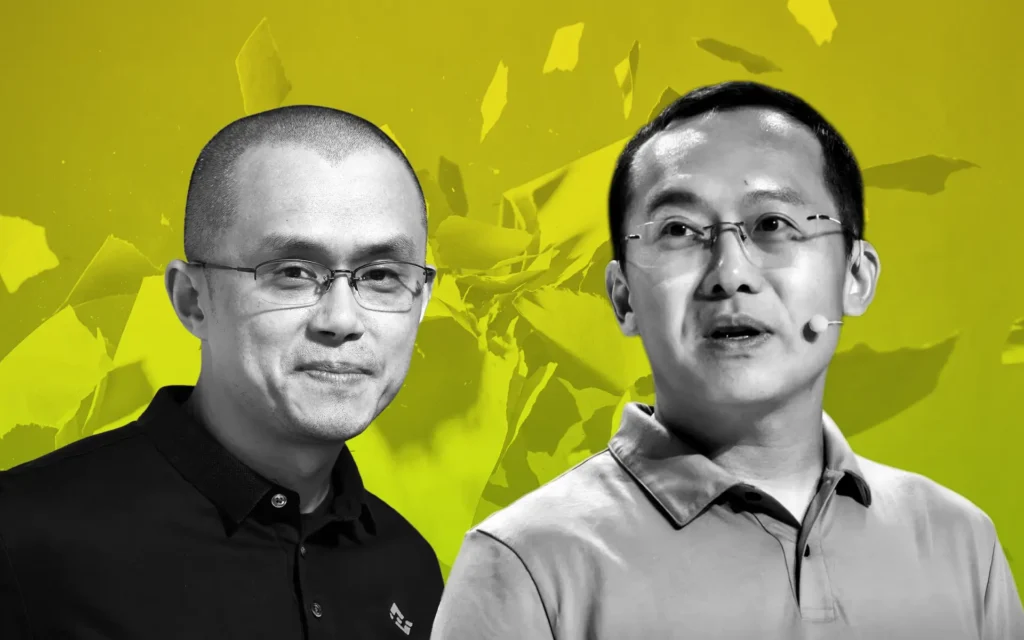
Article: Cookie, Deep Wave TechFlow Original title: A book detonates ten years of grudges, CZ and Star go to war again Introduction: A $1 billion bet, old contract fraud cases, reporting doubts... The two founders of Binance and OKX have unraveled an old scar at the deepest point in the crypto industry. On April 8, 2026, Zhao Changpeng (CZ)'s autobiography “Freedom of Money” (Freedom of Money) went on sale worldwide. This 457-page memoir, from his childhood in rural Jiangsu to his four months in the US federal prison, all sales were donated to charity and topped Amazon's crypto bestseller list. But the real explosion of this book is not that it tells an inspirational story, but who named it. The most controversial section of the book is this: At a dinner in 2025, Huobi founder Li Lin told CZ that he had seen a screenshot showing OKX founder Xu Mingxing (Star) personally reporting him to the Chinese police, and it was this report that led to Li Lin's detention at the end of 2020. After the bomb was dropped, Star responded by posting several long posts on the X platform, directly calling CZ a “habitual liar,” and unraveling an old case from ten years ago. An open scolding war that continued for many days began. Old Grudge: One contract, two versions. To understand the intensity of this war of insults, we must go back to 2014. That year, CZ joined OKCoin founded by Xu Mingxing as CTO. He stayed there for less than a year. According to CZ in the book, Xu Mingxing tried to renegotiate his 10% share in early 2015, and CZ left the job after the two parties broke down. The departure itself was not unusual, but what happened afterwards made the entire Chinese-speaking crypto community watch a big drama. At the heart of the dispute was a commercial partnership CZ brokered during his tenure: he brought in Roger Ver, an early Bitcoin investor, for OKCoin, and the two sides signed a cooperation agreement on the Bitcoin.com domain. Something went wrong with this contract after CZ left. Two versions of the contract were put on the table, one with a six-month termination clause and one without. OKCoin accuses CZ of falsifying the contract, and CZ in turn accuses OKCoin of manipulating transaction volume and falsifying proof of reserves. Roger Ver later sued OKCoin for $57 million for breach of contract. Ten years have passed, and Rashomon has never come to a conclusion about “who falsified the contract”. This time, Star has re-opened a video of the QQ chat transcript that OKCoin notarized back then. He said the video proved that CZ sent two different versions of the agreement (v7 and v8) to OKCoin's accountant in December 2014, and the evidence of falsification was clear. CZ explained in the book that he rarely used QQ, and that other OKCoin employees logged in to his account and falsified chat history. Two people hold their own opinions, and each has its own “irrefutable proof”. Ten years are like a day. New Feud: Report Doubt and OKEx's “The Darkest Five Weeks” “Life on Binance” that really hit Star's pain point is a story about the regulatory storm in China in 2020. On October 16, 2020, OKEx (the predecessor of OKX) suddenly announced the suspension of all digital asset withdrawals because a private key holder “is cooperating with the investigation by the public security authorities”. The private key holder was later confirmed by Caixin and other media as Xu Mingxing. OKEx's withdrawal suspension continued for a full five weeks. OKB tokens plummeted by more than 15% within 24 hours after the news was announced. Users angrily asked “when can I withdraw money” on Weibo. CZ describes this incident in the book, implying that OKEx's wallet system is at risk of a “single point of failure” because Xu Mingxing was detained alone, causing the entire exchange to fail. He also compared Huobi, saying that Li Lin was also under house arrest for about 90 days during the same period, but Huobi's withdrawals were never interrupted because “Huobi's wallet settings are better.” A month later, Li Lin was also taken into custody. CZ claims in the book that five years later, in 2025, Li Lin told him at the restaurant that he saw a screenshot showing Xu Mingxing reporting him to the Chinese police. S...

134d agoLuxurytracy

Amazon founder Bezos is in talks to raise a new $100 billion manufacturing AI fund

Comparatively, according to the Wall Street Journal, Amazon founder Jeff Bezos (Jeff Bezos) is in early negotiations to raise a new fund of 100 billion US dollars. The fund will acquire manufacturing companies and use artificial intelligence technology to accelerate the transformation of these companies to automation. The Amazon founder is meeting with some of the world's biggest asset managers to raise capital for the project. A few months ago, he traveled to the Middle East to discuss this new fund with representatives of the region's sovereign wealth funds. Recently, he went to Singapore to continue to raise funds for the program. The above information comes from people familiar with the matter.

155d ago