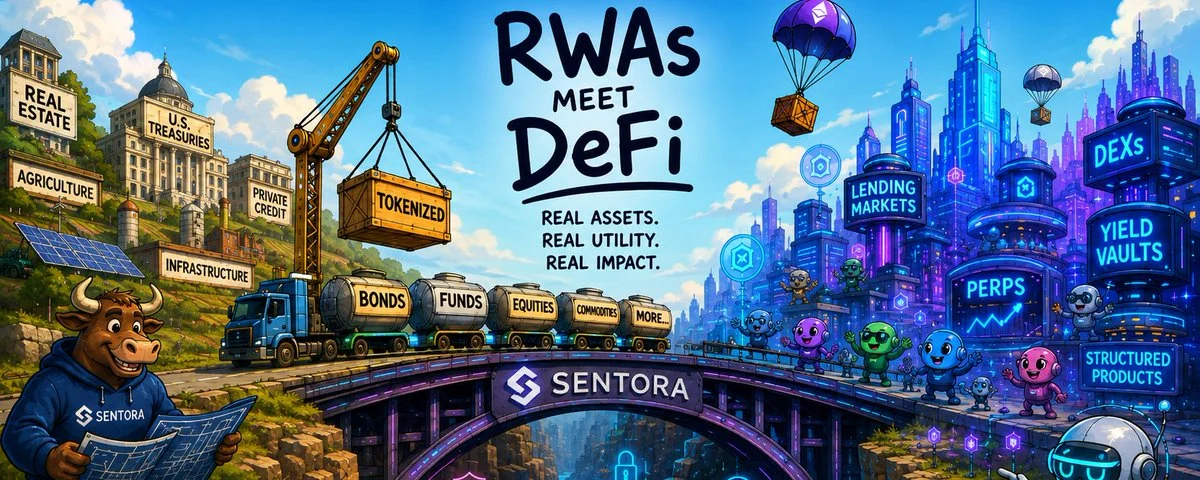
If it's just tokenized assets and doesn't connect to DeFi, what's left of RWA?
Author: Jesus Rodriguez, co-founder of Sentora Compiled by: Luffy, Foresight News Original title: Does RWA still make sense without DeFi? Discussions in the RWA industry often begin with a simple vision: take a treasury bill, fund share, stock, invoice, megawatt hour, or GPU for one hour, then mint a token representing it. Is it useful? It's really useful. But can it be called transformative? It's far from there. This is like putting a bar code on a container and claiming that a global trade problem has been solved. Barcodes make containers recognizable and machine-readable, but they don't create ports, cranes, customs, insurance, financing, shipping routes out of thin air, or bring in buyers from afar. A token is simply an addressable token of interest, and DeFi is a marketplace operating system. The question really worth discussing is not how many types of assets can go on the chain, but how many assets can complete valuation, financing, hedging, transaction monetization, and loss disposal in a stressful environment, and there is no need for offline meetings and coordination every time a transaction occurs. Tokenization completes the representation of equity; what DeFi brings is actual utility. Tokenization is just a bar code, and a similar scene has happened in the history of the supply chain finance market. The reason why mortgages can be scaled up is not as simple as turning a paper document into an electronic record. To actually achieve large-scale expansion, a complete set of operating mechanisms was created around this type of asset: credit review, post-loan services, securitization, credit rating, warehousing and financing, repurchases, hedging, clearing and settlement, and loss allocation rules. RWA also needed to go through the exact same evolutionary process. An asset that can be adapted to DeFi requires six levels: legally enforceable rights, reliable data sources, clear transfer and redemption rules, enforceable secondary market liquidity, collateral parameters that match actual behavior, and a credible settlement and loss disposal path. Most tokenization projects, on the other hand, tend to stop at the top five levels. There is a simple test that can be used to test the maturity of an asset. It only requires answering three questions: How much is this asset currently worth? Can the agreement complete withdrawal and monetization at this point? If the first two judgments are all wrong, who bears the loss? When smart contracts can definitively answer the above three questions, RWA can truly become a basic component of finance. Before that, it was mostly just a digital packaging shell. The deepest technical contradiction of RWA's quadruple time clock is that RWA runs under multiple sets of different time clocks at the same time. The blockchain can complete settlement in seconds and operate uninterrupted for 7 x 24 hours; oracles may update prices every hour or every day; underlying traditional exchanges are closed at night and on weekends; custodians follow bank working days; and the asset redemption process may take 1 day, 5 days, or even 30 days. If you use such a slow-paced RWA asset to support fast-maturing DeFi liabilities, such as stablecoin loans. This is the term shift, and it is also the core model that banks have relied on for hundreds of years: using short-term debt to fund long-term slow assets. This model has practical value, but the risk must be reasonably priced. Imagine a scenario: At 2 a.m. on Sunday, assets hit the liquidation threshold. Smart contracts can seize tokens immediately, but the underlying real-world market won't open until Monday, and the issuer's redemption business will not be processed until Tuesday. On-chain liquidation has been completed, and real-world asset disposal has only just begun. This creates a clearing gap. DeFi requires immediate withdrawal for monetization, but the real world does not allow it. The time difference between the two. This gap has counterintuitive consequences. Even treasury bonds with very low volatility are riskier than native crypto assets that are more volatile when used as collateral. The price of ETH fluctuates drastically, but it can be traded around the clock; the price of RWA assets appears to be stable, and it may only be up to a dozen hours without a new price tag. A flat price sometimes represents safety, and sometimes it's just a disguise of stale data. Liquidity is an exit channel, not TVL. The digital public also has common misunderstandings about liquidity. Liquidity is not equal to TVL, does not equal the existence of a trading pair, nor does it mean that the issuer promises to eventually redeem it according to net worth. Liquidity refers to the ability to convert a position into the settlement asset you need at an acceptable discount within the time window allowed by your debt. Take a crowded theater for example: the size of the hall cannot determine whether it is safe in the event of a fire; what really matters is the width of the exit channel. One copy of RWA to...