虚拟货币监管 · 51
This time is really a bit different - detailed explanation of the eight departments' “Notice on Further Prevention and Disposal of Risks Related to Virtual Currencies”

This time is really a bit different - detailed explanation of the eight departments' “Notice on Further Prevention and Disposal of Risks Related to Virtual Currencies”

Author Profile Liu Yang's 2022 “LEGALBAND” Recommended Digital Economy Lawyers 2024 and 2025 “THE LEGAL 500” China List Recommended Lawyers in the “Fintech” Field 2024 “THE LEGAL 500” Fintech Lawyer of the Year 2025 “LEGALBAND” Client First Choice: Top 15 Fintech Lawyers 2026 “THE LEGAL 500” Asia Pacific List: Two cases handled by recommended lawyers in the field of fintech won the “LEGAL 500” “LEGAL ONE” “Model Level” rating February 6, 2026. I originally thought it was a very normal day a year ago. In the morning, Bitcoin dropped drastically, and the lowest point was close to the 60,000 US dollar mark. In the evening, eight departments including the People's Bank of China, the National Development and Reform Commission, the Ministry of Industry and Information Technology, the Ministry of Public Security, the General Administration of Market Supervision, the China Securities Regulatory Commission, and the State Administration of Foreign Exchange jointly issued the “Notice on Further Prevention and Handling of Virtual Currency and Other Related Risks” (Yinfa [2026] No. 42, hereinafter referred to as “Notice 2.6”), “2.6” is expected to be accounting Entering the annals of virtual currency history, it also seems that they have found the reason for this sharp decline. 1. Unlike previous regulatory documents such as the 94 Notice and 924 Notice, this 2.6 Notice has added an additional content to the final section: This Notice takes effect from the date it is issued. Ten departments including the People's Bank of China abolished the “Notice on Further Preventing and Handling the Risk of Hype in Virtual Currency Transactions” (Yinfa (2021) No. 237). This is the first time in the history of virtual currency regulation that previous regulatory documents have been abolished. At the Financial Street Forum at the end of last year, Central Bank Governor Pan Gongsheng named stablecoins and RWA. At the same time, he also emphasized that the regulatory policies since 2017 are still in effect. Now, eight departments have jointly issued a document to abolish the 924 Notice, so of course, the 94 announcement in the earlier regulatory document should also be abolished. Judging from the title, Notice 924 is the “Notice on Further Preventing and Handling the Risk of Hype in Virtual Currency Transactions”. What stands out is the risk of transaction speculation, while Notice 2.6 is simply summarized as “risks related to virtual currency, etc.,” which clearly covers a wider range of topics. 2. Looking at the issuing unit, compared to the 92410 departmental notice, the Supreme People's Procuratorate and Supreme People's Court were missing from the current 2.6 notice. This actually greatly exceeded the author's expectations. Since 2024, the two high schools have successively declined, and extensive work has been carried out, starting with investigating the virtual currency disposal involved in the case. In the author's opinion, the legal policy on the disposal of the virtual currency involved in the case is also expected to be introduced as soon as possible. However, at the working meeting of the Central Political and Legislative Committee, it was clearly proposed that forward-looking research and legislation should be carried out on virtual currencies. The absence of the two leaders is even more surprising. However, the 2.6 notice also made it clear that “an agreement was reached with the Central Internet Information Office, the Supreme People's Court, and the Supreme People's Procuratorate, and approved by the State Council”. This statement has not appeared in previous virtual currency supervision documents, and the specific reasons and intentions cannot be interpreted and analyzed for the time being. My understanding is that I agree with the relevant content in principle, and I probably haven't thought of a specific way to express it yet. 3. Compared to previous statements, the biggest breakthrough in the 2.6 notice was that it was clarified for the first time that “stablecoins linked to fiat currencies perform part of the functions of fiat currency in disguise in circulation and use. No entity or individual at home or abroad may issue stablecoins linked to RMB abroad without the consent of the relevant departments in accordance with the law and regulations.” The latter half of this sentence is actually not difficult to understand. The literal meaning is very clear. The most important thing is that the first half of the sentence “disguised performs part of the function of fiat currency”. As a criminal defense lawyer, what I am most concerned about is whether in judicial practice, will this be used as a basis for thinking that the exchange between fiat currency and stablecoins is “trading foreign exchange in disguise”? What you need to know is that trading foreign exchange in disguise constitutes a crime of illegal operation, and the crime of illegal business can also be fined one to five times the illegal proceeds and surrender the illegal proceeds to the national treasury. The key point is whether the specific implementation process will deviate, deviate, or increase. If too much effort is used, the risk of the entire OTC industry surges. As we all know, OTC is also an essential industry in the virtual currency field. 4. Regarding RWA, in a nutshell, no one is allowed to work within the country, no domestic entities are allowed to work, and overseas companies and individuals cannot work domestically, nor can they provide services to domestic entities. However, if I could work overseas, I left a chance. The Securities Regulatory Commission issued the “Regulatory Guidelines for Domestic Assets and Overseas Issuance of Asset-Backed Securities Tokens”, which will be interpreted later. 5. Compared to previous regulatory documents, the 2.6 notice uses...

196d agoWendy#compliance #virtual currency #risks

Central Bank: Steadily implement a one-time personal credit repair policy and strengthen virtual currency supervision

Comparative news, according to Jin Shi's report, the 2026 People's Bank of China working conference was held from January 5 to 6. The conference emphasized studying the construction of a financial statistics system and standard system that matches the modern central banking system, and continuing to improve statistical monitoring in key areas such as financial “five major articles” and financing platform debt. Consolidate the effectiveness of efforts to build an environment for the use of cash. Continuously improve the quality and efficiency of managers' treasury management. Properly implement a one-time personal credit repair policy. Further improve the social credit reporting system. Regular long-term optimization of payment services for the elderly and foreign visitors to China. Strictly implement penetrating supervision of payment institutions and supervision of payment business functions. Strengthen virtual currency supervision and continue to crack down on related illegal and criminal activities. Deepen the management and application of innovation in science and technology. Steady development of the digital yuan.

228d ago
RMB Strikes Back: Stablecoins Shifting from Shadow Dollars to Risk Assets

RMB Strikes Back: Stablecoins Shifting from Shadow Dollars to Risk Assets

Author: Liam, Shenchao TechFlow Original title: RMB fights back strongly, stablecoins become “risky assets” In the past six months, the RMB has quietly completed a “counterattack”. The offshore renminbi (CNH) rose all the way from a high of 7.4 in April to 7.06, a record high in a year. Against the backdrop of widespread global currency fluctuations, the renminbi became one of the strongest performing currencies in the Asian market. Some people are happy and others are sad. Bears who once believed that RMB would break 7.3 were forced to close their positions and held US dollars for a long time, including investors who held shadow US dollars in USDT passively “lost” (denominated in RMB). Why is the RMB strengthening at this point in time? Can it last? In the past when the market bought it up, everyone talked about RMB appreciation. The commonly used expression was “Yang Ma took action,” but this round of RMB appreciation is more different from the past, which was more policy-driven, but the result of natural choices made by the market. Why do you say that? Because judging from the data, changes in the closing price are a major contributor to the increase in the central price of RMB. Here's a quick review of the RMB exchange rate. There are two key prices for the daily RMB exchange rate: the final price of the median price due to actual buy-ups and downs in the market: the “reference price” announced by the central bank the next morning to guide the day's transactions. If this round of RMB appreciation is mainly supported by policies, then you will see that the median price was adjusted very strongly ahead of schedule, but the closing price is still weakening, indicating that the market is not buying. However, this time it was the complete opposite. The closing price itself rose first. The median price only “followed the trend” of the closing price after the increase, which indicates that market capital is actually buying RMB. The biggest factor driving the appreciation of the RMB comes from outside. The constant decline in the US dollar has caused the RMB to passively appreciate. Since this year, the US dollar index has fallen by nearly 10% cumulatively. On the one hand, US employment and retail data continued to weaken; on the other hand, expectations of interest rate cuts in the US dollar continued to strengthen, triggering the concentration and liquidation of arbitrage funds. The “passive weakening” of the US dollar has led to a general rebound in emerging market currencies around the world. Among them, the RMB performed the brightest. As the Federal Reserve's interest rate cuts continue to deepen, there is still room for further appreciation of the RMB. If the above is the “passive appreciation” of RMB, then changes in A-shares provide a second logical chain of “active appreciation.” Since August of this year, A-shares have strengthened markedly, and the Shanghai Stock Exchange has broken through 4,000 points, reaching a new high of nearly ten years. In particular, technology stocks represented by chips and CPO have continued to rise amazingly. The attractiveness of Chinese assets has risen markedly, and foreign risk appetite is returning. As Chinese assets become more attractive to global capital, the RMB will naturally appreciate more easily. When the US dollar weakens and the RMB rises, the recovery in settlement and hedging intentions will also boost RMB demand. Since this year, real demand for RMB has risen rapidly in foreign trade markets. The net trade settlement exchange rate rose from 23.9% at the beginning of the year to 54.8% in July, and the hedging rate (forward settlement agreement amount/foreign currency revenue) rose to 10%, a new high of nearly a year. What does this mean? Companies are willing to exchange US dollars for RMB, and companies are willing to lock in the future RMB exchange rate and be bullish on future trends. In summary, the strengthening of the RMB in this round is the result of a “triple synergy”: the US dollar has entered a downward cycle, and the RMB has risen passively. Chinese assets have entered a “valuation repair cycle,” and the RMB continues to rise from “active appreciation.” At the entity level, there is a strong demand for corporate settlement. These three forces reinforce each other, forming a closed loop of RMB appreciation. The benefits are big A In the short term, the appreciation of the RMB will put pressure on exports, but it will benefit the stock market in the long run. In the past few years, the expected devaluation of the RMB has been a “hidden cost” of suppressing overseas capital. Now, that cost is disappearing. In particular, against the backdrop of US dollar interest rate cuts, large amounts of capital have begun to flow globally to find better investment opportunities. According to data recently released by the State Administration of Foreign Exchange, net purchases of domestic stocks and funds by foreign investors in the first half of 2025 were US$10.1 billion, reversing the net reduction trend of the past two years. In particular, weighted assets such as dividend state-owned enterprises, telecommunications, electricity, utilities, and AI+ semiconductor segments leaders will benefit first. According to a Goldman Sachs report, Chinese stocks tend to perform well when the currency rises, and stock returns show a positive correlation and beta coefficient with the RMB exchange rate (under bilateral and basket conditions). Specifically, since 2012, the average foreign/stock correlation and beta coefficient have been 35% and 1.9, respectively, indicating that stocks traded positively 66% of the time when the RMB strengthened. RMB appreciation may benefit Chinese equities through accounting, fundamentals, risk premiums, and portfolio flow channels. Goldman Sachs estimates that in...

261d agoburnking#CNY #stablecoins

NYDFS Head Adrienne Harris Announces Resignation

Comparatively, Adrienne Harris, head of the New York State Department of Financial Services (NYDFS), announced her resignation on September 29, ending her four-year term. During her tenure, she promoted the establishment of a virtual currency supervisory authority and issued guidelines for cryptocurrency listing and stablecoin supervision, strengthening enforcement actions against Genesis, Gemini, etc. Governor Kathy Hochul has appointed Kaitlin Ascrow, the former Deputy Head of the Innovation Department, to take over as acting head on October 18. Harris said in a statement that his tenure “fought for consumers' rights and strengthened New York's leading position in the field of global regulation.”

327d agoWendy

Beijing Third Intermediate Court and National People's Congress held a virtual currency disposal research and demonstration meeting

Comparative news, according to an announcement from the Third Intermediate People's Court of Beijing, recently, the Beijing Third Intermediate Court and Renmin University of China jointly held the Supreme People's Court's opening discussion on the 2024 major judicial research topic “Research on Virtual Currency Disposal Issues Involved in the Case”. Representatives of political and legal authorities such as the Supreme Court, Supreme Prosecution, and the Ministry of Public Security, as well as experts from academia and business institutions, attended the discussion. The conference discussed the virtual currency disposal path involved in the case and the future construction of a supervisory system, and emphasized that the research results need to be combined with judicial practice to help the country's financial security. Zhai Chao, vice-chairman of the Third Supreme Court of Justice, suggested studying outstanding characteristics and adapting to practical needs. In the future, the research team will further research and cooperate with political and legal authorities and financial supervisory authorities to promote the improvement of virtual currency supervision and judicial adjudication rules.

542d ago
DeFi revival What are BTCFi's prospects?

DeFi revival What are BTCFi's prospects?

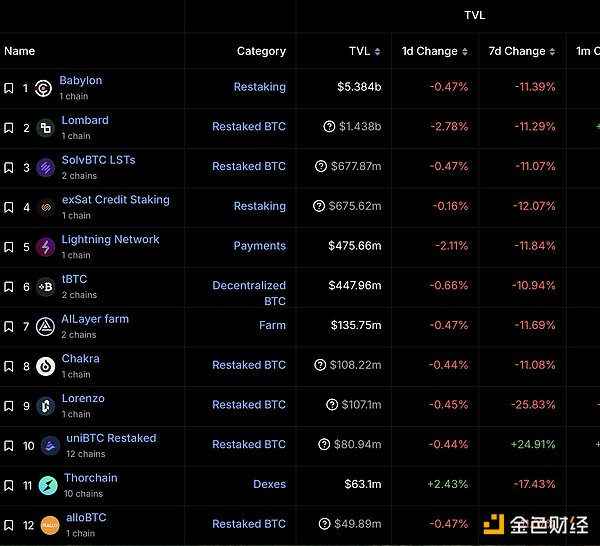
Jessy, Golden Finance With the gradual clarification of virtual currency regulations in the US, DeFi has also become one of the main lines of this bull market. Currently, what people are talking about is DeFi under US regulation, more referring to RWA, US dollar stablecoins, PayFi, etc. with actual assets on the chain. These practices are generally based on Ethereum and its second layer, or some new high-performance public chain. It seems that the only relationship between all of this and Bitcoin is encapsulated bitcoins to participate in financial activities on the chain. In order to change the awkward situation where only encapsulated bitcoins could participate in on-chain finance, BTCFi came into being. The so-called BTCFi refers to financial service platforms and agreements built around Bitcoin and its ecosystem, combined with decentralized financial technology, to expand the financial function of Bitcoin. Specifically, this allows Bitcoin itself to participate in on-chain financial activities, and the originally poor Bitcoin smart contract function has been enhanced. The Bitcoin ecosystem also has more complex DeFi protocols such as centralized exchanges similar to other public chains, overcollateralized stablecoins, and re-staking. Moreover, in addition to BTC itself, some BTC ecosystem related assets, such as inscriptions, runes, RGB++, etc., also participated in DeFi-related activities. According to DeIllama data, BTC's total TVL is currently 6.545 billion US dollars, while Solana's total TVL is 8.297 billion US dollars, and Ethereum's total TVL is 68.31 billion US dollars. As can be seen, BTCFi is still a blue ocean and has high potential for development. Currently, star projects such as Babylon have sprung up on BTCFI. The project mainly allows users to stake bitcoins on another Pos blockchain and receive benefits by introducing a Bitcoin staking agreement without using third-party hosting, bridging solutions, or packaging services. Other than that, what other projects are worth watching? The overall development of BTCFI According to DeIllama data, the total TVL of the representative projects of the BTCFI circuit, such as Babylon, has exceeded 5 billion US dollars. Among them, borrowing and repledge agreements are two core components of the BTCFi ecosystem and occupy the largest market share. BTCFi protocol TVL ranking (data as of December 24, 2024) According to DeFiLama's forecast, the BTCFi market will grow to around $1.2 trillion by 2030. This year was a year of rapid development of the BTC ecosystem. At the beginning of 2024, the overall TVL of BTC was 300 million US dollars, and by the end of 2024, it had reached 6.5 billion US dollars, an increase of more than 20 times. In the BTCFi circuit, lending protocols are one of the most important applications. Traditionally, Bitcoin, as a digital asset, does not participate in the lending market. However, the BTCFi protocol allows Bitcoin to be used as collateral for decentralized borrowing. Typical projects include Liquidium, Shell Finance, etc. Then there is the stablecoin agreement. The stablecoin protocol in BTCFi uses Bitcoin and its derivatives (such as Ordinals and Rune) as collateral to issue stablecoins linked to the price of Bitcoin. In terms of stablecoins, there are Shell Finance's bitcoin-linked stablecoins, Babylon's stablecoins that use Bitcoin as collateral, etc. The re-staking mechanism is also an innovation in the current BTCFi ecosystem. This year, these projects have also achieved significant results in terms of hedging volume, and there are currently quite a few re-staking agreements in the BTCFi ecosystem. Users can restake bitcoins or other crypto assets that have already been pledged to receive additional rewards. For example, Bounce Bit and the Lombard Protocol in the Babylon ecosystem are all protocols that support re-staking. The leading BTCFI project introduced Babylon mentioned BTCFI. Babylon must be a project that is hard to ignore. This is the first project in the industry to introduce Bitcoin's own standard staking. It is essentially a staking, security, and liquidity agreement. The main innovation is the introduction of Bitcoin's own standard staking. Technical upgrades achieved through Bitcoin improvement proposals, such as Schnorr signatures, Taproot upgrades, and Tapscript updates, have improved the efficiency and privacy of staking transactions, and enabled Bitcoin holders to self-host without the need for third party hosting...

605d agoAlvin Liu#BTCFi #DeFi
Alipay's homepage is now being promoted by crypto funds. Will the mainland “lift the ban”?

Alipay's homepage is now being promoted by crypto funds. Will the mainland “lift the ban”?

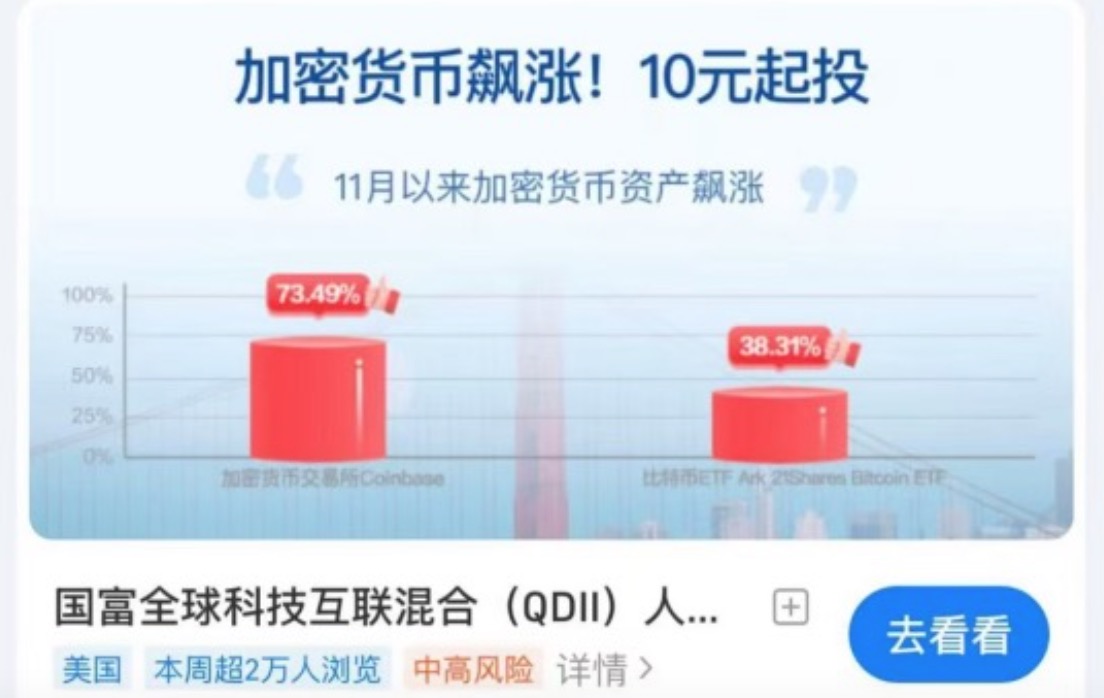
The year-end market once again focused on the actions of the Federal Reserve. The market was eagerly awaiting it, but Alipay, at this point, brought a bit of shock to the industry. The news had ups and downs, and after a series of pins and repairs, Bitcoin has finally returned above $100,000. The year-end market once again focused on the actions of the Federal Reserve. The market was eagerly awaiting it, but Alipay, at this point, brought a bit of shock to the industry. On December 12, according to Wu's blockchain report, community users reported that recently, some mainland Chinese users received a cryptocurrency fund promotion advertisement on the Alipay Fund homepage. The content showed “Global investment and cryptocurrency soared, starting at 10 yuan, and immediately on the bus.” After verification, the fund is Huabao Overseas Technology C (QDII-FOF-LOF). The fund has a limited amount mechanism and is limited to purchases of RMB 1,000 per person per day. After receiving this news, the author also went to Alipay to check it out, but the recommendation mechanism was unclear. The author did not receive promotion on this page, but another colleague found an advertisement for crypto funds on the “Global Investment” interface in Alipay's fund section. In addition, Huabao's products are sold normally on various fund sales platforms in the industry other than Ant Wealth, and Wealth Connect, CMB, etc. also have related displays. The crypto fund also seems to be more than just Huabao Overseas Technology Class C; the interface also recommends Guofu Global Technology Connectivity Hybrid (QDII). The move quickly sparked a buzz in the industry. Does this mean the liberalization of the mainland? Further analysis of Huabao and Guofu revealed that both belong to QDII, that is, qualified domestic institutional investors. QDII is a system that China began implementing in 2006. It refers to an arrangement that allows domestic institutions to invest in marketable securities investment businesses such as stocks and bonds in overseas capital markets, established within a country under conditions where RMB capital projects are not exchangeable and capital markets are not open, with the approval of relevant departments and controlled areas. In other words, due to China's strict foreign exchange management system, domestic investors cannot directly invest in overseas capital markets, but through the establishment of QDII, domestic investors can use this as a medium to invest in overseas markets. The two major crypto funds can lay out overseas assets this time, and it is precisely because they have been granted this qualification. After Huabao Overseas Technology C, in addition to QDII, there is also the word FOF-LOF. FOF refers to a fund whose main investment target is a fund. LOF means that in addition to purchasing and redemption operations at fund sales institutions, investors can also trade at market prices on stock exchanges. As a result, Huabao Overseas Technology C is an open-ended fund that can be traded on exchanges and invested in overseas funds. The form is a matryoshka; in reality, it is also a matryoshka; it's just a matter of putting on the shell from the retail side up. In summary, domestic retail investors can indirectly participate in overseas asset investment through the above model of investing in QDII funds and then using QDII funds as the main focus for overseas layout. To put it bluntly, the user invests the funds in the fund, and the fund manager then uses the funds to buy overseas assets, and the overseas assets also include crypto assets, thus completing the purchase of regulated crypto assets in a compliant manner. The disclosure report also confirms this point. According to the Huabao Overseas Technology Equity Securities Investment Fund (QDII-LOF) report for the 3rd quarter of 2024, in the investment strategy section, it is written that “the fund mainly invests in overseas technology-related funds (including ETFs), and ultimately invests in stocks that support the long-term development of enterprises.” In terms of asset allocation, the fund invests 87.5% in the fund, 8.9% in bank deposits and settlement provisions, and the remaining 3.6% in other assets in the asset portfolio. The question is, since crypto is the selling point, how much of the investment in crypto assets is in the fund? In the core fund investment business section, more detailed investment details will answer this. Among the top ten funds ranked by fair value as a proportion of the fund's net asset value, 5 are ARK ETFs owned by Sister Mu Toujie, accounting for 73.11%. If penetration continues, there are Coinbase and its own Bitcoin spot ETF Ark 21Shares Bitcoin ETF in ARK ETF's holdings. In this way, Huabao has achieved indirect cryptographic investment through a layer of match-fixing. In terms of total volume, Huabao's overseas technology investments include about 4.93% of Coinbase shares and 2.98% of Ark 21Shares Bitcoin ETF, for a total of 7.92%. The latest size of Huabao Overseas Technology C's fund is no more than 406 million yuan, and the actual investment in crypto assets is even less than sufficient. There is quite a bit of selling dog meat on the back of a sheep. Alipay...

618d agoLuxurytracy#cryptocurrency #Alipay
Read the big crypto events of the National Day holiday in one article

Read the big crypto events of the National Day holiday in one article

During the eight-day holiday, industry news continued. Golden Finance compiled the highlights of the National Day to take you through the big events and small events during the short holiday period. October 6 Policy News: Hong Kong Secretary for Treasury: Until Hong Kong officially regulates stablecoins, retail trading of Hong Kong's Secretary for Financial Services and the Treasury will not be allowed during an interview with the Investment Committee. The goal is to stabilize prices, but in the past, stablecoins have fluctuated or even collapsed. The reserve management of stablecoin issuers will affect price stability and investors' right to redeem fiat currencies. Considering these factors, until Hong Kong officially regulates stablecoins, retail trading will not be included. The Canadian Securities Authority provides guidance on crypto asset trading and issuance conditions The Canadian Securities Authority (CSA) provides guidance to exchanges and cryptocurrency issuers on what it calls an interim measure for value-referenced cryptoassets, with a particular focus on stablecoins. The statement clarified that certain cryptocurrencies that reference the value of a single fiat currency may be permitted, subject to terms and conditions. If issuers maintain proper asset reserves with qualified custodians, and cryptocurrency exchanges that provide stablecoins disclose “certain information relating to governance, operations, and asset reserves,” then CSA can allow these assets to be traded. Foreign media: The possibility that the Fed will raise interest rates again has risen to about 50%. According to foreign media sources, traders increased their bets on Friday that the Federal Reserve will raise interest rates before the end of the year. According to data previously released by the US government, the increase in jobs far exceeded expectations last month. The implicit yield increase in contracts linked to the Federal Reserve's policy interest rate indicates that the possibility that the Federal Reserve will raise the benchmark interest rate to the 5.50%-5.75% range at the December meeting is close to 50%. Before the employment report was released, traders thought the probability of a 25 basis point rate hike was about 34%. According to previous news, the full pricing of the Federal Reserve exchange market will be postponed from July next year to September next year. People familiar with the matter: US regulators are considering penalties against Voyager's former CEO, people familiar with the matter said that investigators at a key US regulator have concluded that the co-founder of Voyager Digital Ltd. violated derivatives regulations before the failed cryptocurrency lending company went bankrupt last year. After investigating Voyager's actions, staff at the US Commodity Futures Trading Commission (CFTC) law enforcement agency internally recommended that the agency accuse former Voyager CEO Stephen Ehrlich of misleading customers regarding the safety of their assets. People familiar with the matter said the CFTC committee is now voting to decide whether to take enforcement action against Stephen Ehrlich within a few days. Singapore will set up an interdepartmental committee to re-examine the anti-money laundering system Singapore will set up an interdepartmental committee to re-examine the anti-money laundering system with regard to the biggest money laundering case recently discovered in Singapore. The Monetary Authority of Singapore and other agencies will appoint relevant persons to participate in the committee. Singapore's Ministry of Finance and the Second Minister of National Development will serve as the chairman of the committee. According to reports, the next step in Singapore is to re-examine the anti-money laundering system from the perspective of foreigners purchasing and holding local real estate; corporate entity registration and operation. It was previously reported that on October 3, the total value of assets seized or frozen by the Singaporean authorities in the largest money laundering case in the region was further extended to S$2.8 billion (equivalent to US$2 billion). These assets include 152 properties, 62 cars, thousands of bottles of alcohol, cryptocurrencies, gold bars and jewellery. At the same time, the government indicated that immigration regulations may be tightened to curb the inflow of illegal funds. The US Treasury updated the sanctions list, including the digital wallet addresses of 5 individuals and 1 company The US Treasury's Office of Foreign Assets Control (OFAC) added another batch of personal and corporate cryptocurrency wallets to its Specially Designated Nationals (SDN) list on Tuesday. These wallets are all linked to illegal fentanyl trade. Currently, 6 entities and their digital wallet addresses have been flagged by the government, including 5 individuals and 1 company — Valerian Labs. In OFAC's operation, a total of 17 wallet addresses were identified, covering networks such as Bitcoin, Ethereum, and Tron. Most illegal transactions on the latter two blockchains are received via stablecoins. With the exception of Valerian Labs, all five people's wallets are hosted on the same centralized cryptocurrency exchange, where they each receive...

1050d agody zhang#Alphanonce #Arbitrum #Avalanche #CFTC #DAO5 #F.Actor and Superhero Capital #Foresight Ventures #FTX #Nomad Capital #optimism #Polygon Ventures #SBF #Symbolic Capital #Uniswap #USDC, ETH #WEB3 #Yuga Labs #cryptocurrency #blockchain #Golden Finance
Last week before the holiday, focus on the Arbitrum Odyssey restart and FTX claims

Last week before the holiday, focus on the Arbitrum Odyssey restart and FTX claims

Take a look at the most notable industry events and important project developments in the coming week. This week (September 25 to October 1), the Taiwan Monetary Authority will announce 10 guidelines for virtual currency regulation. FTX debtors must submit proof of customer claims. Here is a week of exciting news about major Web3 events not to be missed: The Taiwan Monetary Authority is expected to announce 10 virtual currency supervision guidelines by the end of September. The Ethereum testnet Holesky will restart on September 28th. Arbitrum will relaunch the Odyssey event. FTX debtors are required to submit proof of customer claims. The Global Al & Web3 Investment Summit “The EDGE” will be held in Hong Kong. Key Events Key events to focus on this week include the development and impact of global virtual asset policies and important developments in the FTX incident. The Taiwan Financial Management Council is expected to announce 10 guidelines for virtual currency supervision at the end of September. The 10 proposed guidelines include strengthening information disclosure, requiring operators to set screening standards, separating and storing assets between platforms and customers, and stipulating that individual coin dealers should also implement anti-money laundering prevention measures. One of the key restrictions is that foreign cryptocurrency companies are strictly prohibited from illegally soliciting business. If foreign VASPs fail to register in accordance with the Company Law and state to the HKMA that they abide by anti-money laundering regulations, they must not solicit business within Taiwan or from domestic residents. The HKMA said it will not be ruled out that a special law will be set up for virtual currency in the future. Before there is a special law, the HKMA will manage virtual asset operators in accordance with the “Money Laundering Prevention Law”. If the operator does not make a legal compliance statement on money laundering prevention, the HKMA will require the other party to make improvements; otherwise, it will use the Money Laundering Prevention Law to punish them. The fine will jump from 500,000 yuan to a maximum of 10 million yuan. According to data disclosed by the Taiwan Financial Services Council on September 10, 52 virtual currency platform operators are planning to join the Taiwan market. Of these, 25 (2 of which are foreign Taiwanese branches) have completed legal compliance statements to prevent money laundering, and another 27 are in the process of complying with them. Additionally, several major crypto exchanges such as Coinbase and Bitstamp may shut down services in some regions this week due to policy reasons: Coinbase plans to stop providing services to Indian users after September 25 and advises users to withdraw all funds in their accounts; Bitstamp will stop providing staking services to US users on September 25; Binance's fiat partner Paysafe will no longer be on Binance from September 25, 2023 Users provide euro deposit and withdrawal services; Bybit will suspend its operations in the UK from October 1. Financial payments giant PayPal is also temporarily suspending cryptocurrency purchase services in the UK from October 1, 2023. The requirement is due to the introduction of new rules by the UK Financial Conduct Authority (FCA) that require cryptocurrency companies to implement additional steps before customers can buy cryptocurrencies. The UK's cryptocurrency financial promotion rules came into effect on October 8. The regulations have stricter rules for cryptocurrency service companies. Many UK crypto-related companies will adjust their crypto-related services to meet regulatory requirements before that date. In addition to regulatory policies, it's important to note this week that FTX debtors are required to submit proof of customer claims by 16:00 EST on September 29 (4:00 Beijing time on September 30). According to an investigation report released by FTX debtors, FTX owes customers approximately $8.7 billion, and FTX's assets are approximately $7 billion, including FTX's 38 properties in the Bahamas, nearly $2.6 billion in cash, and $3.4 billion in cryptocurrencies. Previously, the court sold, pledged, and hedged its cryptocurrency holdings through FTX to return funds to creditors in the form of fiat currency instead of Bitcoin or Ethereum. This includes around $1.2 billion in SOL tokens, $5.6 billion in Bitcoin, and $192 million in ETH. Project progress The Ethereum test network Holesky will restart on September 28. Previously, the Holesky network failed to restart on September 15. Neth...

1062d agody zhang#Arbitrum #FTX #NFTs #WEB3 #Ethereum #Binance #pays #Project progress
IOSG Weekly Brief | Is DeFi Credit Rating Agreement Making DeFi Explode on a Massive Scale? #171

IOSG Weekly Brief | Is DeFi Credit Rating Agreement Making DeFi Explode on a Massive Scale? #171

Part.1 Will the InsightDeFi Credit Rating Agreement cause DeFi to explode on a large scale? Author: Yiping, IOSG Ventures This article is iOSG's original content. Solity and Arkhivist, the projects mentioned in the article have interests related to Solity and Arkhivist. As seed investors, readers are requested to maintain objectivity, carefully screen the information, and analyze objectively when reading this article. It does not constitute any investment reference. If you need to cite, please indicate the source. For reprinting, please contact the IOSG team for authorization and reprinting instructions. Special thanks to the IOSG Ventures R&D and post-investment team for their hard work! Foreword Web3 security flaws pose a major threat to the Web3 ecosystem. According to Chainalysis data, smart contract security issues have caused $3.8 billion in losses. The chart below shows the growing number of Web3 hacking attacks. Decentralized finance (DeFi) covers a variety of risk categories, including: Financial risk: These risks involve the financial stability of DeFi protocols, such as bad debts or extreme market fluctuations in lending agreements affecting the stability of the protocol. Smart contract risks: These risks involve bugs in smart contracts used by DeFi protocols. Off-chain security risks: DeFi protocols don't just include smart contracts; other network infrastructure or applications can also be compromised, including phishing attacks or mnemonic leaks. Specific examples of DeFi risk include: Financial Risk → Liquidity Risk: These risks involve the ability of users to trade assets on specific exchanges or platforms. In DeFi, liquidity risk can occur due to insufficient trading volume or locked funds. Smart contract risk → Oracle risk: These risks involve the manipulation of oracle data, leading to inaccurate prices or other issues. Off-chain security risks → Fund escrow risks: These risks involve losing access to funds due to private key storage or security issues. Smart contract risk → Smart contract upgrade risk: When a smart contract upgrade goes wrong, it may cause loss of funds or other problems. What is currently best known is that smart contract risks cause security issues in DeFi, but financial risks can lead to even greater losses. Take bad debts in a loan agreement, for example. In agreements like Compound, an account is considered unpayable when the loan amount is greater than the total collateral value in dollars. If the account exceeds the collateral limit, it is usually liquidated by a third party (such as a robot), and the user loses the collateral to repay the debt. However, if the liquidation is not carried out in a timely manner, the collateral sold may not be sufficient to cover the debt, leading to an increase in bad debts within the agreement. This situation may pose a risk to the agreement and the lender. If there are more outstanding debts than collateral that can be covered, the borrower may not be able to withdraw all of the funds and the entire system is at risk. Under these circumstances, bank overcrowding can easily occur. Venus is an example. On May 8, the Collateral Factor (Collateral Factor) was raised from 60% to 80%, leading to an increase in XVS collateral borrowing. On May 18, the price of XVS suddenly rose from $80 to $145, prompting borrowers to sell XVS at a profit. This led to a sharp drop in the price of XVS, triggering liquidation and causing Venus more than $100 million in bad debts. Choosing the right collateral factors and collateral assets is critical to the security of a loan agreement. https://quillhashteam.medium.com/200-m-venus-protocol-hack-analysis-b044af76a1ae解决方案许多项目正在解决 Financial risk in the DeFi sector, a key area in the Web3 world. They provide products for institutional investors and agreements to help them understand potential risks and manage products in extreme markets. The three main areas of research include: Risk Dashboards Simulate Credit Ratings Several projects are suitable for these three solutions: Risk Dashboards Risk dashboards are the main solutions in the DeFi world, and valuable data is often overshadowed by noise. While market data such as trading volume, TVL, and market capitalization are easy to obtain, liquidation data and bad debt data are harder to track. Developers need to build databases to monitor the core risk factors of DeFi projects. Commonly tracked data includes: collateral ratio, risk collateral, total collateral supply and loan settlement amount, and event agreement...

1215d agoIOSG#IOSG