Daniel · 676

Citibank: Lowers short-term expectations for the US dollar

Comparing news, Citigroup's monetary strategists have recently turned bearish on the US dollar because the market is preparing for the weakening of the hawkish position of the Federal Reserve, midterm elections, and the expansion of debt buybacks by the US Treasury. Citi strategists led by Daniel Tobon wrote in a research report on Thursday that the team lowered the dollar index forecast for the next three months from 102.12 to 98.34. The shift came after the bank issued a warning: US Treasury Secretary Scott Bessent's latest move to lower long-term borrowing costs — expanding the repurchase scale of 10-30 year treasury bonds — could come at the cost of a weaker dollar. The day before, the US dollar index fell to its lowest level since May, then remained basically flat at 98.9. Tobon and others said their stance on the US dollar has been more neutral in recent months, and warned that risks may rise in the coming months.
2d ago

AI is approaching superhuman mathematical ability, and the world's top mathematicians worry that the value of human research will be weakened

Comparing news, about 40 of the world's top mathematicians recently held a meeting at the San Francisco OpenAI office to discuss a controversial question: when artificial intelligence surpasses humans in mathematical research, what role will mathematicians play in the future. Daniel Litt, a professor at the University of Toronto, proposed extreme ideas at the conference. In the future, high-quality mathematical research may disappear and human mathematical expertise will gradually be lost. He said that although this outcome is not the most likely, the math community must adapt to the changes brought about by AI as soon as possible. Mathematics is considered to be one of the first subjects to be impacted by AI research capabilities. Recently, OpenAI announced 10 mathematical and computer science achievements generated or assisted by AI, covering a number of research fields that usually require years of training to master. OpenAI mathematician and Fields Medal winner Jacob Tsimerman said AI could soon reach a level that steadily surpasses humans in the field of mathematical research. He recently announced that he will join OpenAI to participate in AI security-related work. In recent years, AI has begun to produce some groundbreaking mathematical results. In May of this year, an OpenAI model that had not been publicly released proposed an example of refuting unit distance conjectures. The results were considered by some mathematicians to have reached a level where they can be published. At the same time, Anthropic researchers also used Claude to complete research on high-dimensional mathematical problems. However, the mathematical community is still divided over AI replacing human researchers. Some experts believe that AI can generate proofs, but it doesn't necessarily really understand mathematical concepts. Harvard mathematician Melanie Matchett Wood points out that it is still difficult for top AI models to accurately explain the key difficulties in the proof. Northwestern University mathematics professor Bryna Kra said that math isn't just about getting answers, it's more about understanding results. A proof that isn't understood doesn't really become part of the mathematical literature. At the same time, some researchers believe AI may be a tool for mathematicians rather than a replacement. OpenAI research scientist Sébastien Bubeck said that future mathematics may be similar to software engineering, where AI helps a large number of researchers collaborate to solve complex problems; it may also be similar to physics, driving larger scientific exploration through AI models. As AI continues to break through in scientific research, mathematicians are facing a new era of proposition: whether future mathematical research will be co-created by humans and AI, or whether it will gradually become machine-led.

3d ago

IREN Co-Creation: New AI data centers will further boost AI demand, making infrastructure supply difficult to keep up

Comparing news, Daniel Roberts, co-founder and co-CEO of IREN, wrote that every new AI data center will further increase rather than decrease AI demand. He believes that comparing the current AI infrastructure cycle with the technological boom in the past ignores that stronger AI itself requires more computing power, while cheaper AI will also bring more usage. Roberts points out that every power shift in AI creates new application scenarios that didn't exist a year ago, so demand can grow at the rate of software development, but supply cannot do that. The expansion of computing power supply depends on access to electricity, transmission lines, concrete, steel, and a large number of construction workers, and its growth rate is limited by real-world infrastructure. He said that in the past technological boom cycle, technological progress was often able to help supply catch up with demand, but this time, technology itself is driving demand to grow exponentially, and the pace of real world construction cannot keep up fast enough.

6d ago
From crypto to AI: Why are believers turning collectively?

From crypto to AI: Why are believers turning collectively?

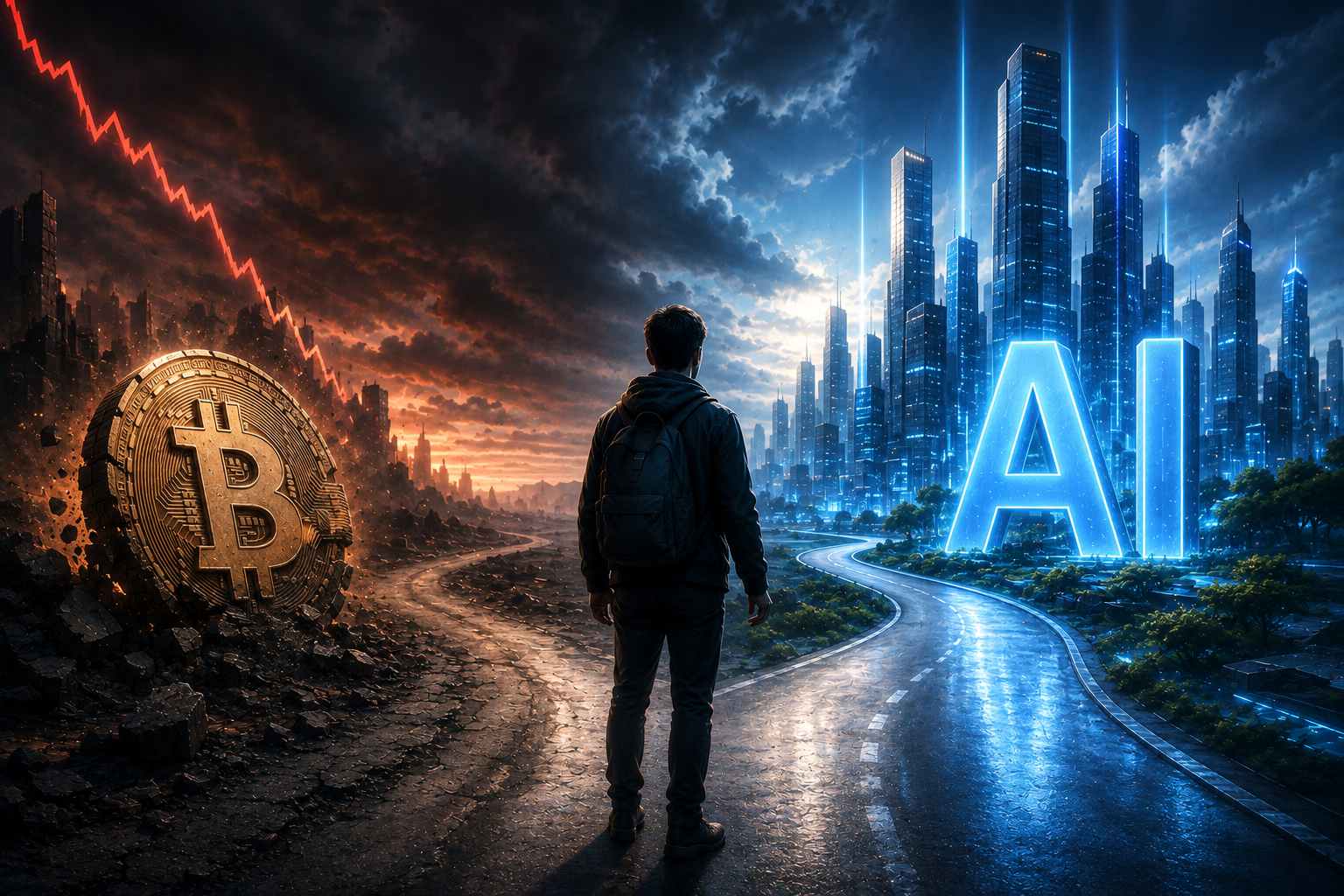
Source: Wall Street Journal Author: Vicky Ge Huang Compiled by Chopper Original title: Why are cryptocurrency believers “throwing coins into AI”? Summary: Individual investors are withdrawing from the cryptocurrency market and switching to AI stocks. Daniel Koss, a 30-year-old investor, cleared Bitcoin and invested all of them on the AI circuit; Ryan Ho, the founder of the social networking platform, also replaced his seven-digit Bitcoin holdings with chip stocks, believing that the structure of the crypto market is weakening and the AI application scenarios are more realistic. Another trader, Minh Le, cashed out some of his crypto assets to buy Ferraris and anime collectibles. Although he recently re-entered the market, his strategy is conservative. Bitcoin fell from a high of $126,000 to around $60,000, decoupling from the trend of US stocks, while AI stock derivatives launched on platforms such as Hyperliquid also boosted capital migration. Bloomberg analysts say the crypto market is undergoing a deep clean-up, and investors believe that the era of Bitcoin's high-multiple growth is over. Daniel Koss has bought Bitcoin in a big way, and he is convinced that cryptocurrency will reshape the financial industry. But after the advent of the AI boom, he changed his investment direction. The 30-year-old investor believes that rapidly developing artificial intelligence technology has the potential to disrupt many industries, so he entered the market decisively. In August of last year, he cleared his six-digit Bitcoin holdings, and now all of his money is invested in the artificial intelligence circuit. “It felt like primitive humans discovered Tinder.” Koss, who is in Zug, Switzerland, said. Koss's position adjustment choice reflects the major capital migration that has taken the entire market by storm over the past year: individual investors and hedge funds have successively sold Bitcoin and various tokens to chase AI stocks. This asset rotation also explains Bitcoin's price dilemma: since it hit an all-time high of over $126,000 in October last year, Bitcoin has continued to be under pressure and has been hovering around $60,000 for a long time. At the time, the Trump administration threatened to impose new tariffs on China, triggering investors to sell high-risk assets. At the same time, chip makers and other AI concept stocks have broken out of the boom that only existed in the crypto market in the past. Bloomberg Industry Research Advanced Commodity Strategy Mike McGlone said, “The crypto market is undergoing a round of deep clean-up, and this is just the beginning.” The US stock market continued to hit new highs this year, yet Bitcoin continued to weaken. Koss has no plans to re-trade Bitcoin anytime soon. In his view, crypto assets have matured, and the era of exponential skyrocketing surges is over. He believes that Bitcoin will never increase tenfold in a year. “Bitcoin is already so large that even doubling it would be extremely profitable.” Even staunch crypto believers are reducing their crypto holdings and turning to volatile AI stocks. Ryan Ho, founder of the social trading platform Legend, revealed that when the price of Bitcoin was close to $120,000, he held a seven-digit Bitcoin position. At the time, he was convinced that Bitcoin “will never fall below $100,000 again.” However, the market backfired. In December of last year, he swapped a large number of bitcoins and altcoin holdings to buy AI-related stocks such as chip companies, including Intel. Currently, he still holds hundreds of thousands of dollars in Bitcoin. Ryan Ho, a 25-year-old entrepreneur, said that the core reason for the reduction in crypto assets was the structural weakening of the crypto market. In his view, after the sharp decline in October, the crypto market no longer has the characteristics of a health-risk asset: demand for buying has dried up, and institutional capital continues to flow to the AI sector. The crypto market then decoupled from the trend of US stocks. US stocks continued to rise, and the crypto market stagnated. Ryan Ho believes that ordinary investors are more likely to be optimistic about the growth prospects of AI. Artificial intelligence has a large number of real implementation scenarios such as ChatGPT and AI-assisted programming. Another driving force behind the shift of capital from crypto to AI is the launch of AI stock derivatives on mainstream crypto trading platforms such as Hyperliquid. “A large number of crypto traders have started trading AI stocks in the past few months, and the core reason is that related trading channels have been opened up.” Ryan Ho said. There are also some crypto traders who chose to settle the bag and end the previous round of sharp increases in Bitcoin and mainstream tokens. Trader and digital artist Minh Le recently monetized some of his crypto assets to buy a Ferrari, while also allocating a large amount of profit to a Japanese anime collection, including “One Piece” and Pokémon collectible cards. Minh LeMinh Le relies on...

8d ago22#AI #Bitcoin

Analysis: The AI bubble may burst or cause capital to be withdrawn from US stocks and US debt at the same time

Comparative news. According to the Golden Ten report, Bank of England's analysis shows that if the AI stock bubble bursts, the impact may spread to the UK, affecting stock prices, British Treasury yields, and the corporate credit market. The Bank of England said in a blog post that if the profits of large US technology companies fall short of expectations, investors may view it as a reduction in the future productivity prospects of the US and withdraw from US assets as a result, rather than seeking safe haven from US assets. This could weaken the dollar and weaken a factor that buffered economies such as the United Kingdom in the past when financial markets were under pressure. Daniel Ostry of the Bank of England's global analysis department and others wrote, “If expectations of artificial intelligence to drive productivity are not met, investors may withdraw from the US bond and stock markets at the same time.” They said, “This will be in stark contrast to typical stress scenarios such as the 2008 global financial crisis,” when investors sought safe haven assets to strengthen the dollar. This has played a supporting role for Britain. On the one hand, it has enhanced the competitiveness of British exports, and on the other hand, it has also increased the value of the British pound of dollar-denominated positions.

9d ago
Silicon Valley's new gang takes shape: AI giants are mass-manufacturing founders

Silicon Valley's new gang takes shape: AI giants are mass-manufacturing founders

By David, Deep Wave TechFlow Original title: Silicon Valley's New Gangster: OpenAI and Anthropic Are Mass Manufacturing Founders Silicon Valley hasn't used the term “Mafia” (Mafia) collectively for a long time. The last time was over 20 years ago. In 2002, eBay spent $1.5 billion to buy PayPal, and a group of young people who had experienced the company's 0 to 1 overnight wealth freedom and then scattered. Everyone knows the story later. Musk did Tesla and SpaceX, Peter Thiel did Palantir, Hoffman did LinkedIn, Chen Shijun and Karim did YouTube... they called the PayPal gang in Silicon Valley. Gangster isn't derogatory; it's a certification that certifies that you came from that winner and that you have the ability to create another winner. This word has been dormant for a long time. The conditions it requires are too stringent. A company that can win enough, a centralized distribution of wealth, and a group of people who have seen the world and haven't been smoothed out yet. Google didn't spawn gangsters, nor did Meta. Until recently, it began to be used frequently by another group of people. People who left OpenAI and Anthropic. Half of 2026 has just passed, and there are people who have left these two leading AI companies and turned over to start new companies, so many can make a long list: Jerry Tworek, the former vice president of OpenAI research, founded Core Automation, former Anthropic researcher Behnam Neyshabur and others formed Mirendil. Among the researchers who just left, some did verifiable mathematics, some did AI that really belonged to them, and others wanted to start an AI that really belongs to them Reinventing PCs at the hardware level... this path has already been crossed once before. Anthropic itself was founded by people who left OpenAI five years ago, and is now valued at 380 billion US dollars, making it the biggest rival of the old owner. The list is still getting longer. These runaways are all using their expertise to prune the leaves of the big tree of AI. When the gang starts looking at a question outside of the big model first. Why are almost none of the people who left OpenAI and Anthropic in 2026 making big models? The answer is realistic, because there is no place on the backbone anymore. Training a cutting-edge model can easily cost several billion dollars. OpenAI, Anthropic, and Google themselves are fighting hand in hand, and entering the startup head-on is tantamount to death. But the stronger the model, the larger the open space around it. Today's models are smart enough, so smart that the bottleneck in the industry is no longer “will it or not”. This group of runaways, when you get together, you'll find that they are actually writing articles about “work” and using their expertise to expand where the model's reach has not yet been extended. For example, can AI actually fall to the job level? The work is done, and believing it or not has become a problem again. I can trust it, it doesn't matter if it's a problem. Big companies can't take care of these layers of trouble, and some of them aren't suitable for them to answer on their own. Almost all of the companies on this 2026 list grew on these few open spaces. One of the most radical open spaces is for AI to research AI on its own. Jerry Tworek, the former vice president of research at OpenAI, and several colleagues founded Core Automation to be an automated research lab where models can read papers, make hypotheses, and run experiments themselves. The judgment behind it is quite ruthless. The bottleneck in AI progress is no longer an algorithm; it is manpower for research. Mirendil, founded by former Anthropic researcher Behnam Neyshabur and others, has just taken $200 million to create another extension of the same logic, a self-accelerating system that allows the model to participate in improving the model itself. The role of humans has been reduced from being the subject of research to being a supervisor. The work was done, and a new problem followed, which was how to confirm that it was done right. As a result, another open space focused on AI trustworthiness. In most fields, verifying an answer given by an AI is far more expensive than generating an answer. Math Inc focuses on this most expensive part. Jesse Han, a former OpenAI researcher, left to found it. The goal is to turn mathematical proofs into a form that machines can verify line by line. Math is one of the few right and wrong things that can be thoroughly checked...

12d agoburnking#AI #Anthropic #OpenAI

Robinhood GC Daniel Martin Jr cuts stock holdings by more than $900,000

Comparative news, according to information released by the SEC, Robinhood (HOOD) GC Daniel Martin Jr sold 10,000 shares of the company on August 3 at an average price of 90.42 US dollars per share, with a total value of about 9042 million US dollars. After the transaction was completed, its direct holdings fell to 461,396 shares.

16d ago
Retail investors flee and foreign investors take over, when will the decline in Korean stocks end?

Retail investors flee and foreign investors take over, when will the decline in Korean stocks end?

Author: Wenser Original title: Soaring 20% and falling 5%. When will the decline in Korean stocks bottom? After experiencing a violent rebound of about 20% last Friday, the KOSPI index of Korean stocks closed down 5% today to an interim report of 6257 points. At the same time, various changes facing the Korean stock market have gradually surfaced: on the one hand, the liquidated account set a record of 500,000; on the other hand, it is a safe-haven operation where more than 24 trillion won was returned from the stock market to banks. Against the backdrop of South Korean President Lee Jae-myung's approval rating reaching a new low and South Korea's financial supervisory authorities taking frequent action, the next step in Korean stocks has become the focus of attention of Korean shareholders and the global capital market. After all, South Korea has 2 giants in the semiconductor industry under the AI boom. Is the stock market losing blood and continuing to decline, or is it regulatory action that favors the stimulus? At least for now, the downturn in Korean stocks is far from over. The sad state of the Korean stock market: Over 500,000 leveraged retail investors have burnt out their positions, and the scale of investment deposits has shrunk by more than 35 trillion won. In the previous article “Korean Stocks Fused 7 Times During the Year: Midsummer When Young People Were Destroyed by Leverage,” we used the true stories of several Korean shareholders as an opening to unravel the truth about the bloody wave of the Korean stock market this summer. However, after nearly half a month of continuous decline and occasional rebound, various data shows that the Korean stock market is currently losing blood: on the one hand, retail investors who don't have enough “chives” are bursting out; on the other hand, it is a reduction in the size of investment deposit funds and an expansion of bank savings funds. Goldman Sachs data: Over 500,000 Korean leveraged retail accounts may have been completely liquidated. On July 30, The Kobeissi Letter, a well-known financial account on the X platform, published an article stating that according to Goldman Sachs data, as of July 13, more than 1.2 million leveraged retail trading accounts in South Korea had triggered additional margin notices. It is estimated that between 320,000 and 360,000 accounts have been completely liquidated, accounting for about 3.4% of the Korean adult population (Odaily Planet Daily Note: Equivalent to every 30 (There is a possibility that only 1 adult in Korea will close a position). With the cumulative decline of the Korea Composite Stock Price Index (KOSPI) of about 18% since July 13, it is estimated that the number of accounts that have been completely liquidated at that time has exceeded 500,000. Despite the violent rebound in the KOSPI Index of Korean stocks and individual stock prices such as Samsung and Hynix on July 31, countless accounts that have gone out of business have forever become dust in the history of Korean stocks. Korean stock “capital flow back to banks”: Over 24 trillion won in time deposits with the five major banks due to adjustments in the semiconductor sector and stricter regulations on leveraged investment, capital to be invested in the Korean stock market was rapidly withdrawn, and the market experienced a “reverse capital migration” phenomenon. According to the data, as of the end of July, the time deposit balance of the five largest banks in Korea (KB Kookmin, Shinhan, Korea Asia, Woori, and NH Nonghyup) reached 973.49 trillion won, an increase of 24.09 trillion won over the end of the previous month, the biggest increase in a single month since the end of the previous month. Capital around the stock market also showed a marked contraction. According to data from the Korea Financial Investment Association, investors' securities account deposits (funds to be invested in stock transactions) reached a record high of 139.69 trillion won on June 4, but as of July 28, they had fallen to 107.20 trillion won, a decrease of more than 32 trillion won in less than two months. The credit transaction financing balance representing the scale of market financing transactions fell to 33.19 trillion won during the same period, a decrease of about 4.5 trillion won from the peak of 37.72 trillion won set on July 2, a decrease of about 12 trillion won % The shock in Korean stocks deterred investors: Investors' deposits plummeted by more than 35 trillion won in 2 months due to the sharp fluctuation in the Korean stock index. In July, the average daily deposit of investors (Daily Planet Daily Note: Investor deposit refers to the funds investors deposit into securities company accounts to buy stocks, here is the average daily statistics) plummeted by nearly 20 trillion won from the previous month. This level is about 10 trillion won less than in March of this year (Odaily note: the KOSPI index was drastically revised due to the US-Iran conflict at the time) According to data released by the Korea Financial Investment Association on August 3, that is, the day the KOSPI Index hit a phased low, the size of investor deposits was 104.6584 trillion won. Compared to the record high of 139.6948 trillion won on June 4, it was reduced in just about two months...

19d agoburnking#RWA
The founder of Celsius was permanently banned from the crypto industry, and the 16.5 million fine may be fully deductible

The founder of Celsius was permanently banned from the crypto industry, and the 16.5 million fine may be fully deductible

Author: CryptoSlate Compiled by: Shenchao TechFlow Original title: The three founders of Celsius were permanently banned from the crypto business, and the $16.5 million fine might not have to be paid out of Shenzhen Guide: Bankruptcy and thunderstorm The three founders of Celsius were permanently banned by the FTC from engaging in core businesses such as crypto deposits, withdrawals, and trading. This ban is more lethal than the $16.5 million fine — it will follow people, and they can't escape it even if they change companies. What's even more ironic is that the fine can be deducted from money previously confiscated assets and bankruptcy liquidation by the Ministry of Justice; real money may not have to be spent at all. The co-founder of bankrupt crypto lending platform Celsius is now facing a permanent court ban from engaging in most areas of the crypto and asset services business. The FTC fixed the merger obligation for the founders at $16.5 million, although Goldstein's judgment stated that it was $2.04 million. Alexander Mashinsky and Shlomi Daniel Leon may not advertise, market, promote, offer, or distribute products or services for depositing, exchanging, investing, or withdrawing assets, or assist in such activities. Mashinsky's ban covers assets in general, while Leon's ban explicitly covers cryptocurrencies, banks, and financial assets. Both prohibitions apply when they are acting directly or through intermediaries. Goldstein's ban focuses on retail crypto businesses. He must not advertise, market, promote, or sell retail products or services used to buy, deposit, withdraw, distribute, or trade cryptocurrencies, nor assist in such sales and marketing activities. The three prohibitions also prohibit substantial misrepresentation of products and services. The ban prohibits obtaining or attempting to obtain customer information from financial institutions through false, fictitious, or fraudulent statements, including bank account details, login credentials, private keys, and wallet information. Mashinsky and Leon must also obtain explicit informed consent before disclosing consumers' non-public personal information. These restrictions are consistent with the actions the FTC alleges in the 2023 complaint. The agency alleges that Celsius is advertised as being safer than banks, promising to withdraw at any time, and advertising a yield of up to 18.63%. The FTC also alleges that the company claimed to have sufficient reserves on June 7, 2022, and froze withdrawals and transfers five days later. Celsius filed for bankruptcy on July 13, 2022. These bans will follow the founders, go beyond Celsius, and cover the assistance they provide to others. Mashinsky and Leon's ban also extends to work done through intermediaries. Over the next few years, the founders must file reports and keep records, leaving a trail for the FTC and providing the court with a basis for enforcing the injunction. The bans apply to these three founders and show how consumer protection cases have imposed lasting restrictions on marketing hosting, yield, and transactional products. Payments made through Department of Justice forfeiture and Celsius bankruptcy settlement can count towards the $16.5 million obligation. Mashinsky's $10 million obligation could be met through qualifying Department of Justice forfeiture. Leon's $4.1 million obligation and Goldstein's $201.4 million clause can be offset by payment or exemption in Celsius's bankruptcy lawsuit. Legal channels are separate but economically overlapping, and these prohibitions do not guarantee additional payments to Celsius creditors. Funds actually received by the FTC may be used for consumer compensation or related relief, and funds not used for relief will be deposited into the US Treasury. Twitter: https://twitter.com/BitpushNewsCN比推 TG Community: https://t.me/BitPushCommunity比推 TG Subscriptions:... https://t.me/bitpush

30d agoburnking#Celsius #originators

US Washington state court issues preliminary injunction against Kalshi

Comparatively, according to Daniel Wallach, the US Washington State Court issued a preliminary injunction against Kalshi, finding that the business it carried out violated the Washington State Gambling Law and was an illegal activity; and the “Commodity Exchange Act” had no right to take precedence over state-level laws.

32d ago