


Silicon Valley's new gang takes shape: AI giants are mass-manufacturing founders
By David, Deep Wave TechFlow
Original title: Silicon Valley's New Gangster: OpenAI and Anthropic are mass-manufacturing founders
Silicon Valley hasn't collectively used the term “Mafia” (Mafia) for a long time.
The last time was over 20 years ago. In 2002, eBay spent $1.5 billion to buy PayPal, and a group of young people who had experienced the company's 0 to 1 overnight wealth freedom and then scattered.
Everyone knows the story later. Musk did Tesla and SpaceX, Peter Thiel did Palantir, Hoffman did LinkedIn, Chen Shijun and Karim did YouTube...
Silicon Valley calls them the PayPal gang.
Gangster is not derogatory; it is a form of certification.Validate that you came from that winner and have the ability to create another winner.
This word has been dormant for a long time. The conditions it requires are too stringent. A company that can win enough, a centralized distribution of wealth, and a group of people who have seen the world and haven't been smoothed out yet. Google didn't spawn gangsters, nor did Meta. Until recently, it began to be used frequently by another group of people.
People who left OpenAI and Anthropic.
More than half of 2026 has passed, and the number of people leaving these two leading AI companies and starting new ones has already reached the point where it is possible to make a long list:
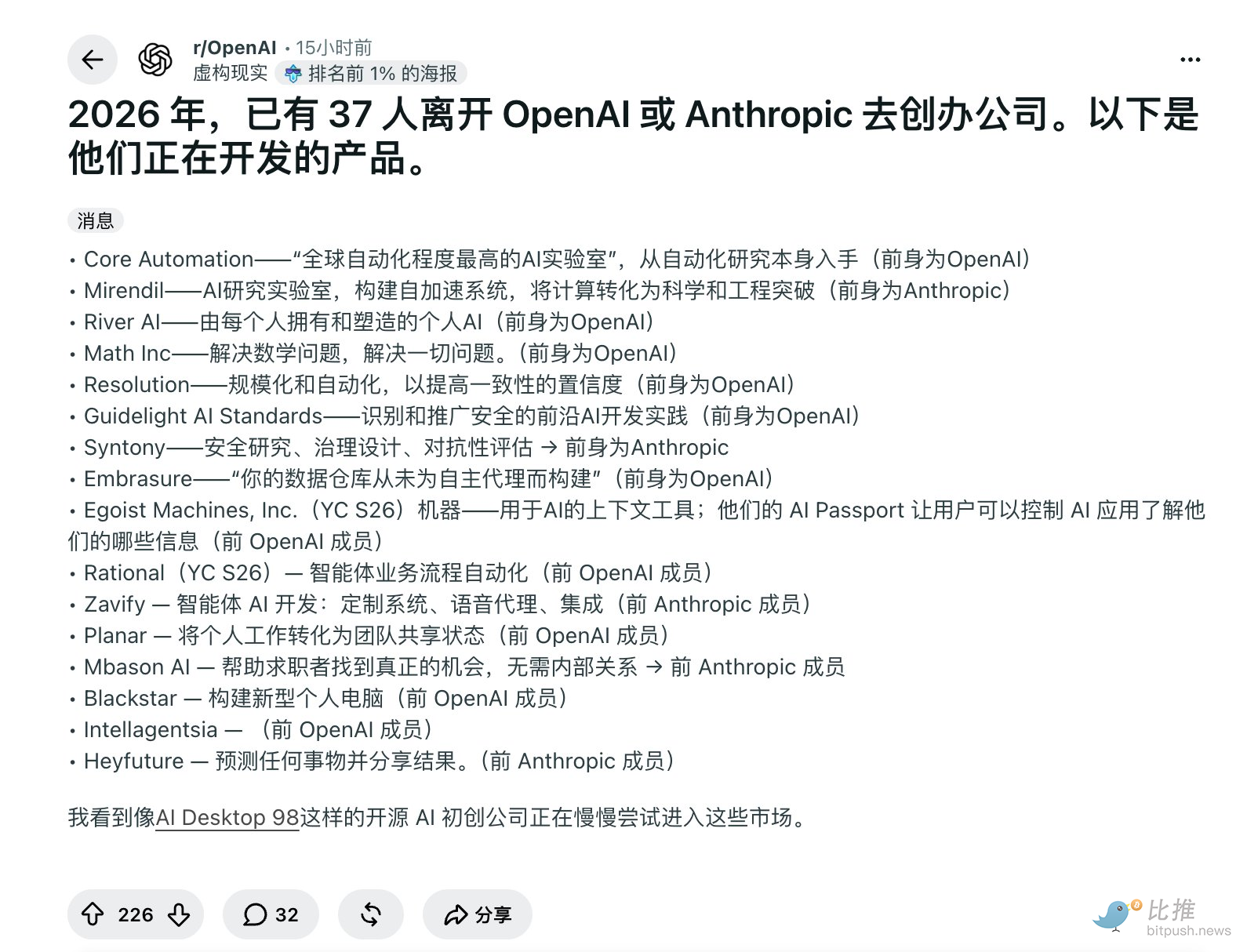
Jerry Tworek, the former vice president of OpenAI research, founded Core Automation, and former Anthropic researcher Behnam Neyshabur and others formed Mirendil. Among the researchers who just left, some did verifiable math, some did real personal AI, and others wanted to reinvent personal computers at the hardware level...
This path has already been crossed once before. Anthropic itself was founded by people who left OpenAI five years ago, and is now valued at 380 billion US dollars, making it the biggest rival of the old owner.
The list is still getting longer. These runaways are all using their expertise to prune the leaves of the big tree of AI.
When the gang starts to circle outside the big model
Let's look at a question first. Why are almost none of the people who left OpenAI and Anthropic in 2026 making big models?
The answer is realistic, because there is no place on the backbone anymore. Training a cutting-edge model can easily cost several billion dollars. OpenAI, Anthropic, and Google themselves are fighting hand in hand, and entering the startup head-on is tantamount to death.
But the stronger the model, the larger the open space around it.
Today's models are smart enough, so smart that the bottleneck in the industry is no longer “will it or not”. This group of runaways, when you get together, you'll find that they are actually writing articles about “work” and using their expertise to expand where the model's reach has not yet been extended.
For example, can AI actually fall to the job level? The work is done, and believing it or not has become a problem again. I can trust it, it doesn't matter if it's a problem.
Big companies can't take care of these layers of trouble, and some of them aren't suitable for them to answer on their own. Almost all of the companies on this 2026 list grew on these few open spaces.
One of the most radical open spaces is for AI to research AI on its own.
Jerry Tworek, the former vice president of research at OpenAI, and several colleagues founded Core Automation to be an automated research lab where models can read papers, make hypotheses, and run experiments themselves.
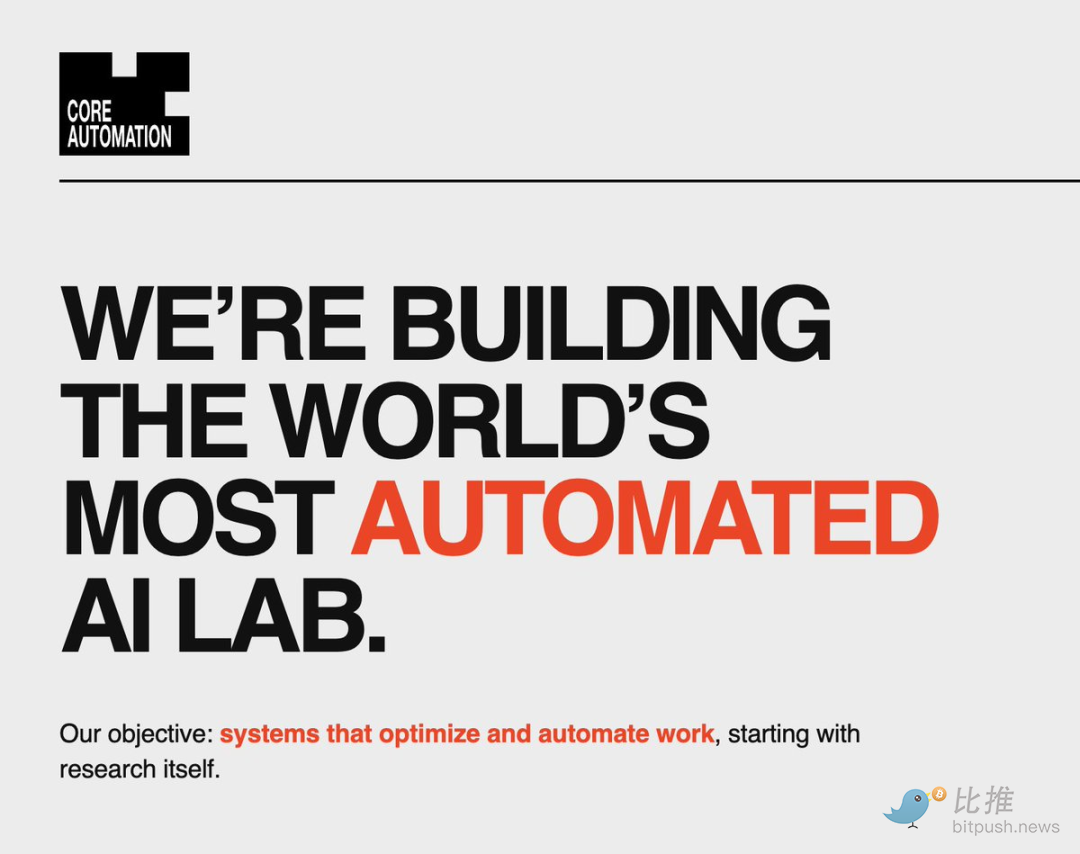
The judgment behind it is quite ruthless. The bottleneck in AI progress is no longer an algorithm; it is manpower for research.
Mirendil, founded by former Anthropic researcher Behnam Neyshabur and others, has just taken $200 million to create another extension of the same logic, a self-accelerating system that allows the model to participate in improving the model itself. The role of humans has been reduced from being the subject of research to being a supervisor.
The work was done, and a new problem followed, which was how to confirm that it was done right.
As a result,Another open space focuses on AI trustworthiness.
In most fields, verifying an answer given by an AI is far more expensive than generating an answer. Math Inc focuses on this most expensive part. Jesse Han, a former OpenAI researcher, left to found it. The goal is to turn mathematical proofs into a form that machines can verify line by line.
Mathematics is one of the few fields where right and wrong can be thoroughly tested. Only by passing the verification here is it possible to move the same ability into another industry. Waiting for AI to start making decisions for people and proving that it's right is probably more valuable than letting it do it.
Going one step further is turning cleverness into “everyday life.”
The model can answer questions, and the model can do the work for you, with a full set of dirty tasks in between, calling up tools, disassembling tasks, memorizing context, and doing one thing from beginning to end... These actually also need support from auxiliary tools.
The two companies, Rational and Zavify, are from the hands of former employees of OpenAI and Anthropic, respectively, and focus on the agent workflow to run the business process for the enterprise;
Coincidentally, Igor Babuschkin, the former co-founder of xAI, founded River AI and wanted to be an AI that truly belongs to individuals and is shaped by individuals.
There is also a different kind of person in this group. Blackstar made by Daniel Edrisian, a former OpenAI Codex engineer, simply started with hardware and wanted to build a PC redesigned for the AI era.
After all the work is done, someone always has to watch.
There's a delicate opportunity here. The AI company itself declared “our model is safe,” and no one believes it; athletes can't also act as referees. As a result, security has become a business that can be done independently. Most of the people doing this business are people who have personally studied AI safety in two laboratories.
What they did, in human terms, was looking for trouble. Syntony, founded by the former Anthropic team, is specifically looking for ways to induce AI to make mistakes and trick it into crossing the border, and test out problems with the system before the bad guys take action.
The other one is scoring. A resolution made by a former OpenAI researcher is studying how to confirm that an AI is actually working according to human intentions, and it is also necessary to mark this level of confidence. Another one is to set rules, also from Guidelight, a former OpenAI employee, who defines what kind of practices are considered safe for the entire industry, and then pushes everyone to follow them...
This group of companies doesn't hit the upper limit of AI capabilities; they stick to the bottom line of AI. The more capable the models are, the better their business will probably be.
And if you were to ask what the difference is between this group of “AI gangsters” and PayPal gangsters, the answer is probably dispersion vs. convergence.
The wave of people who left PayPal did everything: payment, social networking, aerospace, intelligence analysis, because it was an era full of opportunities;
The direction of this new gang member is much more relaxed, because there are only a few open spaces for AI, and the group of people with the deepest understanding of models in the world have used their feet to throw the next bottleneck.
Why now?
There is a key item in the PayPal gang script, a concentrated liquidity incident. The eBay takeover allowed a group of people to get money at the same time and regain their freedom at the same time, and only then did the gang become a climate.
In the 2026 AI industry, the props are in place.
Last fall, OpenAI arranged a round of old stock transfers. Employees cashed out a total of 6.6 billion US dollars, and the company valued at 500 billion US dollars. Larger events are yet to come. Both OpenAI and Anthropic are preparing to go public, which will be launched as soon as this year. For early employees, the night before listing was the best time to leave. The paper wealth in their hands was about to turn into real money, and if they left late, they would have to be tied in gold handcuffs for a few more years.
The money is in place, and the robbers have long since arrived.
VCs in Silicon Valley have made it a practice to stay on the exit channel for two major laboratories. Aliisa Rosenthal, the first head of sales at OpenAI, simply switched careers and publicly stated that she would rely on her former colleague's Internet to find projects. Peter Deng, the former head of consumer products, also joined the venture capital firm Felicis.
None of the Mira Murati products mentioned in the previous chapter can get $2 billion; Mirendil just hit $200 million when it debuted... Money runs after people, to the point of exaggeration.
The escapee's own risk account is actually very easy to calculate. The worst outcome was nothing more than returning to the factory to get another one million yearly salary.
The cost of crowding
Currently, dozens of companies founded by AI gangsters are crammed into the same few open spaces, and they stand on every path against rivals who are equally smart, have the same background, and have no shortage of money.
Another word for crowding is that most will lose.
The story of the PayPal gang is moving because we only remember Tesla and LinkedIn, and forget the dozens of companies that went bankrupt in the same period. This list is likely to be the same. Looking back in a few years, I probably won't be able to name more than five.
There's a more hidden question. The business of these new companies is either getting AI to work or watching AI work. Customers and prospects are tied to the same premise, and model capabilities continue to advance rapidly. Once this premise slows down, many open spaces will disappear at the same time.
But even after counting all of this, this list is still worth keeping.
The real legacy of the PayPal gang isn't a few companies; it's a matter of course. When the most important people of an era start walking away from the same place and follow them, it's usually not wrong.
Twenty years ago, those people defined the second half of the internet. Today, this group of people is surrounded by the AI tree.
People who have planted trees are the first to know which direction to grow.
Twitter:https://twitter.com/BitpushNewsCN
Compare the TG exchange group:https://t.me/BitPushCommunity
Compare TG subscriptions:https://t.me/bitpush
