
KOSPI · 520

Korean retail investors are frantically betting on the recovery of the memory chip sector: 118.5 billion won in a single week to buy US memory ETFs

According to data from the Korea Securities Depository and Settlement Agency, Korean retail investors made net purchases of the “Roundhill Memory ETF” between August 14 and 20 this week, making it the second-largest net purchase of the country's overseas individual stocks and ETF investments (after Alphabet, Google's parent company). This ETF is an actively managed product, mainly investing in major memory chip companies such as Samsung Electronics, SK Hynix, and Micron. Recently, memory chip stocks have clearly picked up. The stock prices of SK Hynix and Samsung Electronics rose 21.6% and 21.8% respectively from August 10 to 21, both exceeding the 10.4% increase of the Korea Composite Index (KOSPI) during the same period. In the US market, Micron rose about 11% over the same period, and SanDisk increased by about 32%. South Korea's domestic ETF market also saw capital inflows. The data shows that the net inflow of the “TIGER US S&P500 ETF” tracking the S&P 500 index from August 14 to 20 was 1709 billion won, and the net inflow of the “KODEX US NASDAQ 100 ETF” tracking the NASDAQ 100 index was 132.3 billion won. Market participants believe that as expectations for the recovery of the semiconductor cycle heat up, investors are increasing their allocation to the AI chip and memory chip industry chain. (Daum) This article is sponsored by GENG, Build Your Fortune on GENG (https://geng.one)
3h agoburnking
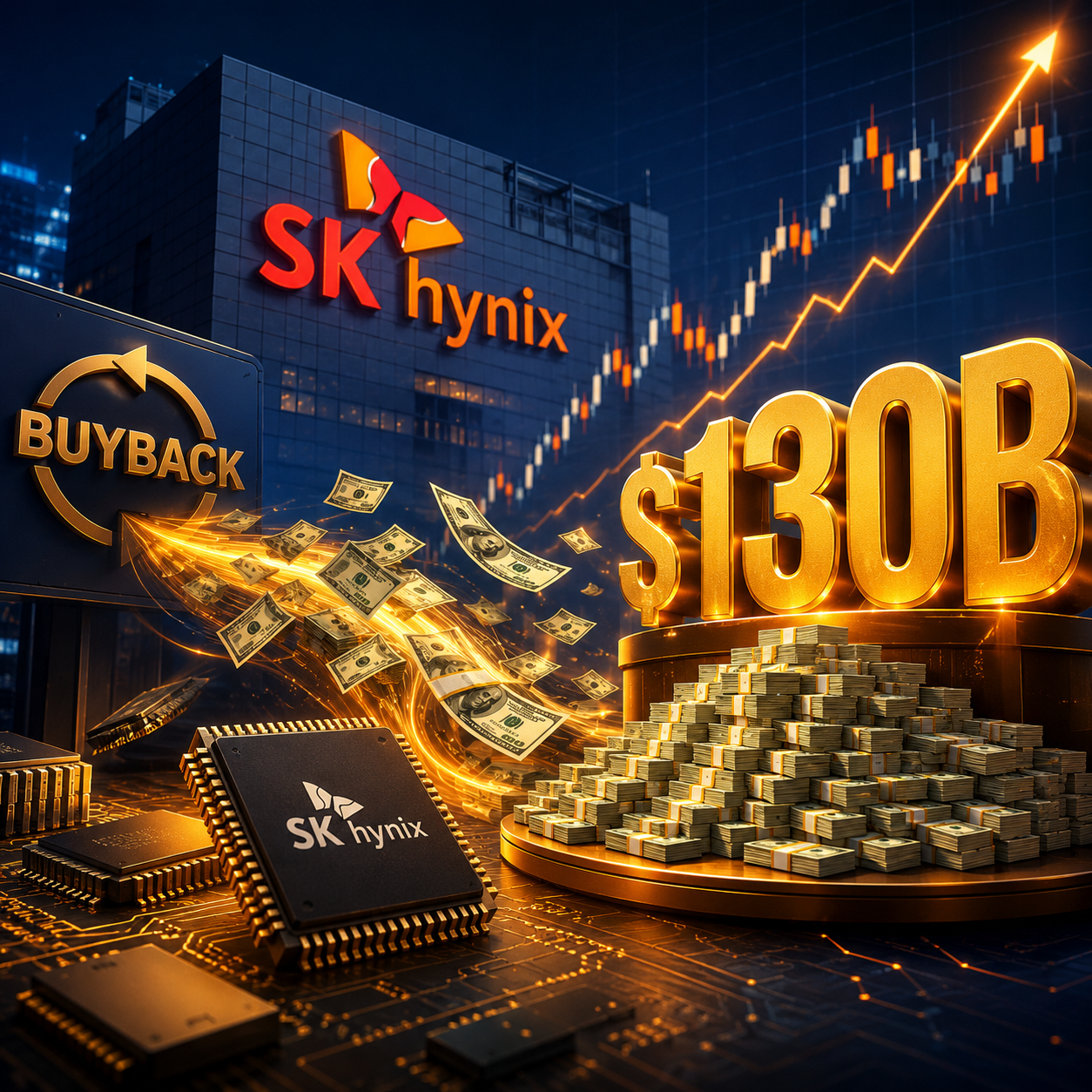
Is 40 trillion just an “appetizer”? The Hynix buyback landed ahead of schedule. Is 130 billion US dollars still ahead?

Is 40 trillion just an “appetizer”? The Hynix buyback landed ahead of schedule. Is 130 billion US dollars still ahead?

Source: Wall Street News Editor: Dong Jing Original title: Wall Street interprets Hynix's repurchase plan: Shareholder return of up to 8% next year, or return at least $130 billion to shareholders by 2027 Summary: J.P. Morgan believes that the shareholder return policy was upgraded from “no more than 50% free cash flow” to “no less than 50%”, changing from the upper limit to the lower limit, sending a clear signal to the market: future shareholder returns will only be greater, not less. Goldman Sachs predicts an 8% shareholder return in 2027, and expects an additional repurchase of approximately 7 trillion won in the future. J.P. Morgan expects additional return of over 16% of its market value by the end of 2027. Follow-up focus will be on the results meeting at the end of October. While the market was still debating the continuation of the AI storage cycle, and SK Hynix's stock price plummeted from a June high, the storage giant suddenly threw a huge bomb on the market. A historic repurchase, which was implemented early, reshaped the market's valuation logic for Hynix! SK Hynix officially announced the market's long-awaited shareholder return policy after closing on August 19, 2026 — it plans to repurchase and cancel 40 trillion won worth of shares, involving 24.07 million shares (3.3% of the shares issued as of the end of the second quarter of 2026), equivalent to about US$28.9 billion. This scale is not only the largest share repurchase in the history of a Korean listed company, but also exceeds the approximately 26.5 billion US dollars that Hynix raised through ADR financing in the US in early July this year. According to Chase Trading Desk, the two top Wall Street agencies, J.P. Morgan Chase and Goldman Sachs, both gave highly positive comments on the announcement in their latest research report on August 20. J.P. Morgan believes that the shareholder return policy has been substantially upgraded from “no more than 50%” to “no less than 50%”, and the policy ceiling has become the policy floor. Following the announcement of a 40 trillion won ($29 billion) share repurchase plan, SK Hynix may return at least $130 billion to shareholders by 2027, according to J.P. Morgan Chase. Goldman Sachs predicts a shareholder return of up to 8% in 2027, and expects an additional repurchase of approximately 7 trillion won in the future. Both J.P. Morgan Chase and Goldman Sachs maintain buying ratings: J.P. Morgan's target price is 2.75 million won (about 84% upside compared to the current price), and Goldman Sachs's target price is 3.5 million won (implying an upward margin of about 133%). The next key catalyst is the third quarter results conference call at the end of October 2026, when the company will reveal a more complete roadmap for shareholder returns. Analysts believe that this aggressive capital action directly proved to Wall Street that the company is “printing money” faster than market expectations. For the stock price, which has plummeted 49% since its high on June 22, this not only completely offset the dilution effect of the recent ADR issuance, but also established a valuation bottom (current annualized price-earnings ratio of only 3.8 times). The scale of the repurchase: The largest in history and earlier than expected. J.P. Morgan analyst Jay Kwon clearly stated that the 40 trillion won repurchase announcement “landed earlier than expected” — previously, the market generally expected the announcement to be released around the end of September, but the company chose to directly disclose it after closing on August 19, showing management's high level of confidence in the company's cash flow situation. In terms of scale, this repurchase has multiple historical significance: 40 trillion won is the largest share repurchase announced by a Korean listed company so far; equivalent to US$28.9 billion, higher than the approximately US$26.5 billion raised by Hynix's US ADR offering in early July, which means that the company actually used the repurchase to “hedge” the previous equity dilution; this amount is equivalent to 63% of the rolling FCF (operating cash flow minus capital expenses) over the past 12 months, & nbsp; It is higher than the previous “no more than 50%” FCF allocation limit policy. At the same time, J.P. Morgan Chase pointed out that if viewed from a valuation perspective, the price-earnings ratio corresponding to Hynix's current stock price is 6.4 times (based on adjusted earnings per share for the past 12 months) or 3.8 times (based on annualized adjusted earnings per share for the first half of 2026). This valuation level can be regarded as a reference benchmark for management to initiate repurchases. Policy upgrade: From “ceiling” to “floor”, the core policy change in this announcement is that the shareholder return ratio statement was upgraded from “up to 50% (no more than 50%)” to “50%”...

1d ago22#SK Hynix #J.P. Morgan Street

Garrett Jin: Bitcoin's key resistance range is between $80,000 and $8.25,000, making it difficult to sustain the momentum for a long time

Comparing news, BTC OG insider giant whale agent Garrett Jin wrote that the Bitcoin price broke through the previous fluctuation range of about $65,000 this week, the biggest one-day increase since March, and broke through $70,000. The breakthrough was driven by multiple factors such as the US Treasury's expansion of bond repurchases, the US Securities and Exchange Commission (SEC)'s proposed regulatory framework for the issuance of crypto assets, and the White House Cryptocurrency Summit. Bitcoin has now entered a tight zone formed from the latter half of $60,000 to the low of $80,000, and the first resistance layer has clearly loosened. Bitcoin's current market bottom base is one of the strongest stages since this cycle. Over the past two months, the $60,000 region has accumulated a large number of new holding costs, which has provided some support for this breakthrough. Although this round of gains was partly driven by bear liquidations, and this emptying momentum is difficult to sustain in the long term, short-term momentum may still push Bitcoin to continue upward and increase the probability of breaking through $80,000. However, $80,000 to $82,500 is still a resistance area that needs to be focused on, and whether it can be effectively broken through in the future will depend on trading volume and price trends; if it can continue to absorb chips below $80,000 before breaking through, it may form a healthier upward structure. Additionally, SK Hynix announced the implementation of the largest share repurchase and cancellation plan in the history of the Korean market this week, and promised to return at least 50% of the estimated free cash flow until 2027 to shareholders through stock repurchases and dividends. After the news was announced, SK Hynix's stock price once surged by more than 10%, which led to a strong rise in the Korea Composite Index (KOSPI) to trigger a buyers' fuse mechanism. Analysts believe that this buyback is expected to ease the market's previous concerns about the decline in risk appetite for Korean semiconductor stocks, the liquidation of leveraged ETFs, and the peak of the memory cycle, but it cannot change the cyclical trend of the memory industry itself. This article is sponsored by GENG, Build Your Fortune on GENG (https://geng.one)

2d agoburnking
KOSPI melting wind direction is slightly chaotic | 0820 weekend ago

KOSPI melting wind direction is slightly chaotic | 0820 weekend ago

Note: KOSPI routinely upside car fusion, overnight US debt bailouts the market, and in case of a single operation, Biotech draws all plates except for big cakes. Yesterday's post-market crackdown reduced the heat of the market, but US stocks continued to be traded continuously overnight around the world. It wasn't calm and quiet, or even the waves were blazing. ◎ The size of US federal public debt has reached a historic level of 40 billion and doubled in 10 years. The US debt market was rescued urgently, and the amount of a single repurchase doubled, from a peak of 2 billion US dollars to 4 billion US dollars each time. That is, a single repurchase at a rate of 1/10,000. Actively buy orders for this market. Major economies are 10-year, 30-year, 50-year government bonds, and long-term bonds. They all obtained active purchasing and risk avoidance, and US debt was relatively low. ◎ Asia Pacific early edition. Japanese and Korean stocks actively responded to the opening of KOSPI in the Seoul General Index, which triggered a technological meltdown. Suspend programmatic automated trading for a short time. Continuously observe the competitive situation in each relevant market during the Asia-Pacific period. Hengke indicated that Science Innovation 50. ◎ Big mochi in particular, I've touched 7 for the first time in a long time. Although I haven't stood it yet, I definitely felt it. ◎ Biology technology. the breakthrough in the melanoma vaccine (phase 3 clinical trial was a huge success) means that biotechnology supported by AI has made great strides in the application stage, and the traditional cycle of phase 3 clinical novel drugs will be greatly shortened. This is good for the carbon base, but it is not good for all carbon bases. Short-term carbon-based well-being surpasses the appeal of silicon-based well-being. Currently, all of the popular sectors in the US stock market overnight have gone to biotech, semiconductors, savings, etc., which are not good. The decline in cost will limit the rebound and growth in the Asia-Pacific market. Although the Seoul General Index has already triggered a rise in melting, and the technical side car sidecar melts 5%, it will still limit the rebound and increase. ◎ Geopolitical. The strategy team failed to predict, and the possible reason the northern part of the peninsula had no voice at all was not open to an unspecified research audience. ◎Oil's oil has surpassed 91. ◎ Reverse emotions. Funding is still plentiful. Although the signal for interest rate hikes has increased, it is currently not mainstream. The main reason is that biotechnology has taken away most of the computing power semiconductor technology. Look at the overall acceptance and absorption situation of the Asia-Pacific market, especially the technology market, the liquidity of interest rate hikes on US bonds today or a week before the last two trading days. ◎ Important related and unfinished matters are replenished and interacted on the board. ◎ Conflicts of interest. This ultra-compact research report has strictly complied with the “Publishing Securities Research Report” business guidelines and internal control requirements. ◎ Disclaimer. Investors need to be aware of their own unique characteristics. The above are not investment suggestions; they are directly quoted, and they are responsible...

2d agoburnking#Blue Chain Think Tank

J.P. Morgan: SK Hynix may increase shareholder returns by an additional $130 billion

Comparing news, according to Bloomberg, J.P. Morgan said SK Hynix may add at least $130 billion in shareholder returns by 2027. Earlier, the company announced a 40 trillion won (approximately $29 billion) share repurchase program and plans to increase the share of the cumulative free cash flow from 2025 to 2027 for shareholder returns from no more than 50% to at least 50%. Jay Kwon, an analyst at J.P. Morgan Chase, said in the report that the key to this 40 trillion won repurchase plan is that SK Hynix has raised the shareholder return commitment limit. According to the new return policy, the company is expected to bring in additional shareholder returns of at least 180 trillion won by 2027, equivalent to 16% of the company's current total market value, which is expected to support the stock price after the recent decline. Kwon said, “We believe the worst period is over, and we expect that in the medium term, stock price sentiment will gradually improve, and investors are advised to increase their holdings in the stock. He added that the buyback plan was announced earlier than market expectations. SK Hynix shares rose 13% on the Korea Exchange on Thursday. Earlier, the company announced that it would buy back and cancel up to 24 million shares, which will become the largest share cancellation plan in the history of a Korean listed company. The rise in SK Hynix also led to the strengthening of the Korea Composite Index (KOSPI). At one point, the stock price of rival Samsung Electronics rose 10%. The market believes that further increases in shareholder return expectations may push South Korea's memory chip stocks to rise again. Previously, the storage sector recently recovered due to market concerns about the sustainability of AI investment and competitive pressure from China. Currently, SK Hynix's stock price is still more than 40% lower than the all-time high set in June.

2d ago

Global equity and debt double kill: 30-year US bond yields soared to 5.33%, and the AI industry chain suffered a severe setback

Comparing news, the global financial market has experienced sharp fluctuations. The European, American, Japanese, and South Korean markets have experienced a double slump in stocks and bonds, and the sharp rise in long-term US bond yields has become the focus of market attention. In the Asian market, the sharp decline in the Korean stock market triggered a trading mechanism. The KOSPI index closed down 5.8%, SK Hynix fell nearly 10%, Samsung Electronics fell more than 8%; and the Nikkei 225 index closed down 3.16%. More than 5,000 A-shares fell, leading the decline in AI industry chain sectors such as semiconductors, computing power hardware, PCBs, memory, and CPO. In terms of US stocks, the three major indices fell for the third consecutive trading day, and the Philadelphia Semiconductor Index fell nearly 5% in a single day. Shares of AI-related companies such as Micron Technology, Western Digital, SanDisk, Marvell, AMD, Intel, Coherent, and Credo experienced a sharp correction in stock prices. According to market analysts, the core trigger for this round of sell-off comes from the rapid rise in global long-term bond yields. The 30-year US Treasury yield rose to 5.33% intraday, a record high since 2007. Meanwhile, French, German, British, and Japanese long-term treasury yields have all risen to multi-year highs, and global long-term capital costs are being repriced. According to data from the US Treasury Department, the amount of US debt held by overseas investors fell to 9.299 trillion US dollars in June, a decrease of about 72 billion US dollars compared to May. Among them, Japan's holdings fell to 1.116 trillion US dollars, reducing their holdings by 26.4 billion US dollars in a single month; UK holdings fell to 939.9 billion US dollars. As risk-free interest rates rise, the market is beginning to re-evaluate the AI industry's high capital investment model. Investors are concerned that continued expansion of data centers, GPU procurement, and infrastructure construction will require significant financing, and that higher capital costs may reduce future cash flow estimates for technology companies. Currently, the market is concerned about three major variables: 30-year US Treasury yield trends, the Federal Reserve's judgment on long-term interest rate paths, and whether subsequent earnings reports from tech giants such as Nvidia and Broadcom can verify AI return expectations. The US Treasury Department will issue 16 billion US dollars of 20-year US bonds at 1 a.m. Beijing time on Thursday. The market will pay close attention to the results of this issuance.

3d ago