
LEND · 694

Fluid Q2 TVL falls to $3.4 billion, revenue down 29% month-on-month

According to the Token Terminal report, Fluid, a DeFi protocol created by the Instadapp team, released data for the second quarter of 2026. The average TVL for the quarter was US$3.4 billion, down 21.1% from the previous year, and still up 84.9%; active loans of US$1.5 billion, down 15.1% from the previous year, up 92.9%; transaction volume of US$18 billion, down 37.3% from the previous month; expenses of US$9.5 million, down 21.5% from the previous month; the contract revenue of US$1.8 million, down 29.3% from the previous year and 9.8% from the previous year; and 70,700 thousand monthly users, down 43.8% from the previous month. The capital structure continues to lean towards Jupiter Lend, which collaborates with Jupiter on Solana, with an average TVL of about $1.7 billion, accounting for nearly half and achieving month-on-month growth, making it the largest lending deployment. There were outflows at the beginning of the quarter due to third-party incidents such as Resolv. Fluid contracts were not attacked, related bad debts were covered by treasury, etc., and there was no loss of user funds. During this period, Bitwise began managing the USDE market on Jupiter Lend, Liquidity-as-a-Service launched and launched a US$100 million susDAI liquidity facility, and RWA related assets such as Huma PST were also connected to Fluid. The team said it will continue to promote institutional-level deployment, Jupiter DEX and Sui expansion, etc., to introduce incremental capital and improve revenue efficiency through vertical product cooperation with institutions.

3d ago#On-chain dynamics
The amount of USDT issued on the Bochang TRON chain surpassed Ethereum and then entered the world's largest USDT distribution network

The amount of USDT issued on the Bochang TRON chain surpassed Ethereum and then entered the world's largest USDT distribution network

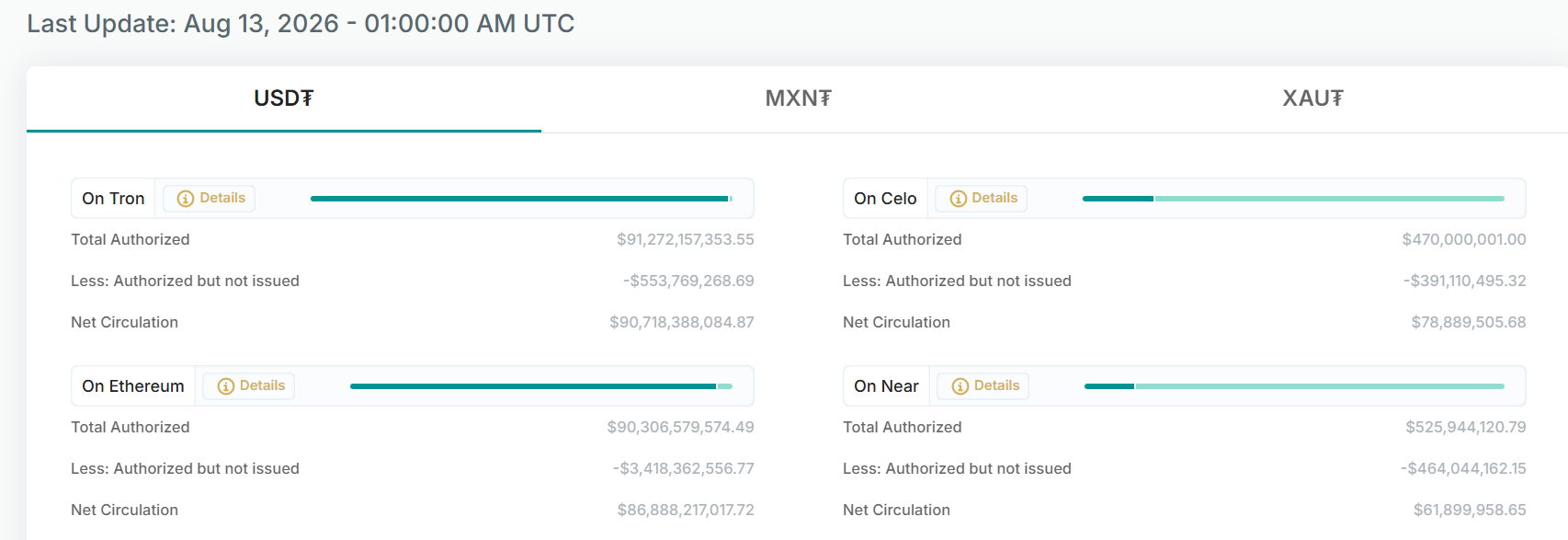
According to official Tether data, as of August 13, 2026, USDT on the Bochang TRON network chain once again increased by 1 billion US dollars, reaching 91.2 billion US dollars. The circulation volume once again surpassed the amount of USDT issued by the Ethereum network (90.3 billion US dollars), ranking first among blockchain networks. This historic milestone marks the further consolidation of Wavefield TRON's dominant position in the stablecoin field, and once again confirms the continued appeal of low-fee, high-efficiency settlement networks to global stablecoin funds. From trading assets to settlement tools, TRC20-USDT usage scenarios continue to expand the growth of USDT on the TRON chain, starting with sustainable real usage requirements. As of August 2026, the distribution volume of TRC20-USDT on the Bochang TRON network officially exceeded 91.2 billion US dollars, setting a new historical record. During the year, a total of about 10 billion copies were added, and the number of accounts held reached about 75.47 million. This size has enabled Wavefield TRON to carry half of the world's USDT issuance for a long time, accounting for about 50%. Judging from the usage structure, the actual payment attributes of Wavefield TRON are becoming more and more clear. According to CoinDesk Research data, in the first quarter of 2026, the average quarterly daily active account value of Bochang TRON rose to about 3.2 million, a new quarterly high. Meanwhile, in retail USDT transfers under $1,000, Bochang TRON's share is about 50%. It still maintains a dominant position in the $1,000 to $100,000 range, and continues to strengthen its “friendly” public chain position for retail and small to medium value settlement. This means that one of the main uses of USDT on Wave Field TRON is always the actual transfer of value between wallets. Looking at a longer period of time, the scale of on-chain transfers and settlements confirms this judgment. According to a research report released by Messari, in the first quarter of 2026, the amount of USDT transfers processed by the Bochang TRON network reached about 2.04 trillion US dollars, and the total number of transactions across the network was about 950 million. The average daily transactions rose from about 10.2 million in the previous quarter to about 10.9 million, which also set a new quarterly record; since 2026, Bochang TRON has led all public chains with annual USDT transfers of about 4.2 trillion US dollars. It depicts not a ledger within a single trading platform, but rather a scenario where multiple wallets directly transfer value on a public blockchain. Specifically, an overseas worker can send USDT to a family's wallet, and the payee can exchange it for local currency; cross-border e-commerce merchants can use USDT to settle with suppliers to reduce the impact of bank business hours and intermediary processes; freelancers can receive rewards from overseas customers and confirm on-chain payments within minutes; and digital asset service providers can transfer liquidity between exchanges, custodian wallets, and market-making accounts. The amount and purpose of the different cases are not the same, but the common requirements are fast payment, transparent fees, and 24/7 operation. Furthermore, cost stability is particularly important in a market environment where network fees fluctuate drastically. Since August 2025, Bochang TRON passed Governance Proposal No. 104 and lowered the unit price of energy by about 60%, on-chain transfer costs have been further reduced. Ecological access and secure collaboration go hand in hand. Whether the stablecoin infrastructure continues to improve and the stablecoin network can develop over the long term depends not only on circulation volume, but also on entry coverage, depth of liquidity, developer support, and risk management capabilities. Wavefield TRON is simultaneously constructing infrastructure in these directions. In terms of application entry, wallets, trading platforms, payment service providers, and DeFi protocols have extensive support for TRC20-USDT, enabling users to deposit, withdraw, transfer, exchange, and interact on the chain relatively easily. As new stablecoins such as USDD are integrated into the TRON ecosystem, stablecoin asset types have been further enriched; agreements such as JustLend DAO have extended the use of stablecoins to collateral and loan scenarios. Stablecoins are gradually shifting from a single transfer tool to the underlying asset for on-chain financial activities. In terms of user experience, mechanisms such as GasFree try to solve a common pain point: although new users hold USDT in their wallets, they may not be able to initiate transactions because there are no native tokens. By supporting stablecoins to pay associated network fees, these solutions help simplify the first-time usage process. For merchants, wallets, and payment applications, reducing the cost of user understanding bandwidth, energy, and native Gas tokens will also help stablecoin services enter a wider range of consumer scenarios. More importantly, scaling up needs to be synchronized with security governance capabilities. In September 2024, Wavefield TRON, Tether and TRM Labs joined forces...

9d agoburnking

LTP strategically invests in Digital Prime Technologies to accelerate Tokenet's Asia-Pacific expansion

Comparatively, Digital Prime Technologies, an institutional digital asset lending technology provider, announced on August 12 that it has received a strategic investment from LTP, a leading global institutional digital asset broker. LTP will be its chief strategic partner in the Asia Pacific region, helping the Tokenet platform expand institutional participation in the Asia Pacific market. Tokenet is Digital Prime Technologies' institutional-grade digital asset and tokenized asset lending platform. Following this investment, LTP will jointly promote Tokenet's global institutional infrastructure with previously joined EquiLend, Galaxy Digital, and Marex. LTP said it will use its network of institutional clients, prime brokerage capabilities and financing expertise to accelerate the adoption of Tokenet among financial institutions in the Asia-Pacific region.

10d ago

Figure cryptocurrency mortgages can be loaned at up to 75% of the collateral value

Comparatively, the crypto lender Figure Lending LLC offers crypto-backed loans. Borrowers can use Bitcoin, Ethereum, or Solana as collateral to receive up to 75% of the value of the collateral while retaining ownership of the tokens. Borrowings generally do not constitute a sale and generally do not trigger a capital gain event. Figure Lending LLC said borrowers should compare maximum loan value ratios, fixed or variable interest rates, regulatory permits, and liquidation terms. The agency offers a fixed interest rate, a loan term of 12 months, a maximum annualized interest rate of 12.62%, and supports same-day loans without requiring a credit score. The approval is based on collateral. Figure provides optional liquidation protection, which is available in some states, and can delay settlement during the loan term due to falling prices; if the loan is overdue, liquidation may still occur. This feature does not apply to non-payment, default, or violation of loan terms, and falling crypto asset prices may still trigger additional margin requirements.

10d ago

Bitcoin miner MARA secures $750 million loan by collateralizing 18,750 BTC to expand AI and energy infrastructure

According to the latest quarterly SEC filing, Bitcoin mining company MARA Holdings revealed that the company has secured 18,750 BTC to guarantee two Bitcoin mortgage loans, with a total loan principal amount of 750 million US dollars. Among them, the financing provided by Coinbase Credit included refinancing the original $150 million credit line and adding $300 million; Two Prime Lending also provided an additional $300 million loan. Both loans have been fully withdrawn, and the comprehensive financing cost is approximately 7.56%, mainly due in August 2028. The collateralized 18,750 BTC was worth approximately $1.2 billion when the transaction was completed. If the collateral ratio falls below the agreed level due to a drop in the price of Bitcoin, MARA may face additional collateral requirements; otherwise, the relevant BTC is at risk of being liquidated. The additional capital will be used mainly for general corporate purposes and support MARA's acquisition of Long Ridge Energy & Power. The deal is worth approximately $1.5 billion, and Long Ridge owns a gas power plant with an estimated installed capacity of 505 MW and more than 1,600 acres of industrial land in Ohio, USA. MARA plans to further develop the local area as a base for Bitcoin mining, AI, and high-performance computing infrastructure. (Crowdfund Insider) This article is sponsored by GENG, Build Your Fortune on GENG (https://geng.one)

10d agoburnking
588 days, 300+ Web3 projects fall: who's still at the table?

588 days, 300+ Web3 projects fall: who's still at the table?

Source: Foresight News Author: Eric Original title: In 588 days, 300+ Web3 projects sank into the deep sea and sailed a thousand sails by the side of a sinking ship, and the disease tree is ahead of time. On the way to prosperity, any industry must go through a round of “dead bodies are everywhere” of elimination, and Web3 is no exception. According to Foresight News's review of public information, since 2025, at least 78 Web3 projects with a total funding amount of more than 1.5 million US dollars have been announced to be shut down. Of these, 69 projects that can confirm the amount of financing have taken away more than 900 million US dollars in total. If you count the small projects that didn't get financing from institutions and died silently, the total number is far over 300. This means that over the past nearly 600 days, an average Web3 project died every two days, or was famous or unknown. Of the 75 projects counted by Foresight News, 37 were shut down throughout 2025, while 41 were shut down in just half of 2026, and 17 were shut down in a single quarter in the second quarter, setting the highest number in a single quarter since this round of clearance. The “hot” DappRadar, Zapper, and established exchanges including BitMEX and AscendEX (formerly BitMax) in the last round of the bull market have all put an end to their business careers in nearly two years. The reshuffle did not stop as the market picked up; on the contrary, it accelerated. After receiving millions of dollars or even tens of millions of dollars in financing, every team that has stepped into this new world has had the proud ambition of “laughing at the sky and going out. Are our generation people from Fenghao?” But after a few years of being baptized in the market, these cold and cruel numbers are still in front of everyone's eyes. Emerging markets are also markets, and Web3 isn't more gentle than other industries. “Not being able to support myself” is the number one “cause of death”. Looking at the “cause of death” of 75 projects, the first one ranked was “insufficient funding,” with 31 projects falling on this issue, accounting for more than 40%; followed by “insufficient market demand,” and 17 companies shut down as a result. The two added up are close to two-thirds of the total. In other words, the vast majority of projects die for only one reason: they have never been able to support themselves. The expressions used by these projects in the shutdown announcement are similar. Many of them say “after trying our best to find a path to sustainable development, we have not found a path to sustainable development.” The subtext of this sentence is: At the beginning of the project, there was actually no idea how to do it, or the initial idea was very different from the actual situation in the market. Some industry observers rated this wave of bankruptcy as “a direct reflection of the failure of the business model and the breakdown of the capital chain, rather than simply fluctuating market sentiment,” which can be described as hitting the head. The investment logic of the primary market has completely changed in the past two years. The first question investors meet is no longer “how much room do you have for imagination”, but “how to make money.” The first batch of projects whose revenue did not cover operating costs or tell a new story fell after the financing floodgates were tightened. The OSL Institute summarized this shift in its annual report as the industry moving from the “first half” to the “second half”: a growth model driven by rising asset prices and innovative agreements came to an end, and the market moved “from narrative to delivery.” To put it more bluntly, the market and capital are no longer willing to pay for “experiments,” and the project's self-hematopoietic ability has become a necessity. Compared to the reason they wanted to be clear, the five projects that announced that the “model is unsustainable” seemed much more honest. For example, Goldfinch, which made unsecured credit loans, lost blood and shut down due to continued bad loans to emerging market companies; the social game Fantasy.Top, which is a popular social game that relies on tokens to motivate, makes it difficult to sustain the incentive model after the popularity recedes. The “unsustainable model” is a very interesting reason for the collapse. Most unsecured credit loans in traditional financial markets are based on big data or personal past credit records to set reasonable limits. As an emerging “lending company,” Goldfinch dares to provide unsecured credit loans in emerging markets without credit data. This is not a problem that can be solved by cryptocurrency and Web3 alone. Obviously, the reason for the birth of this company with a total financing amount of nearly 40 million is hard to convince. I don't know how top institutions like a16z were fooled into entering the market. Additionally, some companies have died due to regulation. Mango Markets shut down through a community vote after reaching a settlement with the SEC...

10d ago22#WEB3

TRON DeFi Summer S2 Community Voting Opens to Determine $1.2 Million TRX Incentive Pool Allocation

According to Twitter news, JUST officially launched TRON DeFi Summer S2 user voting. From now until August 17, all TRX holders can participate in voting to determine the final distribution plan for the $1.2 million TRX incentive pool this season. The voting results will directly influence the coverage and distribution weight of Boosted APR for the S2 season. TRON DeFi Summer S2 was launched on August 5. For a period of 60 days, Boosted APR's exclusive incentives cover core asset pools such as TRX, USDD, JST, and SUN. Users can participate in JustLend DAO in one stop through the DeFi section of the Binance wallet. This vote is an important move by Wavefield Ecosystems at the DeFi governance level, and community participation will influence the formulation of incentive strategies for the next quarter. Holders can participate in voting through the JUST official account.

12d ago

MARA pledges 187.5 million bitcoins to obtain $600 million in new bonds to expand power generation and AI infrastructure businesses

Bitcoin mining company MARA has completed two loans, pledged 187,500 bitcoins, and obtained $600 million in new bonds to expand its power generation and AI infrastructure business. The collateral asset was valued at approximately $1.2 billion when it was sold. The total principal amount of the two loans was US$750 million, of which Coinbase Credit provided US$450 million, including refinancing of the original US$150 million credit line and an additional US$300 million; Two Prime Lending provided an additional US$300 million, and all loans were withdrawn in full. The Coinbase loan interest rate is the midpoint of the Federal Reserve's target interest rate range plus 3.875 percentage points until August 4, 2028; the Two Prime loan fixed interest rate is 7.65% until August 3, 2028. If the principal amount remains the same, the two loans would cost approximately $56.7 million in interest each year. MARA said the loan funds will be used for general business purposes, including paying part of the cash consideration for the acquisition of Long Ridge Energy & Power LLC. The deal is worth approximately $1.5 billion, and Long Ridge has a 505 megawatt gas power plant and over 1,600 acres of industrial land, which MARA plans to use for power generation, Bitcoin mining, and potential AI and high-performance computing parks.

13d ago

Data: Crypto assets were stolen in July at $247 million, the second-highest month in 2026

According to Twitter, DeFilLama data shows that hackers stole $247 million in crypto assets in July, the second-highest month since 2026 after $644 million in April; this amount is a significant increase from both $75 million in June and $60 million in May. Galaxy Digital said that the Coldcard vulnerability was the biggest attack of the month. It has confirmed that three rounds of attacks involved 7,300 wallets, and at least $100 million in bitcoins were stolen; it also identified a suspected fourth round of attacks, which could result in total losses of about $130 million. DeFilLama's hacker tracker estimates that the damage associated with this vulnerability is $115 million. Other attacks in July include the $9 million attack on decentralized finance protocol Bonzo Lend, the Cardano-based wallet SecondFi theft of $2.6 million, the Arbitrum-based perpetual trading platform AFX theft of $24 million, and the theft of Verus Ethereum Bridge of $7.5 million.

15d ago#On-chain dynamics

Cipher discloses second-quarter sell-off losses, PowerCompute mortgages 307 BTC restructuring debts

Comparative news, according to BBX data, yesterday and recently, global listed companies disclosed the latest developments in crypto asset and debt restructuring. The core information is as follows: Cipher Digital lost money in the second quarter due to selling Bitcoin: Bitcoin mining company and digital infrastructure company Cipher Digital (NASDAQ: CIFR) released financial results for the second quarter of 2026. Its total revenue was US$24.84 million (all from mining), with a net loss of US$267.5 million (mainly affected by a loss of US$150.5 million due to changes in the fair value of warrants), and adjusted EBITDA of US$29.99 million. As of June 30, its total cash and restricted cash was approximately US$4.56 billion. Notably, the book value of the company's Bitcoin holdings dropped sharply to $37.8 million compared to $125.4 million at the end of 2025, and has already achieved a loss of about $23.51 million in Bitcoin sales in the second quarter. PowerCompute secures Bitcoin interest rate reduction and debt restructuring: Bitcoin mining company PowerCompute successfully restructured three debts totaling $18 million through Arch Lending, using 307 bitcoins in reserve as collateral to replace previous loans from institutions such as Galaxy Digital. The new financing uses a no-recourse, 30-day revolving structure, with an annualized interest rate of about 2% (far lower than 12% of some old loans), enabling the company to drastically reduce interest expenses without selling Bitcoin in stock. West Main Self Storage slightly increased: The storage company West Main Self Storage revealed 0.155 Bitcoin increases in the secondary market, and its total holdings have now risen to 16.188 BTC.

15d ago#On-chain dynamics