


588 days, 300+ Web3 projects fall: who's still at the table?

Source: Foresight News
By Eric
Original title:588 days, 300+ Web3 projects sink into the deep sea
A thousand sails passed by on the side of Shenzhou, and the sick tree came before Wan Muchun.
On the way to prosperity, any industry must go through a round of “dead bodies are everywhere” of elimination, and Web3 is no exception.
According to Foresight News's analysis of public information, among Web3 projects with a total financing amount of over 1.5 million US dollars since 2025,
At least 78 have announced shutdowns, of which 69 projects with confirmed funding amounts have taken away more than $900 million in investment.
If you count the small projects that didn't get financing from institutions and died silently, the total number is far over 300.
This means that over the past nearly 600 days, an average Web3 project died every two days, or was famous or unknown.
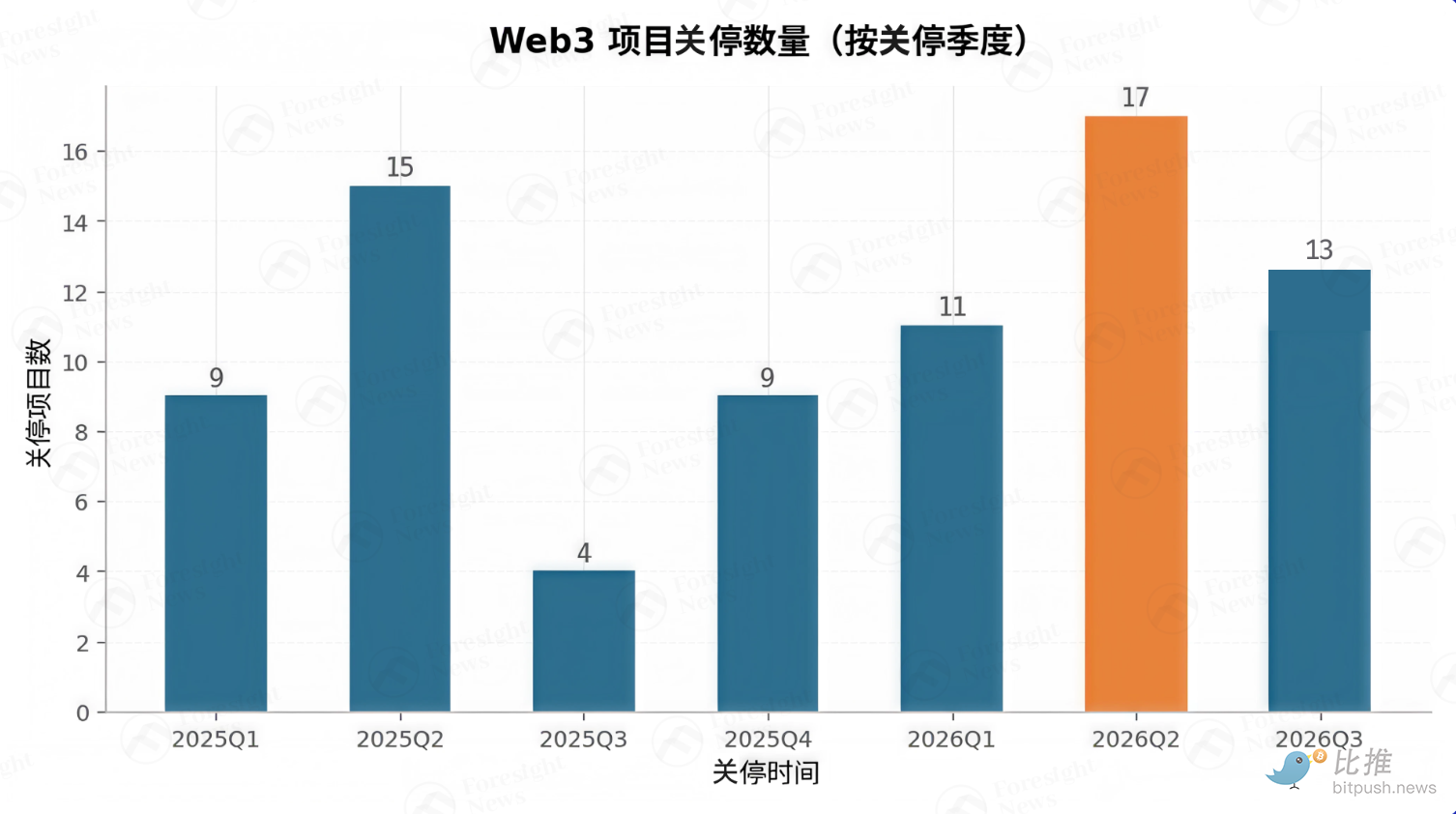 Of the 75 projects counted by Foresight News, 37 were shut down throughout 2025, while 41 were halfway through 2026.
Seventeen were shut down in a single quarter in the second quarter, the highest number in a single quarter since this round of clearance. The “hot” DappRadar and Zapper in the last round of the bull market,
As well as established exchanges including BitMEX and AscendEX (formerly BitMax), they have all put an end to their business careers in nearly two years.
The reshuffle did not stop as the market picked up; on the contrary, it accelerated.
After receiving millions or even tens of millions of dollars in financing,
Every team that has stepped into this new world has had the ambition of “going out laughing at the sky, is my generation a member of Beng Hao?”
But after a few years of being baptized in the market, these cold and cruel numbers are still in front of everyone's eyes.
Emerging markets are also markets, and Web3 isn't more gentle than other industries.
“Not being able to support myself” is the number one “cause of death”
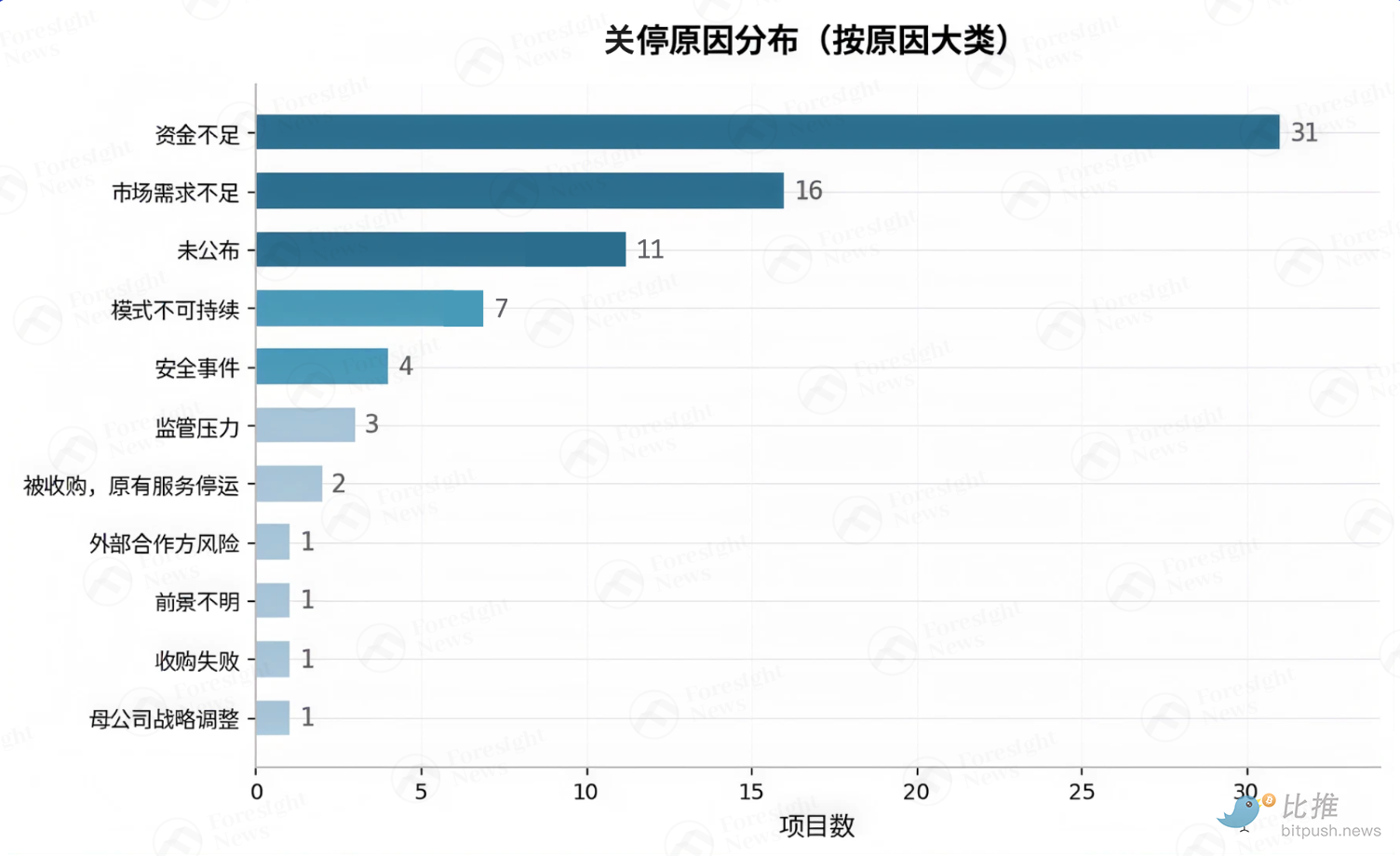
Looking at the “causes of death” of 75 projects, the first one ranked was “insufficient funding”. 31 projects were affected by this problem, accounting for more than 40%;
It was followed by “insufficient market demand,” and 17 companies shut down as a result.
When the two are added up, it's close to two-thirds of the total. In other words, the vast majority of projects have only one cause of death:They've never been able to feed themselves.
The expressions used by these projects in the shutdown announcement are similar. Many of them say “after trying our best to find a path to sustainable development, we have not found a path to sustainable development.”
The subtext of this sentence is: At the beginning of the project, there was actually no idea how to do it, or the initial idea was very different from the actual situation in the market.
Some industry observers rated this wave of bankruptcy as “a direct reflection of the failure of the business model and the breakdown of the capital chain, rather than simply fluctuating market sentiment.”
It can be described as hitting the nail on the head. The investment logic of the primary market has completely changed in the past two years.
The first question investors meet is no longer “how much room do you have for imagination”
It's “how to make money.” The first batch of projects whose revenue did not cover operating costs or tell a new story fell after the financing floodgates were tightened.
The OSL Institute summed up this shift in its annual report as the industry moving from the “first half” to the “second half”:
The growth model driven by rising asset prices and innovative agreements has come to an end, and the market is shifting “from narrative to delivery.”
To put it more bluntly, the market and capital are no longer willing to pay for “experiments,” and the project's self-hematopoietic ability has become a necessity.
Compared to the reason for sweeping up, the 5 projects that announced the “model is unsustainable” seemed much more honest.
For example, Goldfinch, an unsecured credit loan company, lost blood and shut down due to continued bad loans to emerging market companies;
Fantasy.top, a social game that has become popular by using tokens to motivate, has an unsustainable incentive model after the popularity recedes.
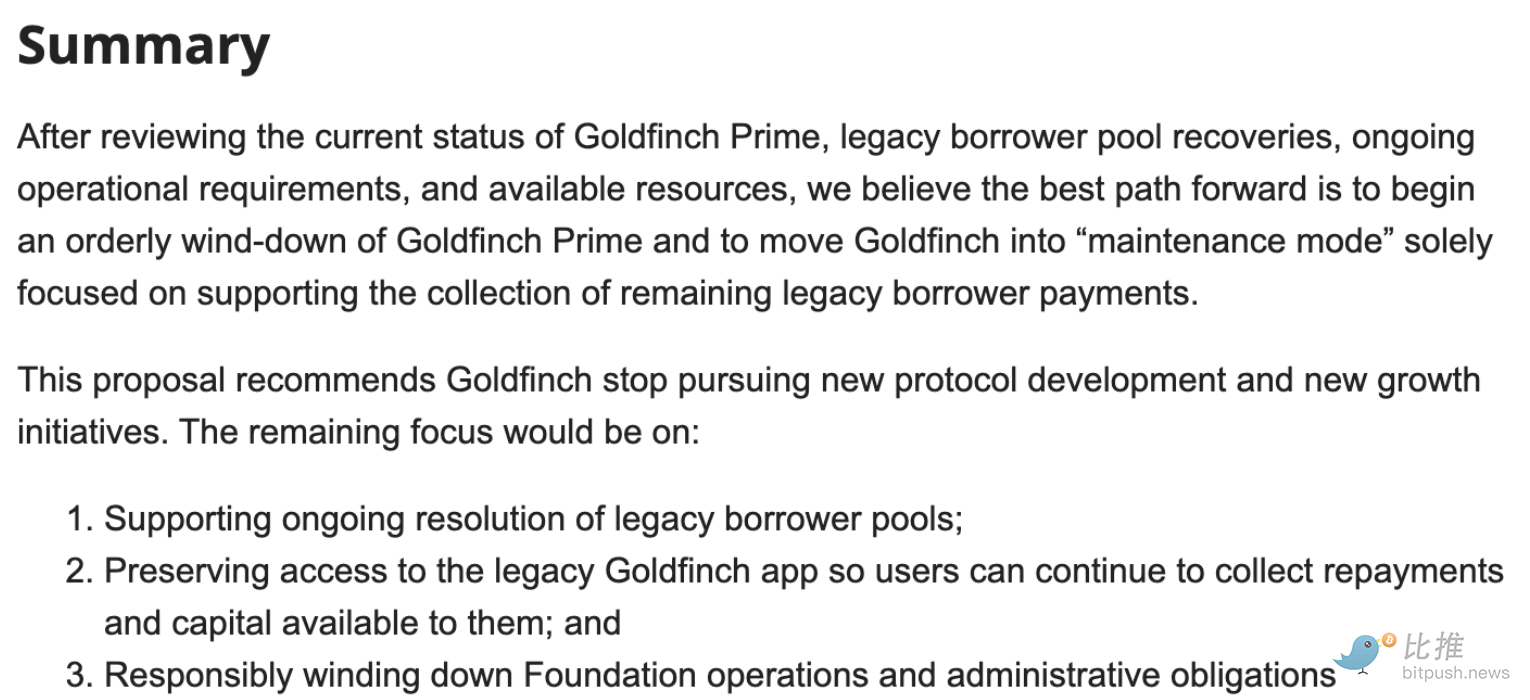
The “unsustainable model” is a very interesting reason for the collapse. Unsecured credit loans in traditional financial markets,
Reasonable credit figures are mostly based on big data or a person's past credit history.
Goldfinch, as an emerging “lending company,” dares to provide unsecured credit loans in emerging markets that are not supported by credit data.
This isn't a problem that can be solved with cryptocurrency and Web3 alone.
Obviously, the reason for the birth of this company with a total financing amount of nearly 40 million is hard to convince.
I don't know how a top agency like a16z was fooled into entering the market.Additionally, some companies have died due to regulation.
Mango Markets terminated the agreement through a community vote after reaching a settlement with the SEC; Tokenize Xchange declined the license application.
Another type of death is quite characteristic of Web3: being dragged down by a larger partner.
The crypto bank Juno was good at operating on its own, but it closed its doors due to the chain effects of bankruptcy of the custodian partner.
This kind of risk embedded in the traditional financial chain is often the part that the project party itself cannot control the most.
Speaking of risk, the 4 projects that directly shut down due to security incidents are also very Web3 specific.
L2 Kinto, Ctrl Wallet (formerly XDEFI), Radiant Capital, and zkLend,
They all directly broke the already tight capital chain because of a hacker attack.
Because of direct contact with real money, if a Web3 project is hacked, it's like a bank's money is being transferred by a hacker.
The instant collapse of trust left the vast majority of projects with little chance of recovery.
These cases revealed the vulnerability of Web3 projects. After being hacked, the project can only use daily operating funds to pay compensation.
At the same time, the price of project tokens dropped sharply, and the ability to sell tokens to obtain capital and refinance was lost. “Death” was almost only a matter of time.
With the exception of a few well-funded projects that can get through this hurdle, most small teams simply can't bear it, but the risks faced by the two are no different.
But from another perspective, not being able to survive a security incident itself probably should be eliminated.
At the end of the inner volume, it's a mess
When data analysis crosses the racetrack dimension, the rules will become more clear.
Since 2023, Bitcoin has gradually come out of the haze, breaking through the $100,000 mark and even approaching the “prediction” of RMB 1 million many years ago;
On the other hand, on tracks such as DeFi, where the head effect is becoming more and more obvious, the bubble continues to be squeezed.
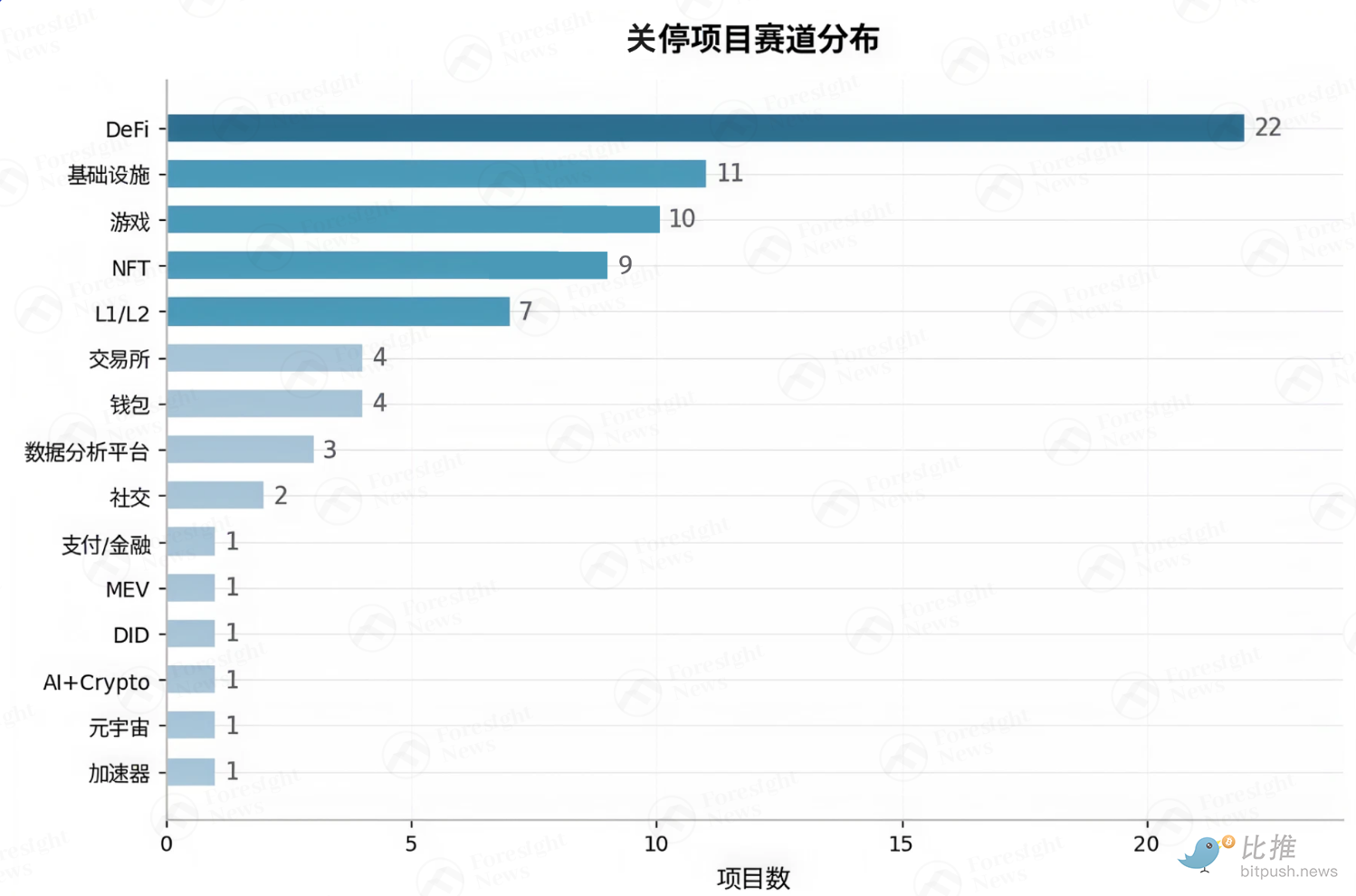
As the hardest hit area of the current wave of bankruptcies, DeFi accounts for nearly 30% of 75 projects.
This distribution itself shows a problem that has been shunned by the industry for a long time: finance is indeed one of the few applications of blockchain technology currently with real scenarios.
However, not all financial products have sufficient market demand, and not all financial products are suitable for independent operation.
Among the 22 falling DeFi projects are the stablecoin agreement Angle, the derivatives agreement Polynomial, and the re-staking agreement MilkyWay.
There are various causes of death. There is a lack of money, no demand, hacking, supervision, and model failure. Cases can be found in almost every death law.
Homogenization is the main line behind it: when Uniswap and Aave have absorbed most of the liquidity, the second-tier story is all that's left.
More importantly, many DeFi protocols are essentially a function rather than a business; they can survive very well as a module of the leading protocol.
If you stand alone, you have to bear customer acquisition, security, and operating costs on your own.
Market demand is limited. When a segment is squeezed into players that far exceed the overall size of the market, some people are bound to be eliminated.
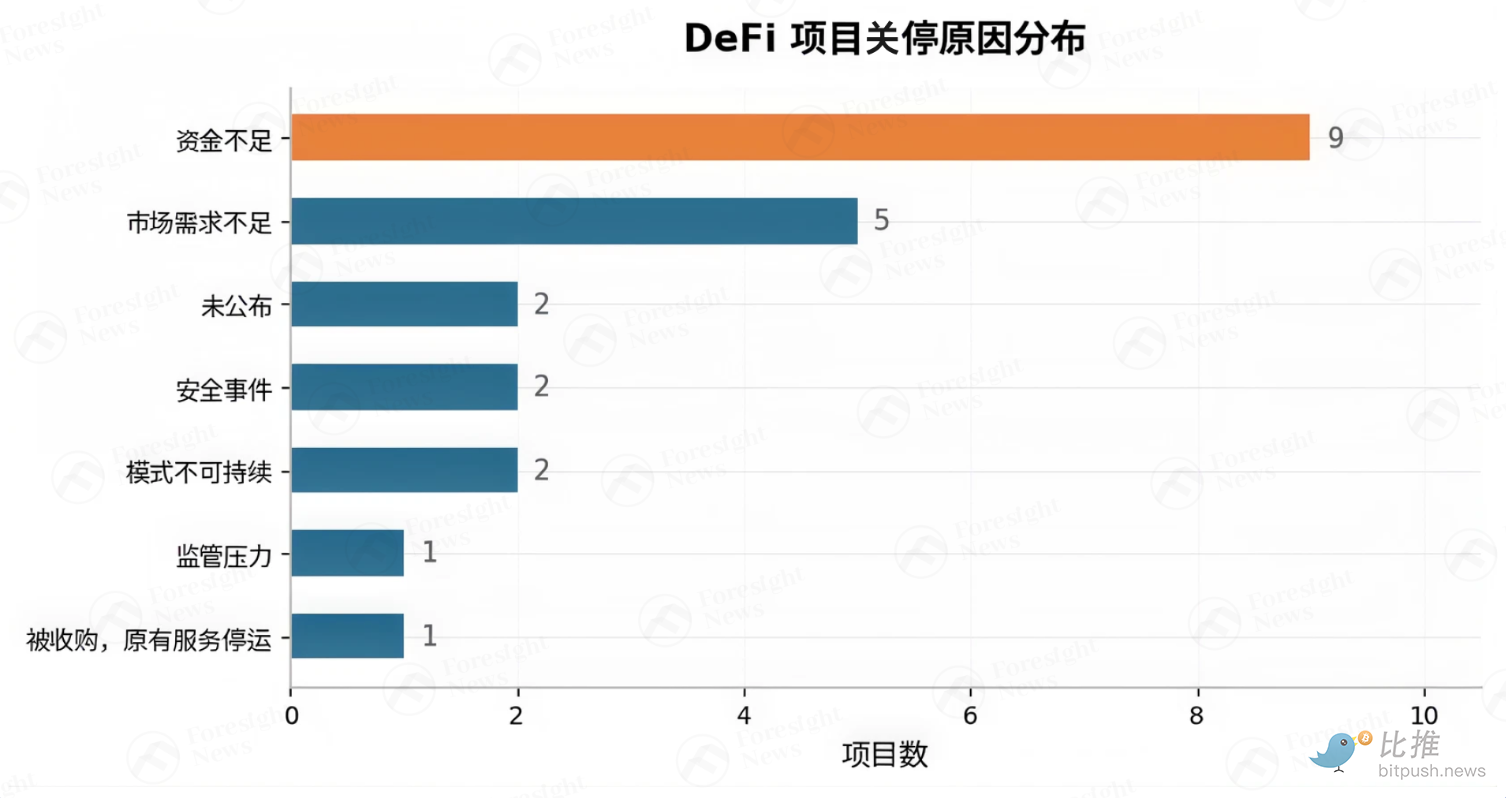
The number one reason for DeFi projects going out of business remains insufficient funding. For projects with few sources of revenue in the Web3 industry, such as DeFi,
They are all plagued by funding issues, and it can be seen that the capacity of mature DeFi circuits is nearing saturation.
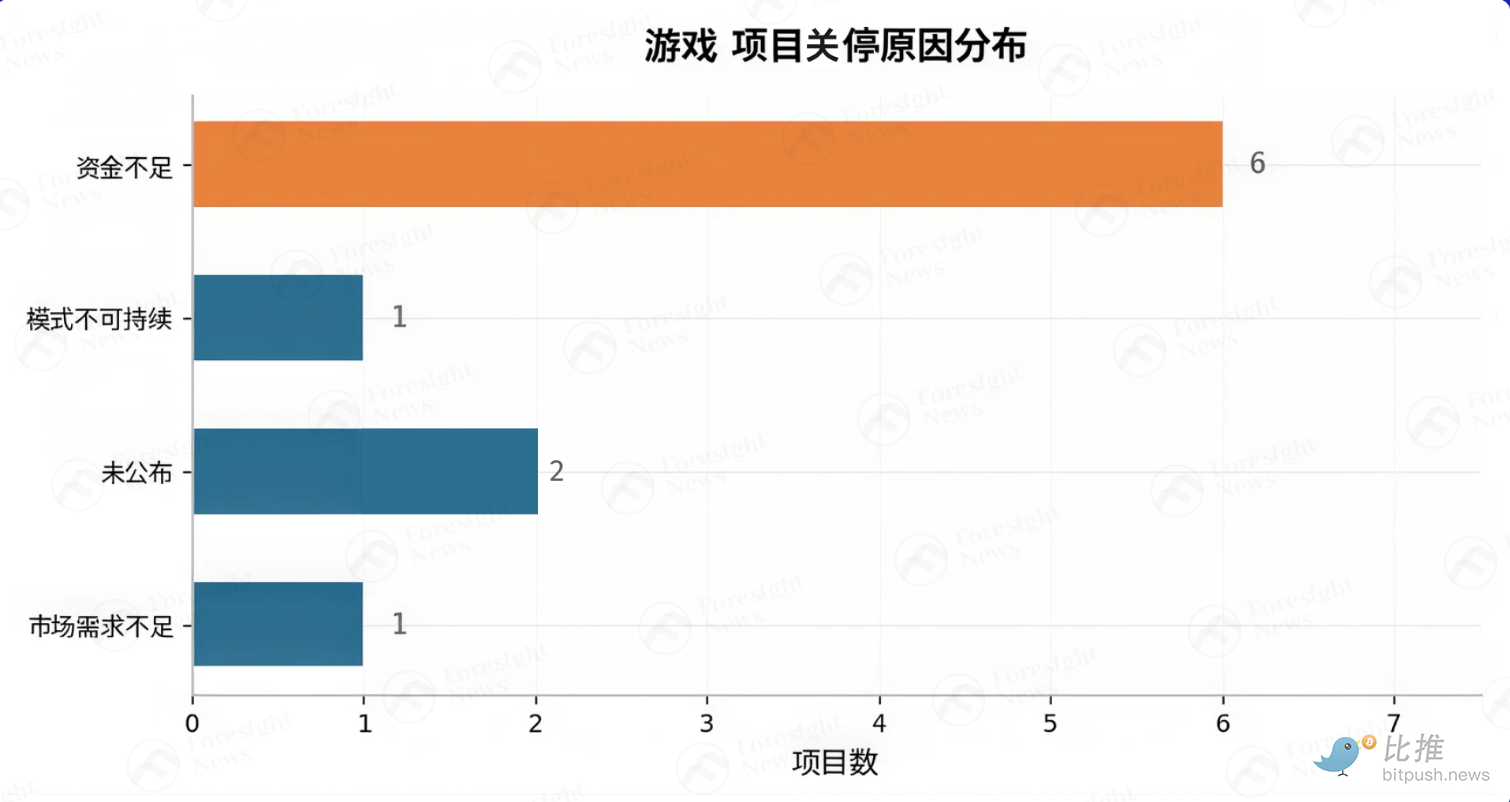
Of the 9 shut-down events on the game track, 6 died because they “couldn't be integrated into the next round.”
This is very much in line with the logic of the content industry: game development can easily take three to five years, burn money violently, and the budget of 100 million US dollars is not an exaggeration in the traditional game industry.
With millions of dollars, the online game team wanted to replicate the 3A experience. Once the test data couldn't support the next round of financing, the project would not have a second chance.
Of the 9 projects on the NFT and metaverse circuit, 4 died due to loss of demand: when X2Y2 was shut down, the total NFT market volume had dropped by about 90% from its peak;
Bloktopia, on the other hand, fell directly into the metaverse narrative ebb.
NFTs and the metaverse should be considered one of the first tracks to be “falsified” in the history of Web3 development.
Currently, NFTs are still struggling, and the metaverse has almost disappeared. The metaverse isn't just fooling Web3,
Even Facebook changed its name to Meta in 2022 and is almost all in the metaverse.
Looking back now, NFTs and the metaverse are more like “unfit to exist” products brought out due to overfunding during the bubble period.
As the economy declined, the baht during these boom years was no longer sought after. From another perspective, the popularity of these projects came too late.
The market did not provide a long enough boom period for them to educate the market and find an operating model that would balance the balance of payments.
Even Yuga Labs, which once received funding of 100 million dollars, recently took back the DAO's rights to control the “how to spend the money” issue.
The fall of L1/L2 and infrastructure points to another surplus.
The public chain was once the most expensive story in the financing market, but when Ethereum Layer 2 had surplus to the point of robbing each other of users,
A new chain with no unique ecology is almost born and dies, and old chains like Kadena and Evmos can only exit gracefully after the market continues to lose blood.
Similar to the infrastructure circuit, the cross-chain, sequencer, and account abstraction, each floor is crowded with more than a dozen teams.
However, the real trading volume of the entire industry simply cannot support so many “road builders.”
The infrastructure sector's elimination game is more in line with our perception of the industry. These projects are not devoid of demand, and they are not broken in terms of operation.
They simply lost in the fierce market competition. The collapse of these companies was also a reminder for investors and industry participants.
The market logic has changed qualitatively. You are new enough, have strong technical skills, and are no longer a “gold medal for escape from death.”
To start a business blindly independently, it is better to incorporate good ideas into existing projects or systems.
The tide receded, and the veteran ran aground with the giant whale
In this round of reshuffle, the scale of financing is also unable to form a talisman.
Of the 75 projects, 23 raised more than 15 million US dollars (nearly 100 million yuan): Mango Markets received 70 million US dollars,
AscendEX has taken $63 million, and Loopring has taken $45 million. Whether you don't have the money to keep burning,
There was still money, but there was no point in burning it; in the end, all of these projects chose not to continue.
What finance can buy is actually very limited. Loopring is one of the first trading protocols to launch zkRollup on Ethereum.
The technology is not backward, and the team is also considered diligent, but under the clash of leading DEXs and centralized exchanges, trading volume has been sluggish for a long time.
In the end, it was only possible to announce the shutdown and transition to the next generation of products. Money can keep the team running and can subsidize users,
It can hold up a few years of decency, but it can't buy real demand.
When no one cares about a company's products, the more financing, the higher the cost of maintaining this “no one cares.”
The more common problem is that the rise in high-value financing is only a time of trial and error, not the probability that a business model will be established.
After receiving funding that far exceeds actual needs, team size, market placement, and token incentives tend to expand simultaneously, and fixed costs are quickly pushed up.
When the market is good, these expenses are overshadowed by growing numbers. Once the market cools down, bloated cost structures make it harder for high-financing projects to make a U-turn than small teams.
Seen from this perspective, sometimes huge financing is not a buffer, but an amplifier. It amplifies the optimism of the project during the boom period and also amplifies the speed at which the bubble falls when it bursts.
Boca, who “throw money with your eyes closed,” is the best example.
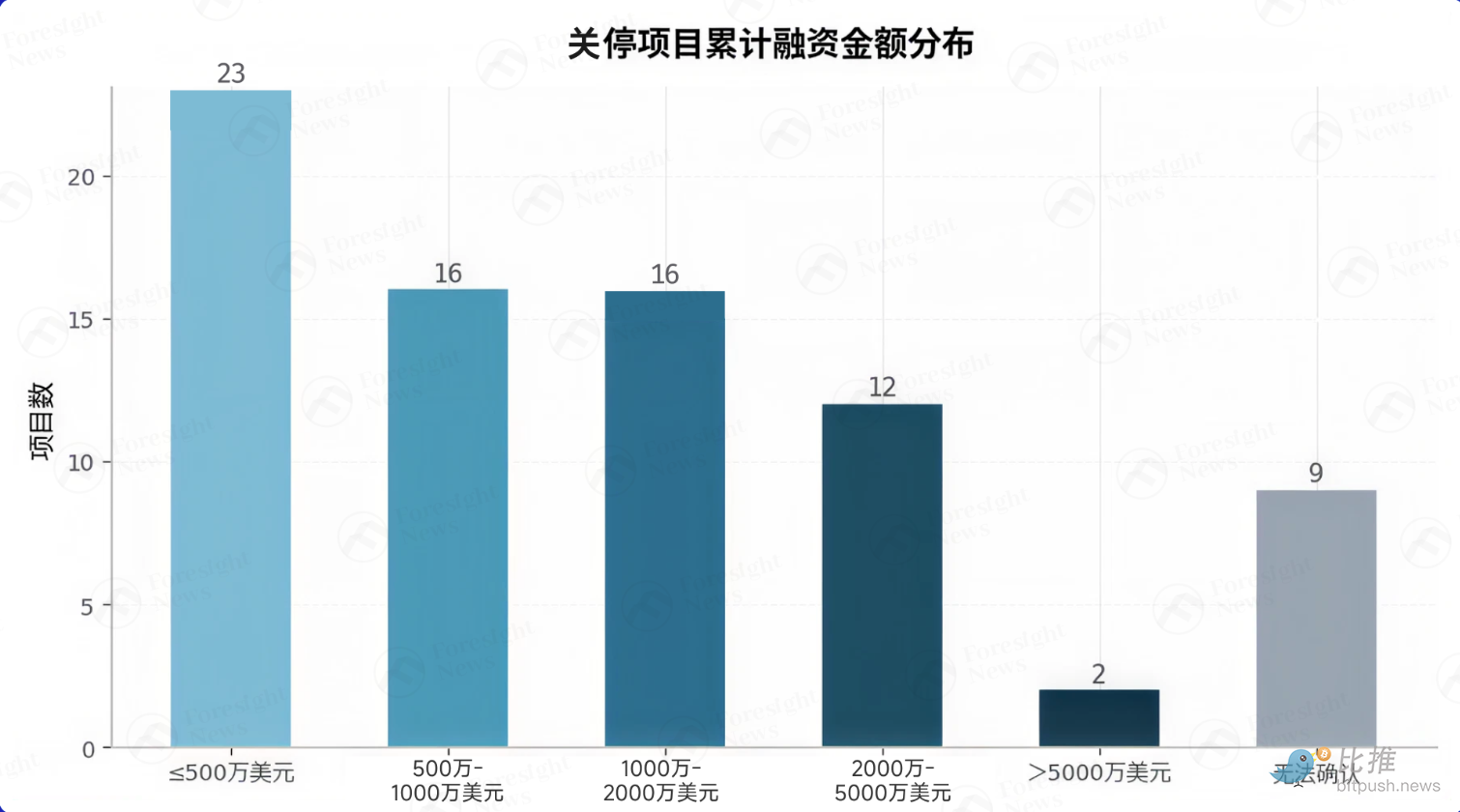 The time-dimensional structure is even more telling: the projects established between 2021 and 2022 account for 45% of the total, which corresponds exactly to the pinnacle of the previous round of financing bubbles.
In those two years, the amount of annual financing in the primary crypto market reached more than 30 billion US dollars, and a large number of projects were born under the logic of “take money first, find demand later.”
Today, three to four years later, concentrated deaths are typical of late settlement.
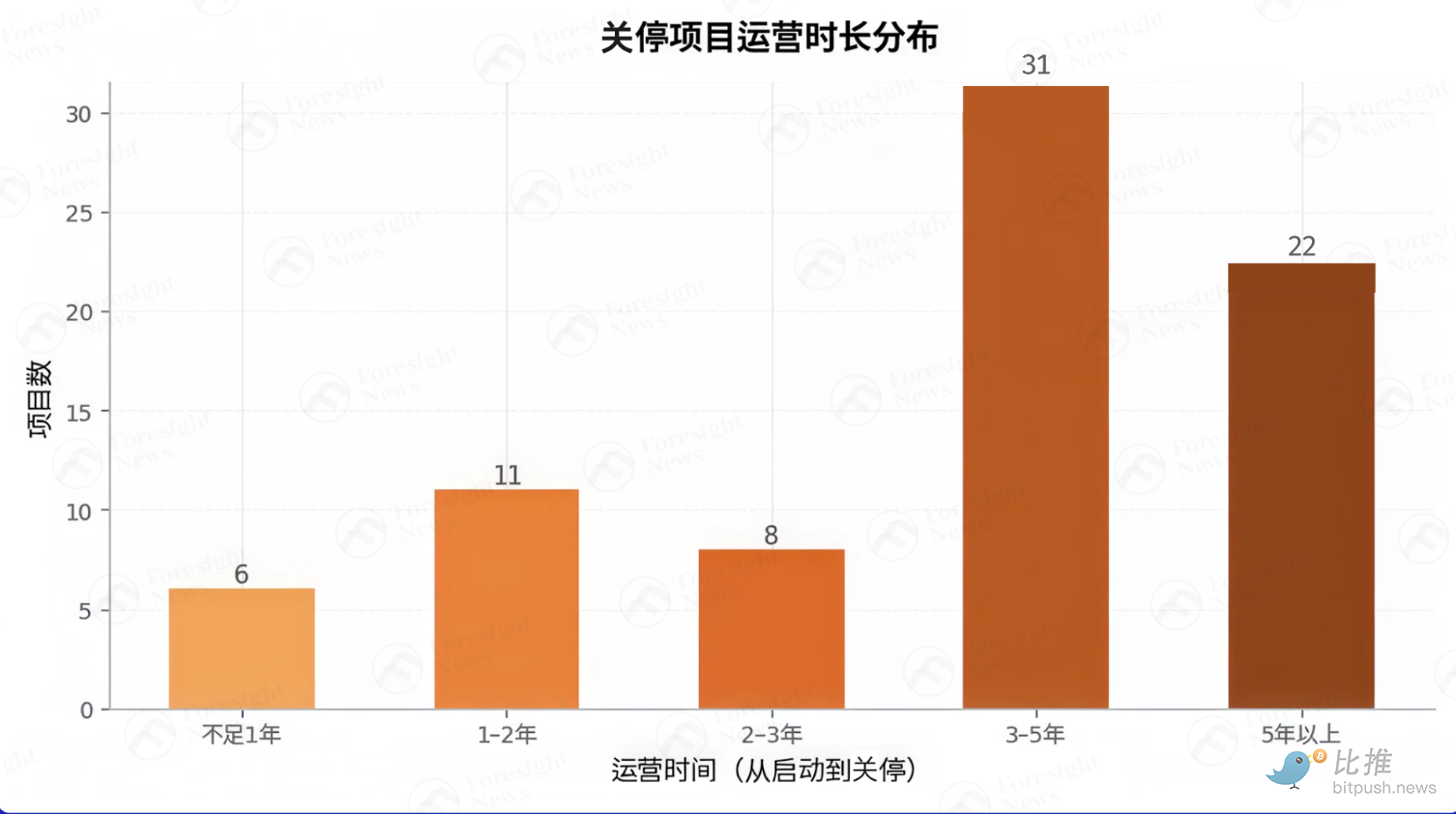
It is worth noting that 9 “veterans” who have been in operation for more than seven years have also fallen in these two years.
These include BitMEX founded in 2014, Loopring founded in 2017, and Blocknative founded in 2018.
The median duration of all 75 projects was four years. This set of numbers together shows that this round of shuffling and elimination is not just speculative projects spawned during the bubble period.
It's a repricing of a number of business models that never really worked. No qualifications, financing, or technical reputation are exempt.
a16z used data spanning ten years to summarize a “crypto price - innovation cycle”:After the price peaked in each round, the number of developers,
Entrepreneurial activities and infrastructure investment will not fall with prices; instead, they will settle down and become the seeds driving the next cycle.
Seen from this perspective, the shutdown list for the past two years is, on the one hand, a late liquidation.
The target of the liquidation was excess capacity that was ripened in the 2021 financing bubble, not the industry itself.
Fundamental data from the industry also supports this: the total market value of stablecoins has surpassed 300 billion US dollars.
The on-chain dollar is penetrating into the payment and settlement process of the real financial system at a speed visible to the naked eye;
Pendle, which only proposed the concept of “revenue tokenization” in 2021, now has a TVL of over 10 billion US dollars, making it one of the leading DeFi protocols;
Ethena's synthetic dollar USdE supply once surpassed $14 billion in 2025.
It became the third-largest US dollar stablecoin after USDT and USDC.
What these projects have in common is that they address real needs and have clear revenue models.
They don't live on stories; they live on cash flow.
On the other hand, the deterioration of the economic environment has caused some projects to be born in a new cycle after 2022.
It soon became clear that it was impossible to survive in the current market environment: DeFi platform Dango chose to shut down after less than 4 months of launch.
Furthermore, in July, three exchanges, BitMax, BitMEX, and BitMart, announced the shutdown.
These exchanges, which were once thought of as “money printers,” are no longer sustainable, which is enough to show that under the surface, the downturn is accelerating.
The story isn't over
Economist Steven Klepper discovered while studying the evolutionary history of the American automobile industry,
Around 1900, more than 200 automobile manufacturers competed on the same stage in the US; only the Detroit Big Three survived decades later.
He summed up this rule as a “reshuffle period” that will inevitably occur in the life cycle of an industry: after the birth of new technology, a large number of enterprises flock in.
The number of enterprises soared to its peak in a short time. Then, when the technological dividend peaked and demand growth slowed down,
The vast majority of players will be removed from the game, and market concentration will increase dramatically.
That's why we need to maintain our confidence in the industry right now.
Under the overall downturn, old DeFi systems such as Aave and Uniswap continue to develop, and Aave has become the undisputed “king of lending.”
Uniswap opened the long-disputed “fee switch” and launched UNI's repurchase and destruction mechanism, linking the development of the agreement to the token's performance.
At the same time, the Pendle and Ethena mentioned above are shining brightly.
Morpho TVL, the new lending protocol, has become the new king of the lending circuit after Lido and Aave.
In addition to this, the integration of Crypto and traditional finance has overtaken the lane.
Stablecoins gradually became a means of payment in emerging markets from Bitcoin trading pairs, and transactions of financial assets such as stocks began to migrate to the chain.
Even NASDAQ and NYSE have promised to eventually move stock trading to the chain.
The reshuffle period has never been a death certificate for the industry; it is the most painful and necessary part of the industry's coming-of-age ceremony.
After years of trial and error, Web3 began to figure out how unreasonable it is, giving up the market, capital, and users for real value.
Around 2010, during the Battle of the Thousand Teams, more than 5,000 group buying websites fought to the point where there was only a single digit left in two years.
Meituan stepped on thousands of “corpses” to the throne; bike sharing in 2017 covered the streets of every city in colorful colors, leaving only yellow, blue, and two years later.
Looking back, along with the bursting of the bubble, the industry itself completed the popularization of infrastructure and the development of user habits in ruins.
The companies that have left this game have left behind talents and extensive industry infrastructure to fulfill their historical mission of existence.
Latecomers were able to build more gorgeous high-rise buildings on this fertile soil, which had been piled up by countless corpses.
[Disclaimer] The market is risky, so you need to be careful when investing.
This article does not constitute investment advice, and users should consider whether any opinions, opinions, or conclusions in this article are in accordance with their particular circumstances. You are responsible for investing according to this.
Twitter:https://twitter.com/BitpushNewsCN
Compare the TG exchange group:https://t.me/BitPushCommunity
Compare TG subscriptions:https://t.me/bitpush
