

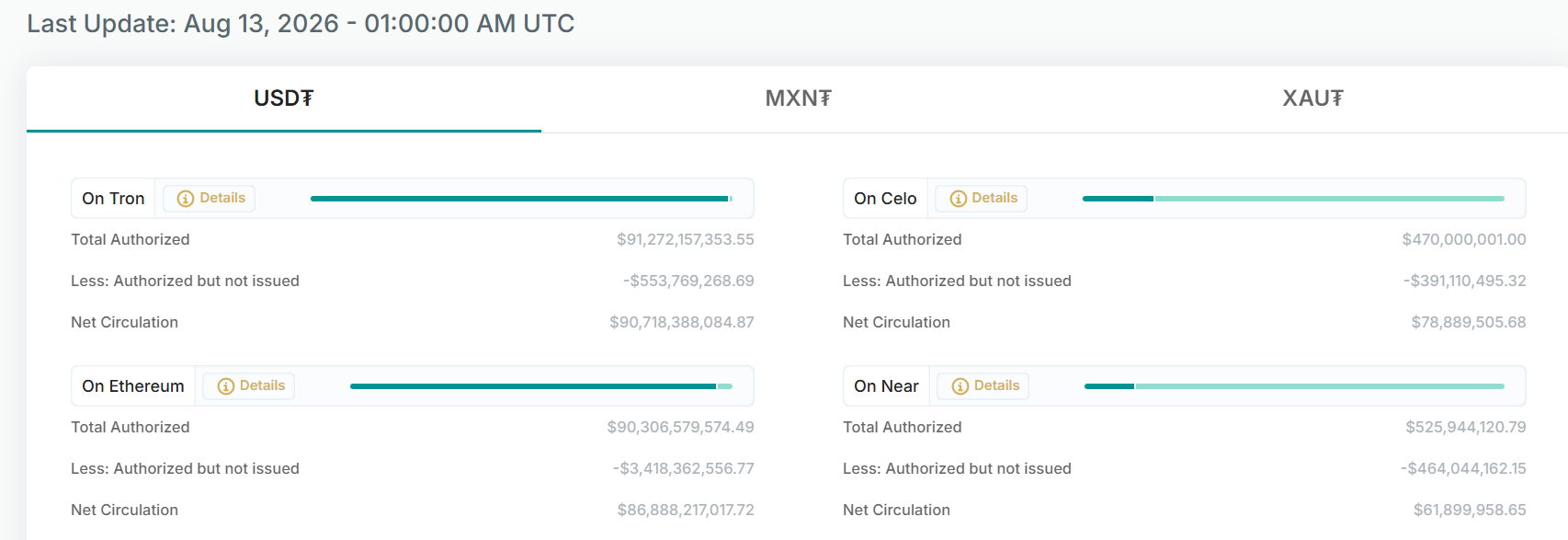
The amount of USDT issued on the Bochang TRON chain surpassed Ethereum and then entered the world's largest USDT distribution network
According to official Tether data, as of August 13, 2026, USDT on the Bochang TRON network chain once again increased by 1 billion US dollars, reaching 91.2 billion US dollars. The circulation volume once again surpassed the amount of USDT issued by the Ethereum network (90.3 billion US dollars), ranking first among blockchain networks. This historic milestone marks the further consolidation of Wavefield TRON's dominant position in the stablecoin field, and once again confirms the continued appeal of low-fee, high-efficiency settlement networks to global stablecoin funds. From trading assets to settlement tools, TRC20-USDT usage scenarios continue to expand the growth of USDT on the TRON chain, starting with sustainable real usage requirements. As of August 2026, the distribution volume of TRC20-USDT on the Bochang TRON network officially exceeded 91.2 billion US dollars, setting a new historical record. During the year, a total of about 10 billion copies were added, and the number of accounts held reached about 75.47 million. This size has enabled Wavefield TRON to carry half of the world's USDT issuance for a long time, accounting for about 50%. Judging from the usage structure, the actual payment attributes of Wavefield TRON are becoming more and more clear. According to CoinDesk Research data, in the first quarter of 2026, the average quarterly daily active account value of Bochang TRON rose to about 3.2 million, a new quarterly high. Meanwhile, in retail USDT transfers under $1,000, Bochang TRON's share is about 50%. It still maintains a dominant position in the $1,000 to $100,000 range, and continues to strengthen its “friendly” public chain position for retail and small to medium value settlement. This means that one of the main uses of USDT on Wave Field TRON is always the actual transfer of value between wallets. Looking at a longer period of time, the scale of on-chain transfers and settlements confirms this judgment. According to a research report released by Messari, in the first quarter of 2026, the amount of USDT transfers processed by the Bochang TRON network reached about 2.04 trillion US dollars, and the total number of transactions across the network was about 950 million. The average daily transactions rose from about 10.2 million in the previous quarter to about 10.9 million, which also set a new quarterly record; since 2026, Bochang TRON has led all public chains with annual USDT transfers of about 4.2 trillion US dollars. It depicts not a ledger within a single trading platform, but rather a scenario where multiple wallets directly transfer value on a public blockchain. Specifically, an overseas worker can send USDT to a family's wallet, and the payee can exchange it for local currency; cross-border e-commerce merchants can use USDT to settle with suppliers to reduce the impact of bank business hours and intermediary processes; freelancers can receive rewards from overseas customers and confirm on-chain payments within minutes; and digital asset service providers can transfer liquidity between exchanges, custodian wallets, and market-making accounts. The amount and purpose of the different cases are not the same, but the common requirements are fast payment, transparent fees, and 24/7 operation. Furthermore, cost stability is particularly important in a market environment where network fees fluctuate drastically. Since August 2025, Bochang TRON passed Governance Proposal No. 104 and lowered the unit price of energy by about 60%, on-chain transfer costs have been further reduced. Ecological access and secure collaboration go hand in hand. Whether the stablecoin infrastructure continues to improve and the stablecoin network can develop over the long term depends not only on circulation volume, but also on entry coverage, depth of liquidity, developer support, and risk management capabilities. Wavefield TRON is simultaneously constructing infrastructure in these directions. In terms of application entry, wallets, trading platforms, payment service providers, and DeFi protocols have extensive support for TRC20-USDT, enabling users to deposit, withdraw, transfer, exchange, and interact on the chain relatively easily. As new stablecoins such as USDD are integrated into the TRON ecosystem, stablecoin asset types have been further enriched; agreements such as JustLend DAO have extended the use of stablecoins to collateral and loan scenarios. Stablecoins are gradually shifting from a single transfer tool to the underlying asset for on-chain financial activities. In terms of user experience, mechanisms such as GasFree try to solve a common pain point: although new users hold USDT in their wallets, they may not be able to initiate transactions because there are no native tokens. By supporting stablecoins to pay associated network fees, these solutions help simplify the first-time usage process. For merchants, wallets, and payment applications, reducing the cost of user understanding bandwidth, energy, and native Gas tokens will also help stablecoin services enter a wider range of consumer scenarios. More importantly, scaling up needs to be synchronized with security governance capabilities. In September 2024, Wavefield TRON, Tether and TRM Labs joined forces...



![[Comparative Daily News Picks] SpaceX rose 19% on the first day of listing, breaking $2 trillion to become the sixth largest company in the US; Galaxy Research: Bitcoin has not yet formed a bottom of this round and is expected to be between $4-4.6 million; Trump intends to create a super weekend: hoping to sign the US-Iran agreement before his 80th birthday](https://www.bitpush.news/wp-content/uploads/2019/03/15509417815768901-200x140.png)