Pyth Network · 129

Kalshi applied to launch a copper perpetual contract using Pyth Network price data and no expiration date

Comparing news, it is predicted that market operator Kalshi will submit an application to the US Commodity Futures Trading Commission (CFTC) to launch a copper perpetual contract COPPERPERP. The contract will track the spot price of copper in dollars and use price data from blockchain market data provider Pyth Network. The contract is settled in cash and does not involve physical copper delivery; regular payments between long and short traders will help keep the contract price in line with the copper price. Perpetual contracts have no expiration date, and traders can continue to hold positions without moving to a new contract. Kalshi was previously approved to offer a Bitcoin perpetual contract in May and submitted an application for a stock index perpetual contract. Less than a week before the copper perpetual contract application was submitted, a Washington state judge asked the company to stop providing local bets on sports, elections, politics, and other events.

2d ago

Hyperliquid supports SEC's repeal of transactional penetration rules and calls for the establishment of best execution guidelines for the on-chain market

Comparatively, in June, the US Securities and Exchange Commission proposed abolishing the Reg NMS core rule Rule 611 (trade penetration rule) and the ban on locking or cross-quotation, believing that order processing should be dominated by market competition and the best execution obligations of brokers. HPC (Hyperliquid Policy Center) and Douro Labs (Pyth Network core contributor) jointly submitted a comment letter supporting the proposal and urging the SEC to provide principle best execution guidelines for the on-chain market. The review letter points out that the premise of Rule 611 is that all places publish prices in advance and that the central information processing system compiles them into the best trading prices in the country, which does not match the actual execution method on the chain. AMM places do not have pre-quotes, and the price is determined by the capital pool at the moment of transaction; the on-chain order book is completely outside the central quotation system. Additionally, the SEC is required to confirm that tokenized NMS shares are still subject to the Reg NMS investor protection framework, and that protection should not change due to differences in settlement ledgers. Abolishing Rule 611 will allow the market structure to evolve through competition rather than regulatory design, and it is recommended that independent reference prices based on transparent, anti-manipulation methodologies be recognized when NBBO is missing or does not reflect on-chain conditions. This article is sponsored by GENG, Build Your Fortune on GENG (https://geng.one)

5d agoburnking

Hyperliquid Policy Center Announces Support for US SEC to Abolish “Penetrative Trading Rules”

According to Twitter, the Hyperliquid Policy Center announced that it has recently submitted a joint opinion letter with Douro Labs to the US Securities and Exchange Commission (SEC) to support the SEC's proposal to repeal Regulation NMS Rule 611 (“Trade-Through Rule”) and to call on regulators to establish a more clear Best Execution (Best Execution) regulatory framework for the on-chain market. The Hyperliquid Policy Center believes that the current transactional rules are based on the traditional securities market structure and are clearly incompatible with the blockchain's native transaction model. HPC and Douro Labs made three recommendations in a joint opinion: First, support the SEC's revocation of the Trade-Through Rule. The two companies believe that the rules rely on the traditional quotation system, and that the system does not accurately reflect the on-chain transaction environment, and continued application may hinder the development of the on-chain financial market. Second, the SEC should establish clear best execution guidelines for on-chain transactions. The on-chain market has new factors that don't exist in traditional markets, such as unquoted trading, 24/7 operation, blockchain network fees, and MEV (maximum extractable value). Brokers need more clear regulatory standards to ensure they can execute transactions on behalf of clients. Third, the regulatory framework should be guided by principles and recognize an independent price reference mechanism. HPC and Douro Labs suggest that when traditional NBBO is unable to cover the on-chain market, the SEC should recognize independent price reference data based on transparent, manipulation-resistant mechanisms. For example, Pyth Network, which Douro Labs participated in the construction of, provides price prediction services for the on-chain market by collecting data provided by exchanges and market participants in real time. This article is sponsored by GENG, Build Your Fortune on GENG (https://geng.one)

5d agoburnking
Meta enters the prediction market, where will Asia go

Meta enters the prediction market, where will Asia go

Source: Tiger Research Author: Ryan Yoon Compiled and collated by: BitPushNews core summary predicts that the market has become the mainstream industry, with a monthly trading volume of $14 billion. Meta's “Arena” project shows that big tech companies have recognized its value. The mechanism is simple: if an event occurs, the contract is settled at $1, and if not, it is $0, so the transaction price can be used as a real-time probability, and the oracles confirm the results after expiration. This is based on “skin in the game” (skin in the game): participants lose money if they make mistakes in judgment, which gives credibility to the information they provide. Western markets have incorporated the forecasting market into a formal system, while Asia's participation is limited, which is leading to capital outflows, loss of information sovereignty, and lack of user protection. Asia's task now is not to block these markets, but to determine how to use this data responsibly within the formal system, because avoiding discussions is tantamount to handing over dominance overseas. 1. The prediction market has found that the PMF prediction market was in the conceptual stage for many years. This changed around 2020, when a small number of small projects began to accumulate meaningful transaction volume and remove regulatory barriers one by one, marking the beginning of the forecasting market as an industry. Since then, growth has accelerated. The current monthly trading volume has surpassed $140 billion, and the leading platform's valuation has reached around $40 billion. Meta's entry made the industry's trend toward maturity even more evident. The New York Times recently reported that Mark Zuckerberg is personally leading a team to develop a prediction market app called “Arena.” The investment of this level of resources by a major technology company shows that the industry has gone beyond the experimental stage and established a business model with proven product and market fit points. 2. Where did the prediction market originate? Predicting markets is not a new invention. Blockchain technology existed in academia and finance for years before it brought it into the wider public eye and helped shape the industry. 2.1. The informal use of the term “forecast market” appeared later than in its actual history. In the 1980s, the concept had various names, including information markets and decision markets, and it wasn't until 2004 that an economics paper identified “forecast market” as the standard term. However, its history of practice dates back several centuries. Its earliest form was a political gamble on election results. In 18th-century London, cafes are full of bets on parliamentary scandals and prime minister changes, and the results and odds are sometimes reported in newspapers. In 19th century New York, an informal futures market that predicted presidential election results operated actively in the roadside market near Wall Street. 2.2. Academic applications in academia began with an experiment at the University of Iowa in 1988. Confused by the poll's failure to predict Jesse Jackson's victory in the Michigan preselection, three economists designed a marketplace where people could trade election results. This is the Iowa Electronics Marketplace (IEM). In 1992 and 1993, IEM was approved by the US Commodity Futures Trading Commission (CFTC) for research purposes. The market is open to anyone willing to invest $5, and between 1988 and 2004, its forecast performance outperformed traditional polls by about three-quarters. It operates as an effective laboratory that combines collective judgment into price. Even so, there was no regulatory framework at the time that allowed it to operate as an open market. 2.3. The early prediction market for binary options is very similar to binary options in the financial market: contracts are paid based on yes/no bets, that is, whether the price crosses a certain threshold within a set period of time. This structure, which settles to 1 if an event occurs and 0 otherwise, is completely consistent with the logic of today's prediction market. Binary options have also entered regulated exchanges. The 2007 US Stock Exchange's fixed return options (Fixed Return Options) and the 2008 Chicago Board Options Exchange (CBOE) binary options based on the S&P 500 index are notable examples. Frequent fraud on offshore platforms led to several major jurisdictions banning the retail sale of these products between 2017 and 2021. Despite setbacks, the basic contract structure (i.e. binary bet) is still the logic for predicting the operation of the market today. 3. Today's predictions...

44d agoWendy#Meta #gaming #Predicting the market #Forecast market topics

Nasdaq chose Pyth to distribute market data and put TotalView's deep order book data on the chain

Comparatively, Nasdaq announced that it has selected Pyth Network as its market data distribution channel to introduce in-depth market and order imbalance data for its core product, Nasdaq TotalView, into on-chain and institutional-level data networks. According to the announcement, Nasdaq will access the Pyth Data Marketplace as a data publisher, so that its market data can be distributed to on-chain protocols, institutional systems and various software-based financial applications through a single interface. This is the first time Pyth has hosted native market data distribution from a major exchange. Nasdaq TotalView is its standard in-depth market data product, covering complete order book information. It can show the depth of pending orders and the behavior of market participants at each price level, and also provides order imbalance data during the opening and closing combined bidding stages.

53d ago

Pyth launches a continuous price index for US stocks and commodities to support the 24/7 trading market

In comparison, blockchain oracles and market data provider Pyth Network announced the launch of a continuous price index for US stocks and commodities to support round-the-clock trading products in the crypto market. The first batch of targets included US stocks such as Nvidia, Tesla, Apple, Circle, and Strategy, as well as commodities such as gold, silver, WTI crude oil, and Brent crude oil. According to reports, Coinbase, Kraken, dYdX, and Nado have taken the lead in connecting to this index to build a new trading market. The pricing system can provide continuous reference prices for perpetual contracts, tokenized assets, forecasting markets, derivatives settlements, and ETF benchmarks, and can update data even when traditional exchanges are closed. Additionally, Pyth has partnered with MarketVector (VanEck's index provider) to develop industry index futures covering topics such as artificial intelligence, defense, and technology.

73d ago

Altius Labs Co-Founder: Wall Street Trading Institutions Are Moving On-Chain

Comparing news, Altius Labs co-founder and CEO Annabelle Huang said Wall Street trading agency Alpha is shifting from physical hosting and nanosecond speed advantages to the use of on-chain infrastructure. Jump has used its high-frequency trading experience to develop a high-performance validator client, Firedancer, for Solana, and its supported project, DoubleZero, is seeking to commercialize its global private fiber and submarine cable network to reduce delays. Cumberland is providing Pyth Network with real-time crypto market data. Jane Street bought and sold over $110 billion in cryptocurrencies in 2024 and recently hired Copper's former head of infrastructure architecture. As stablecoins and real-world assets tokenize liquidity, the scale of the on-chain market will continue to expand, and future Alpha will stem from the production, sequencing, and monetization of blockchain space.

206d ago
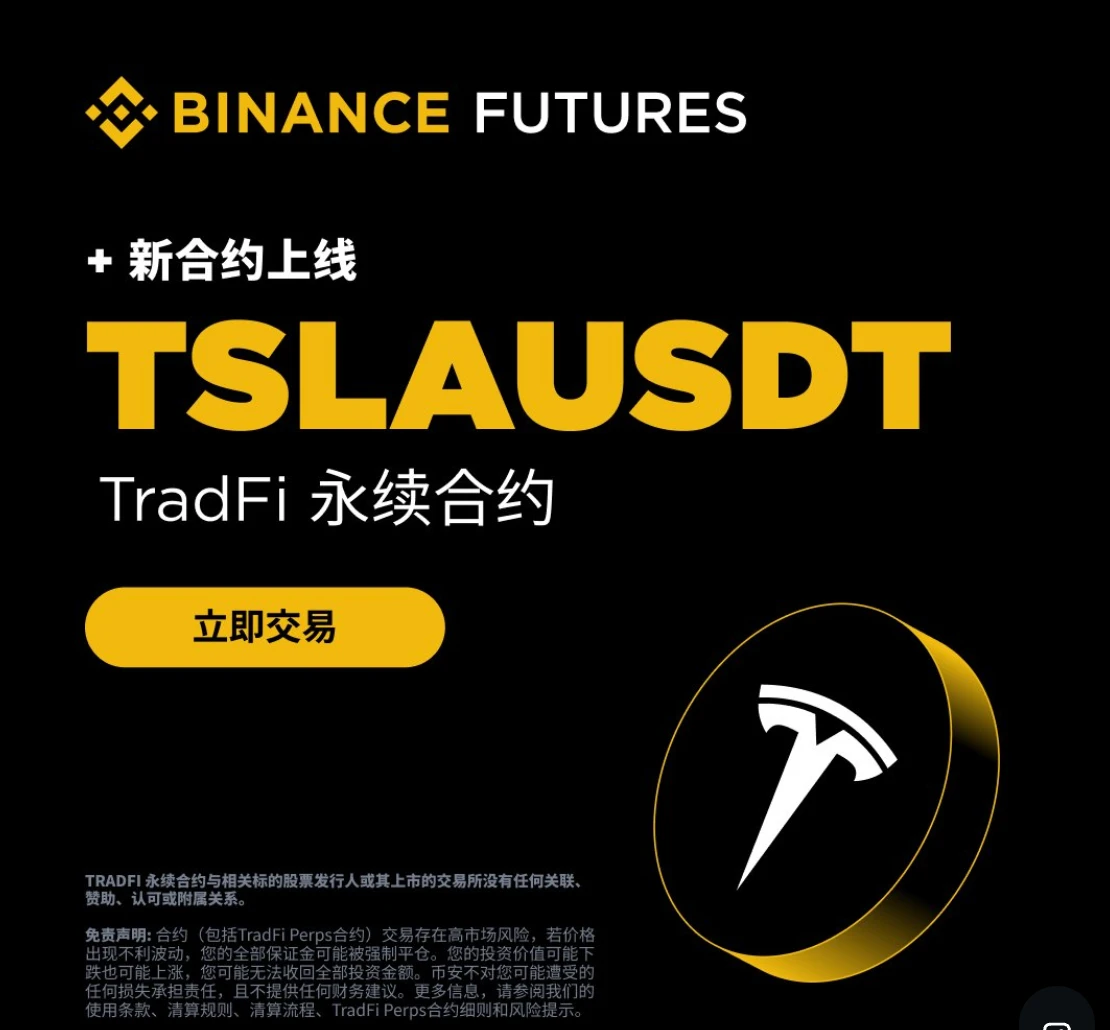
Tesla contract launched, Binance “seizes pricing power” from traditional stock markets

Tesla contract launched, Binance “seizes pricing power” from traditional stock markets

Author: Wenser Original title: Binance launches Tesla contract, pointing out that after the NASDAQ and NYSE submitted applications for stock tokenization transactions on the NASDAQ and NYSE, Binance, the largest crypto company, recently sounded the “trumpet of CeFi's counterattack against TradFi.” On January 24, a Binance spokesperson stated that “we are exploring re-listing the stock token”; two days later, Binance officially announced that “it will launch a Tesla (TSLA) stock perpetual contract on January 28, which supports up to 5 times leverage.” It's worth mentioning that this is another bold attempt by Binance after a lapse of 5 years since it stopped supporting stock tokens in July 2021. Time has passed, and various aspects such as the current market supervision environment and infrastructure construction have undergone drastic changes. Binance's move probably means that a “liquidity battle” between CEX and traditional stock exchanges has begun. The Daily Planet Daily will provide a brief analysis of this matter in this article for readers' reference. Tesla has once again become an experimental field for Binance's stock tokenization trading. What the short-lived “stock token experiment” in 2021 left to Binance was not only facing pressure from regulatory compliance forces, but also the power of CeFi to break down TradFi's power in traditional financial markets. Today, 5 years later, Binance's restart of stock token contract trading harbors greater ambition. The reason for this is a huge change in the following 3 areas: First, the “crypto-friendly attitude” of US government regulators. After the Biden administration stepped down, the Trump administration set off a “crypto storm” in the US and around the world, creating a “new crypto regulatory environment” through various means such as personnel appointments, organizational abolition, and the establishment of laws. The culture of the US crypto market was completely clear; second, the development of tokenized stock trading was in full swing. According to the rwa.xyz website, the total market value of the stock tokenization market is now reported at US$1,096 billion, the trading volume has exceeded US$1.86 billion in the past 30 days, the number of monthly active addresses has exceeded 107,700, and the number of holders has exceeded 170,000. Compared to the market capitalization of less than $500 million in December 2024, the milestone of doubling has been achieved in about a year. As NASDAQ and NYSE related applications may be approved by the US SEC this year, the size of the stock tokenization market will also usher in explosive growth; third, improvements in infrastructure construction such as stablecoins, oracles, and on-chain and off-chain settlement systems. After the GENIUS Act (Stablecoin Genius Act) was signed and passed in 2025, oracle projects such as Chainlink and Pyth Network were selected as official partners of the US Department of Commerce and a series of events such as the US banking system and open applications for crypto banking licenses. Compared to 2021, there was no technical lag in stock token development, listing, settlement, leverage, etc. Based on the above conditions, Binance once again opened the door to “stock contract trading” after connecting to ONDO Global Market, a tokenized stock trading platform. However, the deep meaning of Binance's move is probably due to the following 2 aspects: the first is to search for “new users.” According to Binance's official website, the total number of users has climbed to 306 million, which already accounts for half of the total number of crypto users in the world, which is around 600 million. There is no doubt that Binance has already entered a “bottleneck in user growth,” which is one of the main reasons why it has already begun to use traditional Internet promotion methods. Compared to the hundreds of millions or even a billion of global stock investors and investment institutions, the crypto community is just a “niche group.” In order to continue expanding and growing, Binance's exploration of new TradFi products is both a coincidence and a matter of necessity. The second is to find “additional commercial volume.” In 2025, the total trading volume of the Binance platform reached $34 trillion, even surpassing the 2025 annual stablecoin trading volume (the latter volume was $33 trillion), and it really deserved the name “the world's largest centralized exchange.” However, data details show that the Binance platform's spot-related trading volume is about 7.1 trillion US dollars, accounting for only 1/5 of the total trading volume; in other words, most of Binance's trading volume is still on the derivatives side of contracts, options, etc.; this is not only determined by Binance's own CEX business model, but also reflects the huge role of derivatives products in stimulating trading volume and earning platform fees. Meanwhile, the multi-trillion dollar stock market is Binance's coveted “next piece of cake.” There are good times and places, coins...

207d agoburnking#contract #Binance #Tesla #NASDAQ #NYSE
Inventory of 9 Perp DEX projects that are expected to be airdropped in 2026

Inventory of 9 Perp DEX projects that are expected to be airdropped in 2026

Author: fiyalkin, Crypto KOL Compilation: Felix, PanNews Original Article Title: Inventory of 9 Perp DEX Projects Expected to Airdrop in 2026 Recent crypto KOL fiyalkin has summarized a list of Perp DEX projects that may issue tokens in 2026, including a brief introduction and key data. These projects are all in the early stages of development, and no tokens have yet been issued. Details of the content are as follows. 1. VariationalVariational is a decentralized peer-to-peer (P2P) derivatives trading protocol built on Arbitrum. It focuses on on-chain trading, settlement, and settlement of broad derivatives such as perpetual contracts, options, and futures. Several applications have been developed based on the Variational Protocol, including Omni for simple perpetual contract transactions and Pro for advanced traders and institutions. Unique technology stack: Zero processing fees for all position transactions, only 0.1 USD processing fee for deposits and withdrawals. Loss rebates: When users close loss-making transactions on the Omni platform, there is a 2-4% chance that they will immediately receive a full loss refund. Broad market coverage: Omni supports sufficient liquidity in emerging markets such as RWA and volatility (485 markets in total): Omni's liquidity management system integrates liquidity from CEX, DEX, DeFi, and OTC channels. The program's points program went live less than a month ago. Early traders have shared 3 million points, and 150,000 points will be distributed every week. There are currently around 3.3 million points in circulation, which is still a very early stage considering that credit programs usually last about six months. Currently, Variational Agreements have an open contract (OI) size of $670 million; daily trading volume of $1.5 billion; and 12,000 weekly traders. Additionally, Variational raised $11.8 million between 2024-2025 from institutions such as Coinbase, Dragonfly, and Bain Capital Ventures. 2. Ethereal, the Ethereal DEX platform, is deeply integrated with Ethena Labs' synthetic dollar USDE to build a “one-stop DeFi application” with USdE as the core. Furthermore, Ethereal is the first DEX with margin to earn daily returns, and users can earn profit on their margin even while holding open positions, so every trade can generate compound interest. Ethereal is deployed as an EVM application chain and is configured as follows: Settlement through Arbitrum One Arbitrum execution environment Celestia data availability Currently, Ethereal's open positions have reached 45 million US dollars, daily trading volume is about 80 million US dollars, and the total number of traders has reached 8,000. 3. HibachiHibachi is a privacy-focused trading platform. It received a $5 million seed round in March 2025 from Dragonfly, Electric Capital, and Echo. Team members are from Citadel, Tower Research, IMC, Meta, Google, Hashflow, etc. Hibachi has now launched social networking features, upgraded chart annotation features, etc. Since the beta was released in June last year, the cumulative trading volume has exceeded 6.7 billion US dollars, daily trading volume has reached 7 million US dollars, open contracts (OI) have reached about 1.5 million US dollars, and there are more than 2,000 daily active traders. It has launched a new points system, and no tokens have been issued yet. 4. CascadeCascade is a new 24/7 broker offering a perpetual market covering cryptocurrencies, US stocks, and private equity assets with zero transaction fees. Currently, some invited depositors can access the platform and is expected to open to the public in early 2026. The platform will initially provide more than 10 sustainable markets, and the product lineup will be gradually expanded in the future. The project has evolved from including Polychain Capital, Variant, Coinbase Vent...

229d agoLuxurytracy#DEX #Perp