RWA · 2463

When US stocks opened, AI concept stocks generally rose, and ultra-microcomputers rose more than 2.66%

Comparative news, according to MSX.COM data, when US stocks opened, the Dow rose 0.52%, the S&P 500 index rose 0.41%, the NASDAQ rose 0.47%, and the VIX Panic Index fell 3.25%. AI concept stocks rose 2.66%, Baidu 2.43%, Astera Labs 2.19%, TSMC 2.03%, and Ambarella 1.87%. According to reports, MSX is a leading RWA trading platform. It has launched hundreds of RWA tokens, covering popular US stocks and ETF tokens such as Nvidia, GOOGL, MSFT, AMZN, META, TSM, and AMD.

23h ago

BounceBit Chain updates vulnerability attack progress: will permanently shut down the chain and migrate to BNB Chain

Comparatively, cross-chain revenue protocol BanceBit issued a security incident announcement stating that its blockchain network was attacked by a protocol-level vulnerability attack between 8:02 UTC on August 19 and 01:54 UTC on August 20. The attackers used authorization flaws in the Evmos underlying architecture to transfer BB tokens from 9 main network accounts without the authorization of the account owners. According to the announcement, the attackers transferred a total of approximately 286.5 million BBs through 14 transactions. The impact of the incident was limited to BanceBit Chain itself, and did not involve private key leaks, signature forgery, wallet, hardware devices, or exchange account security issues. BanceBit CeDeFi Strategy, Promo Vaults, Prime, and RWA products were not affected. BounceBit stated that the vulnerability stemmed from a protocol native module authorization verification flaw in the Evmos architecture. When calling the relevant module through a smart contract, the attackers bypass security checks that should verify the authorization relationship of the fund source account, making it possible to specify any account as the source of funds. After the incident, BounceBit Chain stopped generating blocks at block height 20,702,857, then the team decided not to upgrade the chain, but to permanently shut down Bouncbit Chain and re-issue BB as an BEP-20 token based on BNB Chain. BounceBit stated that the new BB token supply will be based on an on-chain snapshot before the first abnormal transfer (block height 20,697,260), and the 286,543,148 BBs transferred by the attackers will not be included in the new token balance. Users do not need to submit an application or migrate their wallets, and the official plan is to automatically distribute the new BB to the corresponding BNB Chain addresses. Regarding the BB in the pledge, BounceBit said it will be restored as soon as the snapshot is in time, and there is no need for coin holders to perform unbundling or redemption operations. Currently, BounceBit has submitted requests for suspension and assistance to relevant exchanges, and reminds users to be wary of scams and not to click on any BB migration or receipt links that have not been officially confirmed. The team said that the new BEP-20 BB contract address and reissue progress will be announced later. This article is sponsored by GENG, Build Your Fortune on GENG (https://geng.one)

23h agoburnking

Ansem: Optimistic about the performance of Robinhood chain-related targets in this cycle

Comparing news, crypto KOL Ansem said on the podcast that Robinhood is a potential dark horse in this market cycle due to its public support for on-chain activities (including meme coins and RWA) and rapid token listing. Ansem believes Robinhood's positive attitude could attract more retail liquidity and innovative projects, highlighting the rapid adaptation of traditional financial platforms to the crypto sector.

1d ago
If it's just tokenized assets and doesn't connect to DeFi, what's left of RWA?

If it's just tokenized assets and doesn't connect to DeFi, what's left of RWA?

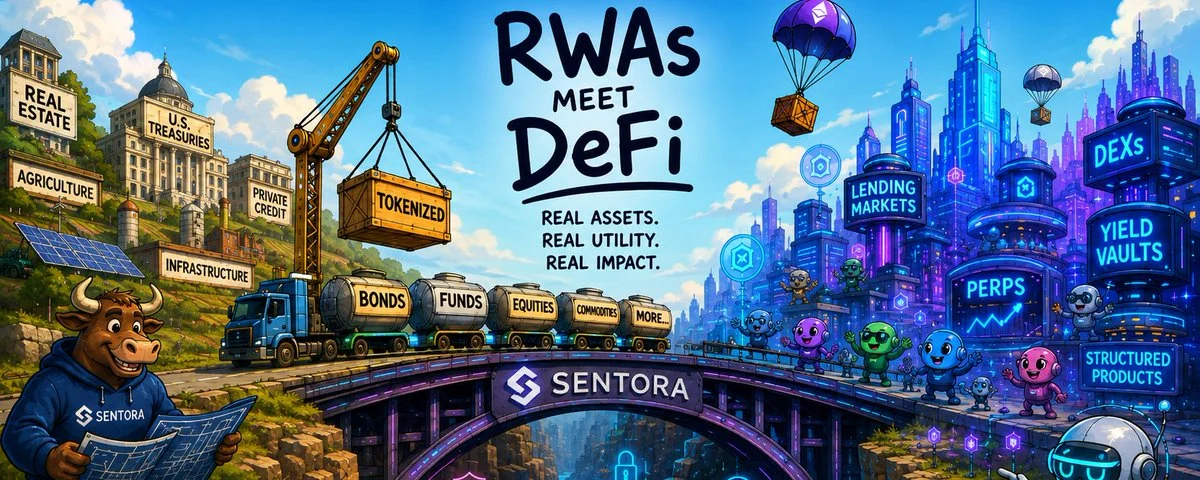
Author: Jesus Rodriguez, co-founder of Sentora Compiled by: Luffy, Foresight News Original title: Does RWA still make sense without DeFi? Discussions in the RWA industry often begin with a simple vision: take a treasury bill, fund share, stock, invoice, megawatt hour, or GPU for one hour, then mint a token representing it. Is it useful? It's really useful. But can it be called transformative? It's far from there. This is like putting a bar code on a container and claiming that a global trade problem has been solved. Barcodes make containers recognizable and machine-readable, but they don't create ports, cranes, customs, insurance, financing, shipping routes out of thin air, or bring in buyers from afar. A token is simply an addressable token of interest, and DeFi is a marketplace operating system. The question really worth discussing is not how many types of assets can go on the chain, but how many assets can complete valuation, financing, hedging, transaction monetization, and loss disposal in a stressful environment, and there is no need for offline meetings and coordination every time a transaction occurs. Tokenization completes the representation of equity; what DeFi brings is actual utility. Tokenization is just a bar code, and a similar scene has happened in the history of the supply chain finance market. The reason why mortgages can be scaled up is not as simple as turning a paper document into an electronic record. To actually achieve large-scale expansion, a complete set of operating mechanisms was created around this type of asset: credit review, post-loan services, securitization, credit rating, warehousing and financing, repurchases, hedging, clearing and settlement, and loss allocation rules. RWA also needed to go through the exact same evolutionary process. An asset that can be adapted to DeFi requires six levels: legally enforceable rights, reliable data sources, clear transfer and redemption rules, enforceable secondary market liquidity, collateral parameters that match actual behavior, and a credible settlement and loss disposal path. Most tokenization projects, on the other hand, tend to stop at the top five levels. There is a simple test that can be used to test the maturity of an asset. It only requires answering three questions: How much is this asset currently worth? Can the agreement complete withdrawal and monetization at this point? If the first two judgments are all wrong, who bears the loss? When smart contracts can definitively answer the above three questions, RWA can truly become a basic component of finance. Before that, it was mostly just a digital packaging shell. The deepest technical contradiction of RWA's quadruple time clock is that RWA runs under multiple sets of different time clocks at the same time. The blockchain can complete settlement in seconds and operate uninterrupted for 7 x 24 hours; oracles may update prices every hour or every day; underlying traditional exchanges are closed at night and on weekends; custodians follow bank working days; and the asset redemption process may take 1 day, 5 days, or even 30 days. If you use such a slow-paced RWA asset to support fast-maturing DeFi liabilities, such as stablecoin loans. This is the term shift, and it is also the core model that banks have relied on for hundreds of years: using short-term debt to fund long-term slow assets. This model has practical value, but the risk must be reasonably priced. Imagine a scenario: At 2 a.m. on Sunday, assets hit the liquidation threshold. Smart contracts can seize tokens immediately, but the underlying real-world market won't open until Monday, and the issuer's redemption business will not be processed until Tuesday. On-chain liquidation has been completed, and real-world asset disposal has only just begun. This creates a clearing gap. DeFi requires immediate withdrawal for monetization, but the real world does not allow it. The time difference between the two. This gap has counterintuitive consequences. Even treasury bonds with very low volatility are riskier than native crypto assets that are more volatile when used as collateral. The price of ETH fluctuates drastically, but it can be traded around the clock; the price of RWA assets appears to be stable, and it may only be up to a dozen hours without a new price tag. A flat price sometimes represents safety, and sometimes it's just a disguise of stale data. Liquidity is an exit channel, not TVL. The digital public also has common misunderstandings about liquidity. Liquidity is not equal to TVL, does not equal the existence of a trading pair, nor does it mean that the issuer promises to eventually redeem it according to net worth. Liquidity refers to the ability to convert a position into the settlement asset you need at an acceptable discount within the time window allowed by your debt. Take a crowded theater for example: the size of the hall cannot determine whether it is safe in the event of a fire; what really matters is the width of the exit channel. One copy of RWA to...

1d agoForesight News#DeFi #RWA

CZ: Supporting the promotion of asset tokenization on all blockchains can help countries attract foreign direct investment

Comparing news, CZ posted an article on the X platform saying that tokenization is one of the best ways for countries to raise capital or attract foreign direct investment, and called for “tokenizing everything.” He said that countries or companies can sell tokenized shares globally. CZ supports tokenization on all blockchains, and says this approach will cause liquidity fragmentation; if a high degree of interchangeability is achieved between different issuers, the fragmentation problem can be solved to a certain extent. CZ also relayed data from BNB Chain, which showed that the number of RWA holders on BNB Chain reached 776,000, an increase of about 370% in 30 days.

1d ago
Millions of dollars are rushing into the market, but some are in a hurry to exit: Pharos's high-interest treasury causes a “view of time” collision

Millions of dollars are rushing into the market, but some are in a hurry to exit: Pharos's high-interest treasury causes a “view of time” collision

Article: Sanqing, Foresight NewsSharos Network joined forces with Vault infrastructure agreement R25 and credit asset management agency Axil to launch Axil Prime Credit Vault (APC), an institutional consumer credit RWA wealth management product issued by Pharos on July 15. The products were launched simultaneously with Binance Wallet, TopNod, OKX Wallet, Bitget Wallet, and KuCoin Wallet, with a total fundraising limit of 100 million USDC, with a target annualization of about 14.3%. As of the closing of the deposit window, a total of $45.39 million had been deposited. This year, there have been frequent security explosions in Web3 on-chain strategies. User funds are looking for new stable income sources, and project parties are also there. Binance Wallet is now offering an additional $300,000 PROS as an incentive to explore RWA Vault's market space, causing the Vault to generate a lot of discussion in the market. The launch time coincided with the redemption period of the Pharos TGE pre-deposit campaign. The previous treasury required the submission of a redemption application about half a month before the end of the lockdown period, stop accruing interest on July 20, and complete the redemption within 7 days. Users accustomed to DeFi T+0 looked back and found that they couldn't help but missed the redemption period and began to question the redemption time and asset safety. R25 and Axil then held an AMA at Binance Square. Well-known KOLs such as Haotian and Tianqing participated in discussions, detailing the differences between RWA assets and DeFi Vault, the role of fund managers (Curators), why consumer credit is worth allocating, and risk management methods from pre-investment to post-investment. In complex asset logic and mixed social media discussions, some users put in one million funds on the last day, while others sought early redemptions from the project party. On July 23, Pharos issued an announcement: Users who submitted applications on time in the previous issue have received all principal and interest, breaking the “financial security” concerns; funds that missed the window will automatically be carried forward to the next three-month cycle according to the treasury's preset rules, and interest will continue to be accrued at 14% USDC per annum. The controversy revealed more important issues than the redemption itself. Although the RWA TVL has exceeded $38 billion, non-institutional chain users are clearly dissatisfied when investing in RWA products. Institution-driven, stable, and high interest rates, but often require longer lockdown periods and complex understanding costs. From DeFi to RWA, is the market really ready? High yield, low threshold, and high liquidity. BlackRock's “impossible triangle” of RWA's BUIDL threshold is $5 million. It is only open to qualified buyers, yet it can be redeemed almost instantly through the stablecoin channel; the APC threshold is so low that ordinary users can buy it at will; instead, it must be locked for three months. Liquidity has never been determined by how high or low the threshold is, but rather how quickly the underlying assets can be realized. The bottom layer of BUIDL is US treasury bonds, and the world's deepest secondary market can take over at any time; the bottom layer of APC is hundreds of thousands of emerging market consumer loans, and few people are ready to buy large amounts of capital at any time. This has formed a triangle that RWA cannot bypass at this stage: high yield, low threshold, and high liquidity; the three can only take two. For example, Franklin Templeton's BENJI starts at $20 (low threshold) and supports daily redemption (high liquidity), and the annualization is only 3% to 5%; if you want double-digit returns, you have to accept non-standard assets and a lock-up period. This is the liquidity premium. A significant portion of the excess income is the consideration for abandoning liquidity. APC, on the other hand, is a combination of high returns and a low threshold, and the cost is liquidity. There is nothing wrong with this trade-off itself; it also explains the full source of this controversy. Retail investors have obtained assets that were originally only open to institutions, and they have also taken over the agency's time rules that focus on long-term matching. The period of use of institutional funds is scheduled before investment, and the lockdown period is a predictable cost; private equity credit and closed-end funds already have redemption restrictions. However, most ordinary users on the chain are not the same; most of the latter's first appeal is to go in and out. So the current “retail” RWA is mostly just distribution-side retailing, to be precise. Web3 wallets and low initial investment amounts have contributed to a low threshold, but the liquidity structure is still designed according to institutional logic. Having understood this triangle, the remaining questions became specific: why must the liquidity side be sacrificed, a high income of 14.3%...

1d agoForesight News#WEB3

AI-concept stocks had mixed ups and downs before the US market, and AVGO rose 1.01%

Comparative news, according to MSX.COM data, pre-market AI concept stocks had mixed ups and downs. MRVL fell 0.54%, AMD rose 0.29%, GOOGL fell 0.36%, MU rose 0.89%, and AVGO rose 1.01%. According to reports, MSX.COM is a decentralized RWA trading platform. It has launched hundreds of RWA tokens, covering AAPL, AMZN, GOOGL, META, MSFT, NFLX, NVDA and other US stocks and ETF tokens.

2d ago

US stocks closed, AI concept stocks generally rose, and Tempus AI rose more than 24.09%

Comparative news, according to MSX.COM data, the US stock market closed up 0.22%, the S&P 500 closed up 0.21%, the NASDAQ closed up 0.16%, and the VIX Panic Index closed down 6%. AI concept stocks generally rose, with Tempus AI up 24.09%, Marvell 9.85%, EPAM 7.1%, Atlassian 6.89%, and ServiceNow up 6.45%. According to reports, MSX is a leading RWA trading platform. It has launched hundreds of RWA tokens, covering popular US stocks and ETF tokens such as Nvidia, GOOGL, MSFT, AMZN, META, TSM, and AMD.

2d ago

Coinbase selects Abu Dhabi as international tokenization hub

According to Twitter, cryptocurrency exchange Coinbase has reportedly selected Abu Dhabi, UAE as its “international tokenization center” with the aim of introducing more traditional financial assets to the blockchain. The move is seen as a significant step forward for Abu Dhabi in attracting global crypto and fintech firms. Coinbase plans to promote real-world asset (RWA) tokenization business through the center and expand its presence in the Middle East and international markets with Abu Dhabi's regulatory environment and policy support. Abu Dhabi has continued to improve its digital asset regulatory framework in recent years, attracting many crypto institutions to settle in.

2d ago