gamefi · 1580

Data: The crypto sector had mixed ups and downs, BTC surpassed $65,000, and the GameFi sector fell nearly 4%

Comparative news, according to SosoValue data, the overall crypto market sector showed a slight upward trend. Bitcoin (BTC) rose 0.57% to break through $65,000; Ethereum (ETH) rose 0.48% to break through $1,900. The Meme sector showed outstanding performance, rising 0.36% in 24 hours. Among them, Tutorial (TUT) rose 52.38%, Pump.fun (PUMP) rose 11.39%, and Pepe (PEPE) and FLOKI rose 2.47% and 2.81% respectively. In other sectors, the Layer1 sector rose 0.27% in 24 hours, with Solana (SOL) up 1.44%; PayFi up 0.25%, Monero (XMR) up 3.8%; CeFi up 0.14% and Aster (ASTER) up 1.59%; Layer2 sector down 0.23%, zkSync (ZK) up 2.41%; DeFi sector down 0.91%, Curve DAO (XMR) CRV) rose 6.39%; furthermore, the AI sector fell 1.76%, but Worldcoin (WLD) rose 6.61%; GameFi fell 3.97%; within the sector, Audiera (BEAT) fell 6.65%, and WEMIX fell 3.08%. The crypto sector index, which reflects the historical market of the sector, shows that the ssINFT, SSImeme, and SSIAI indices rose by 2.85%, 0.63%, and 0.6%, respectively.


12d ago

DeFi Kingdoms: DFK Chain will stop operating on August 28

In comparison, GameFi project DeFi Kingdoms announced that its DFK Chain based on Avalanche L1 (formerly Avalanche Subnet) will officially cease operation on August 28, 2026. The team said it will prioritize the secure migration of player assets to Avalanche C-Chain, and plans to open the SDK to allow third-party developers to develop based on DeFi Kingdoms' systems, mechanisms and assets. Officials emphasized that it was DFK Chain that stopped running this time, not the DeFi Kingdoms project itself, and more asset migration details will be announced in the coming weeks.

21d ago
The 2026 H1 Crypto VC Report Unveiled What Cruel Signals

The 2026 H1 Crypto VC Report Unveiled What Cruel Signals

Source: Tiger Research Authors: Henry Kim, Ryan Yoon Compiled and edited by: BitPushNews Crypto market capital is undergoing a paradigm shift — funding is being concentrated at an accelerated pace on specific tracks and leading companies. Tiger Research and RootData jointly analyzed a total of 9,416 investment transaction data from 2018 to the first half of 2026 to outline the changing trajectory of this capital pattern. The core finding was that in the first half of 2026, capital inflows to the crypto market reached $13.3 billion, almost the same as the full year of 2024's $13.2 billion. However, funding rounds plummeted to just 435, a sharp drop of 78% from the 2022 peak of 1,978. The market is rapidly dividing: on one end there are a few large crypto-native venture capital firms that focus on leading investors, and on the other end are subsidiary investment departments that rely on exchange liquidity. Mid-sized funds, which are sandwiched in the middle and lack a clear competitive advantage, are being pushed out of the table at a speed visible to the naked eye. Game circuit funding rounds plummeted from 141 in 2024 to just 5 in the first half of 2026, a drop of 96%. The payments and stablecoin circuit, as well as capital inflows to the centralized exchange (CEX) circuit, are almost all driven by mergers and acquisitions. Traditional financial institutions participated in 54.5% of all investment transactions recorded in the first half of 2026. 1. 2021 Market Review: Using speed and diversification as a strategy The core strategy of the 2021 crypto investment market is to pursue speed and diversification of portfolios. In that year, investors executed a total of 1,750 transactions (including seed rounds), and competition for speed was so intense that AU21 Capital alone was able to close more than 13 transactions per month on average. Investment decisions at the time were reduced to extremely simple standards, such as token generation event (TGE) timelines and tokenomics (tokenomics, a structure that governs how project tokens are issued and distributed). Since issuing tokens alone can generate returns without any actual product development, venture investors largely pursue a “spray and pray” (spray and pray) strategy, spreading funds across hundreds of projects, regardless of their high or low valuations. Speed of execution was placed above strict due diligence. A new round of financing can close almost instantly, and venture capital firms that miss one round tend to chase the next project with a higher valuation. This fear of misunderstanding (FOMO) continues to circulate throughout the industry. Most VCs running this strategy failed to survive the subsequent bear market, and those that survived fundamentally changed their investment methods. 2. Which VCs have survived: The industry landscape has changed 2.1. Lead investment: The first indicator we need to examine in the past and present is “lead investment” (Lead Investment), which is the funding round that major venture capital companies have historically dominated. Some venture capital firms are still active in leading investment deals, while others have completely disappeared or only recently emerged. Since leading a round of financing has always required the reputation and capital scale only large venture capitalists have, companies that have led major rounds in the past have shown strong resilience, and most of them are still in the top ten today. 2.2. The differentiation of surviving venture capital, judging from the latest data from 2024 to 2026, crypto-native venture capital firms and established large institutions are concentrating their resources on leading investment transactions and participating more deeply in a single transaction. They changed their business model: reducing the overall number of transactions while raising the due diligence threshold, and actively seeking board seats and more influence over project governance. However, the cumulative number of regular round participation (round participation) outside of leading investment transactions showed a very different picture. Among the top 15 venture capital firms that participated from 2024 to the first half of 2026, venture capital institutions under the exchange account for a large share. Exchanges are far more willing to participate in financing rounds than lead investors. Among them, Coinbase Ventures ranked first with 140 transactions, OKX Ventures ranked second with 94, and yZi Labs ranked third with 92. Note: yZi Labs...

38d agoWendy#CEX #DEX #VC #invests #depths #financing
Tiger Research: Crypto employment report for the first half of 2026, the most stable job is actually...

Tiger Research: Crypto employment report for the first half of 2026, the most stable job is actually...

Source: Tiger Research Authors: Henry Kim and Ryan Yoon Compiled and edited by: BitPushNews Key Findings The cryptocurrency job market has yet to recover to its peak in 2022. According to Coincub data, the number of new cryptocurrency jobs reached 66,494 in 2025, a 47% rebound from the previous year, but still below the 2022 high. The contraction intensified in 2026, and newly posted jobs on mainstream recruitment platforms fell by about 80% year-on-year in January. Of the 2,932 active job postings in the first half of 2026, engineering jobs ranked first with 34.1%, while compliance/legal positions ranked second with 10.4%. Active job postings focus mainly on regulatory compliance and technology development. From an industry perspective, centralized exchanges (CEX, accounting for 30.8%) and the stablecoin/payments sector (13.4%) together account for nearly half of recruitment demand. The gaming and NFT sector accounts for 2.4%. In the past, the market was driven by token sales, and recruitment demand focused on community and token sales positions. As the market shifts to institutional participation, the ability to manage product operations and regulatory compliance becomes increasingly important. 1. Peak recruitment in 2021-2022 and current market position The most active recruitment period in the cryptocurrency sector is from the end of 2021 to the first half of 2022. At the time, Bitcoin and Ethereum reached record highs, NFT trading volume surged, and DeFi's total hedged value (TVL) reached hundreds of billions of dollars. Centralized exchanges have aggressively expanded to support global business operations. At the time, Coinbase had over 250 vacancies, Kraken over 300, and Binance over 600. DeFi protocols and the NFT marketplace have simultaneously absorbed large numbers of engineers and marketers, and the GameFi craze has also brought game studios into the recruitment pool. At the time, “expansion” took priority over “proof of profitability.” Beginning in the second half of 2022, the number of new job postings dropped dramatically. Between 2022 and 2023, crypto-related jobs in North America and most of Europe fell by around 40%. The downturn of FTX was exacerbated by the collapse of FTX in November 2022, and the market has not been able to return to peak levels since then. To assess the current state of cryptocurrency recruitment and interpret market direction from the data, Tiger Research has compiled an exclusive data set of 2,932 active job postings (as of June 2026). The data is collected through manual tracking of web3.career, cryptocurrencies jobs.co, direct recruitment pages of major companies (Greenhouse, Ashby, and Lever), and local Korean recruitment platforms (Wanted and Jobkorea). DAO contributor roles, freelance jobs, and contractual arrangements are not included. 2. Mainstream crypto companies continued to lay off workers in the first half of 2026 and restructuring began long before the first half of 2026. Wisely and Consensys made layoffs in the second half of 2025, a trend that continued to major exchanges including Coinbase, Gemini, Crypto.com, and Kraken in 2026. March was the month with the highest concentration of layoff announcements for the first half of 2026. A total of six companies announced layoffs in the same month: Gemini, Crypto.com, Algorand, OP Labs, PIP Labs, and Messari. In the first quarter of 2026, geopolitical tension caused by the situation in Iran coexisted with broader market weakness, and companies that needed to reset their strategic direction seemed to use March as a starting point for action. The reasons for layoffs vary from company to company. Algorand mentioned the macro environment and the decline in token prices. Crypto.com and Gemini point to artificial intelligence (AI) integration. Coinbase announced a shift to becoming an “AI native company.” For some companies, repeated layoffs eventually led to acquisitions, and the purchase price was only a fraction of their previous valuation. Messari went through three consecutive rounds of layoffs starting in 2023, and was sold by Blockworks for about 1,000 in June 2026...

60d agoWendy#CEX #Tiger Research #Exchanges #compliance #employment #layoffs

Most of the crypto market rose, with the AI sector rising nearly 3%, while only PayFi and GameFi sectors declined slightly

Comparative news, according to SosoValue data, most of the crypto market sectors rose, with the AI sector showing outstanding performance, rising 2.87% in 24 hours. Among them, Unibase (UB) rose 54.91%, Billions Network (BILL) rose 8.37%, and Worldcoin (WLD) rose 6.26%. Sectors that performed well also included: the DeFi sector rose 1.02% in 24 hours, and within the sector, LAB (LAB) rose 20.69%; the CeFi sector rose 0.63% and OKB (OKB) rose 1.41%; the Meme sector rose 0.56%, OFFICIAL TRUMP (TRUMP) rose 7.77%; the Layer 2 sector rose 0.21%, and Polygon (ex-matic) (POL) rose 0.93%; the Layer 1 sector rose 0.20%, and Aptos (OKB) rose 1.41% (APT) rose 2.76% In other sectors, PayFi fell 0.03%, but Ultima (ULTIMA) rose 5.08%; GameFi fell 2.61%, and Axie Infinity (AXS) fell sharply by 14.40%. The crypto sector index, which reflects the historical market of the sector, shows that the SSImeme, SSIceFi, and SSImag7 indices rose 0.79%, 0.66%, and 0.60% respectively.

61d ago

Data: The crypto market generally declined, with only the NFT, GameFi, and SocialFi sectors rising

Comparative news, according to SosoValue data, the overall crypto market sector showed a downward trend, with the DeFi sector falling 5.08% in 24 hours. Among them, Hyperliquid (HYPE) fell 8.86% and LAB (LAB) fell 25.19%. Meanwhile, Bitcoin (BTC) fell 1.50%, falling below $62,000; Ethereum (ETH) fell 1.65%, falling below $1,700. Furthermore, the NFT sector reversed the market and rose 4.57%, with Audiera (BEAT) rising 9.51%. In terms of other sectors, the CeFi sector fell 0.20% in 24 hours. Within the sector, Gate (GT) was relatively strong, up 1.10%; the Layer 2 sector fell 0.36%, but zkSync (ZK) rose 5.66%. The Layer 1 sector fell 1.45%, and NEAR Protocol (NEAR) pulled up 5.09% intraday; the Meme sector fell 2.05%, and Cheems Token (CHEEMS) reversed the market and rose 6.47%; the PayFi sector fell 2.10%, but Litecoin (LTC) rose 1.27%. The crypto sector index, which reflects the sector's historical market, shows that SSIsocialFi, SSIDeFi, and SSIai indices rose 0.20%, fell 5.23%, and fell 3.76%, respectively.

73d ago
Avenir Group bets on WasabiCard: Why are U-cards declining and stablecoin payments becoming more pleasant?

Avenir Group bets on WasabiCard: Why are U-cards declining and stablecoin payments becoming more pleasant?

The dividends of capital betting card issuance, compliance, settlement, and enterprise APIs, and stablecoin payments are shifting from “card” to “bottom tier.” Writer: Farmer Frank Lee Lin is betting again. On June 3, 2026, WasabiCard, a global stablecoin payment infrastructure platform, completed a pre-A round of financing. Counting the previous early rounds, the cumulative funding was close to $10 million. Investors include Vernal Capital, Avenir Group, Vision Plus Capital, and 01VC — of which Avenir Group is Li Lin's family office. Interestingly, almost back-and-forth, another piece of news went viral in the community: Fiat24 suspended new account applications in mainland China, while various encrypted payment card services familiar to Chinese users, such as SafePal and Bitget Wallet, all have partnerships with Fiat24's ability to issue cards. On the one hand, capital is being added to an “invisible” payment infrastructure company, and on the other hand, the underlying service provider directly affects some front-end card products due to policy adjustments. Looking at the same point in time, it just provides an opportunity to re-examine the stablecoin payment circuit. And behind this incision is a real demand that is rapidly expanding. 1. U-card decline: The decline is not demand; it is the model. According to the Fireblocks' “State of Stablecoins 2025” report, 49% of the institutions surveyed are already using stablecoins in payment scenarios, while another 41% are in the testing or planning stage, which means that nearly 90% of institutions are already exposed to stablecoin payments in some way. Demand is rising, but the way demand is being met is changing. As we all know, the most discussed form of stablecoin payment in the Chinese market in the past few years is almost a “U card”: users transfer stablecoins such as USDT and USDC to card products and then use them for online subscriptions, purchases, or offline payments, which is also the easiest for everyone to understand and accept. But the U card is just the front end that users can see. What is really complicated behind a card is card issuance qualifications, card organization cooperation, KYC/AML, risk control systems, stablecoin and fiat currency exchange, settlement networks, merchant channels, and cross-border payment capabilities. However, what is often remembered by users is front-end user-facing brands such as RedotPay, KAST, and Crypto.com, but institutions such as WasabiCard are not well known. In fact, thanks to infrastructure companies such as WasabiCard, today it's not difficult to “issue a card” alone. The project party can completely hand over all aspects such as stablecoin acceptance, quota allocation, card issuance, and consumption channels to a third party service provider. In a sense, this is also an important reason for the rapid spread of U-card products over the past few years. So Fiat24's tighter account opening is just an introduction. The real problem is that the C-end U card, which has spread rapidly in the past few years, is essentially a “light front-end, heavy external dependency” model. It has outsourced all the most difficult aspects. The main thing left behind is the brand, customer acquisition, and that level of user interface. Although this solved the problem of “spending U”, it did not solve the problem of “how to continue this business in a long-term, stable, and compliant manner”. Over the past year, many front-end card products have shrunk or even left the market. It has been repeatedly shown that front-end experience alone cannot support a payment business that can go through the cycle. This is critical. U card products can be copied, subsidies can be followed up, and users can rapidly migrate with rates, risk control, and usability. What is really difficult to replicate is back-office capability: can it maintain stable card issuance and billing cooperation in multiple markets; can it handle identity authentication and anti-money laundering requirements in different jurisdictions; can it maintain consistent capital flow and information flow between stablecoin recharges, fiat currency exchange, card consumption, and merchant settlement; whether Avenir Group can form a mature and adequate risk control system in abnormal transactions, high-risk addresses, chargebacks, freezes, and compliance reviews; this is also Avenir Group's ability to form a mature and adequate risk control system; The logical starting point for many institutions to bet on WasabiCard — what institutions are looking at is probably not another crypto card product, but a stablecoin payment business that is moving from a “card” to a “bottom”. 2. Why did Avenir Group bet on WasabiCard Over the past few years, the crypto market has not lacked a grand narrative. From DeFi, NFTs, Ga...

74d agoWeb3 农民 Frank#Stablecoin payments

Data: The crypto sector generally declined, the DeFi sector fell more than 9%, and BTC rebounded slightly

Comparative news, according to SosoValue data, the crypto market sector generally declined, with the DeFi sector falling 9.16% in 24 hours. Within the sector, Hyperliquid (HYPE), which had previously continuously broken historical records, pulled back 9.15%, and LAB (LAB) fell 37.47%, but DeXe (DEXE) bucked the trend and rose 14.58%. However, GameFi and the NFT sector were relatively strong, rising 0.49% and 1.38% respectively. Within the GameFi sector, Audiera (BEAT) rose sharply by 20.27%, and within the NFT sector, APENFT (NFT) rose 0.15%. Additionally, Bitcoin (BTC) rebounded slightly by 1.33% to surpass $63,000; Ethereum (ETH) continued to fall 0.92% below $1,800. In other sectors, the CeFi sector fell 1.37% in 24 hours, and Cronos (CRO) rose 0.12%; the PayFi sector fell 1.55% and Telcoin (TEL) rose 24.29%; the Meme sector fell 2.01%, but Siren (SIREN) rose 28.48%; the Layer 1 sector fell 4.1%, Humanity (H) was relatively strong, up 3.9%; the Layer 2 sector fell 5.59%. Starknet (STRK) pulled up 3.48% in the intraday period. The crypto sector index, which reflects the sector's historical market, showed that SSIsocialFi, SSIAI, and SSIDepin indices fell 8.9%, 8.4%, and 7.49%, respectively.

78d ago

Data: The crypto market is divided, with the SocialFi sector up more than 5.5% and the GameFi sector down more than 6%

Comparative news, according to SosoValue data, the crypto market sector had mixed ups and downs, and the SocialFi sector rose 5.90% in 24 hours. Within the sector, Toncoin (TON) rose sharply by 8.73%. The DePin sector rose 2.99%, and within the sector, Render (RENDER) rose 9.24% and Grass (GRASS) rose 13.67%. In other sectors, the AI sector rose 0.06%, Unibase (UB) rose 18.95%; the Layer 2 sector rose 0.06%, and Celestia (TIA) rose 11.44%. Furthermore, the Layer 1 sector fell 0.28%, but NEAR Protocol (NEAR) rose 12.14%; the CeFi sector fell 0.35%, and Bitget Token (BGB) was relatively strong, up 0.71%; the Meme sector fell 1.23%, and MemeCore (M) bucked the trend and rose 3.63%; the PayFi sector fell 1.26%, and Ultima (ULTIMA) pulled up 1.59% intraday; the DeFi sector fell 2.22%, Hyperliquid (HYPE) pulled back 3.28% after reaching a record high, falling below $60. The crypto sector index, which reflects the sector's historical market, shows that SSIsocialFi and SSILayer2 indices rose 7.27% and 0.09%, respectively, while the SSIRWA index fell 9.13%.

88d ago
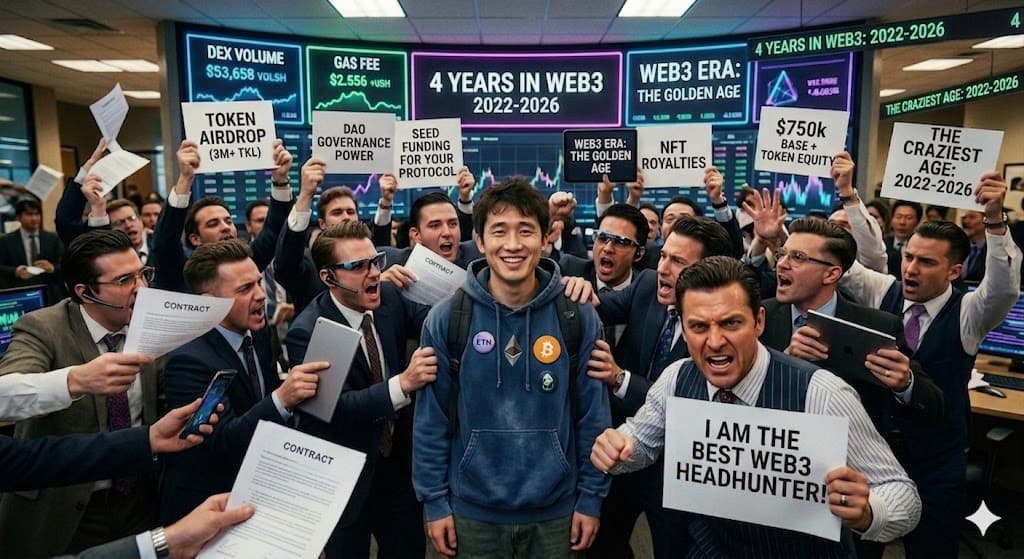
I've been a headhunter for four years on Web3: I've seen the craziest robbers, and I've also seen it quietly transition to AI

I've been a headhunter for four years on Web3: I've seen the craziest robbers, and I've also seen it quietly transition to AI

Author: Joe Zhou, Foresight News Original title: I've been a headhunter in Web3 for 4 years: I've seen the craziest human robbery era, and I've been a headhunter for 4 years on Web3. At the craziest time, a Web3 company burned our recruitment budget of over 20 million in one quarter. Fresh graduates can earn one million a year after entering the business for half a year. The project party just finished financing in the morning and began recruiting 30 people in one go in the afternoon. At that stage, the entire industry was like an uncontrolled money printer. Doubling wages, no work, global remote, token incentives... everyone thinks Web3 money will continue to flow in this way. Even I myself began to think that this industry might actually go crazy forever. However, starting in the second half of 2025, it suddenly cooled down. There is less and less funding news, and the recruitment of HCs on the project side has shrunk in a round, and many bosses who had aggressively (aggressively) expanded before are slowly losing their jobs. Some people are starting to travel. Some companies even just disappeared. Headhunters are the industry's thermometer. The craziness and desolation of all racetracks will be reflected first and most realistically in recruitment needs. This is me, as a Web3 headhunter, that I have seen with my own eyes the madness, bubbles, cooling down, and reorganization over the past four years. “At its craziest, one company burned 20 million.” Four years ago, I first started working as a Web3 headhunter. At the time, I didn't understand anything, and I couldn't even explain what blockchain was. I only know that the company suddenly connected with a “technology-based project partner”. It's so mysterious that I'm not even too embarrassed to say the name. As a result, we helped them recruit almost 20 people and collected 3 million in headhunting fees. You read that right. One company, in one quarter, recruits 20 or 30 people and pays more than 3 million for headhunting alone. If calculated at a rate of 25% of headhunting fees, the combined annual salary of these people is at least 12 million or more. Coupled with benefits, bonuses, etc., this company spent at least 20 million dollars a year on only the money it burned on the “person” found by a headhunter, and there were many similar stories in that year. At that time, Web3, almost every project was expanding like crazy. Many companies have just completed their financing. The first thing they do is not to make a product, but to set up a team first. It doesn't matter if the product comes out first. People must grab it first. One time I was particularly impressed by helping a leading crypto company promote a fresh graduate. To be honest, I was hesitant at first — customers wanted younger ones, but they couldn't be new. However, that kid has a really good background. He graduated from the top 3 universities, and also worked on blockchain-related scientific research projects during his college years. After learning about this company, he showed great enthusiasm, thought the project was valuable, and also had his own unique opinion on the industry, which is rare. We generally don't promote fresh graduates; after all, most of them don't have any practical experience. But I still had the mentality of trying it out and recommended him to a leading crypto company. As a result, the other party directly paid an annual salary of nearly one million. He also had other offers, but this one was clearly higher. The overall market was good that year. By the end of the year, his performance, along with salary increases and year-end bonuses, in less than a year — half a year to be exact — he actually earned more than one million dollars. Are you saying this is an ability? Is it luck? Or is it a gift of the times? I think they have it all. People have been sensing the temperature of the industry for a long time. The first thing I do every day is brush up on financing news. From 2022 to the first half of 2023, Web3 received more than a dozen financing messages every day, worth tens of millions of dollars at a loss. It's impossible for us to get in touch with every company. So then our logic was simple: focus only on the projects with the highest amount of financing. Because they are the richest and the most willing to expand. In those few years, the entire industry was in a state of extreme excitement. As soon as the project was funded, jobs were already being released. Some teams don't even have a full product. There is only one PPT. But even that doesn't prevent them from opening dozens of HC (recruitment places) in one go. That stage is also the best time for headhunters to make money. Many projects, from 0 to 1, are frantically robbing people at home. There are also many people who realized for the first time that they can earn far more money than they used to do in major internet companies without attending classes. To this day, leading exchanges are still recruiting people steadily. But the logic is completely different from what it used to be. It used to be an expansion. Now it's more of a normal business iteration. New businesses will only add a little HC. Moreover, recruitment requirements are significantly higher. They want the new recruits to be better than the original employees. Overall, the top deal...

89d agoburnking#AI topics #OpenClaw topics #WEB3