


Avenir Group bets on WasabiCard: Why are U-cards declining and stablecoin payments becoming more pleasant?

The dividends of capital betting card issuance, compliance, settlement, and enterprise APIs, and stablecoin payments are shifting from “card” to “bottom tier.”
By Farmer Frank
Li Lin placed another bet.
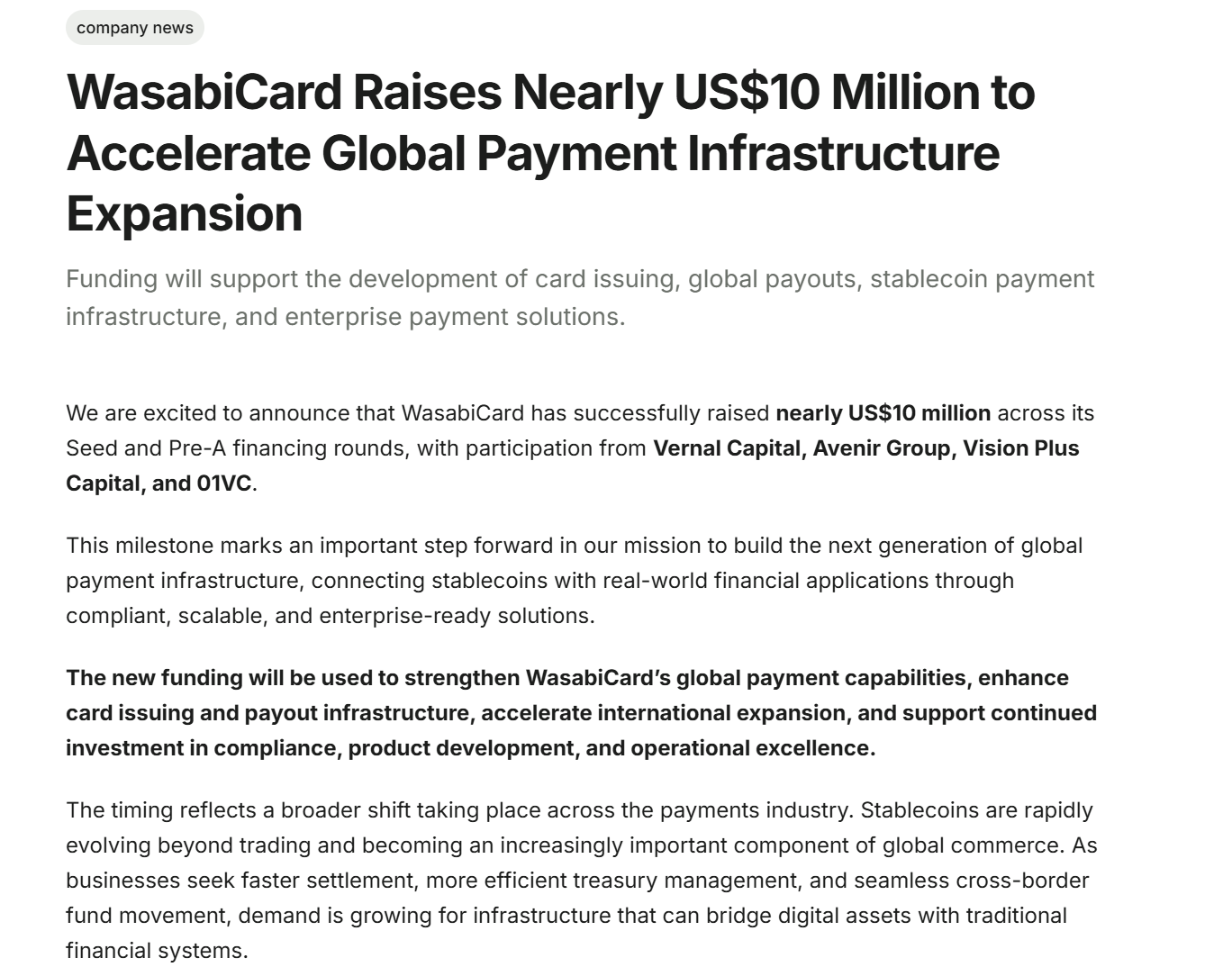
On June 3, 2026, WasabiCard, a global stablecoin payment infrastructure platform, completed the Pre-A round of financing. Counting the previous early round, the cumulative funding was close to $10 million. Investors include Vernal Capital, Avenir Group, Vision Plus Capital, and 01VC — of which Avenir Group is Li Lin's family office.
Interestingly, almost back-and-forth, another piece of news went viral in the community: Fiat24 suspended new account applications in mainland China, while various encrypted payment card services familiar to Chinese users, such as SafePal and Bitget Wallet, all have partnerships with Fiat24's ability to issue cards.
On the one hand, capital is added to an “invisible” payment infrastructure company, and on the other hand, low-level service providers directly influence some front-end card products due to policy adjustmentsSeen at the same point in time, it just provides an opportunity to revisit the stablecoin payment circuit.
And behind this incision is a real demand that is rapidly expanding.
1. U-card decline: retreat is not demand; it is a model
According to the Fireblocks' “State of Stablecoins 2025” report, 49% of the institutions surveyed are already using stablecoins in payment scenarios, and another 41% are in the testing or planning stage, which means that nearly 90% of institutions are already exposed to stablecoin payments in some way.
Demand is rising, but the way demand is being met is changing.
As we all know, the most discussed form of stablecoin payment in the Chinese market in the past few years is almost a “U card”: users transfer stablecoins such as USDT and USDC to card products and then use them for online subscriptions, purchases, or offline payments, which is also the easiest for everyone to understand and accept.
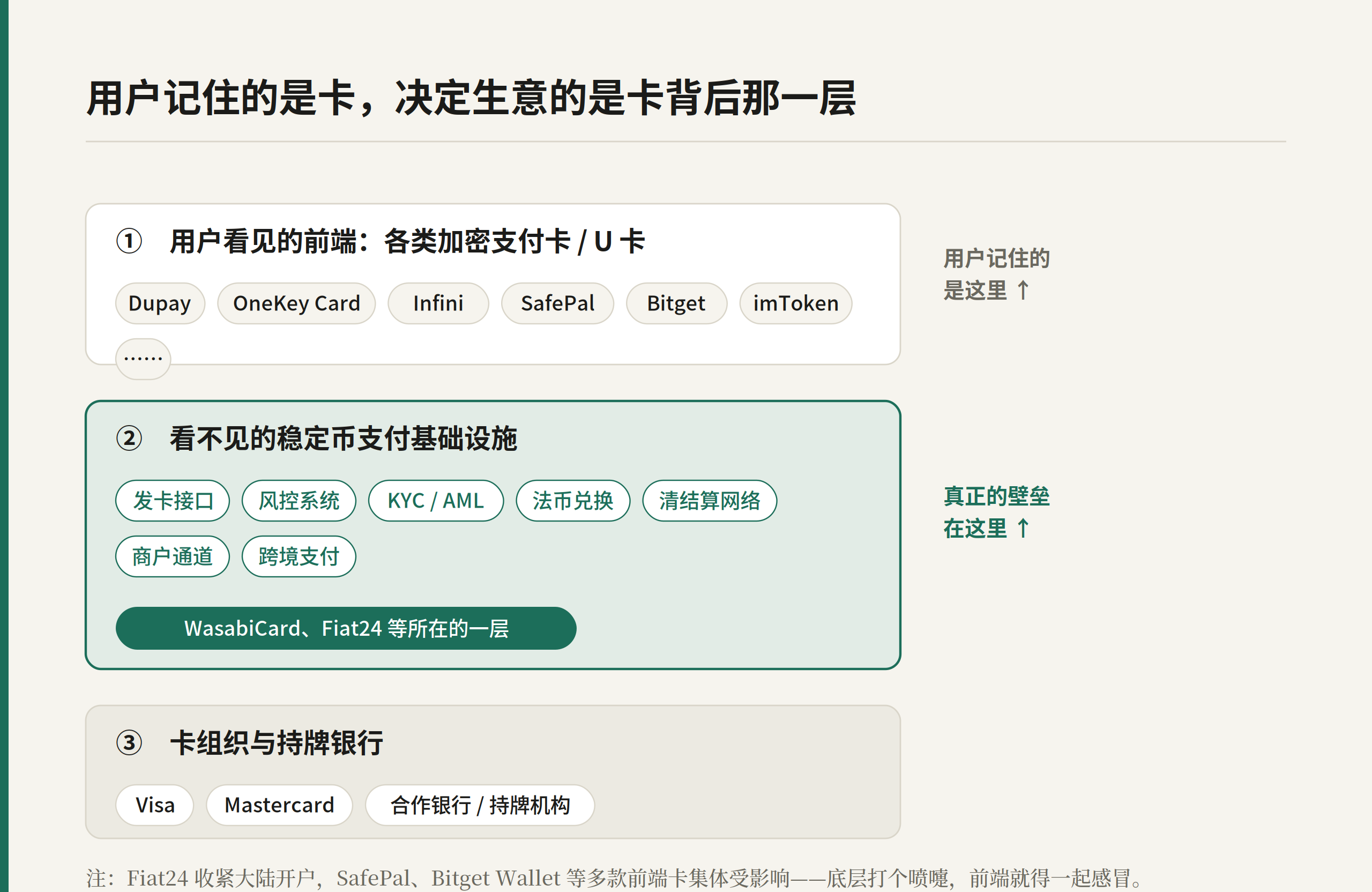
But the U card is just the front end that users can see.
What is really complicated behind a card is card issuance qualifications, card organization cooperation, KYC/AML, risk control systems, stablecoin and fiat currency exchange, settlement networks, merchant channels, and cross-border payment capabilities. However, what is often remembered by users is front-end user-facing brands such as RedotPay, KAST, and Crypto.com, but institutions such as WasabiCard are not well known.
In fact, thanks to infrastructure companies such as WasabiCard,Today, “issuing a card” alone is not a difficult task。
The project party can completely hand over all aspects of stablecoin acceptance, quota allocation, card issuance, and consumption channels to a third party service provider. In a sense, this is also an important reason for the rapid spread of U-card products over the past few years.
So Fiat24's tighter account opening is just an introduction.
The real problem is that the C-end U card, which has spread rapidly in the past few years, is essentially a “light front-end, heavy external dependency” model. It has outsourced all the most difficult aspects. The main thing left behind is the brand, customer acquisition, and that level of user interface.Although this solved the problem of “spending U”, it did not solve the problem of “how to continue this business in a long-term, stable, and compliant manner”。
Over the past year, many front-end card products have shrunk or even left the market. It has been repeatedly shown that front-end experience alone cannot support a payment business that can go through the cycle.
This is critical.
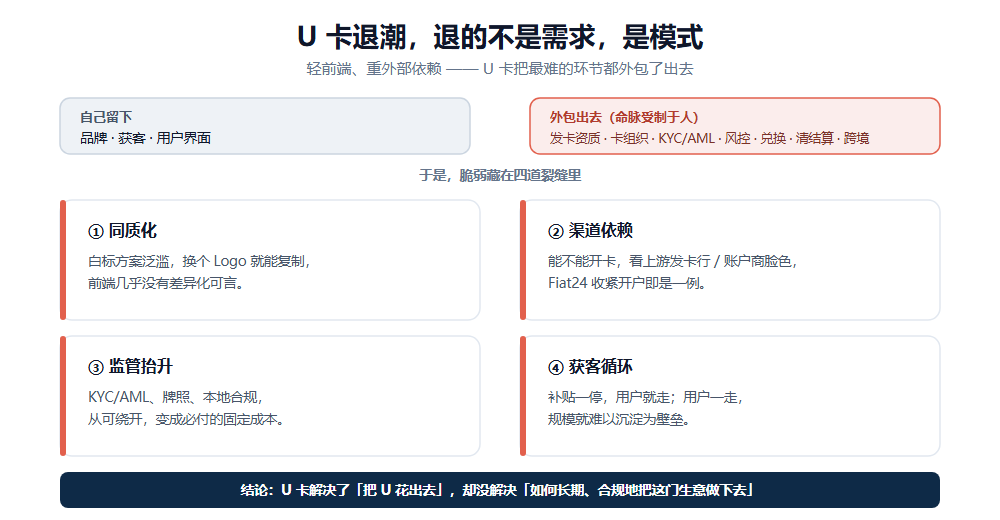
U card products can be copied, subsidies can be followed up, and users will rapidly migrate with rates, risk control, and availability.What's really hard to replicate is the back-office capability:
Whether it is possible to maintain stable cooperation in issuing and receiving cards in multiple markets;
Ability to handle identity verification and anti-money laundering requirements in different jurisdictions;
Can the flow of funds and information be consistent between stablecoin recharge, fiat currency exchange, card consumption, and merchant settlement;
Can a sufficiently mature risk control system be formed in abnormal transactions, high-risk addresses, chargebacks, refunds, freezes, and compliance reviews;
This is also the logical starting point for Avenir Group and other institutions to bet on WasabiCard —What institutions are looking at is probably not yet another crypto card product, but a stablecoin payment business that is moving from a “card” to a “bottom” level.
II. Why is Avenir Group betting on WasabiCard
The crypto market has not lacked a grand narrative over the past few years.
From DeFi, NFTs, GameFi, to public chains, L2, restaking, and AI+ Crypto, the industry cycle is often driven by asset prices, token expectations, and liquidity expansion, but payments have always been a different kind of business. It's not that sexy, and it's difficult to create extreme valuation imagination in a short period of time, yet it is closer to real-world transaction needs.
Because as long as a transaction occurs, every specific process has an opportunity to generate revenue as soon as a transaction occurs, payment, exchange, card issuance, settlement, receipt, and cross-border transfers.
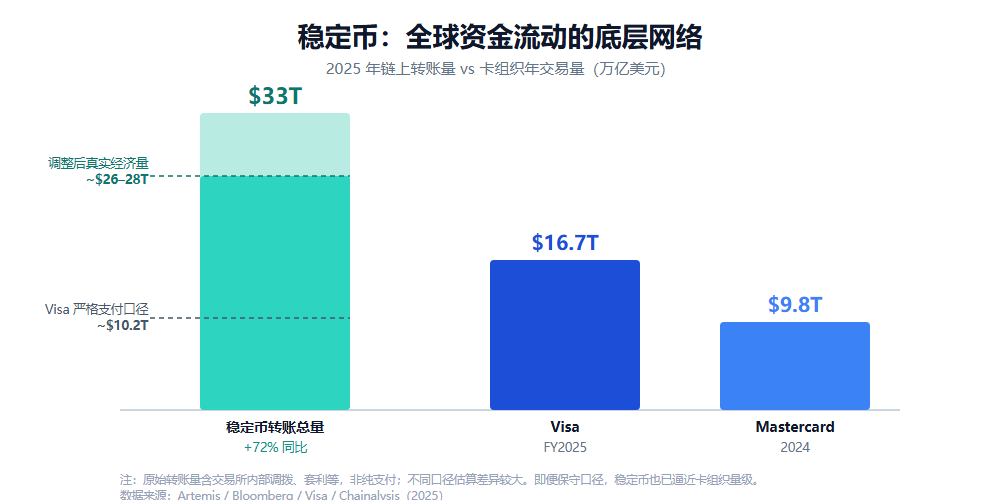
However, the scale of this business cannot be ignored. According to Artemis data, the total amount of global stablecoin transfers reached 33 trillion US dollars in 2025, an increase of 72% over the previous year, exceeding the sum of Visa and Mastercard. Even after excluding non-payment uses such as transfers and arbitrage within exchanges, its real economy is close to the size of traditional card organizations.
Whether these capital flows ultimately correspond to transactions, transfers, or settlements, it means that stablecoins have become an important underlying network for global capital flows, but because of this, an on-chain USDT/USDC transfer requires a complete set of off-chain financial infrastructure to actually become a payment that can be used by enterprises, remuneration that employees can receive, settlement that merchants can accept, and card balances that users can spend.
This is an opportunity for companies like WasabiCard.
What they do is closer to the “dirty work” process, such as connecting card organizations and card issuing resources, building enterprise APIs, processing fund settlement, managing risk control and compliance, and supporting enterprise customers to embed stablecoin payment capabilities into their own business processes. These kinds of things don't attract market attention as quickly as issuing a token, but once the ability is verified, it may become more reusable.
sinceJudging from the business model, B2B infrastructure and C-end card products are naturally two types of business.
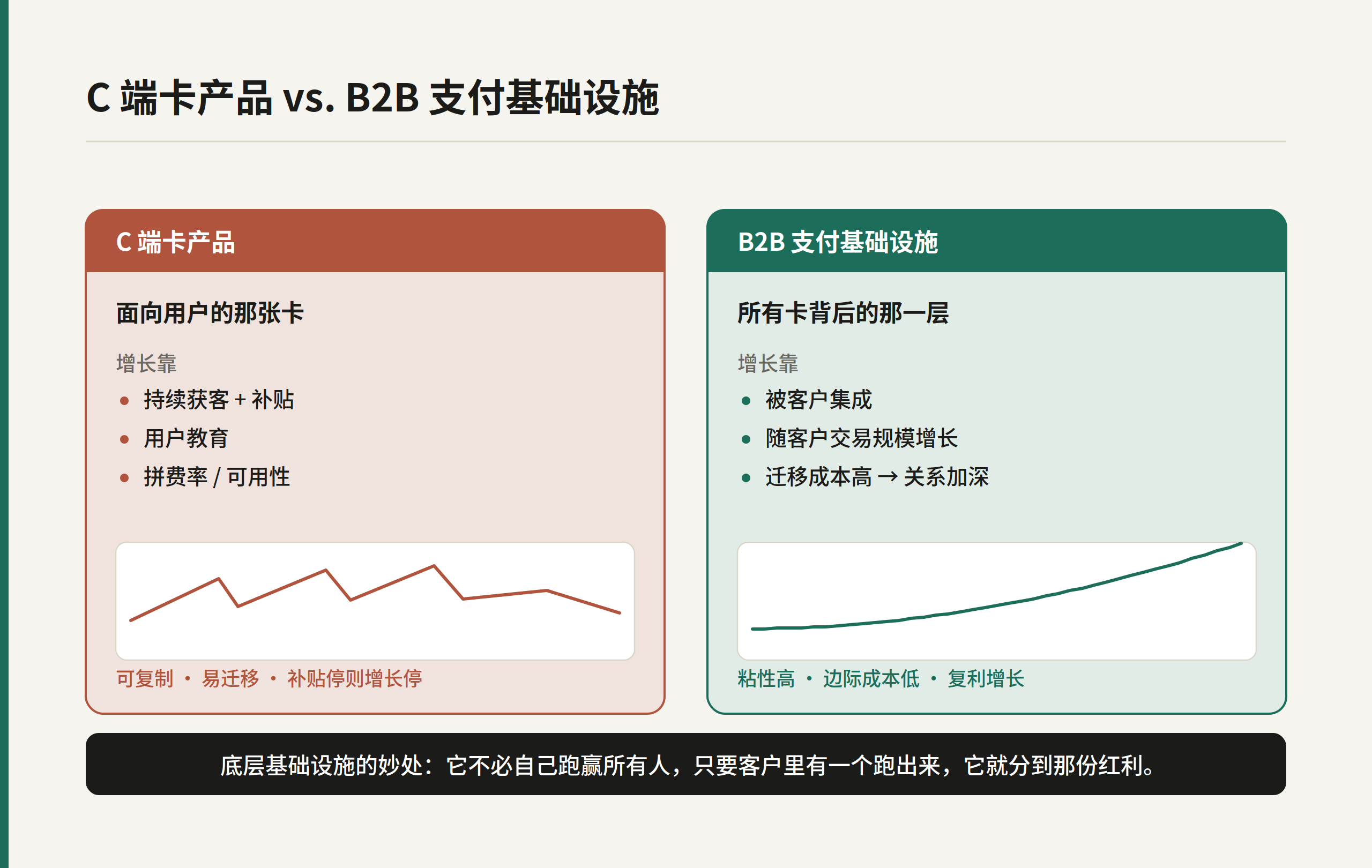
C-terminal card products require continuous customer acquisition, continuous subsidies, continuous education of users, and also face repeated comparisons of user rates, usability, and brand trust; once B2B payment infrastructure is integrated by exchanges/wallets, payment companies, overseas companies, etc., there is an opportunity to continue to benefit as the customer's own transaction scale grows — the former is trapped in the customer acquisition cycle, but the latter is more likely to form compound benefits.
More importantly, once the project party connects a certain payment API to its own business, the migration cost will increase, and the partnership is more likely to gradually deepen around transaction volume, settlement volume, and business scale. This is the beauty of the underlying infrastructure:It doesn't have to outperform everyone on its own; as long as any one of its customers runs out or runs out of scale, it can share the dividends of growth.
Taking these apart explains why capital is more willing to focus on the bottom:
Payments are one of the easiest scenarios for stablecoins to achieve real cash flowCompared to the Web3 narrative, which still relies on token cycles and liquidity expectations, it is closer to actual transaction needs. It is a business model that does not rely entirely on market sentiment, but is more driven by transaction flow and network scale;
Service providers such as WasabiCard have their own business and compliance foundationsIt has accumulated reusable capabilities in B-side customer relationships and a highly compliant system. For investors, “already integrated” is much more valuable than “planned integration”;
Capital is not buying a single point product, but a scalable infrastructure, its growth can be “tied” to the growth of customers, rather than having to re-acquire customers with every order;
For investment institutions, the ceiling of a single-point U-card product depends on how many C-end users it can capture and how often these users spend actively; the imagination of a stablecoin payment infrastructure depends on how many corporate customers it can serve, how many payment scenarios it has, and whether it can become a common layer of capabilities behind more front-end products.
Seen from this perspective, Avenir Group's investment in WasabiCard, instead of interpreting it as some kind of “authoritative endorsement”, is more like an old Crypto player with a keen sense of smell, making a one-way bet on stablecoin payment infrastructure.
Where it points is probably more important than the financing itself.
3. Not comparable to scale, but to position: Where are the barriers on the B-side?
Of course, this doesn't mean that the infrastructure model is naturally easier to succeed. In stablecoin payments, C-side cards and B-side infrastructure are essentially two tracks. There is absolutely no point in the hard ratio to scale; the key is position.
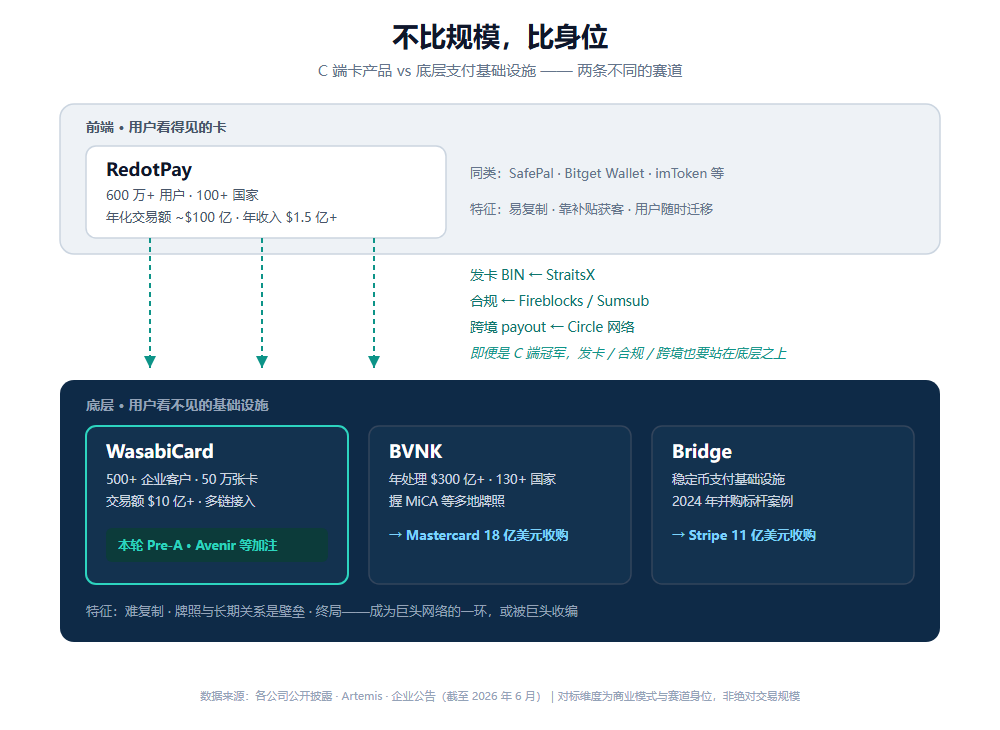
Let's take a look at RedotPay, the benchmark for the C-side circuit. Currently, it has more than 6 million users, covers more than 100 countries, has an annual transaction volume of about 10 billion US dollars, annual revenue of more than 150 million US dollars, and a cumulative financing of 194 million US dollars in 2025, and a valuation exceeding 1 billion US dollars.
It's almost the ceiling a U card can reach — but what's interesting is that even a champion like this has relied on licensees like Reap to connect to Fireblocks and Sumsub for compliance, and for cross-border payouts to connect to Circle's network.
In other words, the card that runs at the top also stands on top of the underlying infrastructure.
Let's also take a look at BVNK, a “graduate” of the B-side circuit. It processes more than 30 billion US dollars in annual payments, covers more than 130 countries, and holds licenses in many places such as MiCA. It was eventually acquired by Mastercard for up to 1.8 billion US dollars, making it the largest stablecoin infrastructure merger and acquisition to date.
What it suggests is another end to this track, which is not to rob C-end users, but to make the underlying capabilities deep enough, continue to refine and mature compliance, and finally be incorporated into the global network by the giants.
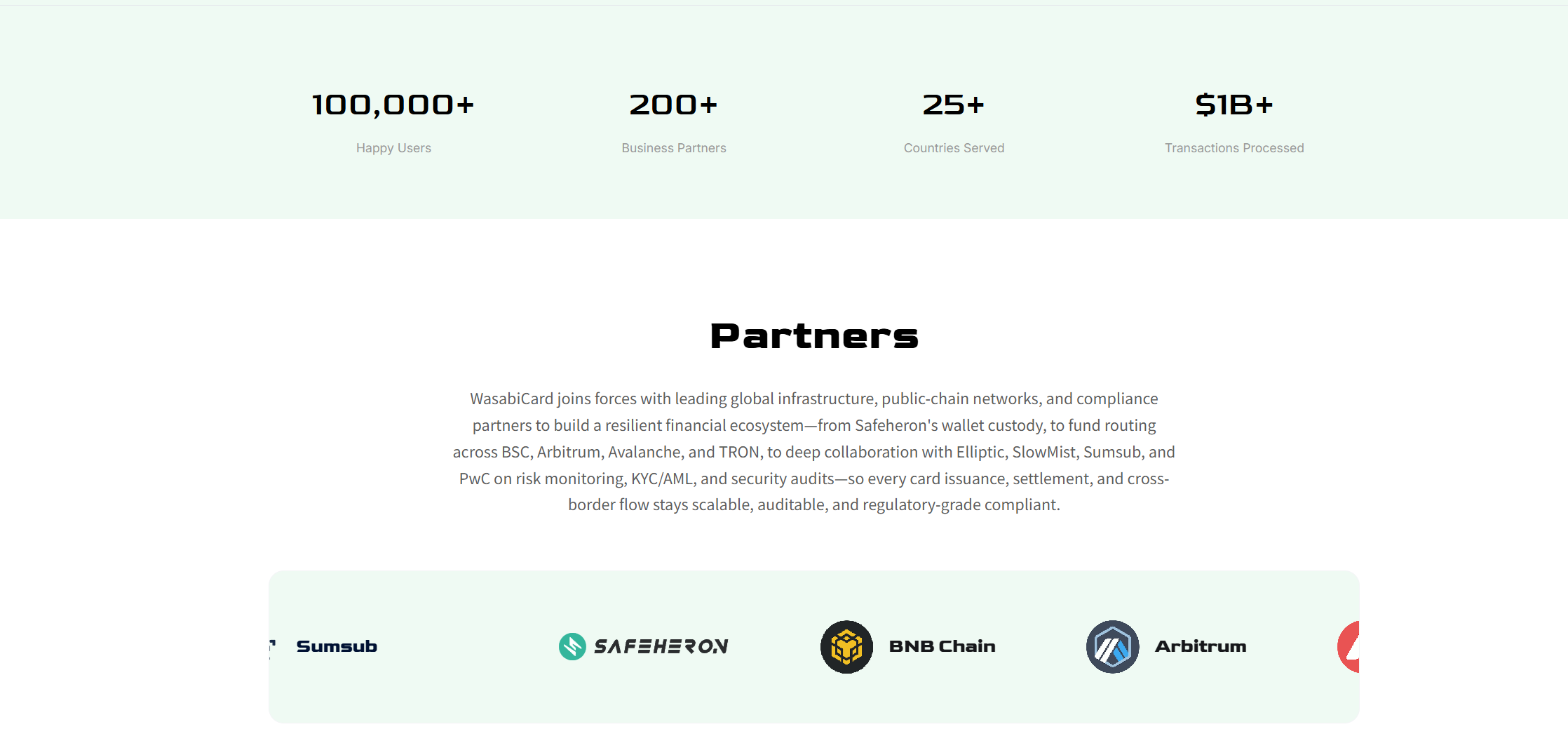
WasabiCard is also on this track. As of this round of financing, it was officially revealed that it has served more than 500 corporate customers around the world, issued more than 500,000 cards, processed more than 1 billion US dollars in transaction volume, and completed access to multiple chains such as Avalanche, Arbitrum, and BNB Chain. Recently, it also joined Circle's partner program.
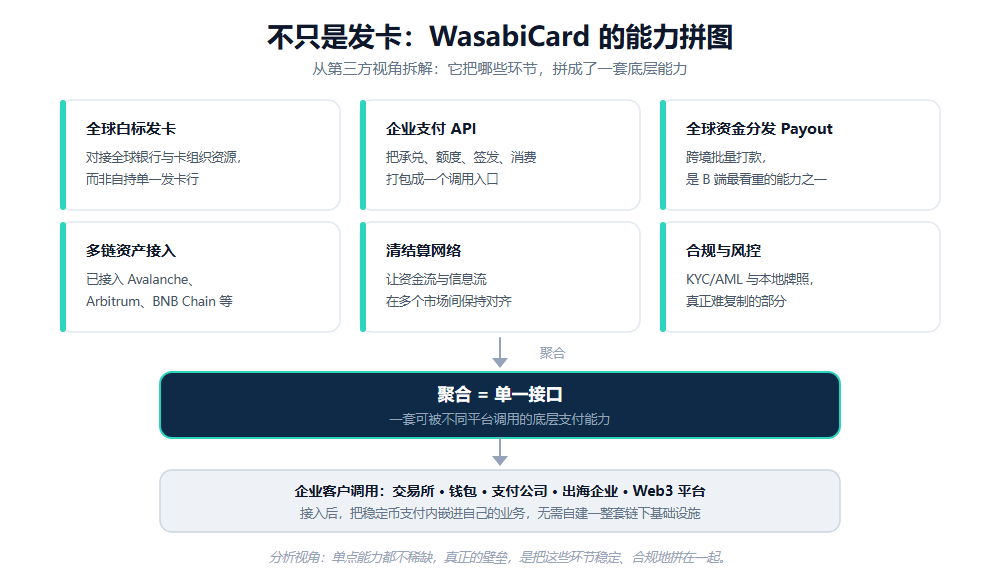
It integrates card issuing, API, settlement and payment capabilities into a single interface, focusing on the localization strategy of cooperating with banking institutions in major global markets. It is positioned as an infrastructure company that can export global white label card issuance, API, settlement and payment capabilities with “one click”, and the localization strategy allows WasabiCard to issue cards to local users in a compliant manner in the global region; at the same time, as its corporate customer, it only needs to integrate the API once to complete global card issuance with one click.
More importantly, judging from public data, WasabiCard's focus is not just issuing cards to consumers, but is continuing to expand global card issuance resources, corporate payment APIs, global fund distribution (Payout), multi-chain asset access, and compliance system construction. This means that it does not provide a single payment product, but a set of underlying payment capabilities that can be used by different platforms and business scenarios.
So, where is this level of power moat?
The Fireblocks report provides just one supporting evidence: when selecting stablecoin infrastructure providers, 41% value “fast and reliable fund disbursement (payout)” the most, and 34% value compliance.Simply put, payout and compliance are the two most valued items for companies when selecting models. They are simply irreplaceable by issuing a card.
For B-side representative players like WasabiCard, it also means proving that they can not only issue cards themselves, but can also become a stablecoin payment operating system behind different corporate customers, serving a wider range of internet companies and cross-border business scenarios.
4. PayFi, the point in time when the “bottom layer” will be seen again?
If U cards were the most popular part of stablecoin payments in previous years, then the next phase that is more noteworthy is probably the PayFi infrastructure.
For a long time in the past, PayFi was easily reduced to “issuing cards” or “cashback on purchases,” which made it look more like a user product circuit than a financial infrastructure circuit.
However, in the past two years, the situation has clearly changed.
The financial infrastructure related to stablecoin issuance, payment, and settlement has become one of the few assets in the crypto industry that can generate stable cash flow, and the PayFi circuit tied to it has also attracted almost all types of playersFrom cryptographic native projects, traditional payment giants, stablecoin issuers, and exchanges, to specialized stablecoin chains, they are all cards in their own way.
What best explains the problem is the chain of actions of traditional payment giants:
In October 2024, Stripe took over the stablecoin infrastructure company Bridge for approximately $1.1 billion, which was considered one of the largest mergers and acquisitions in the crypto sector at the time;
A year and a half later, in March 2026, Mastercard announced that it was planning to acquire stablecoin infrastructure provider BVNK for up to $1.8 billion, paying about $700 million more than Stripe that year, breaking this record;
Around the same time, Visa expanded its partnership with Bridge, which is already covered by Stripe, and plans to expand stablecoin-linked cards from 18 countries at the time to more than 100 countries;
Earlier, PayPal had already launched its own stablecoin PYUSD;
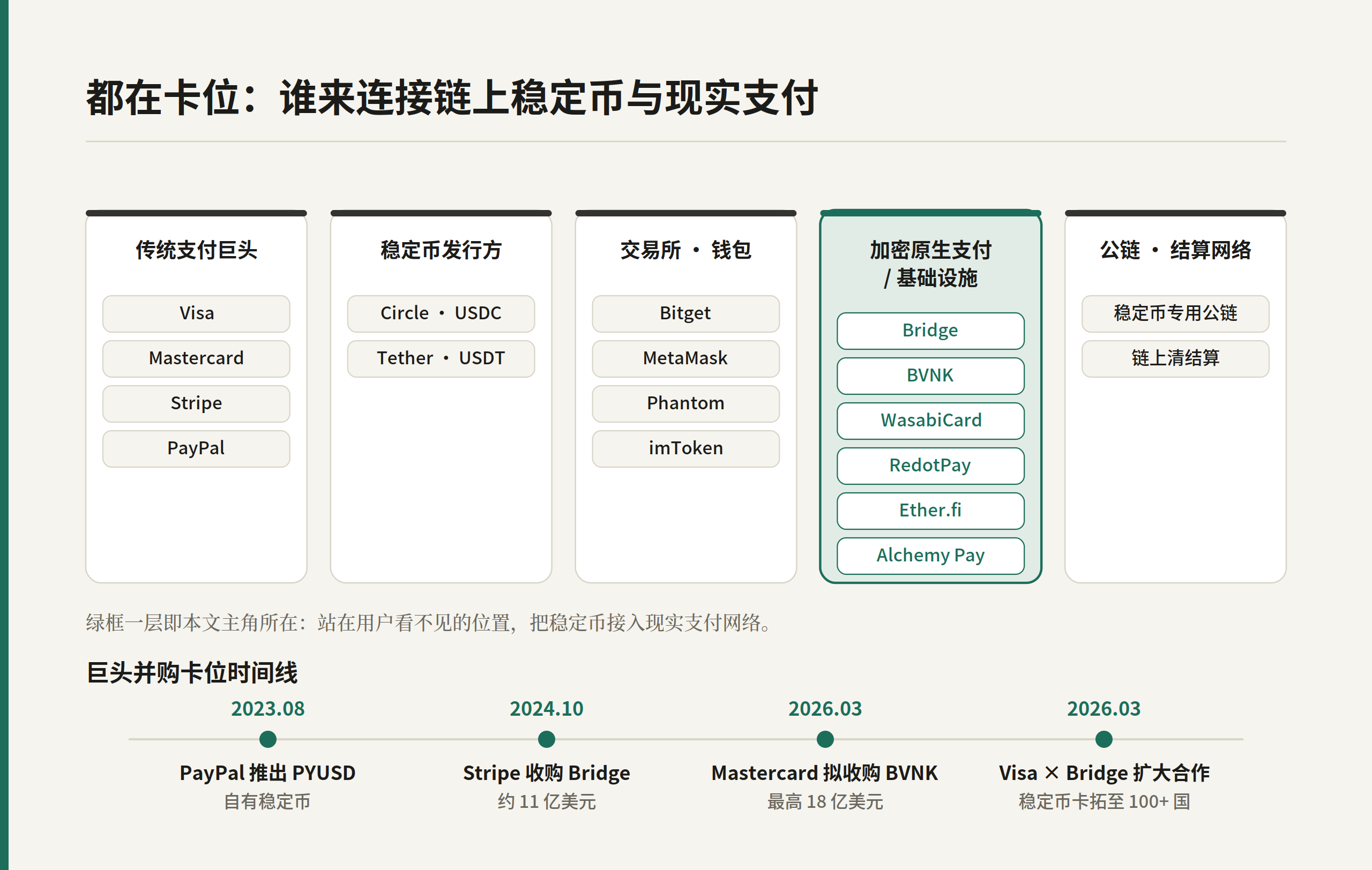
Looking at these actions from payment giants, card organizations, and large fintech companies on the same map, it is no longer an isolated bet by a certain company on crypto payments, but an advance card slot carried out by the entire payment industry around stablecoin entrances.
Because stablecoins have never impacted not only the payment experience, but also the deeper profit and power structure in the traditional financial system — it is directly related to who can control accounts, cross-border channels, and even settlement in the new era. From this perspective,The giants are taking the initiative to connect on-chain accounts, stablecoin assets, and merchant payment terminals. Rather, they are less willing to be bypassed and left behind by others in the next round of payment settlement restructuring.
However, when the giants all began to personally seize the bottom, the window left for independent infrastructure players was particularly clear — either become an irreplaceable part of the giant's network, or grow into that network themselves. After all, regulation and license, KYC/AML, card organization cooperation, and local compliance are just the hardest parts of C-side U card products that used to run on traffic and subsidies.
This also explains why companies like WasabiCard will mainly invest in building a global compliance system, connecting multi-bank business networks, and upgrading core settlement systems. These directions are not sexy, yet it is the underlying capabilities that stablecoin payments must make up for when moving from user products to financial infrastructure.
Looking further afield, PayFi's imagination may extend to AI Agent payments. If AI agents actually start automating transactions on behalf of users in the future, then payment infrastructure can't just be designed around “people.” Machines also require actionable accounts, verifiable authorizations, controllable limits, auditable transaction records, and the ability to automatically execute small, high-frequency payments within compliance boundaries.
This will make the end of the stablecoin payment infrastructure more complicated; of course, this is still a longer-term imagination.
But it at least shows that the value boundary for stablecoin payments is far larger than a U card.
Write at the end
Crypto payment cards are certainly a good business.
It links stablecoins with actual consumption, and allows users to intuitively experience “U can be spent” for the first time. This is why the U card quickly breaks the circle in the Chinese market and becomes PayFi's easiest entrance to understand.
But the biggest bonus isn't necessarily on the card.
In the past, it was easier for the market to remember a card, an app, a cashback campaign, or a low-rate entry, but as stablecoins enter a larger, real-world business scenario, what really determines the long-term pattern of the industry may be the ability at the bottom.
Relative behind-the-scenes players like WasabiCard may not have been the most familiar name in the Chinese-speaking market in the past, but stablecoin payments themselves are a slow business and a heavy business. If they can continue to scale in areas such as compliance, card issuance, settlement, billing, cross-border payments, and corporate APIs, it will have an opportunity to become a sample of key companies in the PayFi era.
Going back to the first two recent pieces of news, they actually point to the same thing, that is, competition for stablecoin payments, and is sinking into the “bottom layer” that users can see from the “card side” that users can't see.
Because of this, the industry may be entering a new phase as more and more capital begins to re-examine stablecoin payment infrastructure.
