


Depth 丨 In 2020, 10 indicators of Ethereum have reached record highs!

From the launch of Ethereum 2.0 and the boom in DeFi yield farming, the ecosystem has experienced exponential growth across the board. Dozens of Ethereum metrics have reached new highs during the year.
Author: Lucas Campbell
Claims that BTC is the “fastest horse” as digital gold and as an inflation hedge are beginning to gain acceptance from investors. As a result, the asset has aroused a new wave of institutional interest, driving prices to new highs.
Legendary fund managers such as Paul Tudor Jones and Stan Drunkenmiller began investing in the asset. Meanwhile, Square, Mass Mutual, and MicroStrategy became the first companies to hold BTC on their balance sheets.
Although the ETH community hosted DeFi Summer 2020, which was characterized by an explosive investment of interest and capital into decentralized finance and unlocked new distribution mechanisms in the ownership economy, the boom largely only existed within the community.
The price of ETH is still more than 50% lower than its ATH so far.
However, the Ethereum economy has performed well during the year. It is worth highlighting:From the launch of Ethereum 2.0 and the boom in DeFi yield farming, the ecosystem has experienced exponential growth across the board. Dozens of Ethereum metrics have reached new highs during the year.
Here are ten Ethereum charts that reached ATH in 2020:
1. Ethereum Utilization Hits Record High
Data source: Etherescan
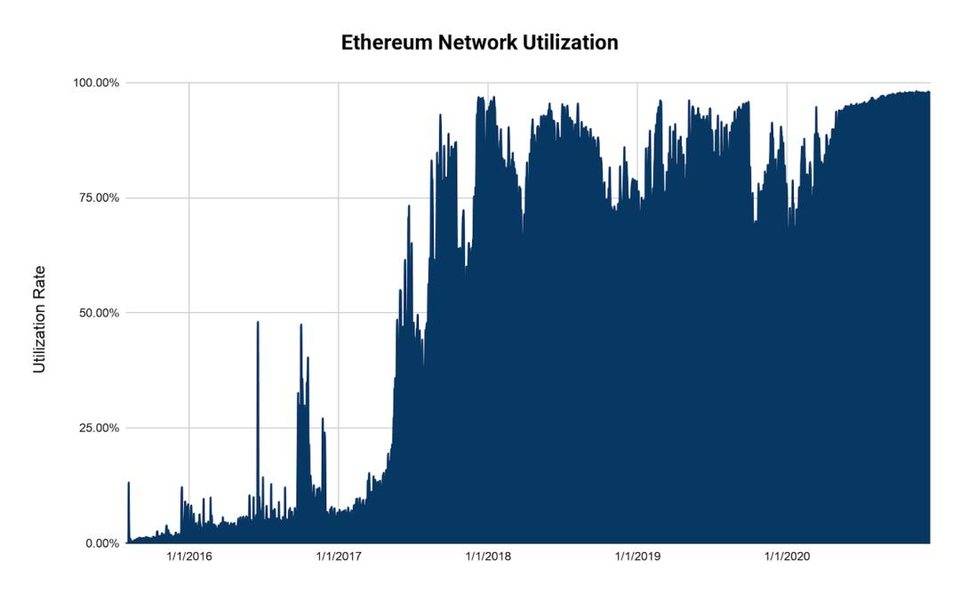
Network utilization can be said to be one of the most basic indicators for measuring the health of any public blockchain. Simply put, it can translate into a need for block space. It means people are actually willing to use (and pay) the ledger as a settlement layer.
The demand for Ethereum's blockchain space has reached its limit. The demand for using Ethereum is so great and ongoing that the network's utilization rate has always been at the top, and it really couldn't be higher.
Whether inAaveorCompoundOn borrowing capital,UniswapExchange tokens, trade derivatives on Synthetix, launch DAO, or send US dollar stablecoins to anyone in the world,There has always been significant demand for Ethereum as a settlement layer in the decentralized economy。
Now, Ethereum needs to scale up. Whether it's a second-tier solution such as an optimistic optimistic rollup or the upcoming upgrade to Ethereum 2.0, the network has reached a point where there is too much demand for block space, and it needs to increase capacity to reach its full potential.
2. Ethereum Hashrate Hits All-Time High
Data source: The Block
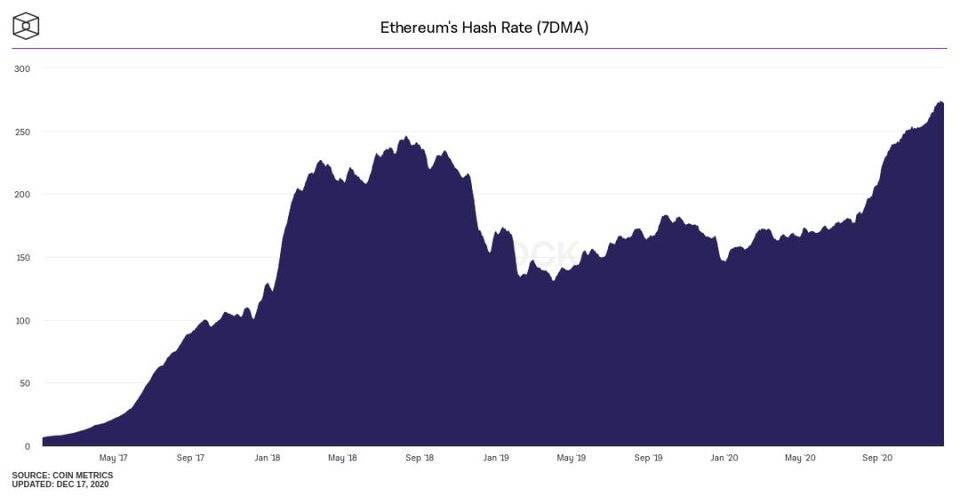
Despite the impending transition to PoS, Ethereum's computing power has climbed to new highs. In other words, the network is more secure than ever. According to The Block's data, Ethereum's current computing power has exceeded 271 TH/s, surpassing its all-time high of around 240 TH/s in September 2018, which was reached during a bear market.
With the July 2021 difficulty bomb set, miners devoured all remaining ETH before their mining rigs were “turned into bricks.” But whether the community needs to postpone the difficulty bomb again is another question.
Even though all of the Ethereum 2.0 phases are working in parallel, which should be much faster than the initial phase 0 rollout, it seems unlikely that the network will switch to PoS within the next six months.
3. Open interest in ETH options hits a record high
Data source: Skew
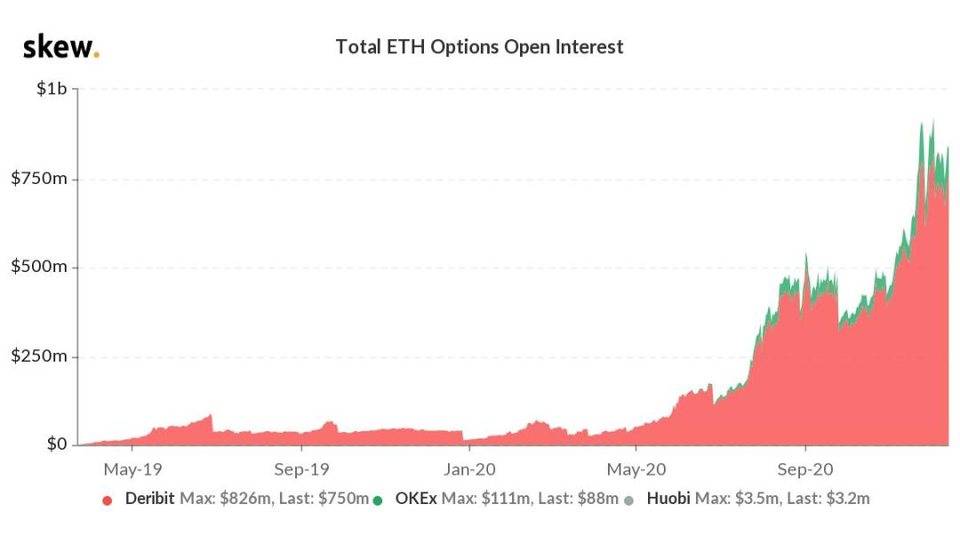
Public interest in options refers to the total circulation value of unexercised options. And this indicator for Ethereum is already close to $1 billion. Although this number is relatively small from a broad perspective, it did give us some important insights about the Internet. Nic described this situation very gracefully in his article:
Just as derivatives first appeared to allow farmers to hedge against crop risks, lock in specific prices for harvests (and obtain liquidity for future crops, so they can buy seeds and fertilizers today), option pairsBitcoinProducers — miners — are also useful. Based on their own equipment, miners can roughly estimate how many bitcoins they will mine under a reasonable __computational power__ assumption. If they want to get an “advance payment” of the expected mining coins, they can sell the call. This means they promised to deliver tokens at a certain price on a certain date — but they can get paid for that promise today. And with this cash advance payment, they can carry out financing operations more effectively.
What this chart tells me is that Bitcoin producers now have access to more sophisticated financial products, which they can use to hedge their risks. In theory, this should mean that the mining industry is more stable and less affected by periods of boom and bust. This allows miners to focus on running their business effectively and frees them from worrying about the unhedged risk of their equipment.
From the same perspective, the development of Ethereum options can make miners operate more efficiently because they can hedge against the risk of volatility and fund operations by selling call options.
Furthermore, the options market allows traders to express their prospects more creatively, and market participants have more tools, which can naturally support more capital inflows.
All in all, the $1 billion open equity is a positive sign for the growth of the network and the financial instruments available to all market participants。
4. The number of DeFi users reached an all-time high
Source: Dune Analytics
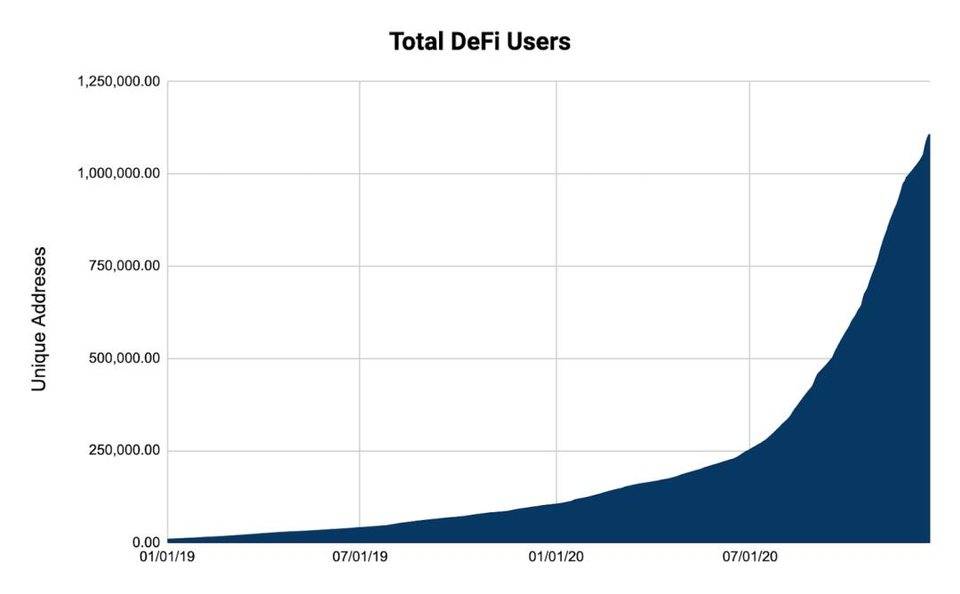
At the beginning of this year,The number of DeFi users was less than 100,000, but then there was a parabolic trend and the number of users of all protocols surpassed 1 million. It's important to note that the “DeFi users” here are actually only the only valid addresses, so it's likely that the actual number was reported.
Anyway, this chart explains all the problems, and the number of standalone wallets interacting with DeFi has risen completely vertically — we all know why.
The introduction of yield farming has sparked a brief frenzy in the Ethereum ecosystem. And it quickly became more fanatical. At its peak, every day there was new farming, endless liquidity mining activity, and wave after wave of degens accessing Pool 2, but it was destroyed within a few hours. This is reminiscent of the ICO era, where new tokens are launched every day promoting the promise of bringing billions of users to cryptocurrencies.
But that's not all bad. The crypto industry has unlocked a valuable allocation mechanism that could have a profound impact on how equity is distributed in the future. What's the point?Give ownership to those who provide and create the most value: users.
Platforms like Facebook, Youtube, Twitter, Uber, and Airbnb don't really create value on their own. They rely on individual and network effects. Everyone who uses these platforms will make it more and more valuable. Whether creating video content for a global population or driving strangers across cities, these multi-billion dollar platforms rely entirely on individuals to generate value. People don't go to Facebook to read Facebook content, and they don't live in an Airbnb house.
It all depends on the individual.
So why not give them ownership of the platform too? This is yield farming pioneered by DeFi. Individuals provide valuable services to the network (such as funding Compound) and gain ownership of the agreement as a result.
It's easy to imagine that in the future, Uber drivers will receive a portion of the shares every time they ride, or Airbnb owners will receive a portion of the shares every time they receive a guest.
5. The total hedging value is at an all-time high
Data source: Debank
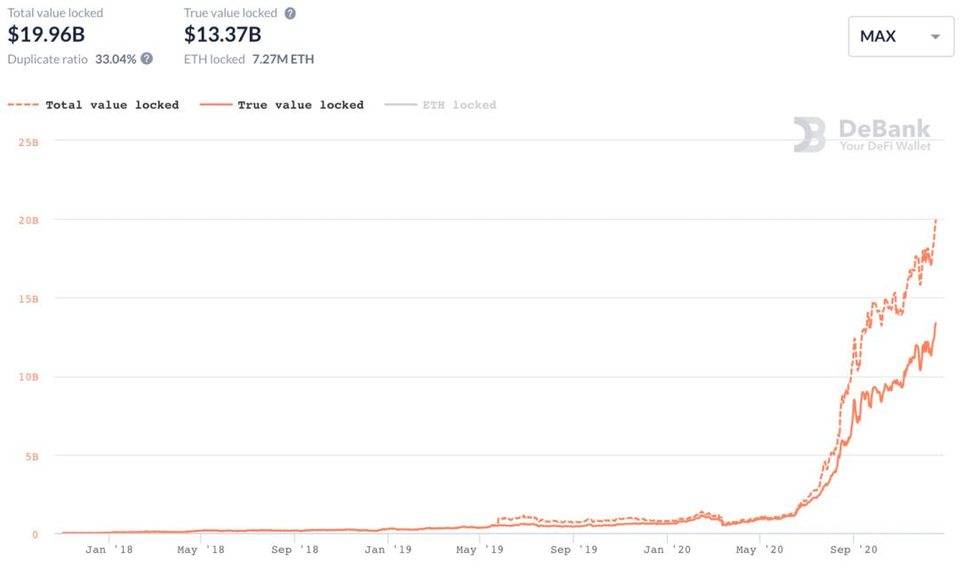
As wallets proliferated, total hedged value (TVL) also saw a massive rise, partly due to the boom in yield farming.
At the beginning of this year, the value of all agreements was approximately $600 million. But it wasn't until February that the sector reached unicorn status. Fast forward to the end of the year, and DeFi had locked in value well over $15 billion — a random 25-fold increase in a year. As mentioned before,DeFi's value-locked growth was mainly due to a boom in yield farming throughout June and September。
Spurred by Compound's COMP Token, capital began pouring into emerging (and sometimes unaudited) DeFi protocols as investors reaped astronomical returns of passive earnings.
6. DEX volume hits record high
Data source: The Block
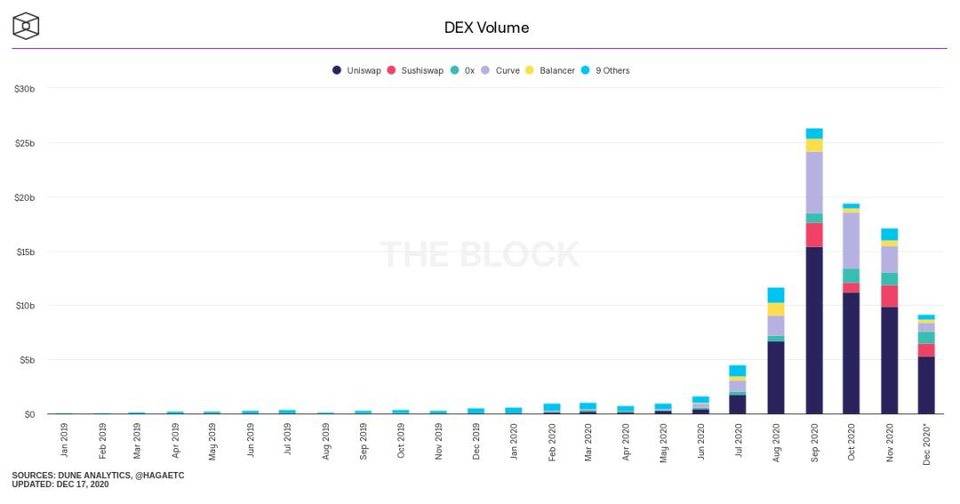
The rise of decentralized exchanges (DEXs) is one of this year's notable events. While they've always been one of Ethereum's most popular use cases, its performance throughout history has been below expectations. The first Ethereum DEXs were plagued by clunky interfaces, slow transaction speeds, and many other issues. If you've ever been involved with this project, you probably remember trading altcoins on EtherDelta.
Since then, things have changed dramatically.
As an effect of DeFi Summer, DEX trading volume soared in 2020 and peaked at over $25 billion in September alone. Even better, these crypto-native exchanges have gained a significant advantage over centralized exchanges (CEXs), as the market share of DEX trading volume reached up to 15% of their centralized peers — a sharp jump from an average of < 1% in 2019. Uniswap,Curveand Balancer are both major drivers in this field.
But so far,Uniswap is the dominant player. Constant-multiplied AMM accounts for nearly 60% of all DEX trading volumeOther products, on the other hand, support low trading volumes in the ten digits of the US dollar. There has been significant progress in this area over the past few years, which is a promising sign that DEXs will really compete with centralized exchanges.
After all,It must be difficult to keep up with the permissionless, global nature of the Ethereum financial agreement. This is especially true for projects like Uniswap when it comes to supporting long-tail assets on Ethereum. Any ERC20 token can be listed instantly—no redirects, no listing fees, and no additional operations. It's a level playing field because everyone has to abide by the same rules. All you have to do is deposit initial liquidity, and anyone and anywhere can access that token — whether it's trading or liquidity regulations.
As a result, GoLiath like Coinbase and Binance is significantly faster when listing new tokens. It's clear that Sushiswap's SUSHI on Binance and Graph's GRT on Coinbase recently went public on the same day.
And maybe one day we'll see CEX start trading using liquidity protocols instead of building their own infrastructure.
7. BTC's impact on Ethereum hits a record high
Data source: BTC on Ethereum
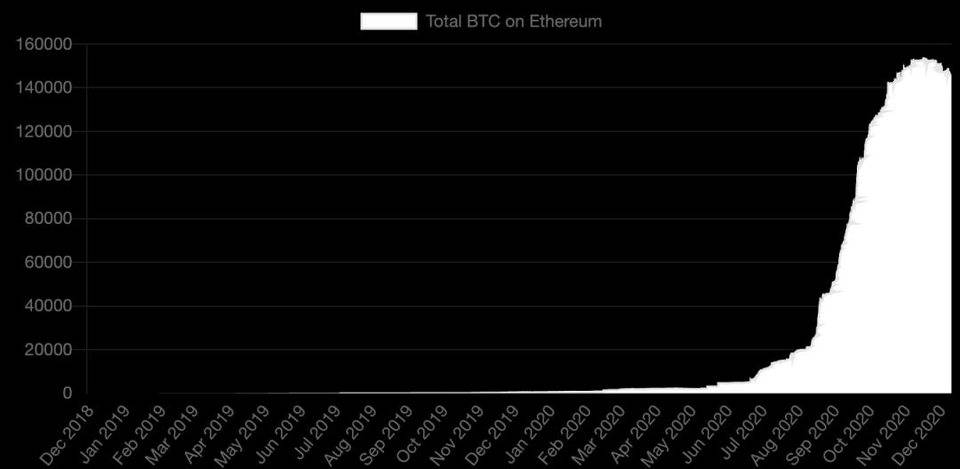
The amount of BTC currently circulating in the Ethereum economy is over $3.3 billion, accounting for 0.675% of all existing BTC.
Similar to everything else in DeFi, this number has taken a crazy parabolic trend due to the boom in yield farming. People can't idle their BTC anymore. Instead, they chose to operate using any of the dozens of high-yield passive income opportunities offered by DeFi. It was so nice, it was irresistible.
Whether it's becoming a liquidity provider on Curve or Uniswap, or depositing it into platforms like Compound and Aave,Ethereum's decentralized economy provides multiple ways for BTC holders to earn passive income in a non-custodial manner, which is in line with the core cypherpunk philosophy. This is in stark contrast to BTC holders' choices, where depositors will have to rely on centralized lenders like BlockFi or Celsius to earn returns.
Even better, there are more Bitcoin wrappers on Ethereum than ever before. While wBTC has historically dominated the asset class, the ecosystem now has more options, including renBTC, tBTC, sBTC, and a few others.
I doubt this is a trend that will end soon. Ethereum will only have more ways to use your funds in the future, and BTC holders will have more options for wrapping Bitcoin.
In other words, it's only a matter of time before we see it slowly rise to 1% or more.
8. Grayscale's ETH holdings hit a record high
Data source: The Block
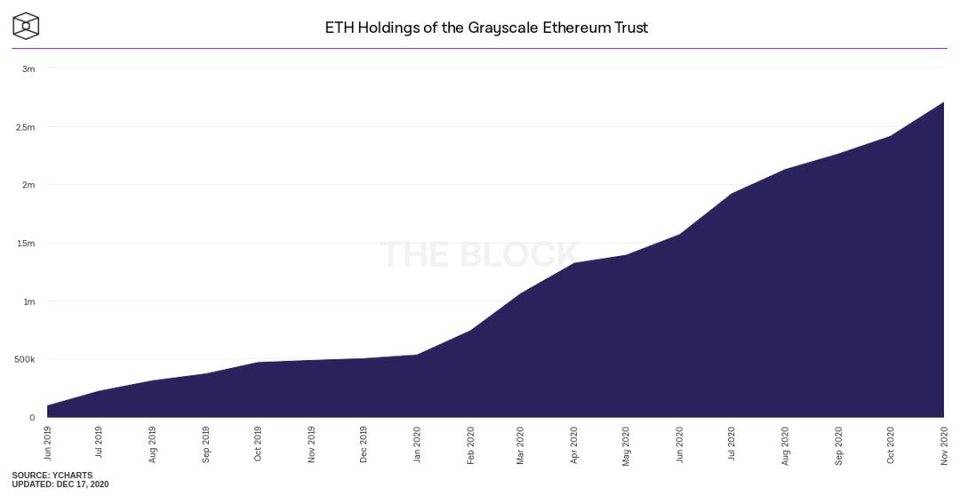
Grayscale is becoming a black hole for crypto assets. Not only does the company hold 2.5% of BTC, they are also increasing their ETH positions to 2.3% of this year's supply (around $1.7 billion) through their $ETHE investment product. The asset's daily trading volume also reached a record high, with an average daily trading volume of over $24.6 million in November — well above its previous record of $15.6 million in August 2020.
But here's a little hint. While the surge in Grayscale's Ethereum products is a good sign, the agency's main interest (they are necessary to mint “shares”) is likely to take advantage of $ETHE's high premium rather than use it for any meaningful long-term investment position.
For reference, $ETHE's premium rate is currently 132% — a pretty good return for ETH locked in for 6-12 months. Regardless, the rise in $ETHE does provide institutional investors and accredited investors with an opportunity to get involved in Ethereum.
They have 6 months to wait for assets to flip to earn a premium, so we can only imagine that at least some of these investors will eventually go down the rabbit hole and start mining their investments to understand what Ethereum is.
9. Stablecoins on Ethereum reach record highs
Data source: CoinMetrics
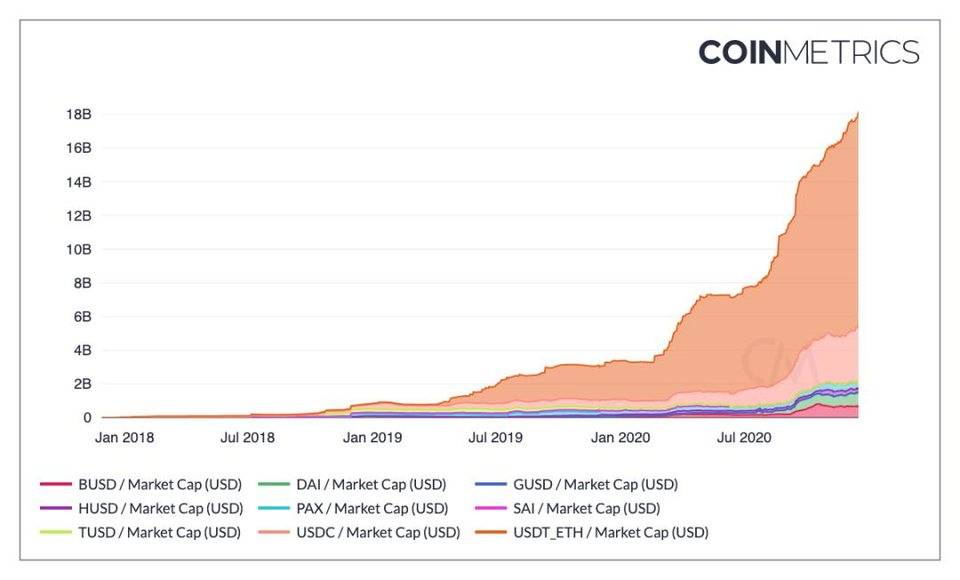
DeFi's Cambrian explosion will only happen with the growth of stablecoins or “dollar stablecoins” on Ethereum. Over the past two years, these dollar-pegged assets have flourished in the ecosystem and now represent nearly $20 billion in value on the network.
But in 2018, stablecoins almost didn't exist outside of Tether (USDT). There are now dozens of different types of US dollar stablecoins, from monetary support to algorithms. And it looks like this trend isn't slowing down.
Since these synthetic dollars are publicly accessible to anyone with an internet connection, Ethereum has greatly increased the dollar's influence on more users around the world. The recent events in Venezuela are a good example. Circle, the agency behind USDC, has partnered with the Bolivarian Republic of Venezuela and Airtm to provide aid to frontline health workers in Venezuela through the use of USDC.
With the cooperation of multiple participants (including the US government), they were able to bypass Maduro's capital controls on the domestic financial system. As a result, they were able to invest millions of dollars in the hands of people fighting for the health and safety of Venezuelans.
This really shows the power of embracing public blockchains.The US and other nation states can bypass restrictions imposed by foreign jurisdictions and expand their reach and influence by using these unlicensed platforms rather than countering them.
10. ETH in deposit contracts hits a record high
Source: Dune Analytics
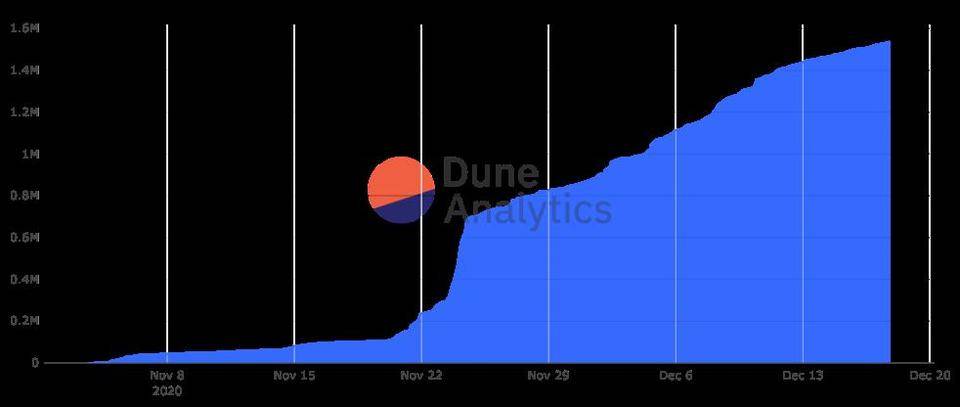
This last picture is a bit of a cheat because it can only go up right now. Despite this, ETH became the first internet bond to reach unicorn status soon after the launch of the Ethereum 2.0 deposit contract. The contract currently holds more than 1.5% of the total supply of ETH, representing a value of over $1.1 billion, which guarantees the ultimate public chain of Ethereum.
Although it's still too early, the signs of capital pouring into the contract suggest thatThe Ethereum community collectively supports advancing this new field of scalable blockchain in a decentralized future。
Best of all, there's only going to be more infrastructure built around Ethereum 2.0.
Whether it's major exchanges like Coinbase or Binance that support ETH staking, the launch of decentralized staking providers like Rocket Pool, or providing individuals with better plug-and-play hardware solutions, participating in Ethereum 2.0 verification will only become more convenient in the future.
Looking to the future
While BTC is celebrating a new high in price, Ethereum also has plenty to celebrate. A range of metrics, from fundamentals to narrative, show the adoption of Ethereum as a global settlement layer for the Internet of Value.
The decentralized economy is being built day in and day out, and there are plenty of developments to prove it. Consider that the DeFi industry barely existed two years ago. There is now over $150 billion in funding to support powerful financial applications, and $200 billion to tokenize dollars — all of which can be accessed by anyone with an internet connection.
Although I emphasized these ten points,There are many other indicators in the entire Ethereum economy that are breaking new records. NFTs and digital art have reached seven-digit trading volumes, and crypto-native financial fundamentals like flash loans have now surged to billions of dollars in transactions.
There's no shortage of entry points:Ethereum is growing。
And there are also fundamental catalysts to support this growth. Ethereum 2.0 is progressing smoothly, CME recently announced that they will support ETH futures in 2021, and Jerome is also warming up banknote printers for a new round of stimulus policies.
