


Where did the high yield of DeFi, which supposes traditional finance, come from?

In recent years, traditional banking services have become increasingly unpopular. The annual interest rate for some bank savings accounts in the US can even be as low as 0.1% (considering that the current US inflation is close to 5%, savings accounts = spending coins); in the same period, the annual interest rate for deposits in Anchor Protocol was 20% (Note: Anchor Protocol was created based on the stable asset protocol Terra Money. It is a new type of savings agreement designed to coordinate blockchains from multiple PoS agreements (Block rewards balance interest rates and ultimately achieve a stable yield storage interest rate) I think anyone knows which one to choose next.
Defi's yield seems unrealistically high all the time, which makes one wonder, how are these yields generated? Are they really sustainable, or is it just a Ponzi scheme?
Compared to other markets such as traditional finance, cryptocurrencies have a high yield. This is also what many skeptics criticize. Abnormally high yield = Ponzi scheme. There doesn't seem to be anything wrong with this logically. But we still need to do our own research and understand that doing due diligence is more important than anything else.
DeFi's high returns aren't just for Degen
DeFi is probably famous for its extremely high yield, even when using relatively safe assets such as USDC, USDT, DAI, and BUSD. You can also get some pretty good returns:
Stablecoin lending on platforms like Aave and Compound: 6-8 percent annual yield
Staking: 4-20% annual return
Liquidity mining: 50-200% annual yield
Degen alluvial yield: 200-30M% annual yield
Obviously, risk and benefit are also positively correlated in the crypto market. For example, lend your stablecoins to relatively secure protocols (Aave and Compound), and they can give you at least 4% of revenue per year. The chart below shows Aave's annual return:
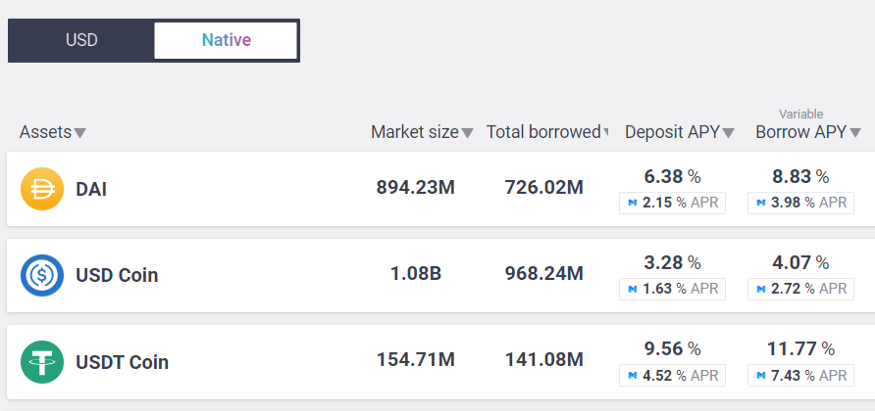
The yield on a loan comes from the borrower borrowing money from the agreement and paying higher interest. The agreement made interest spreads between loans similar to what banks do today. If demand for borrowing rises, so will the yield on borrowing.
The yield between different stablecoins will also vary. For example, the yield of USDT is often high, because USDT, which is currently fraught with various regulatory and shady issues, has caused many investors to start to avoid it, so it is only natural that one point of risk is exchanged for one point of return.
The risks involved in participating in this type of investment are:
The protocol became the target of hacker attacks
Insufficient collateral
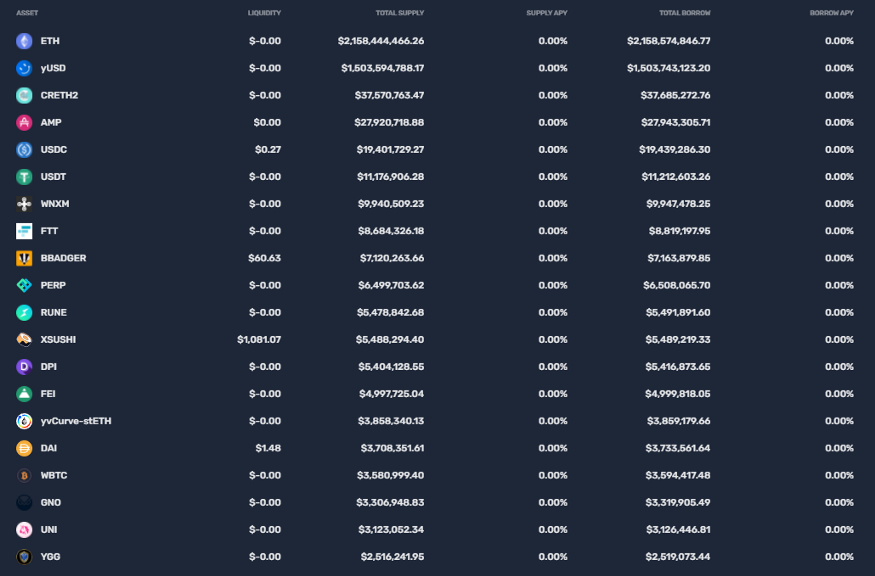
All of this has the potential to cause investors to lose their capital. Cream Finance, which has been attacked one after another, is a pretty good example. Comparatively, we have reported on this project many times before.[DeFi protocol Cream Finance was attacked by flash loans again, losing more than 130 million US dollars]、[Cream Finance was attacked by flash loans, and the AMP token contract has a reentry vulnerability]、[The DNS of the Cream website was attacked, and the team reminded users not to submit private keys and other information to the website]。
Cream Finance's liquidity pool was eventually completely emptied, and users of the product fell victim.
Liquidity mining
Being a lender isn't the only way to earn Defi dividends; you can also choose to earn money by providing liquidity in a liquidity pool, or liquidity mining. This means you can charge transaction fees as a market maker, and sometimes as a reward in the form of governance tokens.
But providing liquidity is not a zero-risk thing either. First, as a liquidity provider, you must hold at least two currencies, which means you have at least two cryptocurrency risk exposures. Second, you may face impermanent loss (impermanent loss), in which case holding tokens is a better option.
Crypto financial consulting firm Topaz Blue recently released aMarket analysis reportAmong them, it was mentioned that 49.5% of the liquidity providers on Uniswap V3 have generated negative returns due to impermanent losses (but even so, the transaction fees provided by Uniswap can still make up for unpaid losses in most cases, which is why a large number of investors are still willing to invest and provide liquidity). In fact, unpaid losses are more like an opportunity cost. You're not really a loss; it's just that the method you choose doesn't have another possibility (simply holding coins) to make more money.
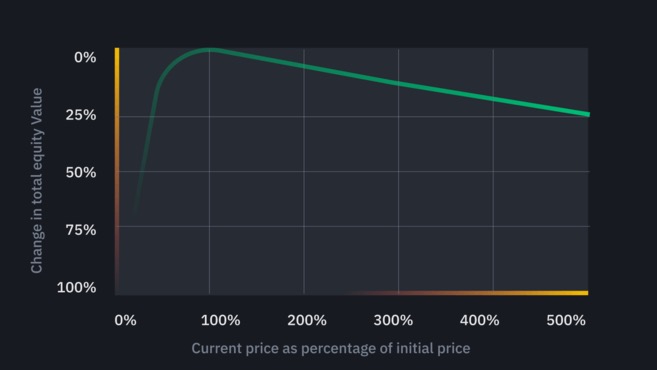
Explanation of pro bono losses
Lending agreements can provide relatively high yields, which are usually driven by the need for leverage. This potential demand for leverage comes in part from traders who make good use of news sources. Often, when they get some insider information, they prefer a desperate way of investing.
Assuming that a trader knows in advance that the project will have huge positive news, the trader may borrow a large amount of USDC from the market at an annual interest rate of 8% (about 0.02% per day) and use it to accumulate a large amount of tokens. As long as the price of the purchased token fluctuates more than 0.02% per day, traders can profit from this loan. However, relying on insider information to operate huge orders is not a wise choice in the Defi field. Such large orders are recorded on the blockchain and eventually monitored by various detection tools (such as Whale Alert), thus becoming a “well-known secret.”
Another major reason for the surge in demand for leverage is the implementation of market-neutral strategies (market-neutral strategies refer to an investment strategy that simultaneously builds long and short positions to hedge against market risks and can obtain stable returns regardless of whether the market rises or falls. Market-neutral strategies are mainly based on quantitative analysis of statistical arbitrage). For example, traders can go long on spot, short perpetual/futures, and collect capital premiums from exchanges. Regardless of the price trend, whether it is rising or falling, a trader's loss on one position will be offset by the profit from the other position.
Assuming that the trading position is leveraged 5 times and calculated with an annual yield of 4% on a delta-neutral (meaning that a trading strategy is not affected by slight price fluctuations in the underlying asset), traders can eventually obtain 20% profit. This is much safer than simply using one-way risk exposure, but at the same time, the return is still quite impressive.
In addition to traders, investors involved in liquidity mining also need leverage
For example, borrowing stablecoins at an annual interest rate of 10%, and then using the borrowed money to fund a pool with an annual income of 30%, this creates a perfect arbitrage opportunity. While earning 20% of the arbitrage space, you can also obtain risk exposure benefits (used in exchange for stablecoins) of the original collateral token. As long as there is this kind of arbitrage opportunity, there will always be demand for high-interest loans in the market. This is the principle that the relationship between supply and demand creates high returns.
Since many new agreements currently provide an annual interest rate of 30%-50% or higher to attract liquidity providers, this will usually raise the price of the coin again (high yield attracts more people to mine, and more people need to buy the agreement's native token to participate in mining, thereby boosting the price of the coin), creating a higher yield.
Risk premium
The risk premium is essentially present in all risky assets. It is defined as the premium for taking risk, which is higher than the risk-free interest rate.
In DeFi, risk premiums can exist on many aspects, from market risk to counterparty risk and illiquid risk and volatility risk. The more risks investors take, the higher the risk premium, and the higher their return on risk compensation. Any transaction in the crypto market is inherently risky, and the market requires a risk premium to cover the risk it bears.
Market risk is the risk of the entire process of investing in cryptocurrency. This includes the market volatility of the cryptocurrency itself, hacking attacks, private key management costs/risks, leverage, etc. Compared to traditional financial instruments such as stocks, cryptocurrencies are generally riskier, so investors demand higher returns on the risks they take. DeFi can also be seen as a derivative of the crypto market. The risks involved are greater. Every minute and every second, all kinds of smart contracts face risks caused by bugs, hackers, and project parties. Naturally, high returns are not surprising.
Counterparty risk also increases returns. For example, you would expect to be compensated for the risk of a counterparty going bankrupt or disappearing with your money. If you trade futures on dYdX, dYdX is your counterparty. If dYdX gets hacked, so are your funds. Therefore, there is a risk premium for trading futures on dYdX.
Therefore, DeFi also follows the most basic financial rules: the greater the risk taken, the higher the yield.
Agreement revenue
Another source of revenue is revenue from agreements. For example, a lending agreement like Aave uses revenue from agreements between lenders and borrowers and allocates them to stkAave holders.
Many DEXs, such as PancakeSwap, use protocol revenue to buy back and destroy their governance tokens, which has some kind of deflationary effect on the token, thereby increasing the price of the coin. Furthermore, by allocating value to token holders, a unique revenue model has been created, that is, the agreement can distribute governance tokens as income. Because people who invest in governance tokens have contributed to the development of the agreement, they can share the future cash flow of the agreement, similar to holding shares in a certain company, but stocks do not allow holders to participate in corporate governance.
This keeps the incentives consistent between depositors and token holders, as they are now incentivized to deposit liquidity, accumulate governance tokens and invest them in earnings, or sell them to others who want to access that revenue stream.
Are high yields sustainable? (A few years or even decades)
In a bull market, the demand for leverage is often frightening because most investors want to invest more to earn higher returns. New projects have also sprung up, which has led to the emergence of a large number of high-yield mining pools. While bringing in new capital, it has once again raised the market's demand for leveraged capital.
Theoretically, agreement revenue will also increase dramatically, because a bull market will generate more transactions, and more transactions mean more transaction fees. Allowing the protocol from the beginning to maintain a high yield to attract users is a virtuous cycle.
But in a bear market, the situation is completely different. In a bear market, the price of a large number of tokens plummeted, and there were fewer and fewer successors. Tightening capital led to an overall decline in yield, and demand for leverage also plummeted. This further led to a decline in transaction volume and protocol revenue, creating a vicious cycle.
DeFi has been in a bull market since the beginning of last year. This means that the market is still in high demand for leverage. And as long as innovation continues in this field, the asset class will continue to grow, and yields will remain high. However, even in the wildest fields, innovation and development will eventually encounter bottlenecks, so DeFi's high yield is probably just a temporary phenomenon.
In the long run, declining yields are an inevitable trend. Compare things out of the blue. Just like the history created by the US dollar in the field of fiat currency, the yield on saving dollars in the 1980s was 20%, but with the Federal Reserve printing large amounts of money, the yield has now dropped to 0%. This is a natural economic cycle, so the Defi market, which follows economic principles, cannot escape this cycle after all.
The market cycle affects demand for leverage, but the most important reference factor for whether earnings can continue is still whether the revenue from the agreement is sustainable, that is, the value created by the agreement itself, the problems solved, and the effects that will last for a long time. Iron still needs to be hard on its own; this principle applies everywhere.
Picture Source: Internet
Author: Chen Zou
This article is from Bitpush.News. The source must be indicated for reprinting
