流动性挖矿 · 1255

Bifrost liquidity mining incentive vulnerability was exploited by hackers, and around $72 million in assets were stolen

According to Bifrost monitoring, according to Bifrost's monitoring, the hackers used the liquidity pool vulnerability to steal assets worth about 720,000 US dollars from the vDOT single coin pool, VASTR/ASTR, and vManta/Manta pools. The relevant assets were then deposited into HitBTC and eventually flowed into Binance. Bifrost has contacted Binance's security department to file a fund freeze request, and submitted a report and on-chain evidence package to law enforcement, including transaction tracking, wallet address, and time stamp. Currently, Bifrost has stopped all liquidity mining rewards and is undergoing a full security review.

13d ago#On-chain dynamics

Paradigm-backed unsecured credit lending protocol 3Jane is open to the public

According to Twitter, 3Jane, an unsecured credit lending protocol supported by Paradigm, posted on social media that the agreement is now open to the public, and users can mint USD3 and participate in liquidity mining to earn JANE tokens. According to reports, USD3 is a credit-backed income stablecoin with a supply limit of 50 million US dollars; sUSD3 is a pledged version of USD3 with leverage exposure. JANE uses a variable total supply design, and the final supply will be determined at the time of final casting in 2026 (range of approximately 1,111 million to 6.666 billion pieces). Currently, 100% of JANE emissions will be distributed to liquidity providers and can be claimed every 7 days (locked) until final casting. Crypto-credit startup 3Jane announced the completion of a $5.2 million seed round in June 2025, led by Paradigm.

72d ago
CEX collectively transformed traditional finance, and altcoins entered a survival test period of “self-survival and self-destruction”

CEX collectively transformed traditional finance, and altcoins entered a survival test period of “self-survival and self-destruction”

Author: Henry Kim, Ryan Yoon Compiled by: Chopper, Foresight News Original title: CEX Embraces Stocks, Are Altcoins Abandoned? The TL; DR cryptocurrency spot transaction fee model peaked, and decentralized perpetual contract exchanges such as Hyperliquid rose. Coupled with the easing of the regulatory environment after the Trump administration came to power, multiple factors compounded the world's leading crypto exchanges to reorient their development direction. Today, major exchanges are laying out traditional financial categories such as stocks and financial derivatives, and their operating models are gradually moving closer to traditional financial institutions. However, problems have arisen, and centralized exchanges have always been the core liquidity providers in the entire crypto ecosystem. Once exchanges gradually weaken the main cryptocurrency industry, the original order of operation of the entire crypto market may be completely disrupted. Since then, cryptographic projects have entered the stage of independent survival. Whether they can break away from exchanges to support independent operation will become a watershed in project development, and the industry landscape will soon be clearly divided. Since June 1, when trading Apple shares on the Binance platform, users can directly trade US stocks such as Apple (AAPL) and Alphabet (GOOGL) through the Binance App. The next day, Binance announced the addition of trading constituent stocks in the Korea Composite Stock Price Index, including SK Hynix, Samsung Electronics, and Hyundai Motor, the three most actively traded Korean stocks. The idea for Binance to lay out the stock business dates back to 2021. In April of that year, the platform launched a tokenized stock trading function, which supports trading targets such as Tesla (TSLA), Apple (AAPL), and Microsoft (MSFT). However, due to continued tightening regulatory pressure, the service was completely shut down in July of the same year. At the time, it was difficult for this business to continue to operate. There were three main structural problems: whether stock tokens were securities or derivatives; the legal characterization of related products was not provided with investor prospectus in accordance with EU regulatory requirements; at the same time, Binance itself was not directly qualified to carry out such business. The German Federal Financial Supervisory Authority, the UK Financial Conduct Authority, and the Hong Kong Securities and Futures Commission all raised objections based on these issues. Now that the stock trading service has been re-launched, the overall structure has been drastically adjusted. Binance currently completes order execution through licensed brokers in the Abu Dhabi Global Market. The business is clearly defined as a securities brokerage service, completely avoiding previous legal disputes. The core contradiction of the 2021 business shutdown: the problem of vague ownership of underlying asset issuers has now also been largely resolved. The current industry movements showed a clear coincidence of time. At the same time, Bybit also launched the traditional financial perpetual contract market. It not only launched Korean stock contracts such as SK Hynix and Samsung Electronics, but also opened up space exploration technology company (SPCX) perpetual contract trading. Coinbase also followed suit, announcing support for SPCX contract transactions. The reasons behind the collective transformation of leading crypto exchanges at almost the same stage, abandoning a single cryptocurrency trading model and switching to a comprehensive traditional financial service platform are worth investigating. The three driving forces of transformation are triple external pressures, which together push exchanges to leave the pure cryptocurrency operating model. Cryptocurrency trading volume continues to decline. The primary pressure comes from the contraction of overall cryptocurrency trading volume. The exchange's core revenue comes from cryptocurrency transaction fees, and the level of trading volume is entirely determined by market sentiment. Binance's average daily spot trading volume fell sharply from a peak of around $45 billion in October 2025. Currently, it is only $7.7 billion, a drop of nearly 80%. The total spot trading volume of all other centralized exchanges also fell from a peak of US$63 billion to US$18.8 billion today, a decrease of about 70%. The volume of transactions continues to shrink, which means that a business model that relies on transaction fees to profit is beginning to be unsustainable. In fact, major exchanges have long realized that it is impossible to build a sustainable revenue system by simply relying on cryptocurrency transaction fees. The liquidity comparison data on the Hyperliquid distribution chain clearly shows the current market pattern: comparing the trading volume of altcoins other than Bitcoin and Ethereum with the trading volume of real-world assets such as stocks and commodities on the Hyperliquid platform, the gap is already evident. Hyperliquid continues to absorb on-chain liquidity through the launch of stock and commodity perpetual contracts. As of mid-2026, 23 of the platform's top 30 perpetual contract trading volume targets were stocks and commodities; instead, cryptocurrency targets became...

73d agoburnking#CEX #altcoins
After US stocks and RWA were launched one after another, the coin industry began to compete for a real moat

After US stocks and RWA were launched one after another, the coin industry began to compete for a real moat

Author: Danny Original title: After US stocks and RWA were launched on exchanges, efficiency is the core competitiveness of the coin industry. If you only look at the surface, it's easy to draw a conclusion: the coin industry is “embracing traditional finance,” and the coin industry assets will cool down?! Binance listed thousands of US stocks in stock, OKX, Bybit, and Bitget launched perpetual stocks, RWA tokens, and synthetic assets, and xStocks moved stocks to Solana. Seemingly, this is an expansion in the asset class — the coin community can finally buy $AAPL, $TSLA, $MSFT, $NVDA... but if you stay at this level of understanding, you haven't actually seen any real changes. The most important structural change in this round is not “more assets,” but rather that different assets are beginning to enter the same credit and margin system. When stocks, stablecoins, crypto assets, and RWA were placed in the same unified account, the competitive logic of the financial system changed: it was no longer “who owns assets,” but “who can use assets more efficiently.” The future belongs to young people. Compared to old people, young people don't have many assets. To achieve Go Big or Go Home, the prerequisite for achieving Go Big or Go Home is to have a place to use assets more efficiently. 1. The main line of financial history: never an asset, but efficiency Financial innovation is often misunderstood as “the birth of new assets,” but the more critical change in history has actually always been the improvement of efficiency. Stocks have not changed the world; securities financing has changed the world; bonds have not changed the world; the repurchase market has changed the world; mortgages have not changed the world; securitization has changed the world. The asset itself is a static inventory. What really determines the scale of finance is whether an asset can be reused (aka credit expansion): whether it can be collateralized, whether it can be re-collateralized, whether it can function simultaneously in multiple markets, and whether it can circulate at a faster speed. For young people, the essence of the financial system is not simply asset growth; it also requires an increase in the speed of capital turnover. It can be complicated, but it's faster. 2. DeFi Summer has already demonstrated this matter once, turning the time back to 2020. DeFi Summer, which many people remember, is liquidity mining, which is an APY that can easily run in the thousands; but that was just an appearance. The real innovation was the first time that collateral between n different systems began to circulate with each other. That path probably goes like this: deposit ETH → mint DAI → buy more ETH → deposit again → re-cast DAI → go back and forth. With every round, the exposure to ETH widens, and the original investment has not changed; the underlying asset of one dollar supports several dollars of credit. Aave, Compound, and later Curve and Convex just made this cycle smoother and more automatic. The protagonist of that round was $ETH. What it proved was never the yield of a farm, but that the same asset can be pledged and used over and over again. And this is the fundamental difference between crypto finance and traditional finance — composability. 3. The core advantage of encryption: It's not an asset, but composability. Many people understand encryption as a “new asset class,” but the real difference in cryptography is not in assets, but in structure — traditional finance is an account isolation system, while encryption is a state sharing system. The same ETH can play multiple roles on the chain at the same time: it is both a spot asset, collateral, a loan asset, a derivative security deposit, or the underlying asset of a yield strategy. The same asset is used over and over; in traditional financial systems, this kind of reuse is highly limited. (Remember the story of Bybit's unified account system overtaking a corner?!) This is the core power of cryptography — turning assets into credit components that can be infinitely restructured. 4. The true meaning of RWA on CEX: It is not an asset chain, but an efficiency boundary extension. Currently, the mainstream understanding of RWA is: stock on chain, bond on chain, and real estate on chain. But this is just a superficial narrative; the real question is — what system do these assets run on after entering the chain? If it's just a “different trading interface,” the meaning is limited. But if you enter a unified margin system: 24-hour trading, real-time settlement, multi-asset collateral, and unified accounts across markets, then the meaning of assets changes. The assets themselves have not changed, but the way they are used has qualitatively changed: the same asset begins to serve multiple systems and participate in multiple cycles at the same time. Efficiency is beginning to become a core variable, and...

79d agoLuxurytracy
It's Not Destruction, It's Reinventing: Hacking and Regulation Are Pushing DeFi to Realism

It's Not Destruction, It's Reinventing: Hacking and Regulation Are Pushing DeFi to Realism

Author: Gu Yu, ChainCatcher Original title: Are Hacking and Regulation Ruining DeFi? In April 2026, a series of security disasters once again brought DeFi to the forefront of public opinion. The Kelp DAO and Drift Protocol attacks collectively caused losses of more than US$575 million. The total locked value (TVL) of DeFi plummeted from about US$172 billion to US$148 billion, and the TVL of the lending sector alone collapsed from US$53 billion to US$40 billion. In recent days, Manuel Aráoz, co-founder of the well-known security audit firm OpenZeppelin, said bluntly on the X platform: “I think all DeFi is unsafe anymore.” He even said that he has begun privately advising his family and friends to clear all DeFi positions, including Aave, MakerDAO, and Compound, which are known as “low-risk blue chip” agreements. Although this judgment is particularly harsh, it is worth pondering. After all, OpenZeppelin has long been one of the most important security infrastructure builders in the DeFi world, and its smart contract standards and security tools have evolved almost throughout the industry. If even those most familiar with smart contract security systems are beginning to question the risks of DeFi and withdraw decisively, then this certainly means that some deeper problem is surfacing. Whenever DeFi has experienced setbacks over the past few years, people have been able to quickly find a specific reason. When the market is sluggish, people blame the macro environment; when hacking occurs, people think it is due to technical flaws; when regulators act, people also attribute the problem to policy pressure. However, if you lengthen the time dimension, people will discover an increasingly clear fact: the plight of DeFi today is not caused by an attack, a regulatory policy, or a failed project, but rather the two core sets of logic that it was originally founded on are being challenged at the same time. A set of logic comes from the world of technology: code can replace trust. Another set of logic comes from the institutional world, that is, an open network can bypass the constraints of traditional financial systems. However, hacking and regulation have hit these two pillars separately. 1. The deep evolution of the DeFi security crisis In the past ten years, the core paradox in the field of DeFi security has not changed. Web3 security researchers have already identified this fatal asymmetry: defenders must close every possible gap that can be exploited, and attackers only need to succeed in one step. On the face of it, the attack methods are nothing more than cliché routines such as cross-chain bridge exploits, multi-signature privilege hijacking, and oracle manipulation. But the Kelp DAO and Drift Protocol incidents revealed an even harsher trend: the most fatal bugs are often not in the smart contract code. On April 18, the Ethereum liquidity heavy staking protocol Kelp DAO was attacked. The attackers used the DVN (Decentralized Verification Network) configuration vulnerability of the LayerZero cross-chain bridge, falsified cross-chain messages, and removed 116,500 rSetH from the cross-chain bridge within a few hours, which was about US$293 million at the price at the time. The nature of this disaster was a misconfiguration, not a code flaw. Kelp DAO chose “1-of-1” for LayerZero's cross-chain verification network — only one DVN node is required to confirm, and cross-chain messages are considered legitimate. When the attackers attacked the two RPC nodes that provided verification data and launched a DDoS attack, the entire bridging system was fictional. On April 1, Drift Protocol, one of the largest perpetual contract DEXs in the Solana ecosystem, was attacked and lost US$285 million, making it the biggest single DeFi attack incident so far in 2026, and the second largest hacking case in Solana's history. It's also not a smart contract bug. The attackers attacked at least two of the three signers of the multi-signature wallet through social engineering, using Solana's durable nonce feature to force them to pre-sign malicious transactions. Once the attackers obtained administrator rights, they completed the theft of funds in less than 12 minutes. The root cause of the attack is a complete failure of operational security (OpSec): improper configuration of multi-signature wallets, blind spots in key management, and flawed social engineering defenses. These two events revealed the deep evolution of the DeFi security crisis: the breakthrough of attacks is moving from traditional smart contract code bugs to the configuration layer and the humanity/OpSec layer...

85d agoburnking#DeFi #custodial #hacks
Audit God urgently calls for “quick withdrawal”: AI agents are turning DeFi into ATMs for hackers

Audit God urgently calls for “quick withdrawal”: AI agents are turning DeFi into ATMs for hackers

Author: Azuma Original title: Frontline Audit Okami Warning: All DeFi is unsafe, close soon! “I don't think all DeFi is secure anymore.” Manuel Aráoz, founder of OpenZeppelin, left an assertion on X yesterday, like a deep-water bomb, once again impacting the already stagnant DeFi market. Manuel has even stated that he has begun advising family and friends to withdraw funds from major DeFi agreements, including blue-chip agreements such as Aave, MakerDAO, and Compound, which were once viewed as low-risk. This isn't alarmist rhetoric from an outsider. On the contrary, Manuel himself is one of the core builders of the DeFi security system, and OpenZeppelin is one of the most mainstream security audit companies in the industry. Its contract library, security standards, and audit framework have penetrated almost the entire DeFi world. The reason for Manuel's complete shift in attitude was AI. Manuel is pessimistic that the ability of AI coding agents to identify and extract smart contract vulnerabilities is increasing exponentially. This means that problems that used to take weeks to be discovered by top white hat teams may now be scanned by AI within a few minutes; in the past, hackers needed to study protocol logic for a long time, and can now be directly automated by AI to analyze attack paths; in the past, the “openness and transparency” of DeFi was an advantage, but now it has become the best training corpus for attackers. Manuel also mentioned an even more fatal issue. Smart contract security is essentially an extremely asymmetrical game — the defender must fix all the bugs, and the attackers only need to find one to steal the funds. This asymmetry is rapidly unbalanced after AI began increasing attack efficiency exponentially. Cold reality: DeFi is already an ATM for hackers. Looking back at the DeFi security incidents of the past few months, you'll see that Manuel's concerns are not exaggerated. April was almost the worst month in DeFi history. On April 1 April Fool's Day, Drift Protocol stole $280 million due to administrative privilege hijacking and multi-signature execution vulnerabilities (see “April Fool's Day Jokes? The Drift Protocol was stolen over US$280 million, or the second largest DeFi heist in the Solana ecosystem”). Then, on April 19, Kelp DAO stole $292 million due to the breach of the bridging agreement (see “DeFi Stole Another $292 Million, Now Even Aave Unsafe?”) Hackers later escaped through loan agreements such as Aave, causing the whole of DeFi to fall into the shadow of bad debts and their associated effects. However, after entering May, not only did the number of accidents not decrease; on the contrary, they spread further. On May 15, THORChain was attacked. Newly added node operators used the GG20 Threshold Signature Scheme (TSS) vulnerability to restructure private treasury keys and directly execute outbound transactions, causing losses of over 10 million dollars. On May 18, Verus's bridging protocol was attacked. The attackers falsified cross-chain payloads, bypassed verification to extract assets from Ethereum reserves, and stole approximately $11.58 million. On May 19, the Echo Protocol on Monad was attacked due to a private key leak. The attackers minted 1,000 eBTC (worth $76.7 million) and withdrew funds via Curvance through previously tested attack paths. On May 24, StabLR, a compliant stablecoin issuer under the MiCA regulatory system, was attacked. The hacker made a profit of more than 2.8 million US dollars by issuing additional EURR and USDR, causing EURR and USDR to become unanchored. On May 25, the SquidRouter module was attacked, and 86 Gnosis Safe wallets were stolen as a result of which approximately $3 million in assets were stolen. On May 27, the private key of the StakeDAO deployer was leaked on Arbitrum. The attackers minted about 5.45 trillion vsDCRV, which were partially exchanged for 43.7 ETH and escaped. High-frequency security incidents have sounded the alarm, from on-chain code to off-chain management, De...

86d agoburnking#AI #DeFi
DeFi Treasury Enters Reshuffle Period: Analysis of the Latest Trends on the Eight Major Races

DeFi Treasury Enters Reshuffle Period: Analysis of the Latest Trends on the Eight Major Races

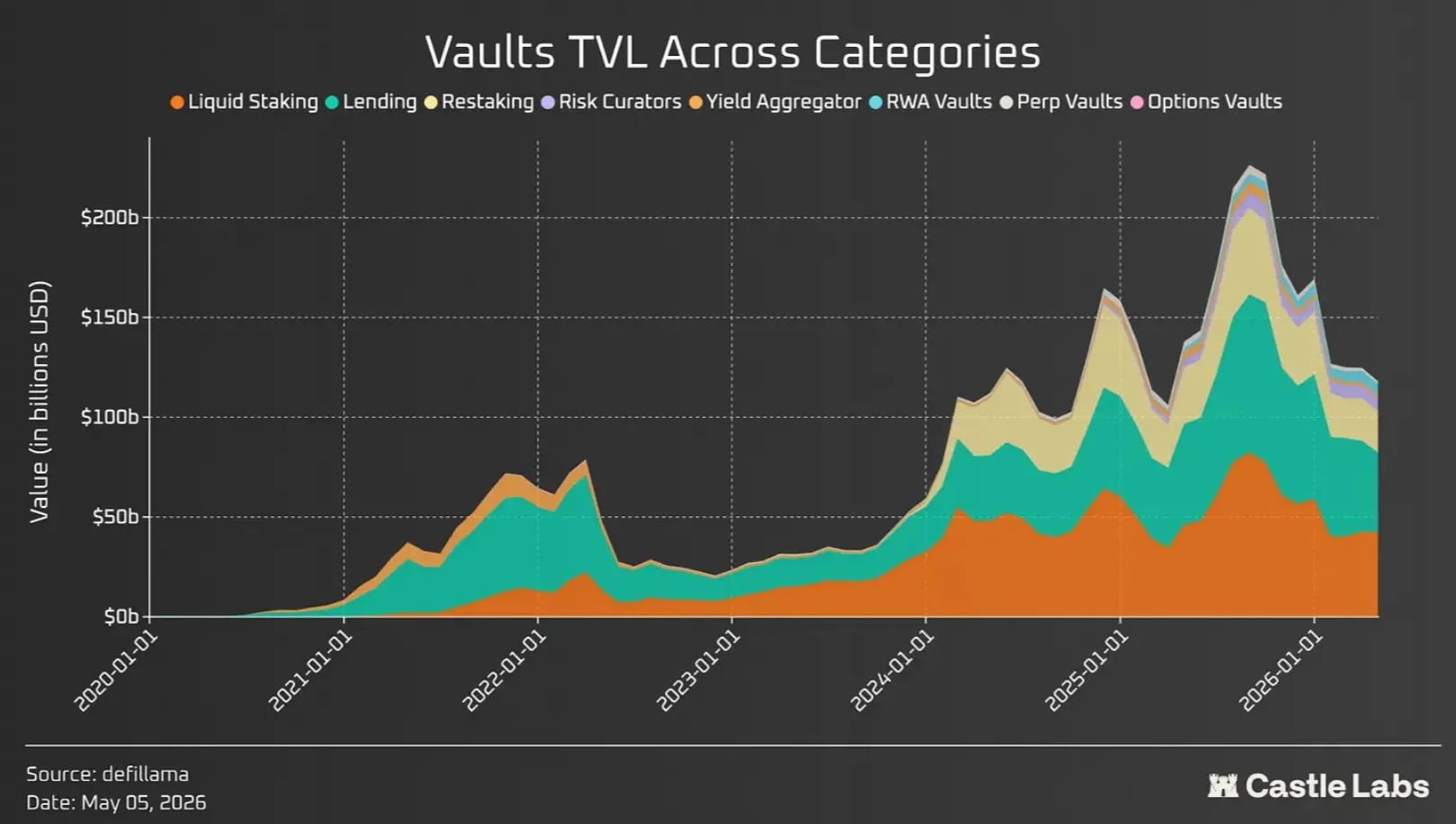
Author: Castle Labs Original title: DeFi Treasury 2026 Annual Report: 8 major tracks, who is rising and who is declining? Compiled by Jia Huan, ChainCatcher This article is an excerpt from our research on “financial treasurization”. Download the full report here Treasury Classification This section of this report provides a quantitative analysis of the treasury landscape to provide a comprehensive picture of the field and its evolution. We analyze the ecosystem by category and track TVL transfers from different treasurers and curators. We have broken down the concentration of curators and provided an outlook on major capital flows, putting the structural transformation that will define this year's treasury in a specific context. Treasury should not be viewed as a single, all-encompassing market, but should be assessed according to its different implementation methods, each with different parameters, risk vectors, and responses to stress tests. Aggregated data can only provide a partial picture, and there is an urgent need for a more detailed analytical perspective. Before starting the analysis, it is important to define the term “treasury” as the basis for our methodology. Our definition is based on the deployment path. Treasury is classified as a “tool for users to obtain active income strategies”. Any asset that is purely an off-chain tool package was excluded from our analysis. Maple's SyrupUSDC complies with treasury standards: users deposit stablecoins into agreements, which lend them to institutional borrowers, and accumulate annualized returns through credit activities that issue tokens. Lido stETH is a vault: users deposit ETH and the protocol earns staking profits, which are distributed through rebase tokens. Centrifuge JAAA is a treasury: users receive AAA-level CLO benefits through tokenized packages that generate revenue through their credit positions. BlackRock's BUIDL is not a treasury by this definition: it is a direct token offering representing a 1:1 claim to off-chain US Treasury funds. We applied this perspective to define eight structural categories: loan treasury, liquid pledge, repledge, risk curated vault, treasury infrastructure provider, yield optimizer RWA credit treasury, perpetual contract LP treasury, and options treasury. For the purposes of this analysis, we used risk curated treasury as an independent category to better understand its dynamics and growth. Before we dive into these categories one by one, let's focus on the overall performance of the vault. Current state of treasury ecology The total net TVL of all defined treasury categories is US$12.4 billion, down about 50% from the peak of US$241 billion around October last year. The downward trend after the October peak was driven by the “October Liquidation Event,” which triggered cascading liquidations across DeFi. Due to overlap, the treasury TVL figure is higher than the current DeFi TVL (approximately $86 billion). For example, liquid staking protocols like @LidoFinance have issued stETH, a rebase asset representing staked ETH earnings, which is used as collateral in lending agreements such as @Aave and @Morpho. If we move to category-level analysis, the overall situation changes dramatically. Recent events have led to an outflow of TVL and prompted the entire industry to conduct a broader reality test on safety and risk management (and hopefully shift to a safety-first approach). Categories such as borrowing, liquid staking, and repledging were the hardest hit because they had the greatest risk exposure to on-chain assets and drive the operation of the on-chain economy; while RWA treasury continued to show unrelated growth due to no risk exposure to crypto assets. Categories such as options vaults peaked in April 2022 and have been struggling ever since. As a result of the “October Liquidation Incident,” risk curator-led vaults were hit on a par with other major categories. Their TVL peaked around the end of October and then declined due to the Stream Finance crash. The three incidents (Stream Finance, Resolv, and Kelp hacks) between October 2025 and May 2026 provided a good stress-testing window, as these crashes/exploits had a cascading effect across DeFi. In the image below, we highlight the TVL history for these categories during this specific period. As before...

87d agoLuxurytracy
The singularity of the mechanism: the right to short sell is the real puzzle that will inspire the next round of copycat bull markets

The singularity of the mechanism: the right to short sell is the real puzzle that will inspire the next round of copycat bull markets

Author: Danny, Crypto Analyst Original title: Singularity of the mechanism, the starting point of the bull market: The right to short sell is the puzzle that will inspire the next round of shady bull markets. In 300 years, there is a rule that has been verified over and over again: the bull market has never been ignited by a certain narrative, but by an upgrade in trading mechanisms. Whether it's ICOs, perpetual contracts, AMM, DeFi, NFTs... They are all mechanism-driven games, and games allow capital to flow into the cycle. It is the upgrading of the mechanism that brings prosperity. Looking back at the starting point of every big market, you'll find that what they all have in common is not “a good story has emerged,” but “market participants have suddenly gained a new way to play.” What sparked the next round of prosperity was never the narrative, but the evolution of every transaction mechanism, from Wall Street to Binance, from spot to contracts, and from DeFi Summer to Hyperliquid, never lapsed. You can short it, you can short — aka equal right to short is an opportunity for the next round of the altcoin bull market. 1. In 1609, a Dutch businessman changed the history of finance. 1609, Amsterdam. The Dutch East India Company (VOC) was the largest listed company in the world at the time. It monopolized the Asian spice trade, and its stock price only rose or fell. Everyone is buying, and everyone is making money. The market has only one direction — upward. Then a businessman named Isaac le Maire did what everyone thought was crazy at the time: he borrowed VOC stock, sold it, and bet it would go down. This was the first recorded short trade in human history. The Dutch government is furious. Parliament believes that this is a malicious attack on the country's pillar enterprises, and legislation prohibits shorting. le Maire was publicly denounced. But that's not the end of the story — despite repeated bans, shorting has never really disappeared in Amsterdam. Because market participants have discovered a fact that cannot be denied by legislation: with shorting, prices have become more real. Those overvalued stocks can no longer maintain false prosperity indefinitely. Today, four hundred years later, the crypto market is repeating the same script. In a market of several thousand altcoins, only buying, not shorting. Prices reflect only half of optimism, and pessimistic voices are forcibly silenced. Every round of the market is the same cycle: FOMO pushes up, the bubble bursts, and there are feathers waiting for the next story to start again. But history has taught us — every introduction of shorting rights is not the end of the market; rather, it is the starting point of the market. 2. The 200th year of Wall Street: How shorting changed from a “national enemy” to a “cornerstone of the market” 1792-1840s: The barren era — the original market where you can only do more. On May 17, 1792, 24 brokers signed the Buttonwood Agreement (Buttonwood Agreement) under a sycamore tree on Wall Street, agreeing to trade stocks with each other. It is the predecessor of the New York Stock Exchange (NYSE). The market at the time was similar to today's altcoin market: you can only buy, hold, wait for dividends, and wait for the New Year. There is no leverage, no shorting, and no standardized delivery process. The average daily transaction volume is probably less than $500,000, and there are only a few dozen participants. The market is extremely small because there are so few things that can be done. Price fluctuations are entirely driven by bullish sentiment. The good news came, everyone bought it, and the price soared. The bad news came. Everyone wanted to sell it, but because the market was too shallow, they couldn't sell it, and the price crashed. There are no bears to make up for purchases when it falls, so there is no natural support in the market. The bottom depends entirely on when the last bulls concede defeat. Is this like the 2024-2025 meme, high FDV, low Float altcoin market? 1850-1860s: Shorting takes center stage — fear and prosperity come at the same time. In the 1830-1840s, a trader named Jacob Little made a fortune by shorting and was known as “the first big short on Wall Street.” However, shorting actually became a mainstream weapon in the decade before and after the Civil War. Daniel Drew, Jay Gould, Cornelius Vanderbilt — these names defined Wall Street in that era. They unleashed an epic series of long and short battles around railway stocks: Drew shorted Erie Railroad, and Gould and Fisk teamed up to snipe Vanderbilt's long positions. These battles are bloody, chaotic, and frauds, but they end objectively...

127d agoburnking#DeFi #NFTs #Binance
The US SEC and CFTC join forces to redefine crypto assets. What kind of compliance era will the industry usher in?

The US SEC and CFTC join forces to redefine crypto assets. What kind of compliance era will the industry usher in?

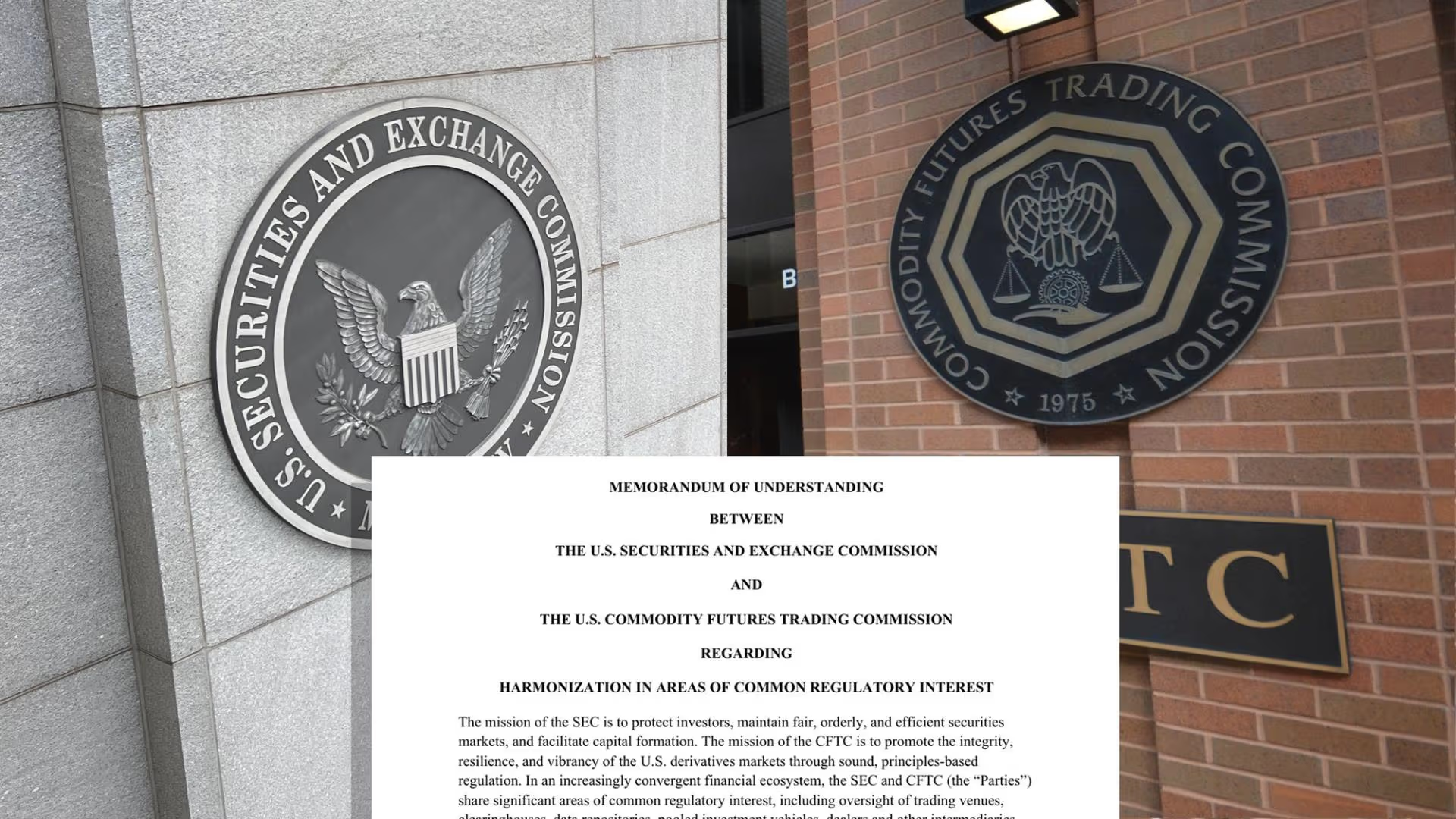
Author: Wenser 2010 Original title: The US SEC and CFTC joined forces to “unbind”. Crypto assets are “digital goods” rather than “securities.” On March 17, local time, the US SEC officially issued the 30th press release since this year. In this explanatory document of less than 1000 words, US SEC Chairman Paul Atkins joined forces with US CFTC Chairman Michael Salinger to break the tight spell on the entire crypto industry for the first time: most crypto assets are not securities, but are classified as “digital goods, digital collectibles, digital tools, and stablecoins.” On March 11 of this year, the two major agencies jointly signed a “Memorandum of Understanding” (MOU), which revealed that they will “clarify product definitions through joint interpretation and rulemaking, and develop a modern clearing, security deposit, and collateral framework.” Looking at it now, this latest explanatory document is the best proof that the two major institutions have joined forces to untie the cryptocurrency market. Predictably, the impact of this document clarifying the classification of crypto assets goes far beyond that. Subsequent intensive crypto IPOs, airdrops, DeFi mining, staking, and encapsulated assets will all usher in new development opportunities. As for what appears to be a convenient door, whether it is the influx of institutional liquidity, countless retail investors, or the scythe hidden in the regulatory machinery, time may only tell us the answer. Explain in detail the five major categories of the US SEC explanatory document: Most crypto assets are not securities. According to the “Fact Form” document issued by the US SEC, the classification of 5 types of crypto assets is clearly defined: the value of digital goods — non-securities — is essentially linked to the programmatic operation of a “functional” cryptographic system and the dynamics of supply and demand, rather than from expectations about profits generated by other people's core management efforts. Digital collectibles — not securities — are designed for collection or use to represent or convey the right to digital expressions or references to works of art, music, videos, trading cards, game items, or online memes, characters, current events, trends, etc. Digital tools — not securities — cryptographic assets that have actual functionality, such as memberships, tickets, vouchers, title documents, or identifiers. Stablecoins — Stablecoins that meet the definition of the GENIUS Act are non-securities, and stablecoin issuers are specifically prohibited from paying interest or revenue in any form (cash, tokens, or other consideration) to their holders. Digital securities (or “tokenized securities”) — are securities — financial instruments presented or represented in the form of cryptographic assets, listed in the definition of “securities,” and whose ownership records are maintained, in whole or in part, on one or more cryptographic networks. In a more detailed 68-page explanatory document that followed, the US SEC also gave its own definition of airdrops, DeFi mining, pledging, and encapsulated assets: DeFi Mining (Protocol Mining): not a securities offering. (Daily Planet Daily Note: There is no structure that relies on profits generated by others' core management efforts.) Pledge: Does not constitute an issue of securities. (Daily Planet Daily Note: If the underlying asset is a digital security, or a non-securities asset but is included in an investment contract, the pledge certificate is classified as a security.) Encapsulated assets: Not securities. (Daily Planet Daily Note: The custodian of encapsulated assets may not misappropriate the underlying assets and cannot transfer, lend, pledge, re-pledge, or use them for any other purpose.) Short investment property: It is not a security. (Daily Planet Daily Note: If the issuer voluntarily announces the airdrop plan and requires users to complete specific tasks to obtain the airdrop, there may be an investment contract risk if there is active labor in exchange for assets, and the consideration relationship is clearly established) Simply put, those that are not securities include: digital commodities, like gold and oil, are actually usable, and the price is determined by market supply and demand. Bitcoin and Ethereum all fall into this category; digital collectibles, like collecting stamps or buying paintings, are used to collect or enjoy. NFT images and game items (including meme coins) that are popular online are all in this category; digital tools, like membership cards, tickets, and licenses, are obtained for use, not for speculation; stablecoins. It's like a digital “shopping voucher”, which is used exclusively for payment, and the value is stable and does not fluctuate. However, there is a hard rule: the issuer cannot pay interest to the holder; once the nature of the interest is paid, it may even be a stock. Digital securities, which themselves are stocks, are just digital alternatives...

149d agoburnking#DeFi #SEC #Exchanges #Platform coins #invests #stablecoins #airdrop #currency #finance

Universe Pro: Unai Engine Achieves $920,000 On-Chain Profit in 50 Days

Comparing news, the decentralized trading platform Universe Pro released its latest UNAI Engine data. Since its launch on January 25, the system has processed a cumulative total of 353,900 transactions in 50 days, achieving approximately $922,100 in on-chain profit. According to the data, the asset management scale was 3.15 million US dollars, the number of users was 4,581; the 30-day yield was 27.41%; the MEV module contributed 824,200 US dollars in profit; and the market making module contributed 9.79 million US dollars in profit. UNAI Engine was launched in two stages. It first obtains spread income through MEV arbitrage, and then launched the DEX market making module to provide liquidity to earn fees and present high-frequency trading characteristics. CEO Mr. Phil said, “Sustainable Web3 growth cannot rely on inflationary rewards or speculative cycles. The UNAI engine proved that on-chain systems can break through execution efficiency through infrastructure.” Unlike traditional DeFi liquidity mining models, the UNAI engine breaks through the bottleneck of idle capital by dynamically allocating funds to the three execution layers of MEV arbitrage, DEX market making, and stablecoin payment settlement, and achieves an efficient allocation of “native market structures”.

157d ago