


The singularity of the mechanism: the right to short sell is the real puzzle that will inspire the next round of copycat bull markets
By Danny, Crypto Analyst
Original title: The singularity of the mechanism, the starting point of the bull market: the right to short sell is the puzzle that will inspire the next round of copycat bull markets
In the 300 years of the financial market, there is a rule that has been tested over and over again: the bull market was never ignited by a certain narrative, but by an upgrade in trading mechanisms. Whether it's ICOs, perpetual contracts, AMM, DeFi, NFTs... They are all mechanism-driven games, and games allow capital to flow into the cycle. It is the upgrading of the mechanism that brings prosperity.
Looking back at the starting point of every big market, you'll find that what they all have in common is not “a good story has emerged,” but “market participants have suddenly gained a new way to play.”
What sparked the next round of prosperity was never the narrative, but the evolution of every trading mechanism
This rule, from Wall Street to Binance, from spot to contracts, from DeFi Summer to Hyperliquid, has never expired.
You can short it, you can short — aka equal right to short is an opportunity for the next round of the altcoin bull market.
1. In 1609, a Dutch businessman changed financial history
Amsterdam, 1609.
The Dutch East India Company (VOC) was the largest listed company in the world at the time. It monopolized the Asian spice trade, and its stock price only rose or fell. Everyone is buying, and everyone is making money. The market has only one direction — upward.

Then a businessman named Isaac le Maire did what everyone thought was crazy at the time: he borrowed VOC stock, sold it, and bet it would go down.
This was the first recorded short trade in human history.
The Dutch government is furious. Parliament believes that this is a malicious attack on the country's pillar enterprises, and legislation prohibits shorting. le Maire was publicly denounced. But that's not the end of the story — despite repeated bans, shorting has never really disappeared in Amsterdam. Because market participants have discovered a fact that cannot be denied by legislation: with shorting, prices have become more real. Those overvalued stocks can no longer maintain false prosperity indefinitely.
Today, four hundred years later, the crypto market is repeating the same script. In a market of several thousand altcoins, only buying, not shorting. Prices reflect only half of optimism, and pessimistic voices are forcibly silenced. Every round of the market is the same cycle: FOMO pushes up, the bubble bursts, and there are feathers waiting for the next story to start again.
But history has already told us --Every introduction of shorting rights is not the end of the market; on the contrary, it is the starting point of the market.
2. 200 Years of Wall Street: How shorting became a “national enemy” to a “cornerstone of the market”
1792-1840s: A wild era — a primitive market where you can only do more.
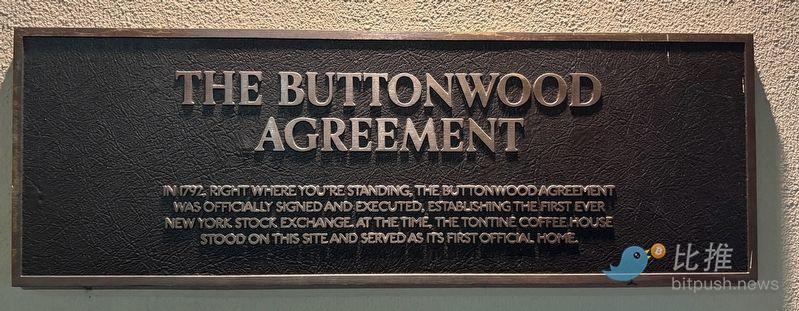
On May 17, 1792, 24 brokers signed the Buttonwood Agreement (Buttonwood Agreement) under a sycamore tree on Wall Street, agreeing to trade stocks with each other. It is the predecessor of the New York Stock Exchange (NYSE).
The market at the time was similar to today's altcoin market: you can only buy, hold, wait for dividends, and wait for the New Year. There is no leverage, no shorting, and no standardized delivery process. The average daily transaction volume is probably less than $500,000, and there are only a few dozen participants. The market is extremely small because there are so few things that can be done.
Price fluctuations are entirely driven by bullish sentiment. The good news came, everyone bought it, and the price soared. The bad news came. Everyone wanted to sell it, but because the market was too shallow, they couldn't sell it, and the price crashed. There are no bears to make up for purchases when it falls, so there is no natural support in the market. The bottom depends entirely on when the last bulls concede defeat.
Is this like the 2024-2025 meme, high FDV, low Float altcoin market?
1850-1860s: Shorting takes center stage — fear and prosperity come at the same time.
In the 1830-1840s, a trader named Jacob Little made a fortune by shorting and was known as “the first big short on Wall Street.” However, shorting actually became a mainstream weapon in the decade before and after the Civil War.
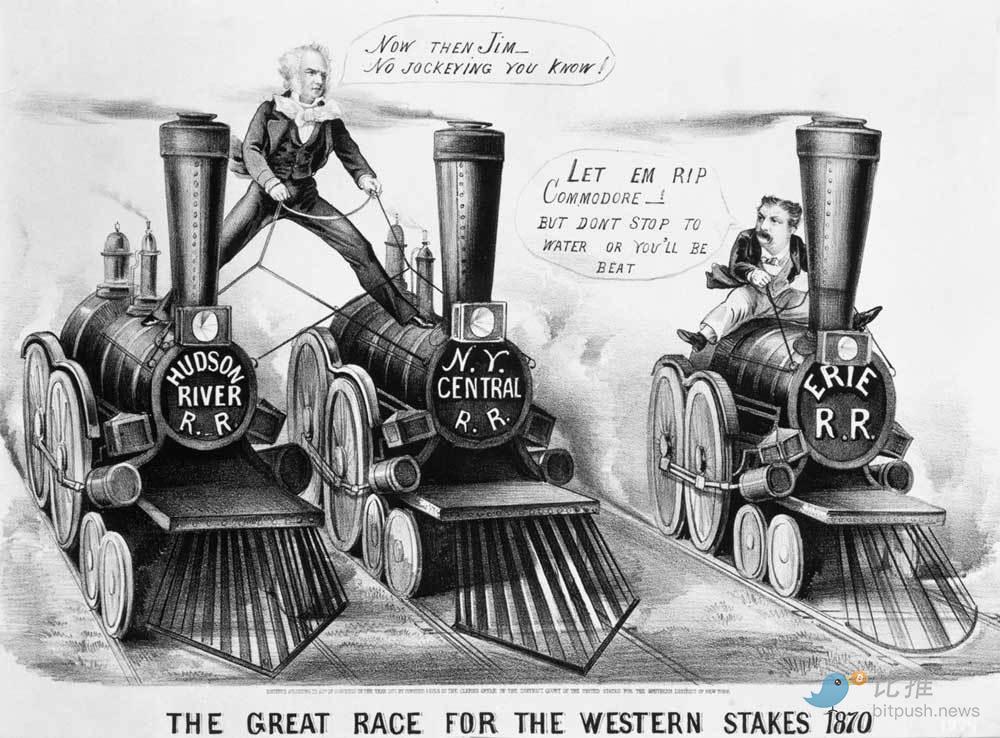
Daniel Drew, Jay Gould, Cornelius Vanderbilt — these names defined Wall Street in that era. They unleashed an epic series of long and short battles around railway stocks: Drew shorted Erie Railroad, and Gould and Fisk teamed up to snipe Vanderbilt's long positions. These campaigns are bloody, chaotic, and frauds, but the objective result is that shorting has gone from being a secret weapon for a few to become a standard tool on Wall Street.
The social response was the same as in the Netherlands in 1609. Members of the National Assembly scolded the shorthakers as “enemies of the country,” and newspapers said they “made a fortune from other people's disasters.” The public's fear of shorting has hardly changed in 400 years.
However, the market's response was the same as it was 400 years ago. It was positive and full of enthusiasm:
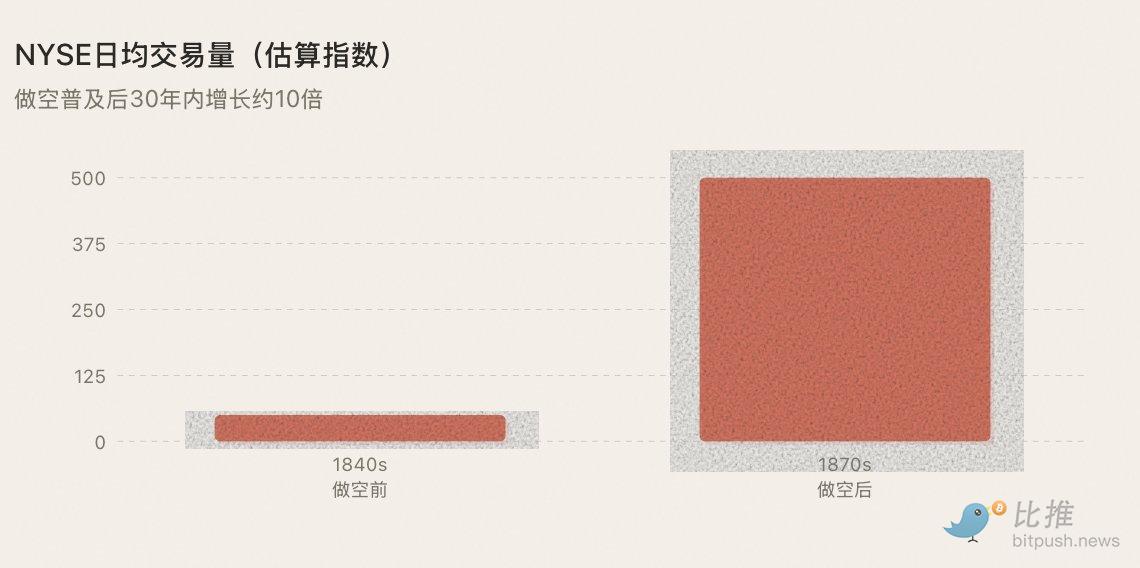
Each shorting creates a sell order, and at the same time creates an inevitable future buy order (short compensation). The trading volume has increased, the spread has narrowed, and more people are willing to enter the market. From a small circle of dozens of people, Wall Street began to become a real capital market.
The Great Crash of 1929 → The Uptick Rule of 1938: the pinnacle of fear, and a turning point.
Wall Street crashed in October 1929. The Dow Jones Index has dropped nearly 90% in two years. Public anger needed an outlet, and bears became the most convenient target — although the real culprits were crazy leverage bubbles and the systemic collapse of banks.
In 1934, the US Securities and Exchange Commission (SEC) was formed. Shorting is once again in danger of being banned outright. However, the SEC made a historic choice: in 1938, it did not prohibit shorting, but introduced the “uptick rule” (Rule 10a-1) — shorting can only be executed when stock prices rise to prevent bears from breaking the market continuously.
The significance of this choice cannot be overemphasized. It establishes a principle that continues to this day: shorting should not be eliminated; shorting should be regulated. Rules are not the enemy of shorting; rules are a prerequisite for shorting to gain legitimacy.
With rules, shorting is no longer a grey area. Institutional funding was originally concerned about being empty; now protected by a legal framework, they have dared to participate on a large scale. Regulation has not killed shorting; regulation has made shorting safer and more credible, and has attracted more capital to enter the market.
The crypto market hasn't really learned this lesson until today.
1973: Standardization of options — from one direction to four.
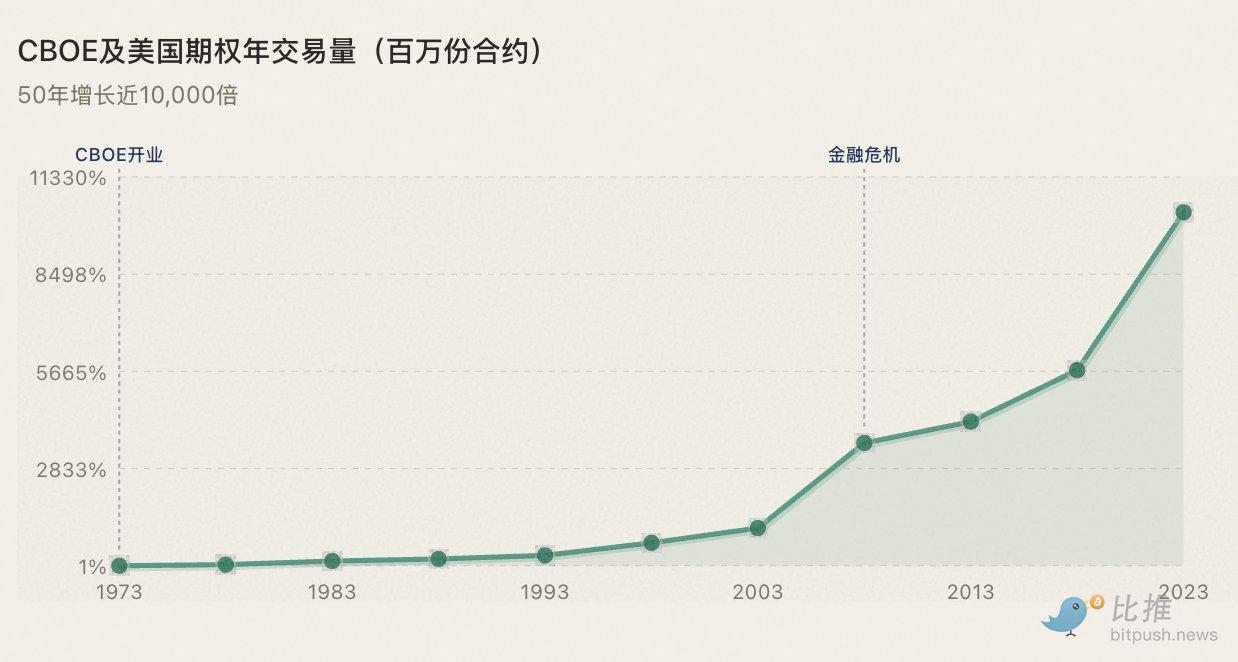
On April 26, 1973, the Chicago Board Options Exchange (CBOE) opened. You can only trade call options (Call) for 16 stocks on the first day. Put options (Put) were added in 1977. In the same year, Fischer Black and Myron Scholes published the Black-Scholes option pricing model that changed financial history, providing a mathematical foundation for options trading.
The meaning of options is that they expand the game dimensions of the market from two (buy/sell) to four (buy/buy/lost/sell/sell-down). For the first time, investors can express their judgments about the market in a very accurate way — not just “rise or fall,” but “at what time, at what speed, how much it rises or falls.”
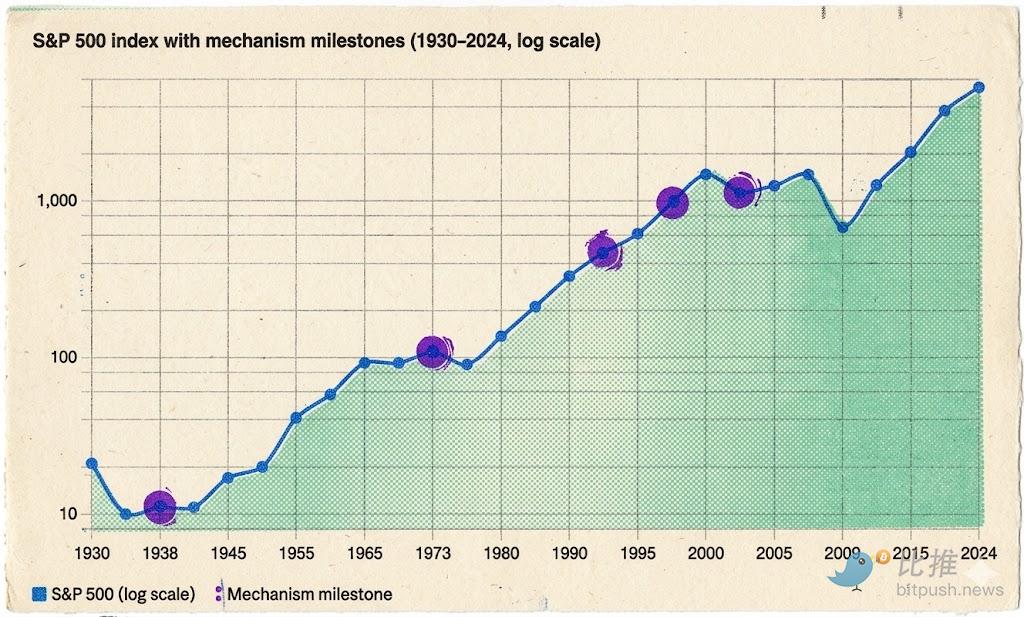
More importantly, options give institutional investors a complete hedging arsenal. The direct trigger for the big bull market in the 1980s (the S&P 500 rose more than 2,200% between 1982 and 2000) was Volcker's control of inflation, Reagan tax cuts, and deregulation, but options provided the risk management infrastructure that dared institutions to expand their positions. Once you can hedge, you dare to take heavy positions; if there are more people who dare to take heavy positions, capital inflows will increase, and a bull market will come.
For the wealthy and institutions, how to control the pullback is more important than how much money can be earned — uncontrollable risk means big money can't come in.
1996-1997: Retail investors broke in.
NASDAQ has been an electronic trading platform since its inception in 1971 — the first in human history. The real changes that occurred in 1996-1997 were two things: SEC's Order Handling Rules broke the market makers' monopoly on quotes; online brokerage firms (E*Trade, Ameritrade) reduced transaction commissions from $50-100 to less than $10.
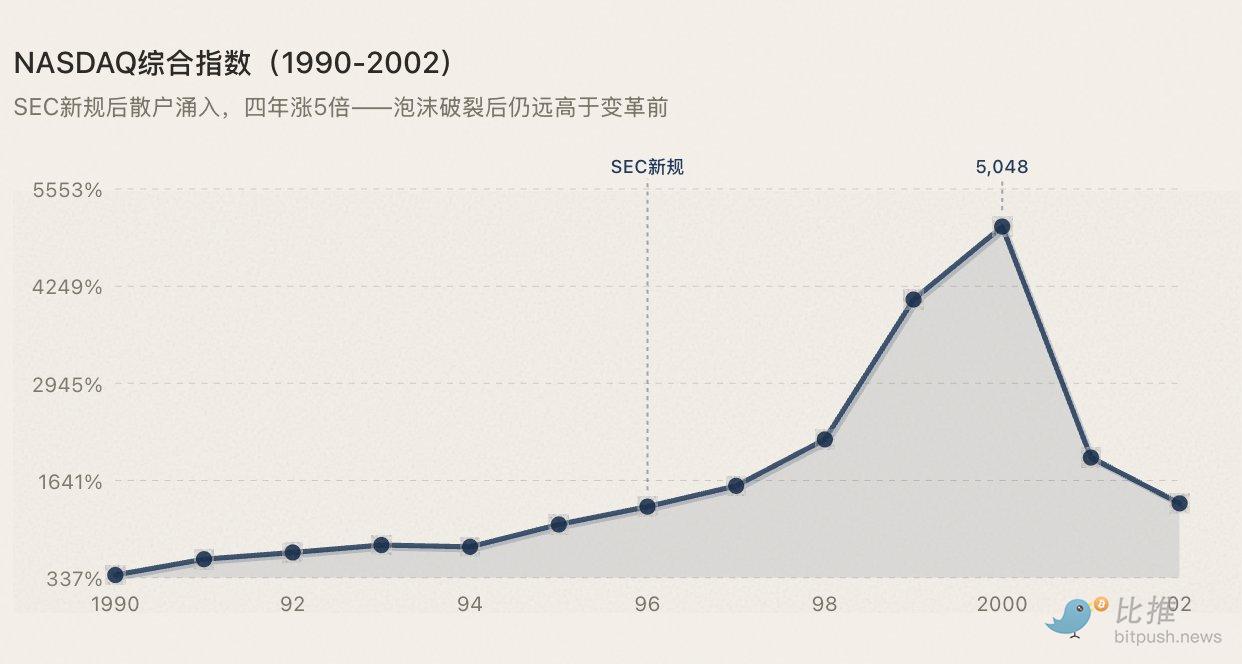
The bubble eventually burst, but NASDAQ's market value was still much higher after the bubble than before the change—because the increase in participants due to infrastructure upgrades was irreversible.
1993-2010s: Complete ecological maturity.
Many people think ETFs are the product of nearly a decade, but the first ETF — SPY (tracking the S&P 500) — was listed on the US stock exchange in 1993. In 2001, the SEC enforced decimalization (Decimalization), which directly reduced the bid-ask spread from $0.125 to $0.01, and transaction costs were drastically reduced. In 2005-2010, high-frequency trading (HFT) rose and once accounted for more than 60% of the daily trading volume of the US stock market. Quantitative strategies, ETF arbitrage, long and short hedging — strategies in all directions are supported by standardized tools.
At this point, the game system for US stocks has fully matured. Go long, go short, hedge, arbitrage — every type of strategy can find a way to enter the market that suits you. Results:

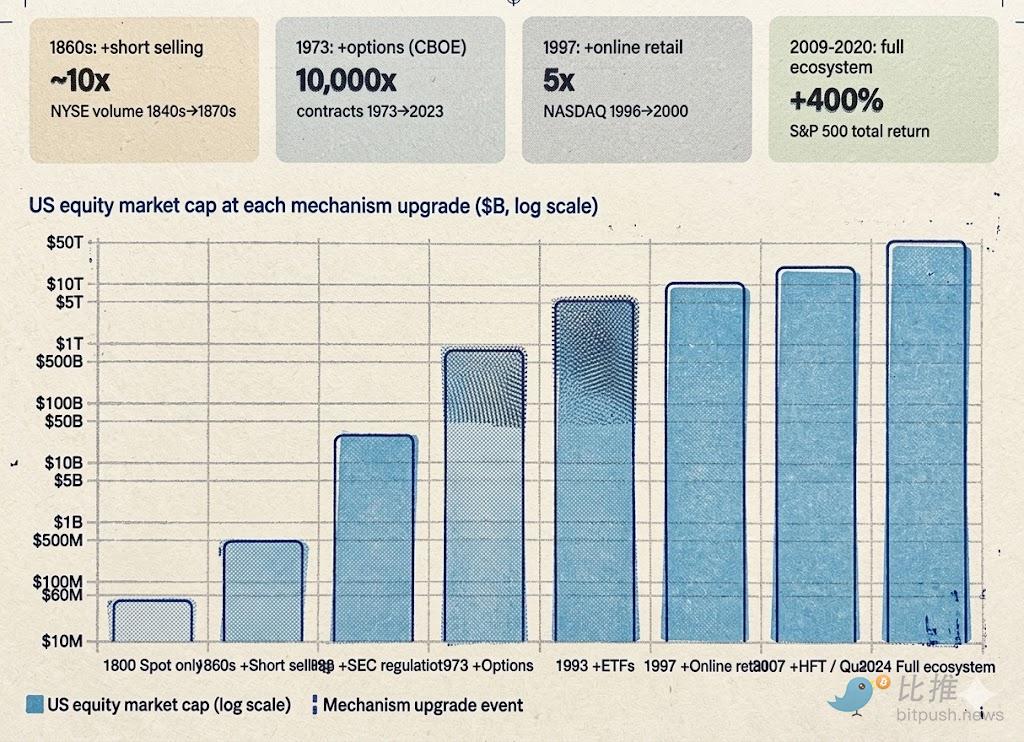
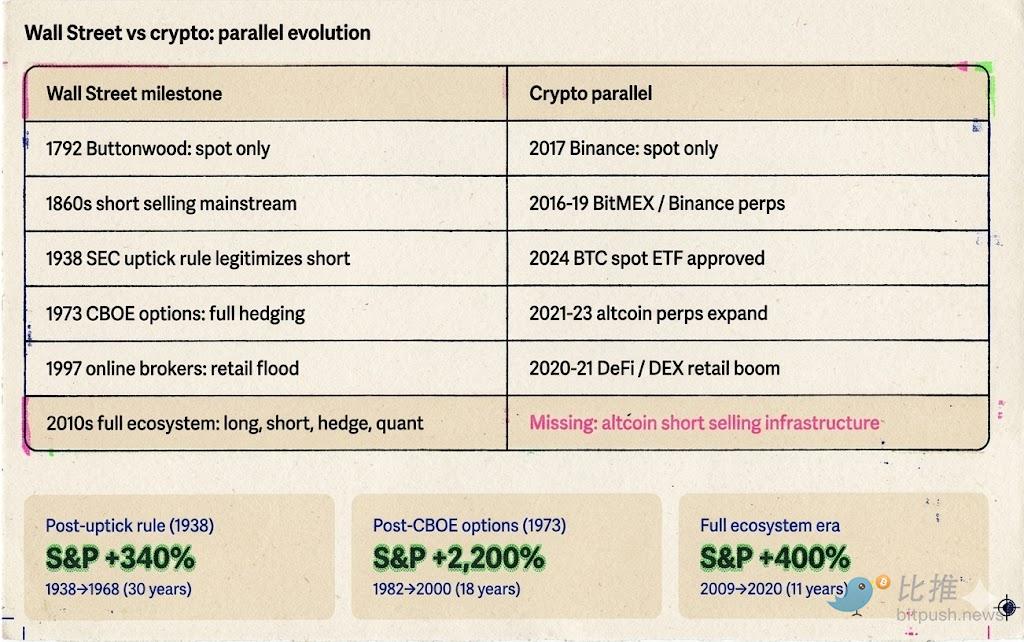
In fact, the rules are too clear: every time a new trading mechanism allows more people to participate in the market in more ways, prosperity comes. (Figure below)
3. Eight years in the crypto market: two hundred years of evolution, eight years to complete
Wall Street took 200 years to upgrade the mechanism. From Binance's launch in 2017 to the maturity of perpetual contracts, it only took less than eight years. But it evolved to the altcoin level and got stuck.
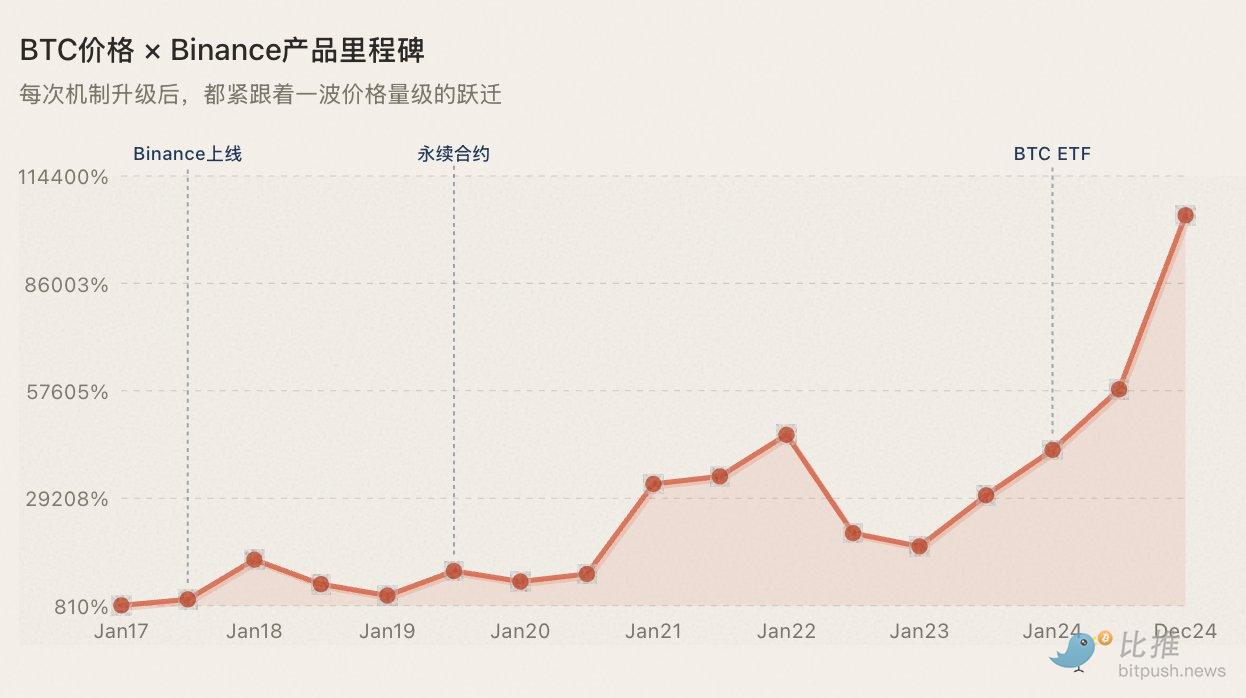
2017 - Sycamore Tree Hour
Binance is online, only in stock. You can do the same thing as a broker in 1792: buy, hold, etc.
The ICO bubble is the best mirror. Everyone is buying it, and the price is only going up. Purchases then dry up — in a market with no bears, there is no natural support without bears to make up, prices fall freely, and the bottom depends on when the last bulls give up. The altcoin has completely crashed. This is exactly the same market characteristic of the Sycamore Tree Era in 1792.
2016-2019 — Shorting weapons appeared.
In May 2016, BitMEX launched the XBTUSD perpetual contract — the first shorting tool in the crypto market. In September 2019, Binance launched the BTC/USDT perpetual contract, and shorting entered the mainstream.
WHAT HAPPENED? Exactly the same thing as when shorting was introduced on Wall Street in the 1860s: liquidity skyrocketed, price discovery went both ways, and volatility structurally declined.
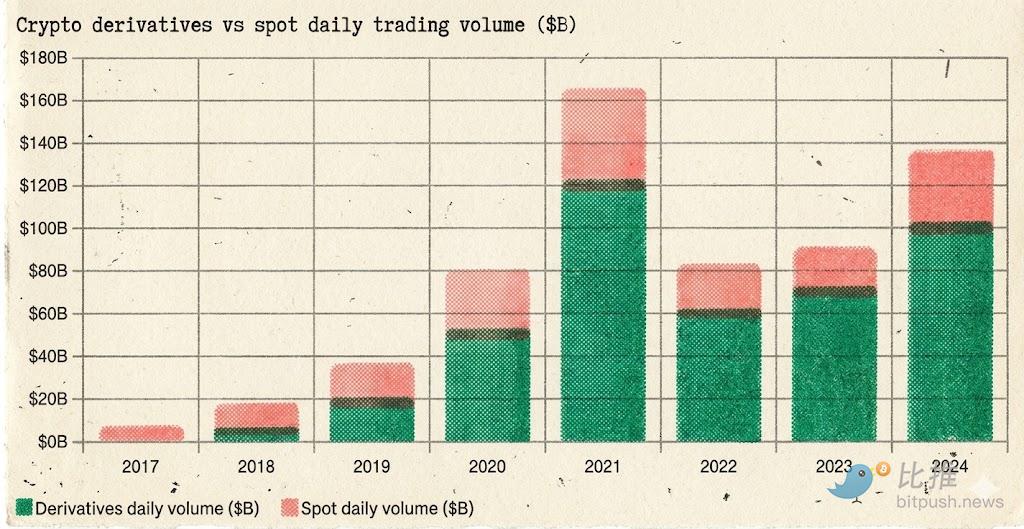
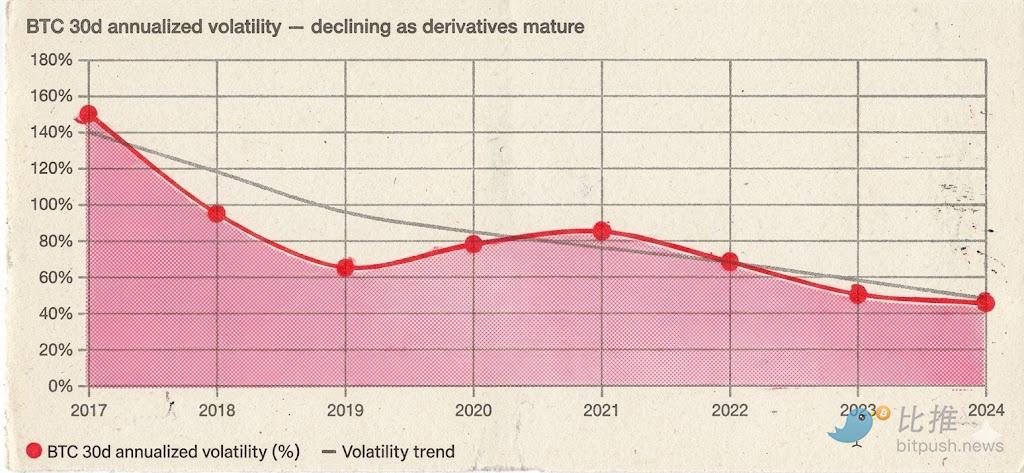
BTC's 30-day annualized volatility fell from over 150% during the 2017 bull market to 60-90% during the 2020-2021 bull market — a bigger increase, but more orderly. There are still sharp rises and falls, but there has been a marked decrease in the “three months' unvigorous decline,” because bears will make up after reaching a price level, forming natural support.
More importantly, there has been a shift in funding levels. With hedging tools, institutional funds are willing to enter the market on a large scale. You can't expect a fund manager who manages billions of dollars to throw money into a market where you can only go long and cannot be hedged. A perpetual contract not only gives retail investors the right to go short; it gives the entire market an infrastructure that “institutions can enter”.
Derivatives increased their share of total trading volume from less than 10% in 2017 to around 90% in March 2026 — derivatives have completely dominated the pricing power of the crypto market:
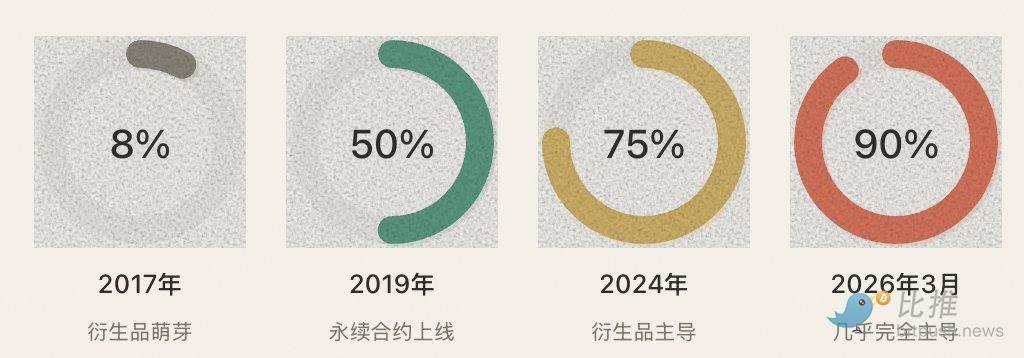
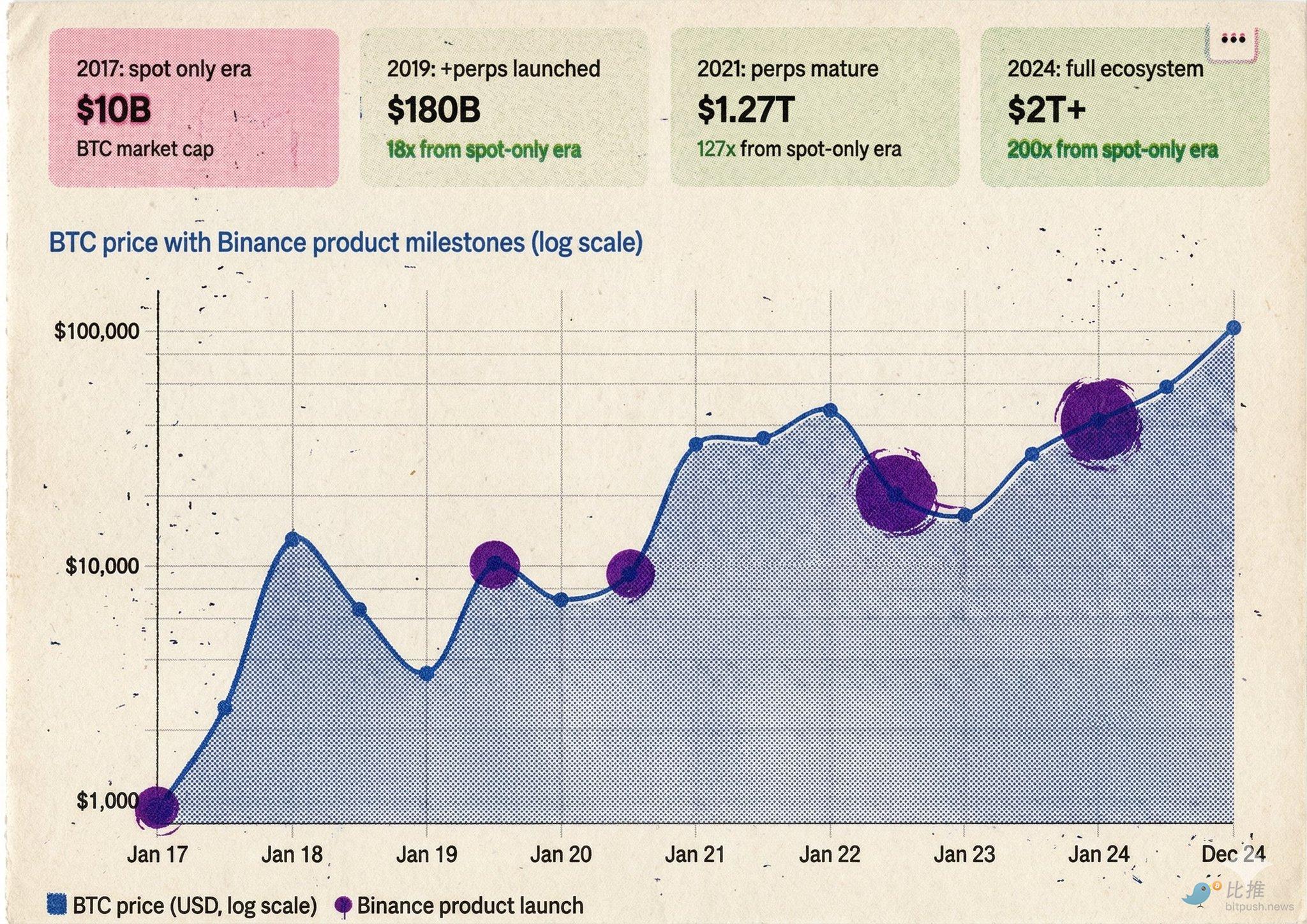
Shorting didn't kill BTC. The shorting took BTC from a $100 billion speculative product to a $2 trillion asset class.
2020-2021 — DeFi Summer: More than just a narrative, a mechanistic evolution itself.
The BTC and ETH options markets matured rapidly in 2020-2021 (mainly Deribit). This is the “1973 CBOE moment” for the crypto market — institutions can not only go short, but also accurately hedge and build structured positions. The dimensions of strategy have expanded from two dimensions to a higher level.
Furthermore, many people categorize DeFi Summer as a “narrative” — just another wave of news, like the NFT craze and metaverse concept. But this is a fundamental misinterpretation. The essence of DeFi Summer is not a narrative, but a structural shift in the trading mechanism.
AMM (automated market maker) rewrites the underlying logic of trading. Before Uniswap, transactions required order books, market makers, and centralized matchmaking. AMM overturned all of this — anyone can use the two tokens to form a liquidity pool, anyone can trade instantly, no need for pending orders from the counterparty, and no one's permission. This isn't a narrative; it's a paradigm shift in trading infrastructure. It allowed thousands of long-tail tokens, which were previously impossible to have a trading market, to gain liquidity for the first time.
Lending agreements create on-chain leverage and circulation strategies. Aave and Compound allow users to collateral assets to lend another asset—this is essentially on-chain margin trading. More importantly, it has spawned “revolving loans”: borrowing stablecoins with ETH, using stablecoins to buy more ETH, and then collateralizing... This strategy is called leverage to go long in traditional finance, and is packaged as “yield farming” in DeFi, but the underlying logic is exactly the same — it is a new type of game that allows participants to participate in the market with more dimensional strategies.
Composability allows mechanical innovation to be exponentially superimposed. AMM + Lending + Liquidity Mining + Cross-Agreement Arbitrage — the combination of these “money LEGO” creates a strategic space that has never existed in traditional finance. Each new combination is a new way to get involved, and every new way to participate brings in new funding and new users.
Therefore, the 2020-2021 super bull market was not a combination of two factors, but three: BTC and ETH perpetual contracts/options gave institutions access to entry and exit, and DeFi's AMM and lending agreements qualitatively changed the on-chain transaction mechanism. The narrative is only a surface package for the evolution of these two layers of mechanisms.
Once again, the same rule was verified:Every evolution of trading mechanisms has spawned the next round of prosperity.
2021-2023 — Altcoins Perpetually Expand
Binance is starting to offer perpetual contracts to more and more altcoins. Every new perp currency will see a step-up in trading volume — not because “up perp” is good news, but because the introduction of shorting tools allows more strategic types of capital to participate.
Quantitative funds can trade the market, hedge funds can arbitrage, and trend traders can go short. The diversity of participants directly equates to the depth of mobility.
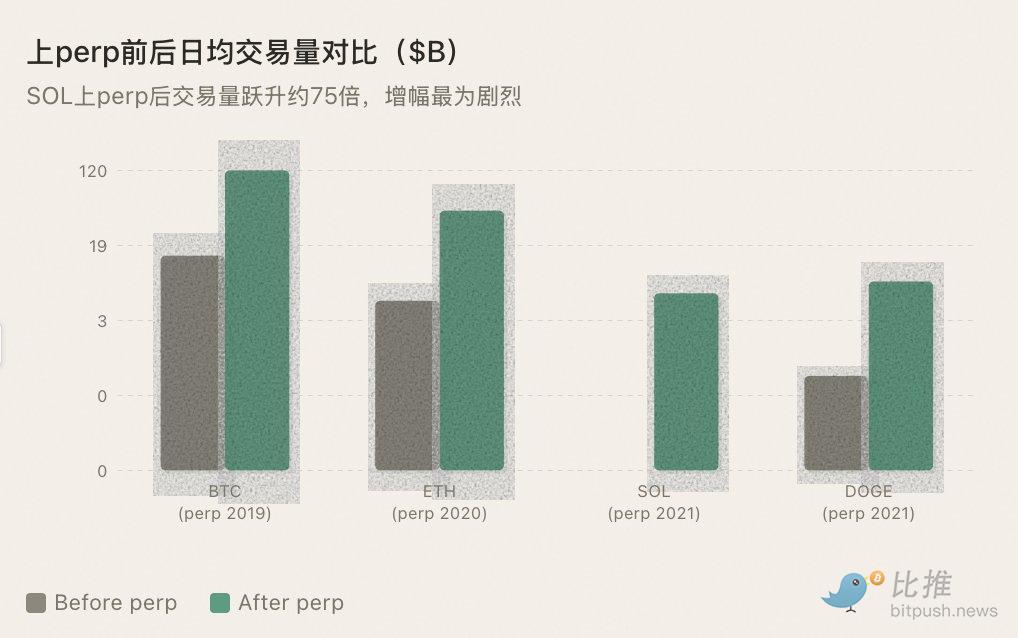
The rule continues to hold: BTC ushered in a big bull market with perp, as did ETH and SOL. Every altcoin that went on perp experienced a shift in liquidity.
2023-2025 — the time when the rules fail
Then, if there are no surprises, then there will be accidents. Like idol dramas, you encounter a “obstacle” around the corner, but it's just a hindrance.
Binance will be offering perpetual contracts on altcoins at an unprecedented rate from the second half of 2023 to Q3 2025. New perp trading pairs are launched almost every week — from mainstream public chain tokens to AI concept coins, from GameFi to Meme, and even some projects with a market capitalization of only a few tens of millions of dollars have received perpetual contracts.
On the face of it, this is a continuation of a historical rule: providing shorting tools for more assets, creating more liquidity, and attracting more participants. Moreover, objectively speaking, these perps are indeed creating liquidity out of thin air — a project that can easily cost several billion FDV but has an actual market value of only tens of millions of dollars, and the spot market alone simply cannot support a decent depth of transactions. Perpetual market-making commercial stablecoins provide bilateral quotes, which is equivalent to injecting a layer of synthetic liquidity into these paper-thin markets.
But this time, the rules didn't work.
The problem lies in the disconnect between “liquidity” and “confidence.” The prerequisite for creating liquidity is that someone is willing to play games. And the reality of 2024-2025 is — everyone is afraid. Today's markets all use perp as the end point, exit signal, and news trading.
Retail investors are afraid.After the FTX thunderstorm, the Luna crash, and numerous Rug Pulls, retail trust in altcoins fell to a freezing point.
What's more fatal is that a large number of new perp projects have malformed tokenomics: billions of FDV with extremely low circulation means that future tokens are waiting to be unlocked and destroyed. Retail investors aren't stupid — you gave me an empty tool, but the target itself was a well-designed chronic blood drawing machine, so why should I get involved? Whether it's going long or short, I don't want to touch it.
The bookmaker was afraid.The launch of perpetual contracts meant that their control behavior was exposed to the fire of shorterers.
In the past, in the pure spot market, bookmakers could pull orders at low cost, and bears posed no threat to him. After perp, every time a pull is likely to lead to a large number of empty orders, and the cost of maintaining the price rises dramatically. The way many project parties respond is not to accept the game, but simply lay flat — don't pull the deal, let the price naturally plummet, and just sell the unlocked tokens slowly. Without the project side of the lottery, there would be no money-making effect; without the money-making effect, no one would trade.
The market makers were afraid.This is the most important thing.
Trading a perpetual contract for a project with an average daily spot trading volume of only a few hundred thousand dollars is extremely risky. Liquidity is too thin, prices are easily manipulated, and market makers' inventory risk (inventory risk) is difficult to hedge against. Once you encounter extreme market conditions, the market makers can't get out of the list at all. After a few thunderstorms, market makers began to tighten quotes, widen spreads, reduce depth, and even exit outright. Without perp that market makers are willing to do, liquidity is an empty shell.
To make matters worse, those altcoin perpetual contracts that are still in operation have become private casinos for bookmakers.
With altcoins with a small circulation market and concentrated chips, bookmakers can do almost anything they want in the perp market. Trading doesn't require much capital — spot control raises prices, and perp, incidentally, reaps a wave of short liquidation funds. It's just as easy to smash the market — first open an empty market on perp, then smash the spot market, and the bears make a profit. Over and over, perp's high leverage became a tool for bookmakers to amplify profits rather than a weapon for retail investors to hedge risk.
The destructive power of this kind of gameplay far exceeds that of the controls on the spot market. On the spot, the bookmaker deceives the retail buyer. On perp, the bookmaker reaps the entire long and short side — whether you go long or short, as long as you stand opposite the bookmaker, your margin is his profit. Experienced traders are afraid to touch these copycat perps; inexperienced traders come in and get harvested repeatedly and then leave forever.
Originally, shorting tools were supposed to limit the power of bookmakers. However, on the highly liquid cottage perp, the relationship was reversed: the shorting tool instead became another knife in the hands of the bookmaker. It's not just the ecology of a particular coin that is being destroyed; it is the trust of the entire crypto market. Every trader who is bombed at a fixed point on a copycat perp is a user permanently lost in the crypto market.
A paradox has arisen: Binance is getting more and more perp, but the volume and activity of the altcoin market is shrinking.
What does that explain? The upgrading of the perpetual contract mechanism for altcoins has hit the ceiling.A perp is a set of heavy machines that require market makers, oracles, funding rates, and centralized approval to operate. BTC and ETH can support this machine, but a few thousand long-tail altcoins can't — the machine is running out of fuel. Instead, those machines that barely worked became the bookmaker's cash machine.
4. Why perpetual contracts are doomed to fail for altcoins
The 2023-2025 experiment has given results, and here's an explanation of why at the mechanistic level.
A dead cycle of liquidity. perp requires market makers to get bilateral quotes for stablecoins. Who wants to market an unknown project with a daily trading volume of hundreds of thousands of dollars? Without market makers, there would be no liquidity; without liquidity, there would be no traders, let alone market makers without traders. Shorting with spot leverage doesn't require building a derivatives market from scratch — borrow tokens and sell them in an existing DEX pool. Lending agreements provide supply, AMM provides execution, and the two are decoupled.
Two prices, two worlds. Perp and spot are two separate pools. When the pool is tight, a single trade can outrun the price difference. If you think you're shorting this project, you're actually gambling in a parallel universe decoupled from the stock market. Spot leverage has only one market from beginning to end, and there is no de-anchoring.
Funding rates are manipulated. Bookmakers push up perp prices to create extreme funding rates. Bears get their blood drawn every few hours, and they can also be worn to death if they go in the right direction. What's worse is that the bookmaker operates both spot and perp — spot pulls, and perp eats short positions and bursts out of positions. Spot leverage is only the loan interest rate, which is determined by supply and demand, and is not distorted by the long or short ratio.
Synthetic positions do not generate real selling pressure. This is the most critical point. If you go short on perp, there will be no sell orders on the spot market. The dealer turned his right hand on the stock, and the perp bears posed zero threat to him. Shorting with spot leverage is borrowing real tokens to sell in spot — real selling pressure directly affects the price, and bookmakers must buy with real money to maintain high prices.
Approval + Oracles. perp requires trading platform approval and reliable oracles, and small coins lack both. On-chain loan shorting does not require approval, and the liquidation price depends on AMM's real-time price.
A perpetual contract is a set of heavy infrastructure, and the operating cost is higher than the value it can create for long-tail assets. What altcoins need is the lightest way to short — borrow tokens, sell them, and buy them back when they drop. This is spot leveraged lending shorting.
5. Are you afraid of shorting, or are you afraid of not finding a price?
From Amsterdam in 1609 to Wall Street in the 1860s to Crypto Twitter in 2024, the fear of shorting has never changed. “If you go short, you'll break the plate.” “Shorting is a malicious attack.” “Shorting has caused the market to collapse.” ——It's been 400 years, and the wording is almost unchanged.
However, 400 years of history have proven the same fact over and over again: the cost of fear shorting far exceeds that of shorting itself.
When criticism is not allowed, praise will no longer be meaningful. If shorting is not allowed, going long would be meaningless.
Because in a market where you can only buy, the price only reflects half the optimism. The pessimistic half of the message—doubt, negativity, fraud—was forcibly silenced. Everyone can only “like” and no one can “leave a bad review.”
Such prices are distorted, fragile, and unsustainable. It's not a price discovery; it's a price illusion.
Being able to go long or short is the most basic respect for price discovery.
And only with the discovery of real prices can the market have lasting potential. Institutions dare to come because prices are credible; market makers dare to come because they can do it both ways; long-term investors dare to come because the current price has been tested by bears and is not the line drawn by the bookmaker.
Conversely, markets without price discovery are left to live by narratives. Every round of popularity is a waste of time, then wait for the next story to attract a wave of people to take over. It's always this cycle, and it can never be accumulated.
The biggest tragedy in the altcoin market is not “too many bookmakers,” but they don't even have the basic conditions for price discovery.Prices aren't real; what kind of long-term value are you talking about?
6. Shorting is not a bearish tool; it is a catalyst for a bull market
The most counterintuitive rule in history:Every time a shorting mechanism is introduced, it does not lower prices in the long run, but rather raises prices.
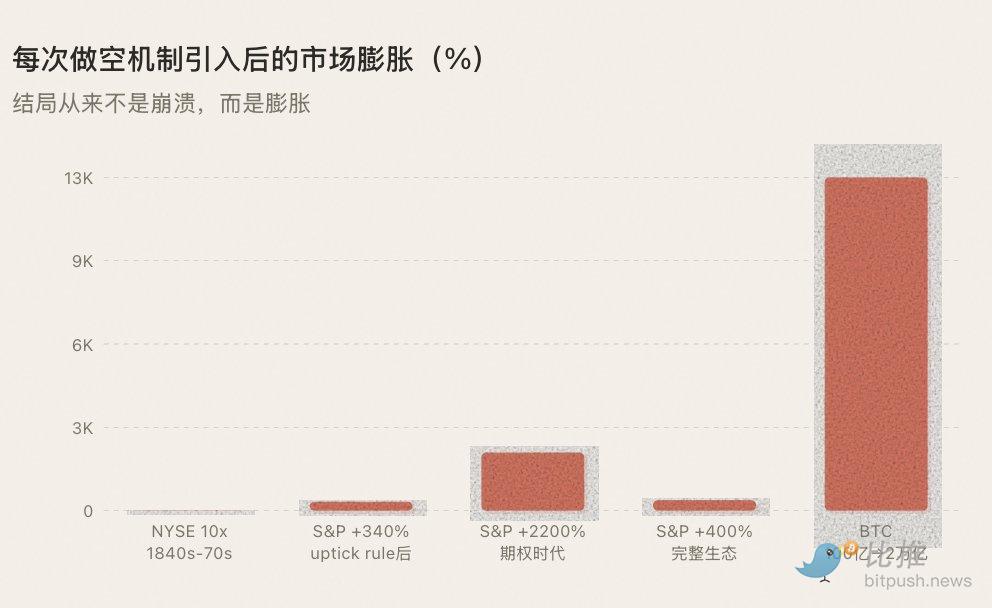
After shorting became popular in the 1860s, NYSE trading volume increased tenfold in ten years, and Wall Street went from being a small circle to a real capital market. After the uptick rule was legalized and shorted in 1938, institutional capital entered the market on a large scale, and the S&P 500 rose 340% over the next 30 years. After the inception of CBOE Options in 1973, options trading volume increased 10,000 times in 50 years, and US stocks ushered in decades of continuous expansion. After the launch of the BTC perpetual contract in 2019, the BTC volatility dropped from 150% to 50%, while the market capitalization swelled from $10 billion to $2 trillion.
Each time, the end was not a market crash, but an expansion of the market.There are three reasons:
1. Shorting creates liquidity - every short order is a sell order + an inevitable future purchase order (reimbursement). The more active shorting, the deeper the liquidity.
2. Shorting attracts new players — market makers, quantitative funds, hedge funds, and arbitragers are not here to smash the market; they provide liquidity, which is oxygen for a bull market.
3. Shorting builds trust - prices tested by bears are trustworthy prices. Trustworthy prices attract real capital, and real funds drive real growth.
A complete gaming tool doesn't destroy confidence; it builds confidence.
7. The path to the next round of the bull market
From Amsterdam in 1609 to the crypto market in 2025, four hundred years of financial history have proven the same pattern over and over again:First there is institutional evolution, then there is prosperity.This order cannot be reversed.
The current altcoin market is stuck in a death spiral:You can only go long → a single model → fewer and fewer people make money → fewer and fewer people trade → liquidity is exhausted → the market is weak.Gambling can still gamble big and small, so why can you only buy altcoins and not open them?
Perpetual contracts won't solve this problem — 2023-2025 experiments have proven. perp is a heavy infrastructure, and long-tail altcoins can't support it. “Up Perp” itself has also become another narrative trigger. Like “on spot” and “on alpha,” it has become the origin of news trading, breaking away from trading and gaming itself. Trading instruments were originally meant to serve transactions, but now they have in turn become the object of trading — for long-tail assets, perp is structurally the wrong tool.
The right path is on-chain”Native spot leverage for shorting”——Through over-collateralized loans, borrow real tokens, sell them in the spot market, generate real selling pressure, and participate in real price discovery. There is no need for market makers to build a market from scratch, no need for oracles to maintain anchoring, no need for capital rates to flatten price differences, and no one's approval.
This is consistent with the birth path of every shorting mechanism in history. Le Maire's shorting in 1609 was not approved by the Amsterdam trading platform. The shorting of Wall Street securities in the 1850s was not designed by the NYSE. They are all created spontaneously by market participants — first the tools, then the rules. What the SEC did in 1938 was not to invent shorting, but to establish a framework of rules for shorting that had been in operation for nearly 100 years.
The on-chain shorting agreement follows the same path.
When this happens — when an altcoin is no longer just a one-way game of “buying and waiting to rise,” but the long and short sides go head-to-head with real money in the spot market — the quality of the market changes radically. Liquidity will return, participants will return, and funds will return. Not because there are new stories to tell, but because there are new ways to play.
If the law of history continues to hold — and we have no reason to think it won't — then the tipping point for the next round of the altcoin bull market won't be a new story, a celebrity shouting a list, or a certain halving.
It will be an infrastructure upgrade: let thousands of long-tail altcoins get the native on-chain spot leverage shorting tool — this is where the coin industry has pricing power.
This time it's no longer after BTC's liquidity spillover to altcoins, but the other way around.
8. Conclusions
In 1609, the Dutch government banned shorting, and le Maire was publicly denounced. In the 1860s, the US Congress scolded bears as enemies of the country. After the collapse of 1929, the public called for the complete elimination of shorting. In 2024, “shorting” is still a swear word in the crypto community.
For 400 years, people's fear of shorting has never changed.
But 400 years of history have proven the same thing over and over again: every time this fear was overcome and shorting rights were introduced into the market, the market did not collapse — the market expanded.
Amsterdam has become a global financial center. Wall Street went from a sycamore tree to a trillion-dollar capital market. Binance has become a space agency. BTC went from $100 billion to $2 trillion.
Now, a few thousand altcoins are locked in a “can only do long” cage. There is no price discovery without shorting, no trust without price discovery, and no lasting prosperity without trust. The entire market has degenerated into a single game of gambling “as expected” — fewer and fewer people make money, fewer people participate, and quieter.
However, for those altcoins that barely have perpetual contracts, shorting tools have instead become new tools for bookmakers to harvest, causing market trust to be lost at an accelerated pace.
When criticism is not allowed, praise will no longer be meaningful. When shorting is not permitted — or if shorting is just the bookmaker's prerogative — the price will never be real.
What is scarier than the fear of shorting is a market where prices are not discovered.
Bull markets have never been waited for; they have evolved mechanisms. And the core of every mechanical evolution, from 1609 to today, has always been the same thing --
Return the right to short sell to the market.
Who wants to walk with us and shout the phrase “whether you look at it or not, you can short it”. (inspired by @heyibinance)

Twitter:https://twitter.com/BitpushNewsCN
Compare the TG exchange group:https://t.me/BitPushCommunity
Compare TG subscriptions:https://t.me/bitpush
