


The US SEC and CFTC join forces to redefine crypto assets. What kind of compliance era will the industry usher in?
Author: Wenser 2010
Original title: US SEC and CFTC join forces to “unbind”, crypto assets are “digital goods” rather than “securities”
On March 17, local time, the US SEC officially announced the results of this year30th press release. In this explanatory document of less than 1,000 words, US SEC Chairman Paul Atkins teamed up with US CFTC Chairman Michael Salinger to break the tight spell on the entire crypto industry for the first time:Most crypto assets are not securities, but are classified as “digital goods, digital collectibles, digital tools, stablecoins.”
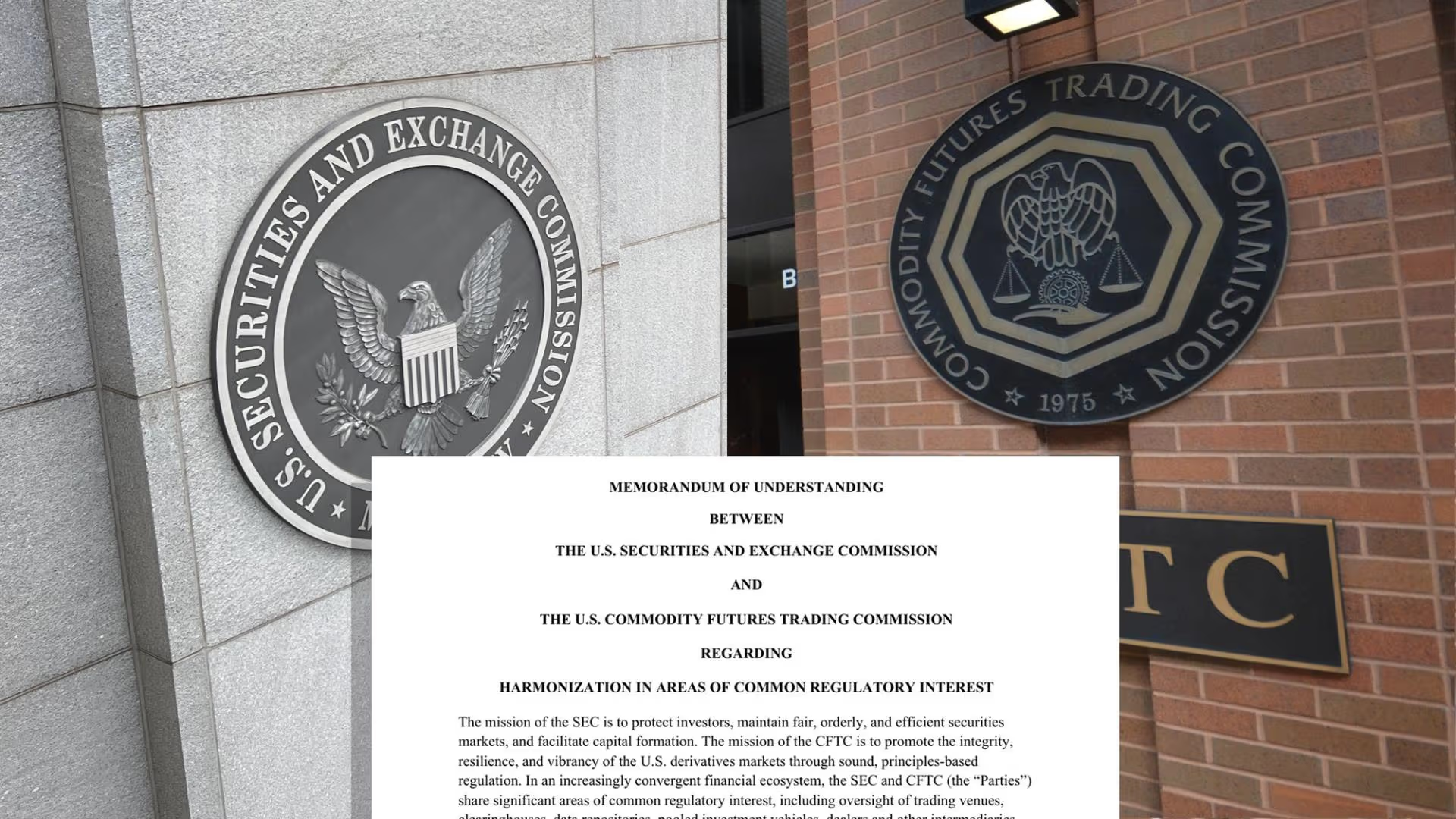
On March 11 of this year, the two major organizations joined forcesMemorandum of Understanding signed(MOU), which revealed a series of initiatives to “clarify product definitions and develop a modern clearing, security deposit, and collateral framework through joint interpretation and rulemaking.” Looking at it now, this latest explanatory document is the best proof that the two major institutions have joined forces to untie the cryptocurrency market.
Predictably, the impact of this document clarifying the classification of crypto assets goes far beyond that. Subsequent intensive crypto IPOs, airdrops, DeFi mining, staking, and encapsulated assets will all usher in new development opportunities. As for what appears to be a convenient door, whether it is the influx of institutional liquidity, countless retail investors, or the scythe hidden in the regulatory machinery, time may only tell us the answer.
Explain the five major categories of the US SEC explanatory document: Most crypto assets are not securities
According to the US SEC release“Factual Form” fileIt clearly defines the classification of 5 types of crypto assets:
The value of digital goods — not securities — is essentially linked to the programmatic operation of a “functional” encryption system and supply and demand dynamics, rather than from expectations of profits generated by others' core management efforts.
Digital collectibles — not securities — are designed for collection or use to represent or convey the right to digital expressions or references to works of art, music, videos, trading cards, game items, or online memes, characters, current events, trends, etc.
Digital tools — not securities — cryptographic assets that have actual functionality, such as memberships, tickets, vouchers, title documents, or identifiers.
Stablecoins — Stablecoins that meet the definition of the GENIUS Act are non-securities, and stablecoin issuers are specifically prohibited from paying interest or revenue in any form (cash, tokens, or other consideration) to their holders.
Digital securities (or “tokenized securities”) — are securities — financial instruments presented or represented in the form of cryptographic assets, listed in the definition of “securities,” and whose ownership records are maintained, in whole or in part, on one or more cryptographic networks.
More detailed later68-page explanatory documentChina and the US SEC have also given their own definitions for airdrops, DeFi mining, pledging, and encapsulated assets:
DeFi Protocol Mining (Protocol Mining): Not a securities offering. (Daily Planet Daily Note: There is no structure that relies on profits generated by others' core management efforts.)
Pledge: Does not constitute an issue of securities. (Daily Planet Daily Note: If the underlying asset is a digital security, or a non-securities asset but is included in an investment contract, the pledge certificate is classified as a security.)
Encapsulated assets: Not securities. (Daily Planet Daily Note: The custodian of encapsulated assets may not misappropriate the underlying assets and cannot transfer, lend, pledge, re-pledge, or use them for any other purpose.)
Short investment property: It is not a security. (Daily Planet Daily Note: If the issuer voluntarily announces the airdrop plan and requires users to complete specific tasks to obtain the airdrop, there is active labor in exchange for assets, and the consideration relationship is clearly established, it may constitute an investment contract risk)
Simply put, stocks that are not securities include:digital goods,Just like gold and oil, they are things that can actually be used, and the price is determined by market supply and demand. Bitcoin and Ethereum all fall into this category;digital collectibles,Just like collecting stamps or buying paintings, it's for collecting or enjoying. NFT images and game items (including meme coins) that are popular online are all in this category;digital tools,Just like membership cards, tickets, and qualifications, you get them for use, not for speculation;Stablecoins.It's like a digital “shopping voucher”, which is used exclusively for payment, and the value is stable and does not fluctuate. But there's one hard rule:The issuer cannot pay interest to the holder,Once the nature of interest payments changes, it may be considered a stock.
digital securities,This itself is a stock; it's just a digital package, so it's still within the stock range.
Mining, using computers to help keep accounts online to earn coins, does not count as issuing shares; pledging means locking coins to help maintain the security of the network, and by the way, earn rewards; it does not count as issuing shares. But if the coin you lock is itself a stock, then that's another story. Encapsulation means converting one type of currency into a form that can be used on another network. Similar to exchanging change, it does not count as issuing shares. Airdrop means that the platform sends you coins for free, and it doesn't count as issuing stocks. However, if the platform requires you to do a task before sending it to you, then it's a bit like an “employment relationship,” and the nature may be different.
Notably, this document admits for the first time that an “investment contract” can be terminated,This also means that even if a token is initially issued through financing (ICO), it can no longer be considered a security as long as it is decentralized or has instrumental properties later.
Although these are currently still at the level of “explanatory documents” and have not reached the point of specific written laws and regulations, the previously confusing cryptoasset classification system has been initially clarified, providing some evidentiary support for subsequent supervision and enforcement. Subsequently, the potential impact of this document may benefit the market from the following aspects.
Non-securities classification of crypto assets has been released, with three benefits or driving market recovery
At present, this explanatory document jointly issued by the US SEC and CFTC is more like a “New Crypto Development Declaration”, which will directly drive the explosive development of forecasting markets, crypto IPOs, and DeFi agreements.
New explanation clears up Polymarket airdrop barriers, and crypto IPOs go hand in hand with token issuance
After the US SEC's latest crypto asset regulation explanation was released, crypto KOL @harrysewThe post statedThe framework may “give the green light” to POLY token launches and airdrops, and regulatory uncertainty has been significantly reduced. On the one hand, Polymarket can use its real-time data prediction function, and POLY tokens will become instrumental tokens; on the other hand, mining, staking, and encapsulating assets can also be carried out smoothly, and the application scenarios of POLY tokens will be further expanded.
With this, Polymarket is expected to grow from an “illegal gambling house” that was previously shouted by local regulators to a “global truth machine” that predicts the future and supports the development of events.
The new explanation is convenient for crypto exchanges to go to the US for IPOs, and platform coins are no longer negative assets
For exchanges interested in crypto IPOs in the US stock market, such as OKX and Kraken, this explanatory document can be described as drowsy and someone sent a pillow.
In the past, exchanges were often limited by balance sheets, and were unable to clearly define and comply with the assets held by the platform, including platform coins, because they were afraid that regulators would deduct the “cryptocurrency is a stock” cap on you.
Now, with the help of this explanatory document, the audit barriers before the IPO have been removed in one fell swoop, and the former platform coin is no longer a reluctant obstacle to the IPO.
The new explanation favors the development of DeFi protocols, and massive liquidity may pour in
This explanatory document is also a “death free gold medal” for many DeFi agreements.
In the past, many DeFi agreements, including Uniswap, received a “regulatory subpoena” from the US SEC, but now, pledges, encapsulated assets, and spot holdings are clearly not securities. In view of this, many institutional-level funds can also enter and use DeFi protocols in a compliant, high-volume form.
Of course, asset management giants such as BlackRock and Fidelity are still unable to enter smoothly in terms of liquidity mining, governance tokens that promise returns, and revenue aggregation agreements.
Conclusion: The era of reckless encryption died, and the market accelerated into the “era of big consolidation”
Of course, just like the opposite of a coin, as the legal boundaries defined by the US SEC and CFTC become more clear, the “fuzzy dividends” and “gray areas” within the cryptocurrency industry in the past will also face liquidation at the same time. To a certain extent, the crypto industry, like the banking and credit industry in the past, is also gradually being gradually incorporated into regulatory and compliance systems. New cryptographic projects require more investment in human and material costs in regulatory compliance, airdrop issuance, and pledge design, etc., which will also affect cryptographic innovation to a certain extent.
But in any case, for the crypto market, where liquidity is scarce, every detailed explanation from regulators is a ticket offer to the mainstream financial sector. Although the ideals of decentralization are getting farther and farther away from us, more importantly, the crypto industry is becoming more closely connected with mainstream people, so its vitality and survival can be guaranteed to a certain extent.
Between disappearing in silence and being held in check, I think most people would choose the latter.
Twitter:https://twitter.com/BitpushNewsCN
Compare the TG exchange group:https://t.me/BitPushCommunity
Compare TG subscriptions:https://t.me/bitpush
