


Messari's 2022 Crypto Trend Forecast Report: Chapter 6 [NFT & Web 3.0]
![Messari's 2022 Crypto Trend Forecast Report: Chapter 6 [NFT & Web 3.0]](https://images.bitpush.news/2021/12/special_cn-20211208-163899884590719583.png:企业微信截图_20211203215435.png)
This article is a translated version of Messari's 2022 Crypto Trend Research Report, Chapter 6 [NFT & Web 3.0]. The translation comparison team will continue to follow up. For more information, please join:
Compare the Discord communityhttps://discord.gg/QSvv7MZ2tz
Compare to Telegramhttps://t.me/bitpush
The term “Web3” is now increasingly heard in the market because it is easier to understand than “crypto crypto,” and will replace it as synonymous with the decentralized technology movement. Web3 is better at attracting new people, and it seems less scary for regulators.
Mason defined Web3 as “a paradigm shift to a more democratic internet,” where the entire network is managed collectively, and everyone has the right to govern. Chris Dixon said that Web3 gave us “an opportunity to move to the crypto economy. And establish a completely consistent system of incentives for network owners, network participants, and third-party developers”. I love these definitions. Rearchitecting internet services and products to benefit users rather than managers is Web3.
1. NFTs — digital goods on the global ledger
Let's start with this year's most landmark asset class — NFTs, and yes, they're like ICOs during this bull run:Sky-high hype, crazy fluctuations, lots of early players profiting from it, and outright trash. But as a new asset class, they will change the world. NFTs are cool because they represent traceable scarcity, composability, and programmable digital assets. An NFT could be a stock, a virtual weapon in an MMORPG, a personal avatar on social media, a new piece of digital art, a piece of land in a metaspace, or a record of your data on Facebook. The potential of NFTs
It's limitless because the blockchain behind it will be a global transaction book for virtual, physical assets. The “real world” version of an NFT might be a contract similar to a house (verifiable scarcity), and if I were to prove ownership to my insurance company, I probably only needed to sign a transaction using a wallet with a contract receipt
That's it. I can allow Airbnb guests to have access to that home with specific NFTs (programmability), or I can apply for a home equity credit line and use the NFTs as collateral to collateral on a peer-to-peer loan platform.
But that's all an afterthought; what we have now is just a toy.
I logged in to the VR casino with my virtual identity (verifiability), then sat down in a chair, and the bookmaker recognized my profile picture as TBI (digital representation of assets). Since this is my 10th time playing at this casino, my player cards can flash (programmable) to attract more players to play at my table.
The casino definitely likes customers like me, so they decided to send me a virtual “wine voucher” that can be redeemed for a gift on Uber, Eats, Drizzly, or any app that recognizes these NFTs. If you can use your imagination, you'll see a huge potential business opportunity here.
The value of the existence of NFTs is so intuitive that even the New York Times has reported it. Here's a column by Ezra Klein:
“Think of it this way. We have an internet to easily deliver information. We can effortlessly share news articles, music files, games, gifs, tweets, and more. The internet makes all of this free and within easy reach. But it's also for this reason that it can't add more value to information, and many times we just need that special value. What the internet is particularly lacking is verifying the following: identity, ownership, and authenticity, and it is these things that give creators a way to get paid. If we are likely to live in a global, virtual, and interconnected world (metaverse) in the future, then
NFTs will become the most basic and most important module for building everything in that world. Many people don't want to live in a virtual world right now because all of their information is subject to a big, centralized tech company. It's understandable that if you've ever switched social media platforms for some reason, you have to face the dilemma of rebuilding your audience and reputation from scratch. Or if you've ever bought virtual items in a game, then discovered that the game maker controlled all the trading rules, and finally discovered that one day you can't trade your virtual items anymore, or even transfer them away, this frustration can only be experienced by people who have experienced it. Or, if you're a VR believer, and you're shuddered by Mark Zuckerberg's Meta prospects.
NFTs can exist beyond these blockchains and metaverses.
For example, if you have 1000 unique South Park-themed avatars, each can be minted with 1 ETH. You can send ETH to the SPA NFT contract to mint the one you want, but only if the contract status reflects that no more than 1000 avatars have been minted so far. Thanks to the ERC-721 standard, these little South Park guys can trade on the Ethereum blockchain like any other NFTs based on that standard.
This is 100 times better than most ways to buy virtual goods today, because today the virtual asset market is generally highly centralized, and scarcity only exists in the eyes of developers; they can change the rules and scarcity as they wish. And NFTs broke this impasse:
1) Created the “shortest bond” connecting users and creators
2) Cheap and efficient
3) Provide both parties with traceable and verifiable ownership of virtual assets.
This is true whether we're talking about digital art, digital identities, community memberships, gaming products, or financial assets.
It's not about personal assets; almost all smart people in the cryptocurrency space agree that most NFTs will follow the same path of the 2017 ICO — going back to zero. But other early projects will be more successful, and the entire asset class will explode within the next decade. NFTs will impact every corner of the global economic system, and kids will have more things that “look like NFTs rather than physical objects.”
2. One $69 millionJPEG, in the field of cryptography“Mona Lisa“
Whether you're optimistic about NFTs as a transformative new technology or not, you'll still be shocked that people are spending tens of millions of dollars on “JPEG.” To understand this isn't outright hype, we need to start with the most famous painting in history — “Mona Lisa.” Think about the “basic elements” of its value - history, rarity, meme attributes, artist reputation, and value changes in related markets. [Mona Lisa] was sought after even among contemporaries for its uniqueness. More importantly, however, it has some “off-chain” properties that make it famous. The home of “Mona Lisa” is the most famous museum in the world, the Louvre. It was also the target of the most famous art theft in history. Because of its simple and mysterious smile, it has become a meme and trope in pop culture. As a result, more people want to take photos with “Mona Lisa” and complete their social media “check in” tasks. For the Louvre, “Mona Lisa” can be said to be a kind of capital and asset. It brings in tens of millions of dollars in tourism revenue to the Louvre each year. In short, it's a painting full of stories.
So do you know anything similar in digital art?
Beeple's “Everydays - The First 5,000 Days” has all of these key elements, and ultimately makes it the “Mona Lisa” in the crypto space.
A famous artist?Right, Beeple already had 2.5 million fans when it sold the title.
Proof of scarcity?Right, Beeple's painting represents his daily record for 14 years and is almost impossible to copy.
A novel backstory?Yes. It wasn't stolen, but it made history as the first NFT art piece to be auctioned through Christie's. And the price itself ($69 million) reinforces the rarity of this piece of art.
Even if Beeple's reputation in the industry were to be damaged in the future, that won't change the uniqueness and fame of his first Everydays auction.
So is this success a one-off, or can it be replicated?
Physical art is a $1.7 trillion market with annual sales volume of around $60 billion. At the end of the third quarter of 2021, the total market value of NFTs was just $14 billion. This doesn't include “personal avatar collectibles,” and the total sales of art NFTs to date are less than $2 billion. That's less than 1% of the physical art market, while digital art is only one-tenth of the total NFT market.
Aren't these numbers familiar?
Despite the popularity of the NFT market today, this early development process from physical art to digital art may eventually look like the Bitcoin “bubble” in 2013. Bitcoin's market capitalization was 0.1 percent of gold in November 2013, and the digital art market is now 0.1 percent of the physical art market. So I can boldly predict that the digital art/NFT market will experience a huge crash like Bitcoin and a long bear market (in particular, most of these assets have extremely poor liquidity), but the entire market will grow more than 100 times after 10 years.
As new challengers continue to emerge in the market (similar to Bitcoin facing rivals like Ethereum), even if you invest in Beeple's original project or other top projects, you probably won't be able to keep up with the growth rate of the total “market value” of NFTs (the market is diluted). Therefore, it is very important to participate in more long-term projects in the field of NFTs, especially those related to infrastructure. And these projects are likely to far exceed the expected value of many “blue chip” NFT projects. Investing in infrastructure (like SuperRare) in a niche market like art probably won't beat the first 1% of NFTs in the end, but given the lower time cost required for such a project, maybe it will eventually pay for a better return. Because you don't need to be a professional NFT connoisseur to be successful. As the NFT infrastructure continues to develop, the overall corresponding market return is beginning to become attractive.
3. PFP - Punk and Ape
If you value pure aesthetics, Beeple and other digital artists might be your thing. But you're going to miss the revolution around social identity in NFTs. By the third quarter of this year, PFP (profile picture) sales had exploded to $5 billion. PFP's value comes entirely from its early community and their memes. Although they may be aesthetically rough, there are still thousands of people who pay real money to buy these PFPs, many of them to show off:
1) They were participants in early memes
2) Learn the full history and background of NFTs and why these specific PFPs are worth investing in
3) Friends are desperately needed, and there is plenty of money to burn.
4) All of the above.
There is a reason why the huge amount of hype we've seen about PFP exists. Because they are a symbol of identity in the crypto community, this will also spawn into the metaverse in the future. Some top PFP owners may even get priority access to new projects and activities, share community benefits (in the form of airdrops), participate in community governance, and use their PFP as an asset to create more value. If NFTs continue to expand their influence, more celebrities will want to own these “digitally scarce” things. In the future, Crypto Punks, Bored Apes, and Pudgy Penguins may all represent a person's digital identity and even become part of one's own future online reputation. Just as brands rely on slogans, images, brand ambassadors, etc. as intangible assets to support value, the cryptocurrency community can also use NFTs in a similar way. They have a way of wrapping the entire subculture in a single PFP project and using NFTs as a ticket to getting started.
Unless you accept the reality that virtual goods of these memes are already ubiquitous, it will be hard for you to understand the value of PFPs, and they will be part of our identity. As Fred Ehrsam said, “Imagine you live on the internet. The way the world knows you isn't mostly through your face or your clothes, but through your digital profile picture. You're certainly willing to spend a lot of money on something like CryptoPunk: it's your face in the digital world. Plus, it's a ticket to a small, unique internet club. As a native crypto user, being a CryptoPunk holder is as important as being a member of the Augusta National Team as an old school businessman (Augusta National Golf Club, sometimes called Augusta, is a golf club in Augusta, Georgia, USA. Unlike most non-profit private clubs, the Augusta Nationals Club is a for-profit company, and it doesn't disclose its revenue, shareholding, membership list, or ticket revenue. Usually members are more expensive than rich.)”.
CryptoPunks are valuable because they represent the first PFPs minted on the Ethereum blockchain, a history that cannot be tampered with. These 10,000 pixelated Punk jpegs each have a different combination of “attributes.” And these “attributes” are also part of the history of cryptocurrencies. They have a magical origin story because they were launched fairly, but then quickly forgotten by the market, and then reappeared before people's eyes due to their indelible “historic” nature. Amidst the boom in NFTs, Punks began going viral on social media as Twitter profile photos, and of course their rising prices, and soon became a sought-after target.
But then a few things kept me away from PFP.
1. I don't know what I can do with this PFP; I can only hold it and pray that I have contributed to the community.
2. As someone who has organized meetings and planned a community, I can responsibly say that expensive tickets are a good way to screen users, but this has nothing to do with the final quality of the community. Once the popularity drops slightly, people will turn to communities that accept invitations and merit-based rather than play this expensive paid game.
3. Along these lines (we'll touch on DAO and social tokens later), I'm more interested in the Friends With Benefits community. I'm looking forward to being accepted by the “Friends With Benefits” community more than the community in the PFP field.
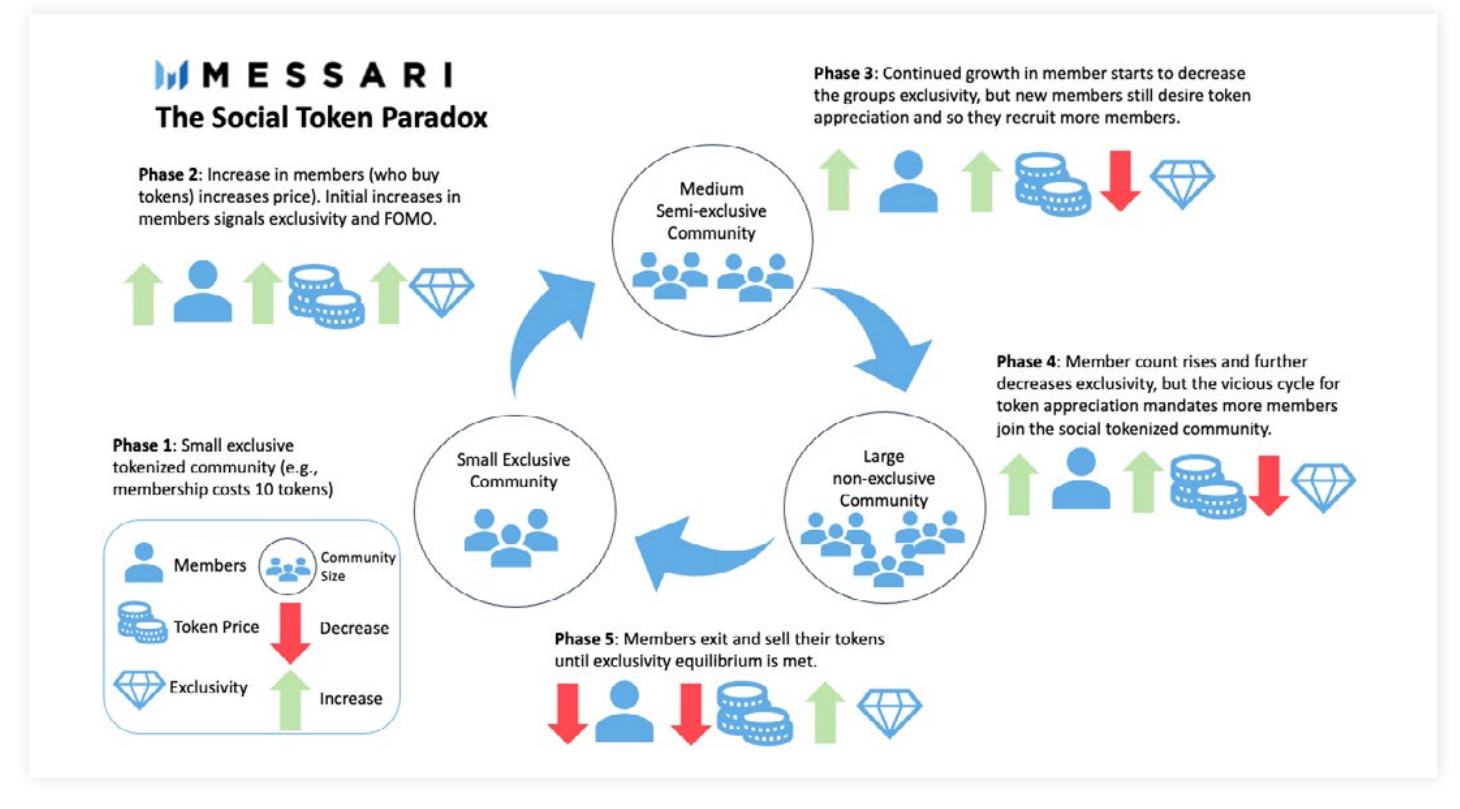
If you're still keen to buy PFP, then choosing your camp is very necessary, and you need to be prepared to use it as a luxury item you can spend, and never once“investment”。
Source: Messari
Compiled by: Comparing Exclusive Chen Zou
This article is from Bitpush.News. The source must be indicated for reprinting
