


Balance sheet decline, or is deleveraging gracefully and harmoniously?

Over the past year, industry insiders, experts, and big V's have continuously discussed the question of whether our country is falling into a so-called “balance sheet recession.”
In particular, when the July social finance data was released, it actually caused quite a bit of shock. (See Liu Jiaolin's 8.13 article”The growth rate plummeted by 27.3 billion》)
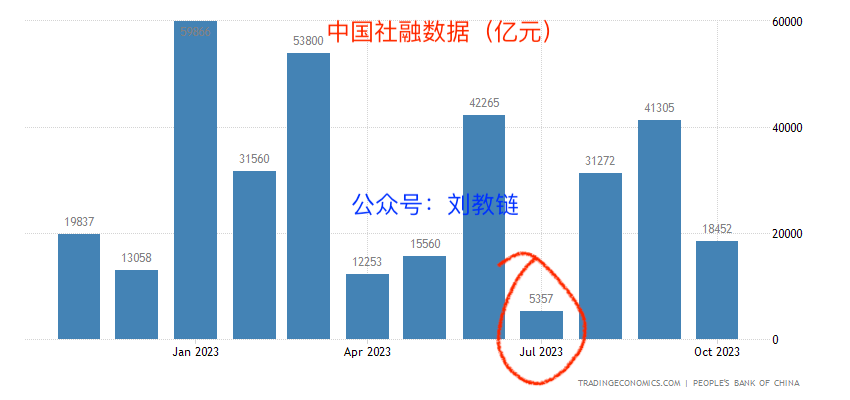
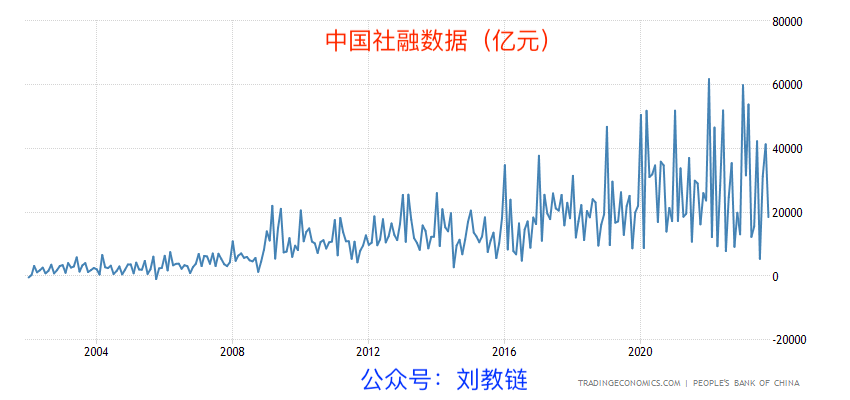
However, looking at it over a long period of time, this fluctuation is not surprising.
The term balance sheet recession (balance sheet recession) was first proposed by Gu Mingchao, a Taiwanese American economist born in Japan. It is used to refer to a specific form of economic recession, where high indebtedness in the private sector causes individuals or businesses to generally repay debts to increase savings rather than consumption or investment, which in turn causes economic growth to slow down or decline, leading to a recession.
This recession method was proposed to differentiate it from the economic recession caused by a sluggish commodity cycle. The balance sheet recession was driven by the debt cycle. It was simply excessive borrowing. It reached a stage where deleveraging was forced, and the economy supported by a weak bamboo pole (lever) plummeted along with a broken bamboo pole.
It is believed that Japan's decades-long recession, which began in 1990, and the financial crisis of the United States in 2007-2009 all fall under this pattern of recession.
In layman's terms, people all over the world felt that they borrowed too much money and were under too much pressure to pay interest every month, so they all chose the same, active, or forced to choose a lifestyle or business method that cut back and cut expenses, and used their balance to repay old debts in order to reduce the pressure to repay their debts. However, people suddenly changed from borrowing money to saving money to repay debts, which actually led to an economic recession. This is the so-called balance sheet recession.
This question sounds a little unbelievable to Chinese people who still maintain traditional Chinese virtues. Isn't it an excellent quality in our culture to cut back on food, be frugal, and focus on savings?
Why is it that in the eyes of economists, everyone in society upholds excellent quality, but as a result, it is regarded as the main culprit in causing the economic downturn?
So, do you really want traditional virtues and excellent quality?
Dario, founder of the Bridgewater Foundation, introduced this reason in his popular science video “How the Economic Machine Works.” Readers who haven't read it can take a look at Liu Jiaochain's 8.23 article “China's deleveraging”.
The reason is that one person's expenses are the income of others. Everyone is unwilling to spend money, which makes it difficult for everyone to make money.
Another important reason is that modern fiat money is mostly in the form of debt money. In other words, if you take an asset as collateral to a bank, the bank can create currency based on the valuation of that asset. For example, you mortgaged the house, the bank printed the money, and the developer got the money. (See Liu Jiaolin's 8.27 article”Xu Jia money printer》)
You get the debt, the developer gets the money, and the bank gets the business.
Your debts are the bank's financial assets. Banks can package and sell these financial assets to financial management and trust companies. They then sort these financial assets, redivide and combine them, package them into gorgeous high-yield wealth management products, and sell them to middle class or wealthy people who have three melons and two dates in their pockets seeking to preserve and add value. (See Liu Jiaochain's 8.4 article”The big thunder of 230 billion dollars exploded》)
One link at a time. In the whole chain, every link is waiting to make money. Only you, who are burdened with debt and regular debt repayment, can provide them with income and profit.
The principal amount you repay will be offset by the corresponding equal amount of debt, and then both disappear together on the balance sheet. The interest you repay is converted into revenue for each link in the above chain.
The characteristic of debt money is that it was created out of thin air and disappeared out of thin air. Its entire life cycle, from creation to disappearance, is to take away interest — the product of your hard work — and bring it to countless people who benefit from it.
You said Laozi is not playing anymore; he needs to pay off all his debts. Well, as much debt you pay off, how much money is eliminated. For example, you paid off 1 million dollars in one go and paid off a debt of 1 million. Well, financial assets that originally had 1 million debts disappeared from the balance sheet in one fell swoop. The assets disappeared. At the same time, there will always be 1 million fewer liquid currencies in society. In other words, this 1 million disappeared without a trace as the debt disappeared.
And everyone waiting to enjoy every aspect of your hard work and 30 years of interest is not happy.
As society has less money to circulate, money is naturally more tense and harder to earn. Wealthy people who were originally happy to enjoy your interest benefits naturally lost a little less income because you cut back on food and saved money to pay off your debts.
What if more people pay off their debts? For example, if 100,000 people each pay off 1 million debts, then 100 billion in assets and 100 billion dollars of money will evaporate from the world.
Assets and liabilities have declined, and the size of the balance sheet will naturally continue to “bang” and “bang” shrink. There is less and less money in society, and everyone feels that it is getting harder and harder to earn money. Assets have shrunk or even thundered, and people feel that they are poorer, so they are even more afraid to spend money. As a result, the economy fell into a slump and even recession.
However, because of this, they accuse ordinary people of cutting expenses, defensive savings, and even afraid to continue borrowing money if they don't spend money. This is a loss of conscience for a few economics researchers.
The deleveraging cycle is an era of returning to traditional virtues.
When the plane is falling, the important thing is not to shout “the plane is falling”; it is as if no one else knows that the plane is falling. The important thing is to find a way to get the plane back up. And it was definitely not the passengers who picked up the plane, but the captain.
Dario gave four methods:
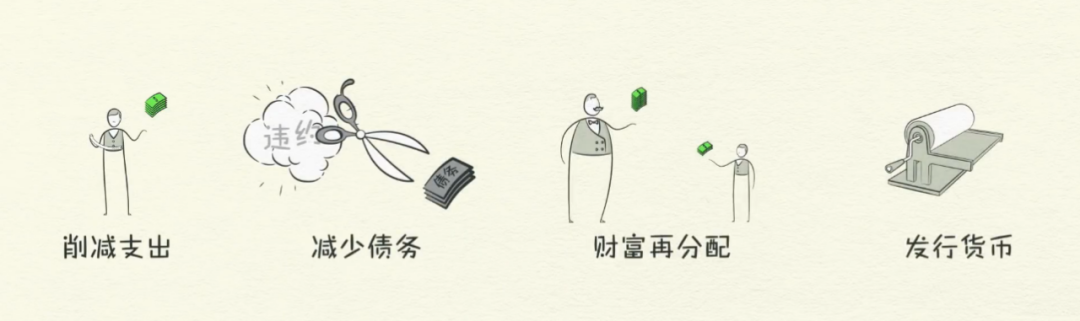
Compared to those who say that their balance sheets are in decline, cutting spending is exactly the number one operation in Dario's approach.
Since people are already overwhelmed by high leverage and high debt, they also have to use the balance sheet decline as a moral stick to accuse people of not actively spending or borrowing. What is the point of this, and what is the intention?
The second trick is debt reduction. As you can see, exchanging debt means reducing debt. In Dario's opinion, this is also natural and the right approach.
Of course, debt money is mathematically impossible to pay off all debt. Because every 1 yuan in debt corresponds to 1 yuan. However, if you want to pay off this 1 yuan debt, you will need to add additional interest to this 1 yuan. If the overall social debt is A, then the total amount of money is also A. If you want to pay off all of the debts, you need to repay A+B in total, of which B is interest. As can be seen, it is mathematically predetermined that debt money will not be enough to pay off all debts until the currency is completely destroyed. In other words, the total amount of money payable is always greater than the total amount of existing money.
Because it's still unclear, it's bound to be on the margins; some people want to borrow new and old. Leverage increased more and more, and when it reached a point where it couldn't be increased, the debt cycle peaked.
However, the debt reduction method does not mean paying off debts, but rather canceling debts in a reasonable and legal manner.
Illegal cancellation of debts is called non-payment of debts. There are many ways to write off reasonably and lawfully. For example, rollover, the original 30-year debt has now been extended to 100 years to be repaid, etc.
The third method is called wealth redistribution. What is important is direction, to rationally and legally redistribute money from places with more, from the rich to places with fewer, and to the poor.
Inflation and helicopter throwing money might be a fun route. Because you can't just take money out of other people's pockets, print more and distribute them to everyone on a per-person basis.
For example, Lao Wang has 100 million, and in addition, there are 99,999 Zhang San who are poor, only 1 yuan per person. The gap between the rich and poor between Lao Wang and Zhang San is 100 million times. Print 100 million more. The average distribution was given to these 100,000 people, and each received 1,000 yuan.
After the redistribution, Lao Wang had 101 million yuan. Meanwhile, Zhang Sanmen each received 1001 yuan. The gap between the rich and the poor between Lao Wan and Zhang San has been reduced by about 100,000 times.
What if we print 10 billion more, and send 100,000 per person? Lao Wang is 101 million, Zhang San is 100,000 yuan. The gap between rich and poor has been further reduced to about 1,000 times.
This method is close to UBI (Universal Basic Income, Basic Income for All), which has been heard a lot in recent years.
According to social security account distribution, each person is paid a few thousand yuan a month to meet basic food and drink, which is beneficial to boosting economic and social harmony. This is UBI's philosophy.
UBI is actually a bit of a communist “distribution as needed” meaning. Since each person needs this much money every month to maintain a basic living, it is unconditionally distributed to everyone.
Of course, the current mainstream plan may still be the socialist idea of “distribution according to work.” In other words, print money to do some major project or something, let everyone do the work, and then use labor and skill to earn this money.
However, allocating by means of investment will still cause problems with debt and return on investment. If you invest 1 trillion dollars, you still have to take back 1 trillion dollars plus the benefits. Therefore, there will still be the problem that A+B is always greater than A mentioned above. Unless we can live with these investment projects being unprofitable and unprofitable.
The last method, and the only thing you have to do, is to print money. Because deflation means that money, or liquidity, has evaporated. Once the water is dry, it is necessary to release water and rain.
Printing money is not difficult; it is rare to send money, that is, how to distribute the new currency effectively in a reasonable way.
The central bank can print money, and the treasury can spend money. So America's approach is that the Federal Reserve is responsible for printing money, and the Treasury is responsible for spending money.
An active monetary policy means easing money and releasing water, but the released water can easily be blocked in the financial system.
An active fiscal policy means setting up projects and spending money, building rivers, and directing water to where it should go.
If it were a UBI-style public money disbursement, it would be a general reduction in Ganlin.
Dario believes that as long as it is properly controlled, the money printed and the water released can just fill the hole where the deflation caused by deleveraging has disappeared, then an elegant balance can be achieved, that is, harmonious deleveraging, and the economy can land softly. Then, after everyone's balance sheets are repaired, the aircraft will take off again, and the economy will recover again, and move on to the next prosperity.
(Official account: Liu Jiaolin. (Knowledge Planet: Reply to “Planet” on the official account)
(Disclaimer: Nothing in this article constitutes investment advice. Cryptocurrency is an extremely risky breed, and there is a risk that it will return to zero at any time, so please participate carefully and be responsible for yourself.)
