


Mars Research Report: Exploring the Bitcoin Layer 2 Network Stacks — Exploring the Investment Value of STX
This article explains how Stacks introduces smart contractsBitcoinBlockchain, and the investment value of STX tokens. Stacks realizes a symbiotic relationship with Bitcoin through the Pox consensus mechanism. Miners receive STX rewards by producing blocks, and holders receive BTC rewards by participating in stacking. Stacks also designed the sBTC mechanism, which allows smart contracts to read Bitcoin status and settle transactions on the Bitcoin chain. Stacks has a first-mover advantage, and its ecosystem covers wallets, NFTs, DEX,DeFiIn other fields, STX has long-term investment value as a native token. With the development of the Bitcoin L2 circuit, the Stacks ecosystem will also explode, with great potential.
Original author: Boss Cat (@catboss_s)
Source: Mars Finance
This article will first explain in detail how Stacks introduces smart contracts into the Bitcoin blockchain from the perspective of technical architecture and consensus mechanism. At the same time, it will also explore the investment value of STX (native token issued by Stacks) based on various potential factors based on fundamental analysis.
Part 1: Detailed explanation of Stacks from a technical perspective
Stacks is a Bitcoin Layer 2 network that aims to implement extended functionality without modifying Bitcoin itself and introduce smart contract functionality to the Bitcoin blockchain. Enables smart contracts and decentralized applications (dApps) to use Bitcoin as an asset without trust and settle transactions on the Bitcoin blockchain.
Stacks has its own native token, “STX.” Stacks Chain miners receive STX rewards by producing blocks, while STX holders can receive BTC rewards by participating in the stacking process. The two use the Pox consensus mechanism to cooperate to provide security guarantees based on the Bitcoin blockchain for the Stacks blockchain.
How does Stacks implement the introduction of smart contracts into Bitcoin?
Simply put, Stacks introduced a new consensus algorithm called Stacking. The Stacking consensus algorithm uses a consensus mechanism called Proof of Transfer (POX) to make Stacks blocks unaffected by forks and achieve 100% Bitcoin finality, thereby inheriting all of Bitcoin's security.
At the same time, Clarity, a smart contract programming language specially designed for the Stacks blockchain, can read the state of the Bitcoin main chain, so that smart contracts on the Stacks layer can also read the Bitcoin state, and can be triggered by standard Bitcoin transactions. This further enables transactions to be settled on the Bitcoin chain, and records of all smart contracts and transactions can be verified in a trustless manner, just like Bitcoin transactions.
Stacks also designed and innovated a decentralized Bitcoin pegging mechanism, sBTC, which is linked to BTC 1:1 to enable smart contracts to be written to the Bitcoin blockchain in a trustless manner, unlocking hundreds of billions of dollars of BTC assets.
Next, let's analyze these technical principles in detail.
Consensus mechanism: Proof of Transfer (POX)
Proof of Transfer (PoX), is a novel blockchain consensus mechanism that enables Stacks to settle transactions to Bitcoin and establish a symbiotic relationship with Bitcoin. This unique relationship allows Bitcoin to be extended without modifying Bitcoin itself.
In the POX consensus mechanism, there are two types of participants: Stacks miners and Stackers (which can be understood as STX stakers). The entire PoX process can be broken down into two core mechanisms: Stacks miner production blocks (i.e. mining) and Stackers signature verification transactions (blockchain). In this mechanism,
• Stacks miners:Spend BTC to win mining opportunities on the Stacks Chain to get rewards for newly minted STX tokens, STX transaction fees on the Stacks Chain, and contract fees.
• Stackers:By participating in the POX consensus mechanism, STX holders sign to verify the validity of the Stacks block and determine whether the block is included in the Stacks chain, thereby receiving a portion of the BTC bid by the miner as a reward. This process of participation is called “stacking.”
So, how does the POX consensus mechanism keep the Stacks block unaffected by forks and achieve 100% Bitcoin finality?Next, I'll use an example to describe the overall process of miners producing blocks, Stackers signing and verifying transactions, and interacting with the Bitcoin blockchain in the entire consensus mechanism.

Stacks Chain Interacts with Bitcoin Chain

Stacks Chain block production and on-chain process, source:Stacks
As shown in the image above, the overall principle is roughly as follows:
Each Bitcoin block corresponds to a new Stacks miner term, during which a single Stacks miner is responsible for producing all Stacks blocks.
During the tenure of Stacks Miner A, the user initiates a transaction. The transaction is broadcast to the memory pool. Stacks Miner A adds the transaction to the Stacks block “A4” and then sends the block to Stackers for signature verification. When 70% of Stackers signers verify its validity and reach an agreement, the block will be added to the Stacks chain.
Next, a new Stacks miner B came along and submitted a block-commit transaction to the Bitcoin chain. This transaction sends BTC to the reward set addresses of all stackers in the current STX staking cycle. At the same time, the Bitcoin script op_return of this transaction contains the index block hash (index block hash) of Stacks Miner A, thereby triggering a change in the Stacks chain's miner term. The “index block hash” here is the hash value of all previously accepted Bitcoin transaction hashes identified on the Stacks chain, as well as the hash value of the Stacks block itself, which anchors the history of the Stacks chain to the history of the Bitcoin blockchain.
Then, because Stacks Miner B submitted a BTC transaction in accordance with the rules and obtained the mining qualification for the next term according to the encryption algorithm, the “TenureChange-BlockFound” transaction was triggered. This is information monitored by Miner A, Miner B, and Stackers.
Next, Stackers initiated a term change transaction on the Stacks chain. Stackers will decide that “block A6” is the last block produced by Stacks miner A, and then miner B will immediately build a block for his term on top of block A6. At this point, Miner B's term of office begins.
The tenure change process from Miner B to Miner C will also repeat the similar process described above.
As can be understood from the above process,
Implement quick blocks:Stacks Chain block production is about 5 seconds per block after Stacks Nakamoto is upgraded. This is achieved by separating miners' block production from cryptographic sequencing (a method of randomly selecting miners). The stacks chain's miner tenure is anchored 1:1 with the Bitcoin block, and each Stacks miner can produce multiple Stacks blocks.
Achieve 100% Bitcoin's finality:
The final certainty of the Stacks Chain transaction is that after two Bitcoin blocks in the Bitcoin blockchain, the finality of Bitcoin was obtained.In the example above, when Miner C's term of office arrives, Miner C will submit a block-commit transaction to the Bitcoin chain. This transaction will include the index block hash value of Miner B's first block B1. This hash value actually contains the status information of all Stacks blocks during Miner A's term. However, block A4 during Miner A's term contains the user transaction TX. It can be seen from this that at this point, this transaction during Miner A's term was recorded on the Bitcoin chain along with Miner C's block-commit transaction.
Forks are allowed within the six settlement blocks in the Bitcoin chain, and the entire Stacks chain will fork as the Bitcoin chain forks.From the example above, we know that there are two types of transactions on the Stacks chain, which rely on Bitcoin transactions and internal transactions. If Bitcoin forks, internal transactions will not be affected. Transactions that rely on Bitcoin are carried out by reading the state of Bitcoin and will be affected by Bitcoin forked transactions, but they will follow the finality of Bitcoin and fork as Bitcoin forks.
There are almost no forks in the Stacks chain's internal transactions.In the Stacks chain, miners are only responsible for producing blocks, and whether the produced blocks can be added to the Stacks chain is determined by the Stackers signature. So there are almost no forks within the Stacks chain. (Note: The reason we say “almost” no forks here is because when 31% or more of Stackers refuse to sign, a fork situation may occur. Stacks' solution in this case is called “Stacker Blessing.” (However, this is rarely the case, so I won't expand on it in this article.)
Implement transactions on the Stacks chain to be settled on the Bitcoin chain.As can be seen in the example above, the Stacks chain miners package the user's transaction in a Stacks block, then the Stackers signature confirms adding the block to the Stacks chain. When the next block in the Bitcoin chain arrives, the Stacks chain will change the miner's term of office, and the new Stacks miners will continue to produce Stacks blocks. When the term of office was changed, the New Stacks Miners Association submitted the Stacks Chain's transaction status to the Bitcoin chain. In this way, transactions on the Stacks chain can be settled on the Bitcoin chain.
Consensus Algorithms: Stacking
Holding and locking STX for one or more cycles and supporting the security and consensus of the Stacks network to receive BTC as a reward is a process known as “stacking.”
The differences between Stacks stacking and ETH staking are:EthereumIf the pledge verification node commits fraud or the network goes offline, etc., the staked ETH tokens may be cut or even forfeited. Stacks doesn't have stacking.
Stacks miners and stackers
In the Stacks chain, miners and stackers are important participants in “stacking” and maintainers of the chain's cybersecurity. They are completely decentralized, anyone can be a miner, and anyone can be a stacker. After the Nakamoto version was upgraded, miners decided the content of the block, and Stackers decided whether the block was included in the chain. This partnership between the two achieved the Stacks chain's ability to quickly block blocks and 100% Bitcoin finality.

Overview of miner and stackers' behavior
How do miners get mining opportunities?
Miners get the chance to mine by spending BTC, and the winning miners are selected through a verifiable random function (VRF), which is proportional to the amount of BTC spent. Following the Nakamoto version upgrade, “ranking probability” will also be introduced to mitigate the impact of “Bitcoin miner MEV resistance” and promote fairer mining opportunities.
The rewards that miners receive come from three sources: STX rewards obtained by mining, Clarity contract fees, and Stacks transaction fees. Among them,
Mining rewards are based on a fixed schedule: 1000 STX/block for the first 4 years, then halved every 4 years until 125 STX/block will be released indefinitely.
Clarity contract fees and transaction fees fluctuate with network usage.
Bitcoin Miner MEV Resistance: Some Bitcoin miners are also miners running Stacks. They can review “block-commits” transactions submitted by other Stacks miners in the Bitcoin block and then exclude these other Stacks miners from their Bitcoin block. When STX block rewards are attractive enough and the costs of winning Stacks miners are minimal, they win mining opportunities for Stacks miners. Following the Nakamoto version upgrade, Stacks changed the sorting algorithm to ensure that Bitcoin miners had no advantage as Stacks miners and that they had to spend competitive bitcoins to have a chance to earn STX.
How do Stackers get BTC rewards?
Stackers refer to stakers who hold and lock STX for one or more cycles in the Stacks chain.
Reward period: It is fixed, 2,100 Bitcoin blocks, about 15 days. During each reward cycle, miners transfer funds to a collection of Stackers addresses set up during the preparation phase of the cycle to receive rewards. Each reward address only receives bitcoins from miners once during a rewards cycle.
Eligibility to participate in the rewards cycle:
Participate before the rewards cycle begins. Once a rewards cycle begins, Stackers can only choose to participate in the next.
Specify the number of cycles to participate, at least 1 cycle and up to 12 cycles (25,200 Bitcoin blocks or about 7 months).
Provide a supported Bitcoin address to receive rewards.
Stake a minimum amount of STX tokens to secure a bonus slot, or pool with others to reach the minimum amount.
The BTC address to receive the reward, in one of the following two formats
Legacy (P2PKH), starting with 1.
Segregated Witness/Segwit (P2SH), beginning with 3.
Currently, the “Native Segwit” format (starting with bc1) is not supported.
The minimum staking amount of STX tokens is a dynamic value that adjusts the reward threshold based on participation.
Miner funds can be transferred to up to 4000 Bitcoin addresses per reward cycle, so the participation threshold is 0.025% (1/4000) of STX's liquidity supply. However, if the participation rate is below 100%, the reward pool can accept lower STX staking amounts.
How to choose the best stacking strategy to get the most rewards?
There are two main types of stacking: running stacking yourself or adding stacking to a pool. Among them, stacking pools are also divided into managed and unmanaged. Which method you choose depends on your crypto experience and how much STX is available. The specific differences are as follows:
Run Stacking yourself:A certain amount of STX needs to be met with a dynamic minimum value (approximately 100,000 STX at the time of writing; this value grows as STX's liquidity supply increases). Self-stacking allows you to receive rewards directly from miners without having to trust a third party.
Add pool stacking:If you don't meet the minimum requirements, you can also join mining pool stacking. Mining pools are usually operated by an independent third party that combines participants' STX amounts, stacks them on their behalf, and then pays out rewards (minus possible fees) on a pro rata basis to each participant. Stacking pools are divided into managed and unmanaged.
Hosted pool:For example, OKX or Binance. You'll need to send them your STX tokens and run Stacking using their wallet. They'll pay out the rewards to your designated BTC address, or in STX or other tokens.
Unmanaged pools:You'll never access your STX directly, but you'll need to “delegate” STX to the pool. Also, you need to trust these pools to pay you rewards. STX can be withdrawn from the pool at any time, but funds will remain locked until the end of the selected stacking period.
Although you can run Stacking yourself, you can get rewards directly from miners without having to trust a third party. However, the minimum amount of STX required per cycle may increase, which will have an impact on the rewards received. Therefore, in order to maximize rewards, even if the minimum requirements are met, stacking in a pool is probably the best option. To understand how the increase in STX's dynamic minimum value affects rewards, check outthis article。
Stacking channel selection can be done fromStacks websiteGet it.
It can be done atStacking ClubCheck out various stacking data and statistics on.
Programming Language: Clarity
Clarity is a smart contract programming language designed specifically for the Stacks blockchain. It is a determinable smart contract language, optimized for predictability and security based on lessons learned from common Solidity bugs, and aims to prevent similar vulnerabilities from occurring. Clarity's advantage is that it anchors smart contracts to the Bitcoin blockchain, which allows smart contracts to operate according to the state of the Bitcoin blockchain.
Key Features of Clarity
Determinable:Clarity can determine what the program will do from the code itself, and can perform a complete static analysis of the entire call graph (call graph) of the smart contract. For example, the cost of running the Clarity code and data usage can all be analyzed, which allows us to predict what a Clarity program will do and how much it will cost.
No compilation required:Unlike Solidity, Clarity requires no compilation and is an interpreted language. The contract source code improves readability, and also avoids the complexity caused by the compiler and contract bugs caused by compiler-level errors.
Visibility of Bitcoin's status:Clarity smart contractA built-in Bitcoin SPV certificate is providedIt's easy to read the status of the Bitcoin blockchain. This means that its smart contracts can trigger some logic based on Bitcoin transactions.
SPV, “simple payment verification”, is the process of verifying the validity of transactions in a Bitcoin light client environment.
Read more to understandhere。
Clarity also has many advantages, such as not allowing re-entry, preventing overflow and underflow, mandatory response processing, attaching post-conditions to transactions (transactions that can be rolled back), etc. These unique features allow Clarity to prevent many common smart contract bugs.
Learn more about Clarity's protection against smart contract bugs:Turning 8 dangerous smart contract flaws into “Clarity”Highlights some of the most common smart contract bugs and how Clarity can prevent them
Of course, the current Clarity is not as good as a compilable smart contract in terms of run-time performance due to its non-compilable nature. But with the Nakamoto version upgrade, Clarity Wasm will fix this. By compiling the Clarity smart contract to Wasm, the execution speed of the contract will be significantly improved, and compatibility will also be greatly improved.
The difference between compiled languages and interpreted languages: Compilation and interpretation are ways of interpreting and processing the source code, but their operation methods are different, so efficiency is also different. The compilation type compiles all the source code into machine language, and runs the whole thing at run time, which is also highly efficient. The interpreted type interprets the source code line by line into machine language and executed by the computer only when the corresponding statement is executed.
In summary, Clarity, as an innovative programming language after Solidity, has indeed made up for some of the shortcomings of the Solidity language. However, as a smart contract programming language for the Bitcoin blockchain, Clarity's biggest effect is that it has a built-in Bitcoin SPV certificate, making the Bitcoin status readable on the Stacks chain. This also means that smart contracts on the Stacks chain can be triggered by Bitcoin transactions, thereby enabling the Bitcoin blockchain's programmability on its Layer 2 network Stacks.
Decentralized Bitcoin pegging mechanism: sBTC
sBTC is a decentralized pegged BTC asset operated by a group of permissionless, decentralized, and dynamic participants.Participants receive financial incentives through Stacks' Pox consensus mechanism to properly execute linked operations. If Stacks was able to introduce smart contracts into the Bitcoin blockchain through a series of innovative technologies described above, then the 1:1 linking mechanism between sBTC and BTC unlocks BTC assets as a programmable productive asset (generating profits) based on the former, which enabled Bitcoin to enter the DeFi field.
Using this linking mechanism, smart contracts can use Bitcoin as a currency asset in Stacks to carry out various DeFi transactions such as loans and BTC stablecoins. Although wBTC (a wrapped Bitcoin asset on Ethereum) can also be used for these DeFi games, wBTC is issued by a centralized agency, and its BTC reserve certificate is not transparent enough, and an additional “pegging fee” is required in the process. In contrast, the sBTC pegging mechanism operates in a trustless decentralized manner. The minting method is recorded in a script on the Bitcoin chain, and there is no additional pegging fee as an incentive, which makes the sBTC pegging mechanism more advantageous.
How does sBTC work?
Actually, the simple understanding is,sBTC is a token on the Stacks blockchain.Similar to other Ethereum ERC20 tokens, it is based on the Stacks homogenized token standardsip-010Defined, issued by a Clarity smart contract. The minting and destruction of sBTC tokens is carried out by the sBTC protocol.
When a user wants to use BTC on the Stacks chain: the user first creates a deposit transaction on the Bitcoin chain (transfer to a BTC multi-signature wallet address). The deposit transaction will notify the sBTC protocol how much BTC has been deposited and the user has received the sBTC stack address. The sBTC protocol will then mint 1:1 sBTC tokens and send them to the user's receiving address.
When the user wants to withdraw BTC assets: the user creates a withdrawal transaction on the Bitcoin chain. The withdrawal transaction informs the sBTC protocol to withdraw the amount of sBTC, which Stacks address to withdraw from, and the address to receive BTC on the Bitcoin chain. The sBTC protocol will then destroy the amount of sBTC from the given Stacks address and issue the same amount of BTC to the given BTC address to complete the withdrawal.
In this process, the Stackers collection for the current cycle needs to provide a signature for the BTC withdrawal to fulfill the transaction. If it reaches 70% or more, the signature is successful, and the withdrawal operation can be carried out. Stackers will also be rewarded with BTC for this. The collection of Stackers signers is dynamic during each stacking cycle, and changes every cycle.

Deposit and withdrawal process
How secure is sBTC?
In the above process, asset deposits and withdrawals are signed and verified by “Stackers” every cycle. When more than 70% of the Stackers have signed, the agreement will execute the operation, which means that at least 30% of the validators are honest and the assets are safe. Currently, Stackers are a combination of trusted institutions (Figment, Copper, Blockdaemon, Luxor, etc.), stacking pools (OKX, Binance, Coinbase, Xverse, etc.), and single node operators. This combination of hybrid signers ensures the security and decentralization of the Stacks network.
Also, sBTC runs on the Stacks chain, so it also has all the characteristics of the Stacks chain, such as its transaction security properties are the same as Bitcoin transactions, etc. Of course, moving BTC to any layer or chain other than the Bitcoin chain introduces additional complexity and security assumptions. There are also potential risks for sBTC:
When Stackers are greater than 70%, it is possible to steal the current cycle's BTC. If they do, Stackers will lose their staked STX capital and BTC rewards. However, this is economically unreasonable because they have locked in STX capital worth more than sBTC. Also, as long as the Stackers' mix is decentralized enough, it's difficult to achieve more than 70% collusion. So this is only theoretically possible.
Bitcoin chain miners are reviewing stacking operations in a remote 51% attack and trying to steal bitcoins from bitcoin scripts/wallets. Since the Bitcoin chain has never been successfully attacked by 51%, this is currently only a theoretical possibility.
The potential risks of sBTC contracts. Although the SBTC contract is written in Clarity language, which can avoid some contract flaws at the programming language level, there may also be unknown risks, which require strict security analysis to avoid them.
Higher performance and extended functionality: Subnets

Achieve the scalability of Stacks through subnets and different VMs
Although after the Nakamoto version was upgraded, Stacks optimized the block generation speed, which was increased from 10 minutes to 5 seconds. However, in terms of performance, some application scenarios may have different requirements for low latency, high throughput, and bursts of transaction volume (e.g., NFT minting, gaming).
Subnets (Subnets) aim to make Stacks scalable and improve its network performance, but the cost is to reduce the decentralization of the execution layer, but transactions can still be settled on the Bitcoin blockchain through Stacks. Subnets are used for execution, not for storing assets. With high-performance subnets, developers and users can choose high throughput when needed, and then extract their assets to the core Stacks layer as needed. Subnets can support smart contracts in different programming languages. As shown in the image above, one subnet can support Clarity VM, while the other can support Ethereum's Solidity language and EVM compatibility.
Stacks subnets are similar in concept to other public chain subnets (such as Avalanche's subnet), except that applications on the Stacks subnet benefit from Bitcoin's finality and security.
To sum it up:
Through a series of innovative mechanisms such as POX, Stacking, and Clarity, Stacks has implemented a “Bitcoin layer”, using the Bitcoin blockchain as a secure basic settlement layer and Stacks as the BTC Layer 2 extension layer, so that smart contracts can be applied to the Bitcoin chain. At the same time, sBTC is linked to BTC 1:1 as a token on the Stacks chain, unlocking BTC L2 DeFi. Liquidity was released for trading BTC as an asset.
Part II: Exploring STX's Investment Value
In the previous section, we analyzed in detail how Stacks, as a Bitcoin Layer 2 network, can implement BTC smart contracts and unlock BTC L2 DeFi. Well, in the Bitcoin L2 sector, which is highly anticipated in this round of the bull market,Where is Stacks located? What is the investment potential of “STX”, the native token of Stacks?
Fundamental information
Let's first list various information on Stacks from several fundamental dimensions, including technology, tokenomics, community, ecological adoption, on-chain data, market competition, etc.
Technical advantages
Leading technical solutions: Judging from the ideal Bitcoin smart contract attributes, using BTC as a native asset, settlement based on the Bitcoin chain, and symbiosis with the Bitcoin chain (functional dependency), there is no doubt that Stacks technology has a leading edge.
Adequate technical reserves: As can be seen from Stacks's entire roadmap, Stacks has crossed the bull and bear, and the Stacks team has been BUIDL even during the bear market. Since its launch in Q4 2018, Stacks has gone through several updates and has continued to build in the Bitcoin field. Its knowledge of Bitcoin technology and related technical reserves are also at the leading edge.
Complete technical information: atStacks website、Stacks documentation、Stacks GithubAbove, you can see very detailed Stacks technical information. This data is by no means something that can be built up in a short time; it takes time to accumulate. Precisely from this accumulated data, it can be seen that Stacks has a complete set of community governance processes from technical ideas, to technical proposals and SIP, to community discussions, development and implementation, etc. This is also the foundation for the development of the Stacks ecosystem.
Overall, in the Bitcoin L2 space, Stacks has a first-mover advantage. In contrast, many agreements have just begun to be built in the BTC L2 field, and Stacks is in a leading position in terms of both the maturity of technical solutions and technology research and development capabilities.

Stacks roadmap
team background
Currently,Stacks consists of multiple independent entities, developers, and community members. They are working together to develop the Bitcoin blockchain.
Hiro: Focus on providing and maintaining developer tools within the Stacks ecosystem
Stacks Foundation(Stacks Foundation): Supporting the development of the Stacks ecosystem through governance, R&D, education, and funding
DiLing Technology(Daemon Technologies): Focuses on supporting Stacks mining and staking (staking) and Asian market business
Key studio(Secret Key Labs): XVerse, a Bitcoin wallet focused on providing direct participation in stacking.
Key team members
Brittany LaughlinChairman of the Stacks Foundation and founding partner of Lattice Ventures, provides start-up capital and networking relationships to entrepreneurs serving under-innovative industries. In the past, she was a general manager at Union Square Ventures and has worked for 3x Entrepreneur, etc. She graduated from New York University majoring in marketing and international business.
Ryan Shea, Co-founder of Stack. A graduate of Princeton University, he is an investor in cryptocurrency, biotechnology, and deep technology.
Muneeb Ali, Co-founder of Stack. Graduated from Princeton University with a doctorate degree. He is also CEO of Trust Machines. He is one of the main characters in George Gilder's “Life After Google” (Life After Google) book and a technical consultant for the HBO TV series “Silicon Valley” (Silicon Valley).
The Stacks team is not a company; it can be viewed as a decentralized team organization. This organization is all dedicated to building on Bitcoin. There are Hiro, which builds tools for developers, the Stacks Foundation, which promotes ecological development, and XVerse, which focuses on Bitcoin wallets. At the same time, Muneeb Ali, as a co-creator of Stacks, is very active on Twitter, actively participating in community exchanges and discussions, and evangelizing the development of Stacks.
Financing situation
Stacks first started R&D in the Princeton Computer Science Department in 2013. It later raised $47 million through the ICO issuance of STX tokens in 2017, and raised an additional $23 million in 2019 as the first SEC-qualified crypto company in the US Reg A and Reg S offerings. Currently, according toCryptoRankAccording to data, Stacks raised a total of 95 million yuan. Many of its investors come from famous VCs in the crypto field, such as IOSG, Blockchain Capital, HashKey Capital, etc.

ICO/Pre-sale, Source:Cryptorank

Funding Rounds, Source:Cryptorank
Token economy:
1.32 billion STX were distributed in Stacks' Genesis block. These STXs were distributed through several ICOs in 2017 and 2019. The price of STX issued in 2017 was $0.12, the 2019 ReGS issue price was $0.25, and the 2019 SEC compliant issue price was $0.30.
Stacks expects future supply to reach approximately $1,818 billion by 2050. After the Genesis block tokens were released, the increase in token issuance was brought about by mining, and inflation was carried out at a variable rate of increase. Currently, according toCoinMarketCapAccording to data, the total circulation of STX has reached 1.45 billion.

Segmentation of tokens in the Stacks Genesis block, Source: Stacks 2.0 White Paper
Current token statistics: (data from coinmarketcap)
• Total circulation: 1.45b
• Max Supply: 1.82b
• Market Capitalization: $4.41b
• FDV: $5.54b
• Market Capitalization/FDV: 0.79
Ecology and community
According to DeFilLama's on-chain data,The total TVL of Stacks and its ecosystem is nearly $150 million.As BTC L2 continues to receive attention, the Stacks ecosystem is also booming. Its ecosystem projects cover all areas of crypto, such as wallets, NFTs, DEX, DeFi, as well as inscriptions, domain names, etc. Here are a few current hot projects.
Alex:Bitcoin DeFi protocol based on the Stacks chain, including AMM, BRC-20 DEX, Launchpad, cross-chain bridge, etc.
StakingDAO:A liquid staking protocol that enhances capital efficiency for STX token stakers. Through StackingDAO, users stake STX tokens into the protocol, receive STStX in return, and earn Bitcoin revenue in this way, while also being able to use STStx in other Stacks DeFi applications.
Zest Protocol:Bitcoin-based decentralized lending platform. Users can earn rewards by depositing bitcoins into the yield pool or borrow from the loan pool with their Bitcoin holdings.
Uwu Protocol:A lending protocol based on the UWU Cash stablecoin, built on the Stacks chain, mainly consists of two core components: UWU Cash (UWU Cash) and UWU Shares (XuWu).
For more Stacks ecosystem projects, check outhere。

Protocol TVL rankings in some Stacks ecosystems, source:Defillama
Currently, according toTwitterScoreData, Stacks is very popular in the Twitter crypto space and has a lot of influential followers.

Source:TwitterScore
Discover the value of STXLong-term value
To assess whether a token has investment potential, from a fundamental point of view, it is necessary to meet at least three major aspects:
Technological innovation: the key to progress
Flywheel effect of tokens: banknote printing, airdrop, high yield, staking
Storytelling: The Power of Narratives
The more innovative technology is, the better its ability to tell stories. Stacks' technological innovation satisfies the ideal Bitcoin smart contract attributes, and its ingenious design combines high efficiency and heavy security.
Achieving the token's flywheel effect requires motivating users to hold tokens through project revenue, staking, or other mechanisms. For example, airdrops and high returns give Ethereum and its ecosystem's tokens a flywheel effect. For Stacks, the flywheel effect probably comes from two aspects. One is to use the stacking mechanism to obtain BTC rewards by locking STX to participate in Stacks consensus signatures. Another is that sBTC tokens were issued by designing token standards similar to ERC20, and linked to BTC, unlocking BTC's DeFi gameplay. Currently, many of the Stacks ecosystem projects are DeFi protocols built on Bitcoin.
Narrative brings technology and tokens to life, and it stimulates imagination and belief to create a strong, engaged community. Stacks was originally composed of decentralized entities and communities, and they have been working together to advance the development of the Stacks narrative and have become a solid foundation for the Stacks community. At the same time, with the adoption of spot BTC ETFs, the arrival of BTC halving, the upgrade of Stacks Nakamoto, and the rise in BTC L2 competition, these are all elements of the hype narrative.
The narrative itself can drive the development of tokens, but without technological innovation, the narrative is a bubble. The narrative, combined with technological innovation and the token's flywheel effect, allows the token to maintain a high price for a longer period of time. After the detailed analysis above, we believe that Stacks fully satisfies the three aspects of investment potential assessment. You could say,As the leader of the BTC L2 circuit, Stacks's native token STX has long-term investment value.Moreover, in the long run, the STX price will rise as each narrative hotspot heats up until the BTC L2 season arrives.
Correlation with BTC price trends
The financial incentives of the Stacks chain are closely linked to Bitcoin. Miners get the chance to mine STX by bidding for BTC, and STX stakers are rewarded with BTC by staking the ratio of STX. So,BTC and STX prices should be positively correlated, and STX prices will follow BTCpricesGrow as you grow,The comparative price chart in the chart below also roughly illustrates this.
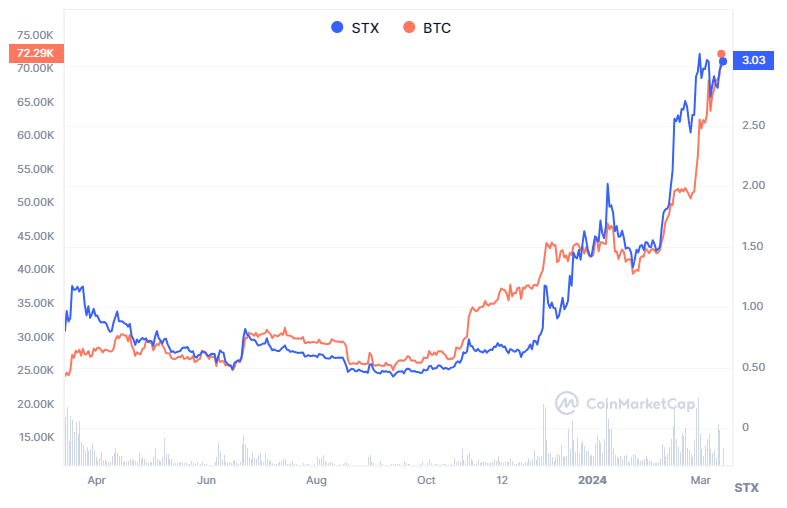
BTC and STX price trends, source:Coinmarketcap
Future price estimates
If BTC L2 Stacks is compared to Ethereum L2 Optimism, and estimated at current prices, OP accounts for less than 1% of the ETH market value. Well then,If Stacks accounts for 1% of BTC's current market capitalization, the STX price would be around $9.7, and the increase would be more than three times higher.
Of course, this price is only an estimate; there are many factors that influence the token price. We only think the usual way of thinking and don't make any investment suggestions.
summed
With the adoption of the spot BTC ETF, the BTC price reached a new high, and the Bitcoin L2 circuit is also expected to show tenfold and 100x alpha in this round of bull market. As a leader in the Bitcoin L2 field, Stacks has great prospects and potential for development. Although the price of STX has increased by 413.68% compared to last year, we believeStacks is still in the early stages, and the real explosion is likely to occur when BTC L2 season arrives.And when the BTC L2 season actually arrives, the Stacks ecosystem will explode.Focus on TVL's rapidly growing ecosystem projects.
References:
1. Stacks Whitepapers
https://docs.stacks.co/stacks-101/whitepapers
2. SIP007: Stacking Consensus
https://github.com/stacksgov/sips/blob/main/sips/sip-007/sip-007-stacking-consensus.md
3. Remembering the Right Stacking Strategy
https://www.stacks.co/blog/stacking-strategy-how-to
4.Clarity Camp
https://clarity-lang.org/universe#camp
5.Clarity of Mind
https://book.clarity-lang.org/title-page.html
6.Making sBTC ready for DeFi prime time
https://forum.stacks.org/t/making-sbtc-ready-for-defi-prime-time/14421
7.The Ultimate Stacks Nakamoto Guide
8.Subnets
https://github.com/hirosystems/stacks-subnets
9. First Class In-depth Report: Comprehensive Interpretation of Stacks Characteristics, Ecological Status, and Token Economy
https://www.stackschina.com/news/toudengcang-in-depth-analysis-of-stacks-report
10.rootdata-stacks
https://www.rootdata.com/zh/Projects/detail/Stacks?k=MTM%3D
11.Cryptorank-Stacks
