After rising 400 times in 24 hours, why did GOR coins on the Solana chain suddenly explode?
Source: BlockBeats
Author: BUBBLE, kkk, Ryo
Original title:Skyrocketing 400 times in 24 hours, what concept did Gorbagana speculate on?
Recently, the “Gor” token on the Solona chain increased 400 times in 24 hours. At one point, its market capitalization exceeded 40 million US dollars, but the whole incident actually started with the founder of MetaLEX@lex_nodeConcerns about Solana's decentralization, and the topic sparked a response with Solana's co-founder Tory on social media X, and exchanges between the two sides on X gradually revealed the idea behind the token.

Who is Gabriel Shapiro
Gabriel Shapiro”lex_node” Prior to becoming General Counsel of Delphi Labs, he was initially an attorney in the Silicon Valley office of a Wall Street law firm, specializing in buyer acquisitions for tech companies such as Paypal and FaceBook, and the turning point of joining cryptocurrency was also a coincidence. On a Valentine's Day dinner date, he received a call from a Facebook shareholder asking him to go back to his office to help Mark Zuckerberg complete the WhatsApp acquisition.

Mark allegedly bumped into the WhatsApp team at the restaurant and convinced them to sell the company. The deal was completed within 5 days, and Gabriel Shapiro, the attorney responsible for the acquisition, thoroughly studied its end-to-end encryption technology in the process of studying WhatsApp and used this as an opportunity to gain a deeper understanding of the cryptocurrency industry.
He came into contact with Ethereum in 2015 and attended an Ethereum conference. The speaker at the conference happened to be Nick Szabo, who was once considered “Satoshi Nakamoto himself,” and he was on stage writing about The DAO, which made him, who also works in the legal profession, deeply fascinated him. He believes in a DAO-like economic system that operates automatically through procedures and rules.
He built MetaEx for the “New Cybernetic Economy DAO” theory, which uses a unique set of on-chain agreements and off-chain legal arrangements to link DAOs to the real world by combining autonomous on-chain code with off-chain legal entities to create a cybernetic organization that is flexible, efficient, legal, and responsible for its DAO.
Ethereum Classic = Solana, Ethereum = Gorbagana?
And yesterday, Gabriel Shapiro had a heated debate over “chain legitimacy and trademark control.” Gabriel Shapiro reviewed the fork of Ethereum after THE DAO incident in 2016, pointing out that back then, the Ethereum Foundation relied on controlling the “Ethereum” and “ETH” trademarks to successfully shape the new chain after the hard fork into an orthodox version and devalue the original chain to Ethereum Classic.
In his opinion, this fact shows that so-called “decentralization” is actually subject to Web2-style legal powers at critical times. He further warned that today the Ethereum Foundation's effective control over the “ETH” trademark may have been lost, as brands such as MegaETH and ETHDenver have long been widely used without authorization.
He believes “if a company owns a trademark but doesn't have a credible neutral rule that determines how it's used, then the project isn't truly decentralized/autonomous.” In his opinion, this fact shows that so-called “decentralization” is actually subject to Web2-style legal powers at critical times. Solona's founder, Tory, responded, “No matter where you are, as long as everyone uses the same ledger, the brand name doesn't matter.”

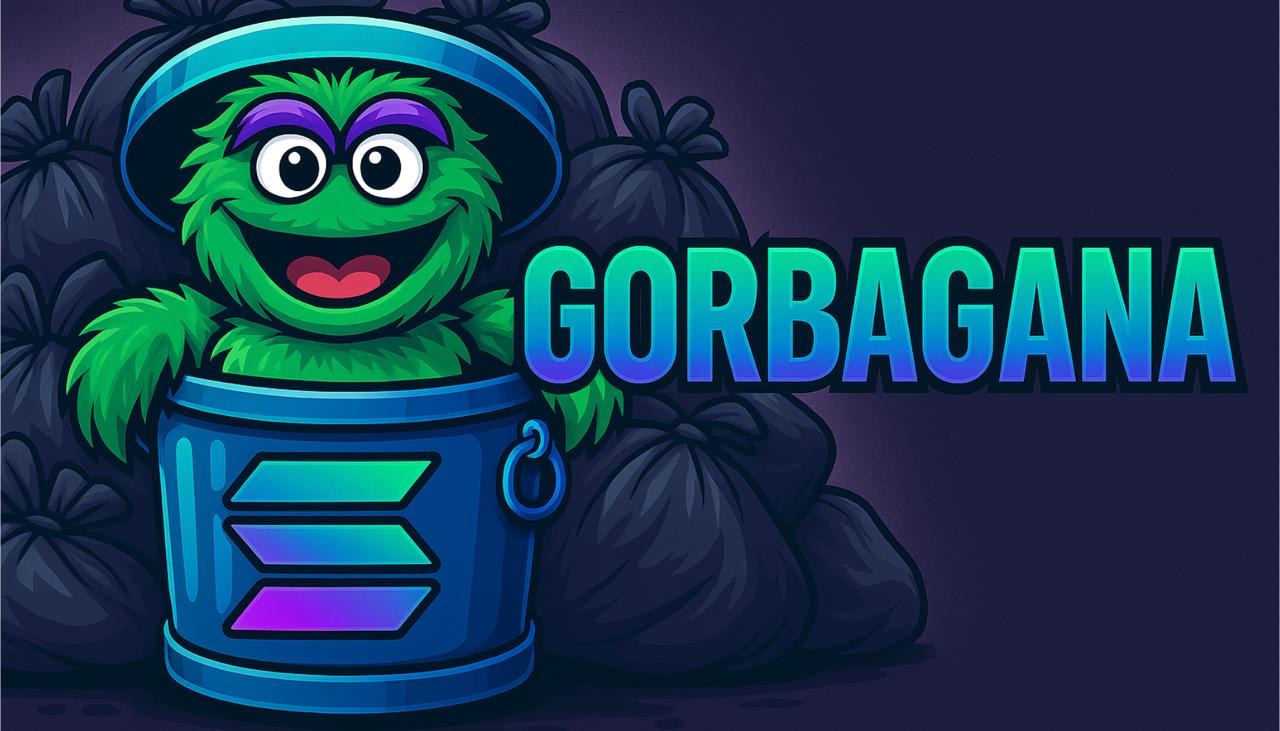
It was also proposed to imagine that if Solana were to fork one day, one would keep the original names Solana and $SOL tokens, and the other chain would call itself “Gorbagana”, with the logo Oscar the grouch.png. This naming method is easily reminiscent of the homonym of garbage, making the narrative more ironic

Toly's response was, “If no one makes the Gorbagana chain within 48 hours, I'm very disappointed.”

Meanwhile, a meme with the token name “Gor” was launched via Pumpfun. The prototype is Oscar the Group (Oscar the Group), a green monster living in a trash can, famous for his whining, garbage, and misogynistic attitude, and the term “Gorbagana” itself clearly derives from the ironic variant of “Garbage.”

The token's market capitalization quickly climbed to $1.6 million, and received Tory's attention and comment on the three trash can icons. The move triggered complete Fomo in the community, and $Gor's market capitalization once topped $10 million in a short period of time.

What's even more ironic is that GOR-chain was actually destroyed in less than 48 hours@MidTermDevIt was developed, and after Tory responded to it, the token's market capitalization reached a new high of $40 million.

but@MidTermDevThe account may have been “hacked” since then, and a new token has been launched (it has now almost returned to zero). presently@MidTermDevIt has been banned, and the development team has been taken over by the CTO, and the core members include@0rdlibrary,@Sarv_shaktimanetc.
Another cabal feast? Who makes money on $GOR
Behind this capital frenzy, it is intriguing that the “Gor” token's first place in the profit ranking, the wallet address starting with A4DC also received 861 Sol's revenue from the “IBRL” token, and currently ranks 4th in the profit list. Among them, “IBRL” is also Tory's key project. On the on-chain data tracking platform Arkm, the domain name of this address is circled.sol. It has financial transactions with the certified entity wallet Coyote, and the certified entity points to the X account@4pfcoyot。
When the market capitalization of $Gor recovered to $7-8 million, Coyote bought a total of 350 Sol. Coincidentally, Tory soon replied to a tweet about the development of GOR-chain, which caused the “Gor” market capitalization to skyrocket to 40 million US dollars. Coyote also used this wave of growth to complete its liquidity exit, making a profit of more than 1500 Sol. After this anti-human operation, Coyote made huge profits. Up to now, Coyote has earned 1,780 Sol on $GOR, ranking at the top of the profit list.

In stark contrast to this, a well-known Chinese on-chain KOL acted calmly. Although he had already bought 200 Sol at an average market price of 4 million dollars, he sold a large amount of chips when the price rose to 7 million US dollars. Later, the story developed further. After choosing to sell a large number of chips when the market capitalization reached 11 million dollars, he went higher at 25 million dollars, eventually raising the average price to around 26 million US dollars. Currently, he is only making a profit of 370 Sol.

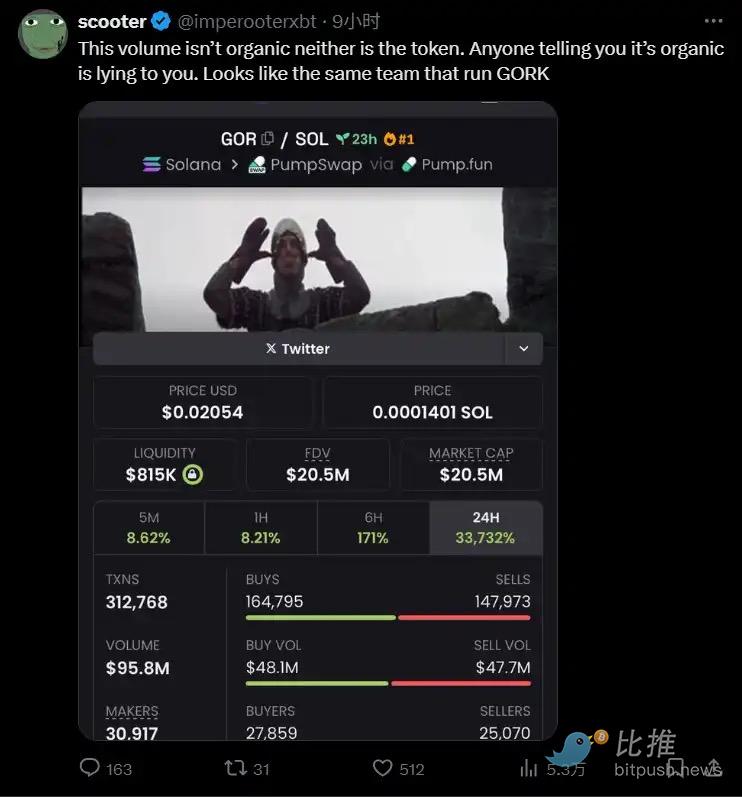
Unlike Fomo's retail investors, there is an opinion in the community that “Gor” isn't as interesting as it might seem on the surface. @imperooterxbt bluntly said, the token was created by the same team as “GORK,” but there seems to be a lack of reliable evidence.

Although this social experiment may seem like just another “feast of intrigue” to most people in the community, the move to a “centralized brand” mentioned by Gabriel Shapiro does reflect a long-standing question. Since Ethereum can “randomly” become an Ethereum classic, can garbage (Gorbagana) also replace Solana.