


Tokenized Stocks: From the “Shadow Market” to Mainstream Transformation and Test Questions

Source: Web3 Practitioner
Author: Crypto Big Coconut
Original title: Tokenized stocks simplify investment and bring new opportunities and regulatory challenges!
In the late 1980s, physicist Nathan Most (Nathan Most) worked on US stock trading platforms. Unlike traditional financial practitioners, the starting point of his career was not in the banking or trading field, but in the logistics industry's transportation of metals and commodities. His entry point was not the financial instrument itself, but the architecture design of the underlying system.
At the time, mutual funds were the mainstream tool for gaining broad market exposure. Although they provided investors with the possibility of decentralized allocation, there was a significant lag in efficiency — investors were unable to trade in real time during the trading day, and had to wait for the day to close before confirming the transaction price after placing an order (it is worth noting that this characteristic continues to this day). For investors who are used to trading individual stocks in real time, this experience is outdated.
Nathan proposed a groundbreaking idea: design a product that tracks the S&P 500 index and can be traded like individual stocks —Package the entire index as a new listing tool. This idea initially faced many questions: the mutual fund was not designed for real-time transactions, the supporting legal framework was lacking, and market demand was unclear. Despite this, he continued to push forward.
In 1993, S&P Depositary Receipts (SPDR) were officially introduced under the code “SPY”, becoming the world's first exchange-traded fund (ETF). This tool, which aggregates hundreds of stocks, was initially viewed as a niche product, but eventually grew into one of the world's most traded securities — SPY's trading volume even surpassed the total number of constituent stocks it tracks on many trading days. The liquidity of a synthetic financial instrument overtakes the underlying asset; this phenomenon itself is extremely enlightening.
Today, a mirror image of history is surfacing in the blockchain field.
Robinhood、Backed Finance、Dinari、RepublicOther platforms are launching tokenized stocks — blockchain-based assets designed to anchor the price trends of private companies such as Tesla, Nvidia, and even OpenAI. The core position of these tokens is to provide price exposure rather than ownership: investors do not have shareholder status or voting rights, and what they buy is not a share in the traditional sense, but a tokenized certificate linked to the price of the underlying asset.
This essential difference has already sparked controversy.OpenAIElon Musk and Elon Musk both expressed concern about Robinhood's launch of a tokenized stock product. In its statement, OpenAI clearly stated: “These 'OpenAI tokens' are not company shares; we are not partnering with Robinhood or endorsing such products; any transfer of OpenAI shares requires company approval, and we have never approved the relevant operation.” Musk, on the other hand, bluntly stated that such “shares” were false targets.

In response, Robinhood CEO Tenev (Tenev) said that the core value of tokenized stocks is to provide retail investors with access to private assets.
Unlike traditional stocks directly issued by companies, tokenized stocks are created by third parties: some platforms claim to use 1:1 underlying shares as endorsements, while others are fully synthetic derivatives. Judging from the user experience, its price fluctuation is similar to the underlying stock, and the operation interface is similar to traditional broker applications, but its actual legal and financial compliance is still weak.
Nevertheless, such instruments are appealing to specific groups of investors — particularly market participants outside the US. If investors in Lagos, Manila, or Mumbai want to allocate Nvidia shares, the traditional path often requires overseas brokerage accounts, high minimum holdings, and long settlement cycles; while tokenized stocks track underlying asset trends through on-chain transactions, eliminating these transaction frictions — no wire transfers, no complicated forms, no intermediary threshold, and only a digital wallet and trading market.
This convenience may seem innovative, but the underlying logic can actually be traced back to the historical rules of the evolution of financial instruments.
However, real challenges remain. Platforms such as Robinhood, Kraken, and Dinari have limited operational coverage in emerging economies. For example, the legal and practical viability of Indian users can legally buy tokenized shares through such channels is still unclear. If tokenized stocks want to truly broaden global market access, the resistance not only stems from the technical level, but also involves regulatory frameworks, geographical barriers, and infrastructure shortcomings.
Evolution trajectory of derivatives and path mapping of tokenized stocks
Futures contracts have long provided investors with a tool to trade based on price expectations without holding an underlying asset. Options allow investors to express judgments about volatility, timing, or direction, and usually do not need to buy stocks directly. These products all serve as alternative paths to access underlying assets.
The emergence of tokenized stocks follows a similar logic: they are positioned not to surpass the stock market, but to provide new access channels for groups that have long been excluded from the public investment system.
The evolution of new derivatives often follows a traceable path: the initial market is full of vague perceptions, investors are difficult to price, traders are on the sidelines, and regulators are cautious; speculators then enter the market to test boundaries, expand product forms, and the arbitrage market is inefficient; if the value of the product is verified, mainstream participants will gradually accept it and eventually integrate into the financial infrastructure.
Index futures, ETFs, and even CME and Binance's Bitcoin derivatives all follow this path — they're not inherently popular tools, but rather a testing ground for speculators: they trade faster, riskier, and more flexible.
Tokenized stocks may be entering the same stage: initially used by retail investors to chase the exposure of private market assets such as OpenAI or pre-IPO companies, then arbitrators use the spread between tokens and underlying stocks; if trading volume continues to grow and infrastructure is mature, institutional trading departments may gradually step in, especially in regions with clear compliance frameworks.
Early market activity inevitably showed chaotic characteristics: insufficient liquidity, large spreads, and significant weekend price fluctuations. But this is often the case in the early stages of the derivatives market — they are not perfect replicas of the underlying asset, but rather a stress test of the market's endurance, and an important way to discover demand before assets are adjusted.
This structure has one notable characteristic (or flaw, depending on the point of view) — the time difference.
Traditional stock markets have fixed opening and closing periods, and even derivatives based on stocks often operate during market trading hours; tokenized stocks do not necessarily follow this rule. For example, a US stock closed at $130 on Friday. If earnings leaks or geopolitical events occur on Saturday, the token price may react immediately, while the underlying stock is at a standstill. This characteristic allows investors to absorb the impact of news flows during stock market closures.
Only when the trading volume of modern tokenized stocks significantly exceeds that of underlying stocks can the time difference cause systemic problems.
The futures market addresses such challenges through capital rate and margin adjustments. ETFs rely on authorized participants and arbitrage mechanisms to maintain price consistency, while tokenized stocks have not yet established a similar mechanism — the risk of price deviation and insufficient liquidity problems exist objectively, and their correlation with reference assets is highly dependent on the issuer's credit endorsement.
The stability of this foundation of trust is uneven. For example, when Robinhood launched OpenAI and SpaceX tokenized products in the European Union, both companies denied participation, and there was no coordination or formal partnership between the two parties.
This is not about denying the value of tokenized stocks, but rather clarifying their essence: are investors buying price exposure or synthetic derivatives with vague rights and recourse?
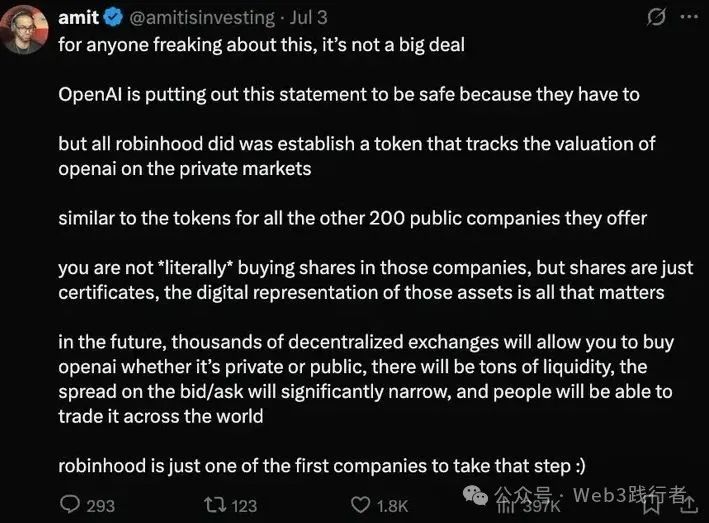
As market participant @amitisinvesting said, “OpenAI's statement is more about compliance prudence. Robinhood simply created a token that tracks OpenAI's private equity market valuation, similar to its tokenized product for more than 200 listed companies. Investors do not 'directly' buy shares in these companies, but shares are essentially a form of evidence, and the core value expressed by numbers is the stability of asset mapping. In the future, thousands of decentralized exchanges will support the trading of assets such as OpenAI (regardless of whether they are listed), liquidity will increase dramatically, trading spreads will be significantly narrowed, and investors from all over the world can participate in the transaction — Robinhood is just one of the first companies to take this step.”
The differentiation of the underlying architecture and market exploration under the gray scale of regulation
The underlying infrastructure of tokenized stocks is significantly divided: some are issued under the EU regulatory framework, some rely on smart contracts and offshore escrow mechanisms, while platforms such as Dinari try a more compliant path. Most participants are still testing the boundaries of legal viability.
In the US, securities regulators have yet to make a clear statement. The SEC's regulatory stance on token issuance and digital assets is clear, but tokenizing traditional stocks is still a grey area of regulation. Platforms are cautious about this; for example, Robinhood chose to launch related products in the EU rather than the mainland of the US.
Even so, the market demand is clear: Republic provides synthetic exposure to private companies like SpaceX, and Backed Finance packages open market shares and issues them on the Solana chain. Although early, these experiments continue to advance. The core logic is to resolve transaction friction rather than restructure the nature of finance — tokenized stocks do not necessarily optimize the economic attributes of ownership (which is not their goal), but rather simplify the participation experience.
For retail investors, “accessibility” is often a core requirement. The competition for tokenized stocks is not the stock itself, but the traditional way to obtain shares. If investors can obtain Nvidia's directional exposure in stablecoin-holding apps with a few clicks, they may not be sensitive to whether the product is in synthetic form.
This preference is not a new phenomenon: SPY's success has proven that “asset packaging” can become a mainstream market form, and derivatives such as CFDs, futures, and options also follow this logic — initially as a trading tool, and eventually serve a wider audience. These derivatives are sometimes even ahead of the underlying asset, absorb market sentiment faster, and their price changes reflect fear or greed faster than the underlying market.
Tokenized stocks may be evolving along this path: the current infrastructure is not mature, liquidity is clearly divided, and the regulatory framework needs to be clarified, but the underlying driving force is clearly discernible — building a tool that reflects the value of the asset, is easy to obtain, and sufficient to support participation. If this mapping relationship remains stable, more trading volume will lean towards it, and eventually evolve from a “shadow market” to a mainstream tool with the meaning of price signals.
Nathan Most's original intention was not to reshape the stock market, but rather to discover inefficiency and design a smoother interface; today's token issuers are doing the same thing, but the “packaging tool” this time is a smart contract, not a fund structure.
It is worth paying attention to whether these new tools can maintain stability in the midst of market turbulence.They are not stocks, nor are they regulated products; they are “instruments of proximity”. For many users — particularly those far from traditional financial systems or in emerging markets, this “proximity” may be enough.
