


12-country stablecoin regulatory race map: who is leading the way?

Author: Fairy, ChainCatcher
EDIT: TB, ChainCatcher
Original title: When stablecoins break the circle: In-depth analysis of 12 countries' stablecoin regulatory policy competition
The circle-breaking effect of stablecoins continues to expand.
From high-frequency related topics popping up on Douyin's hot lists, to content creation turned to by traditional financial bloggers, to active inquiries from relatives and neighbors, stablecoins seem to have become a social buzz word that permeates everyday life.
At the same time, the global policy side also ushered in a critical turning point. Over the past year, the attitude of many countries towards stablecoins has changed from careful wait-and-see to acceptance: Hong Kong's “Stablecoin Regulations” are about to be implemented, the EU MiCA Act is officially implemented, and the US has passed the “Genius Act”. Stablecoins are quietly leveraging the foundations of the global monetary system.
This article will systematically sort out the latest developments in stablecoin regulation in various countries and analyze the underlying logic and strategic implications of this financial transformation.
A look at the global stablecoin regulatory situation in one table
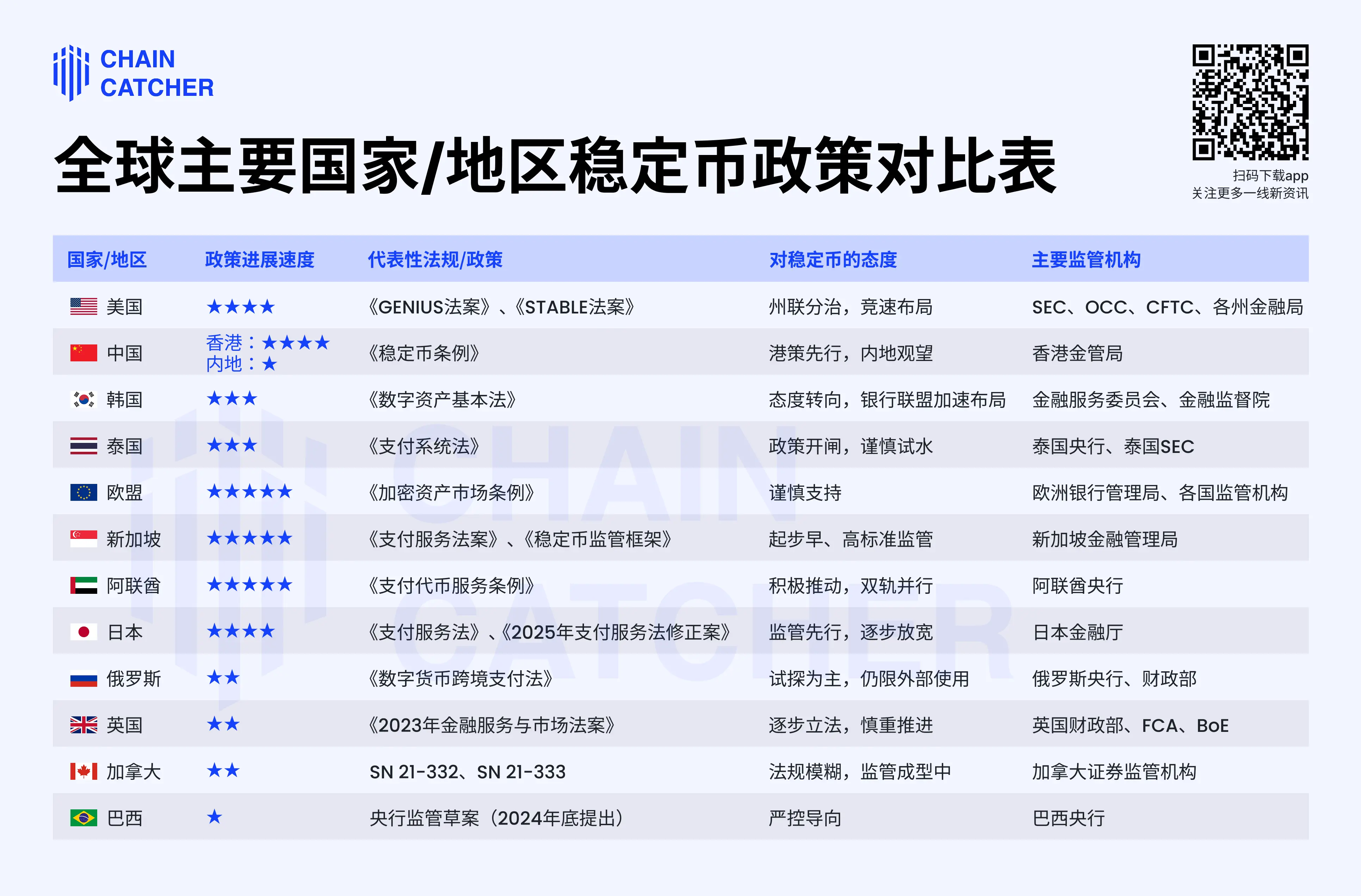
Analysis of the evolution of stablecoin policies in the world's top twelve core markets
US: federal division of states, racing layout
The speed of policy progress: ★★★★
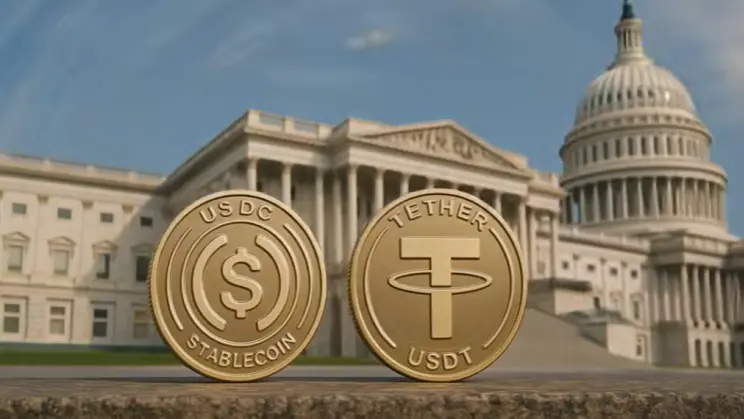
The development of stablecoins in the US is showing a “federal+state level” dual-track situation. On the one hand, the federal government is speeding up the unification of the regulatory framework at the legislative level; on the other hand, states are taking the lead in testing the waters and promoting the implementation of the system first.
At the state level, many localities have taken the lead in implementing specific regulations and regulatory frameworks:
Wyoming passed the Wyoming Stablecoin Act in 2023, established the “Wyoming Stablecoin Commission,” and plans to issue the state-supported stablecoin WYST on August 20, 2025.
In 2018, the New York Department of Financial Services required stablecoin issuers to obtain a BitLicense license or trust company license and comply with strict regulations.
California passed the Digital Financial Assets Act (DFAL) in 2023, establishing a comprehensive licensing system covering stablecoin issuers. The DFAL will officially take effect in July 2026.
Regulatory legislation at the federal level is also progressing rapidly:
The “GENIUS Act” was signed into effect by Trump on July 19, 2025.
The bill requires prohibiting the issuance of yield-based stablecoins, monthly disclosure of the composition of reserves and audits, and the CEO and CFO being responsible for the authenticity of the data. Issuers can choose to be regulated by the federal or state, and small issuers (with an issuance amount of <$10 billion) can choose to be regulated only by the state.
The “STABLE Bill” was introduced in March 2025. It has now been reviewed by the House of Representatives and is awaiting a vote in the Senate. The draft bill is largely the same as the GENIUS Act.
China: Hong Kong policy first, wait and see from the mainland
Policy progress rate: Hong Kong ★★★★ | Mainland ★
Mainland China and Hong Kong have formed a “outpost plus mainland” stablecoin regulation linkage pattern: Hong Kong took the lead in establishing a mature regulatory system to accelerate the attraction of enterprises; while the mainland remained cautious at the policy level.
On the Hong Kong side, its Stablecoin Ordinance will officially come into effect on August 1, 2025.
Currently, about 50 to 60 companies have expressed their intention to apply. Half of them are payment institutions and the other half are large-scale internet platforms. Most of them have Chinese investment backgrounds. JD, Standard Chartered, Ant, etc. have already begun relevant preparations. The industry expects to issue only 3 to 4 licenses in the first batch, and the entry threshold is quite high.
According to reports, the first batch of licenses may adopt an “invitation application system” rather than a unified public application. In the early stages, stablecoins were mainly linked to the Hong Kong dollar and the US dollar.
In the mainland, in the past, there was a trend of “preventive suppression” for a long time, but recently several provinces and cities have released signals of research and concern about stablecoins.
On July 7, at the Wuxi Municipal Committee Reform Promotion Conference, it was proposed to explore “stablecoins to empower foreign trade development” and expand new space for digital trade;
On July 9, the official account of the Jinan Municipal People's Government Research Office published a special stablecoin article written by Xinhua News Agency;
On July 10, the Party Committee of the Shanghai State-owned Assets Administration Commission held a central group study meeting to study the development trends and coping strategies of cryptocurrencies and stablecoins;
On July 18, the China Industrial Internet Research Institute hosted the “Symposium on Stablecoins and Industrial Digital Assets”.

South Korea: Changing attitudes, speeding up the layout of banking alliances
The speed of policy progress: ★★★
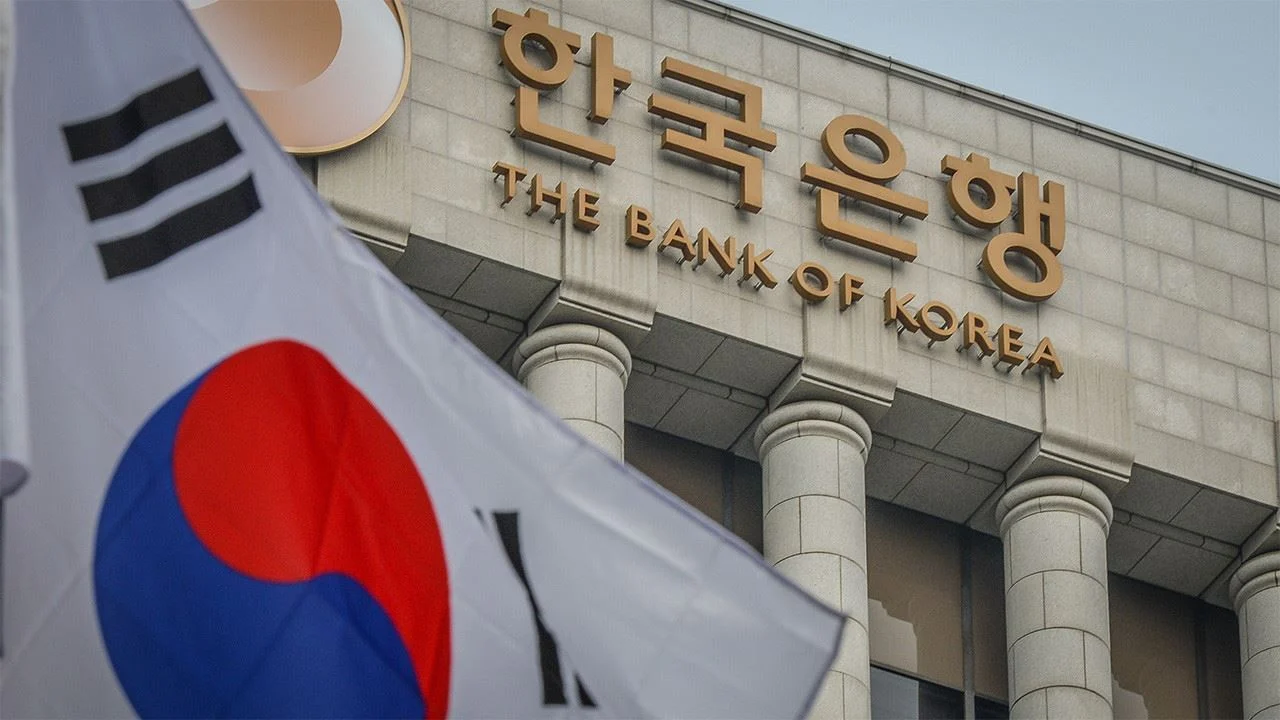
Korea is undergoing a transformation from “wait and see” to “entering the market.” In the context of new President Lee Jae-myung's promise to support the development of the Korean won stablecoin, South Korea's ruling party officially proposed the “Digital Asset Basic Law” on June 10 to allow local companies with capital exceeding 368,000 US dollars to issue stablecoins, marking a relaxation at the policy level.
Currently, Korea's eight major banks are preparing to establish joint ventures and plan to jointly issue Korean won stablecoins. Participating institutions include Kookmin Bank, Shinhan Bank, Woori Bank, Nonghyup Bank, Korea Industrial Bank, Suihyup Bank, and the Korean branches of two major foreign banks, Citibank and Standard Chartered. The project is being jointly promoted by the Big Eight Banks, the Open Blockchain and Decentralized Identity Association, and the Financial Supervisory Authority. If approved by the regulatory authorities, it is expected to be launched by the end of this year or the beginning of next year.
However, current regulations are still uncertain. South Korea is currently experiencing a stablecoin bubble, and there is no clear guidance on regulation, according to an analysis by Four Pillars research director 100y.eth. Financial news reports almost every day that banks or companies apply for stablecoin-related trademarks, and the stock prices of related listed companies usually rise 15% to 30% on the same day.
Thailand: Open policy, test the waters cautiously
The speed of policy progress: ★★★
Thailand's stablecoin policy gradually moved from early vigilance to prudent testing. As early as 2021, the Bank of Thailand initiated stablecoin regulatory exploration and issued preliminary guidance. Among them, stablecoins anchored to the Thai baht are regarded as “electronic money” and are regulated by the “Payment Systems Law”, and relevant agencies are required to consult the central bank for approval before issuance; while stablecoins anchored in foreign currencies (such as USDT and USDC) are not prohibited, but require further supervision.
The real turning point came in 2024. In August, Thailand set up a regulatory sandbox to allow specific service providers to experiment with cryptocurrencies
In 2025, the scope of the pilot will expand at an accelerated pace:
In January, Thailand's finance minister said at the Securities and Exchange Commission meeting that the government is considering issuing stablecoins backed by 10 billion baht treasury bonds.
In March, Thailand's Securities and Exchange Commission (SEC) approved USDT and USDC as tradable assets into the country's regulated exchanges.
In July, SEC and BOT jointly launched a “national encryption sandbox”, which allows foreign visitors to exchange digital assets (such as USDT and USDC) for Thai baht through a licensed platform for travel expenses.

EU: Unify supervision, prudent support
The speed of policy progress: ★★★★★
The EU's attitude towards stablecoin development can be summed up as “careful support”: it not only fully affirms the potential of stablecoins, but is also highly vigilant about financial stability, regulatory arbitrage, and money laundering risks.
In June 2023, the European Union officially issued the Crypto Asset Market Regulation (MiCA), the core goal of which is to comprehensively regulate the crypto asset market. Some provisions came into effect on June 30, 2024, and stablecoin-related provisions were fully implemented on December 30, 2024. The Act applies to the 27 EU member states and the three countries in the European Economic Area (EEA), including Norway, Iceland, and Liechtenstein.
MiCA sets a high threshold for issuing and operating stablecoins: issuers must obtain authorization from member state regulators (such as BaFin in Germany, AMF in France) and establish a legal entity in the European Union. Stablecoins that meet “importance” standards (such as large trading volumes) will be uniformly regulated by the European Banking Authority (EBA).
MiCA also requires that non-Euro-denominated stablecoins must not exceed 1 million or 200 million euros per day in any currency region. Once the limit is exceeded, the issuer must suspend the issuance of the stablecoin and submit a rectification plan within 40 business days.
Currently, the EU has issued MiCA licenses to 53 crypto businesses, including 14 stablecoin issuers and 39 crypto asset service providers.

Singapore: Early start, high standards
The speed of policy progress: ★★★★★
Singapore is at the forefront of stablecoin regulation. As early as December 2019, Singapore introduced the Payment Services Act, which clarifies the definition and classification of payment service providers.
Subsequently, the Monetary Authority of Singapore (MAS) published the draft Stablecoin Regulatory Framework in December 2022 and initiated public consultation, and officially launched the final version on August 15, 2023. This regulatory framework applies specifically to single-currency stablecoins (SCS) issued in Singapore and anchored in the Singapore dollar (SGD) or G10 currency, and is included in the regulatory system as a supplementary provision to the Payment Services Act.
MAS sets a high entry threshold, and issuers are required to meet the following requirements:
The capital of the stablecoin issuer is not less than 50% of the annual operating expenses or S$1 million;
Stablecoin issuers must not engage in other business such as trading, asset management, pledging, lending, etc., nor can they directly hold shares in other legal entities;
Liquidity assets meet the size required for normal asset withdrawals or are 50% higher than the annual operating expenses.
The reserve assets of stablecoin issuers can only consist of the following assets with extremely low risk and sufficient liquidity: cash, cash equivalents, and remaining bonds with a maturity date of not more than three months.
Currently, a number of institutions have applied for stablecoin issuance qualifications from MAS. Among them, StraitsX (XSGD issuer) and Paxos are both regarded as examples of pioneering compliance implementation.
UAE: Active promotion, two tracks in parallel
The speed of policy progress: ★★★★★
The UAE has shown support and openness in its stablecoin policy. In June 2024, the Central Bank of the United Arab Emirates issued the “Payment Token Service Regulations”, which clarified the definition and regulatory framework for “payment tokens” (stablecoins).
As a federal country composed of seven emirates, the UAE's regulatory system has a distinct “dual system”: the central bank is responsible for federal-wide regulation, while the Dubai International Financial Center (DIFC) and Abu Dhabi Global Market (ADGM) are financial free zones and enjoy independent legal systems and regulatory powers.
Compared to the European Union's MiCA or Hong Kong's Stablecoin Regulations, the UAE's new regulations define stablecoins in a relatively broad manner, but they still set certain boundaries:
Issuance of algorithmic stablecoins and privacy tokens is prohibited
Stablecoins are not allowed to pay users interest or other returns linked to the time the coin is held
In terms of specific applications, the UAE stablecoin market has also begun to bear fruit. In December 2024, AE Coin was approved by the CBUAE, making it the UAE's first fully regulated dirham stablecoin.
In April 2025, Abu Dhabi's sovereign wealth fund ADQ, the corporate group IHC, and Abu Dhabi Bank, the largest bank in the UAE, jointly announced that they will launch a new stablecoin anchored in the dirham.

Japan: Regulation first, development pending
The speed of policy progress: ★★★★
Japan is at the forefront of the world in stablecoin regulation and has taken the lead in completing the basic legislative framework. Its regulatory path is mainly achieved through improvements to the Payment Services Act (PSA).
In June 2022, the Japanese Diet passed a revised version of the Payment Services Law, which officially came into effect in June 2023. The revised law defines stablecoins in detail, clarifies the issuing entity, and lists the licenses required to trade stablecoins. It limits stablecoin issuers to three categories: banks, trust companies, and fund transfer service providers.
In March 2025, the Financial Services Agency of Japan promoted the “2025 Payment Services Law Amendment” to optimize the stablecoin issuance mechanism: trust-based stablecoins are allowed to use up to 50% of reserve assets for specific low-risk instruments, such as short-term treasury bonds or term deposits. The law also added a special registration category for crypto intermediaries, lowering the threshold for participation in OTC transactions.

Russia: Mainly testing, still limited to external use
The speed of policy progress: ★★
Russia's attitude towards stablecoins has changed markedly in recent years, from initial caution or even opposition to limited support. This change is mainly due to the strategic demand for cross-border settlement and autonomous financial systems under geopolitical pressure.
In 2022, the Bank of Russia pushed for a complete ban on cryptocurrencies. However, there was a critical shift in policy trends in July 2024. The Russian Federation Parliament passed two bills to officially legalize cryptocurrency mining and allow enterprises approved by the central bank to use crypto assets, including stablecoins, to make international settlements with overseas partners. However, in the domestic sector, cryptocurrencies are still not allowed to be used as a means of payment.
In March 2025, the Bank of Russia issued a proposal to allow “specially qualified” high-net-worth individuals and some companies to invest in crypto assets and explore a more transparent and controlled market environment during a three-year pilot period.
Outside of the policy context, Ivan Chebeskov, head of the Ministry of Finance's Digital Financial Assets Department, publicly stated that Russia should consider launching its own sovereign stablecoin to adapt to the evolving trend of the global payment system.

UK: Regulation in progress
The speed of policy progress: ★★
UK policy is at a critical stage of bridging from framework design to legislation implementation. The relevant regulatory system is based on the Financial Services and Markets Act 2023, and is supported by secondary regulations and regulatory guidelines developed by the Financial Conduct Authority (FCA) and the Bank of England (BoE). The bill received royal approval on June 29, 2023, and for the first time included “digital settlement assets” (including stablecoins) within the scope of laws regulated financial activities.
In November 2023, the UK Financial Supervisory Authority announced regulatory requirements for companies issuing or hosting fiat-backed stablecoins. The proposed framework will seek to apply several existing regulatory standards that are currently applicable to many FCA authorized entities to the field of stablecoin activity.
In April 2025, the UK government issued a consultation document on draft legislation in the field of cryptocurrency, and plans to add additional regulated activities, including operating a crypto asset trading platform and stablecoin issuance.
Despite ongoing regulatory developments, the Bank of England's governor has shown a more conservative stance. Its central bank governor, Andrew Bailey, has publicly stated many times that large-scale use of stablecoins may weaken public trust in the national currency and even pose a systemic risk to the financial system.
Canada: Legislation is blurry, regulations are taking shape
The speed of policy progress: ★★
Compared with markets such as the US and EU, Canada's policy is more conservative, and the local stablecoin market is developing slowly.
In December 2022, the FTX crash caused turmoil in the global crypto market, and the Canadian Securities Regulatory Authority (CSA) then tightened its policy to include stablecoins within the scope of “securities and/or derivatives” regulation.
Since 2023, the CSA has issued two key documents, SN 21332 and SN 21333, which propose a regulatory framework for “fiat-linked stablecoins.” According to relevant regulations, stablecoin issuers are required to register as securities issuers, submit a prospectus, or sign a letter of commitment approved by CSA.
Last month, the Bank of Canada supervisory authority said it is ready to regulate stablecoins and the regulatory framework is being developed.

Brazil: Strict Control Orientation
The speed of policy progress: ★
According to data from the Central Bank of Brazil, over 90% of the country's cryptocurrency transactions involve stablecoins, which are mainly used for cross-border payments, but this trend has also raised compliance concerns.
Bank of Brazil Governor Gabriel Galipolo said that the central bank initially thought stablecoins were popular because they provided a convenient way for people to hold dollars. However, after thorough research, it was discovered that a large number of stablecoin transactions are related to cross-border shopping, and the transaction method is opaque, and may be used to evade taxes or money laundering activities.
To this end, the Bank of Brazil proposed a new draft regulation in December 2024 to include stablecoins in the foreign exchange supervision system and prohibit transfers to wallets controlled by non-Brazilian entities.
Overall, Brazil's regulatory direction is very clear: on the premise of strong control, priority is given to suppressing high-risk trading scenarios.
Despite stricter regulations, traditional banks are beginning to explore compliance paths. Brazil's largest bank, Itau Unibanco (with over 55 million customers), is planning to launch a stablecoin pegged to the real. Currently, Itau is studying the relevant experiences of other banks and is awaiting the introduction of a Brazilian stablecoin regulatory framework.
