


Zhao Changpeng's speech in Hong Kong: Interpreting stablecoins, RWA, DAT (Cryptographic Treasury Strategy), and AI

Source: SevenUp DAO
Original link: https://mp.weixin.qq.com/s/TKrBS54M6rs49_xbnq26Ew
On August 27, at the “Hong Kong Crypto Finance Forum”, Zhao Changpeng (CZ), founder of Binance (Binance), the world's largest digital asset trading platform, explained his forward-looking thoughts on the future development of the industry.
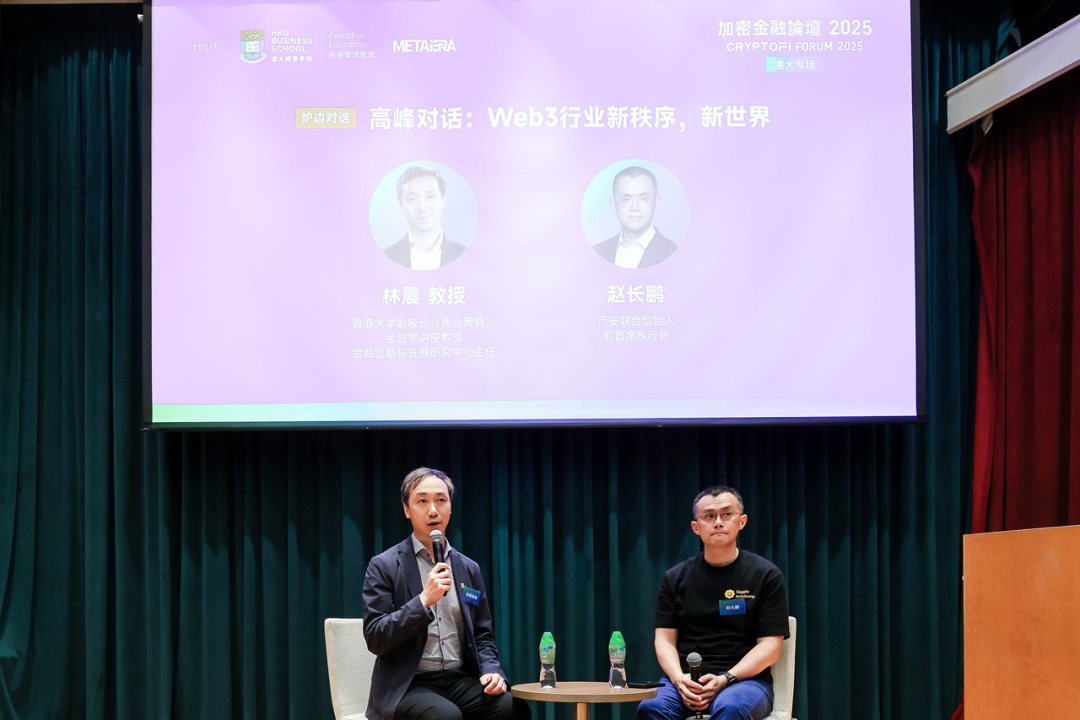
Chang Peng (CZ) focused his discussions on five topics: the evolution of stablecoins and the strategic position of the US dollar, RWA's regulation and liquidity bottlenecks, the potential of decentralized exchanges, the new investment direction provided by the crypto asset treasury (DAT) model for traditional investors, and changes in trading models brought about by the integration of AI and Web 3.0.
Zhao Changpeng (CZ)'s views not only reflect his deep insight into the current development of the industry, but also show his strategic thinking on the future pattern of digital finance. These insights are an important reference for understanding trends and investment opportunities in the crypto finance industry.
The following article is compiled based on the views of Zhao Changpeng (CZ) on the scene. The author maintains the original CZ expression as much as possible.
1. Zhao Changpeng (CZ) on stablecoins: From volatile “safe havens” to a powerful tool for dollar globalization
Actually, I'm not an expert in the stablecoin field, but the Binance platform hosts about 70% of the world's stablecoin trading volume, making us the most important stablecoin distribution channel in the industry.
Let me give you a brief history of the development of stablecoins. The earliest prototype of stablecoin technology was “Colored Coins,” which was the first “on-chain asset” solution explored by the Bitcoin community. In 2014, USDT was initiated by Brock Pierce, and the initial development of the project was lackluster, then Pierce gradually withdrew, giving way to the current USDT team Craig Sellars and others. Until 2017, there was no significant improvement.
When Binance was founded in 2017, we focused on cryptocurrency trading, supporting trading pairs such as Bitcoin to Ethereum and BNB, but lacked fiat currency trading features. This raises a user experience issue: every time the price of Bitcoin falls, users can only withdraw Bitcoin to other fiat exchanges and exchange it for fiat, and there is great uncertainty about whether these funds will flow back to our platform.
At the same time, it's also extremely unfriendly to the user experience. To improve the user experience, we decided to support USDT as a “safe haven” when the market falls. At the time, we understood stablecoins as a short-term storage tool, so the decision to support USDT was relatively simple — there were no complicated cooperation agreements or strategic partnerships, but simply integrated this product.
At this point, USDT ushered in a period of rapid development:
First, after 2017, coin exchanges entered a period of rapid development, and many platforms, including Binance, began to support USDT, driving the rapid growth of USDT.
Subsequently, USDT ushered in a second wave of growth momentum: many Asian users wanted US dollars, but it was difficult to directly open US dollar accounts, and USDT provided them with an alternative. Tether's profitability has always been outstanding, and they have kept a relatively low profile due to US regulatory pressure and difficulties in bank cooperation.
In 2019, US compliance agency Paxos took the initiative to contact us with a proposal to cooperate in issuing stablecoins, which later led to BUSD. From 2019 to 2023, the market value of BUSD grew to $23 billion. During this period, we invested little resources and mainly carried out some brand support and promotion activities, such as “free withdrawals”.
In 2023, the US government withdrew the BUSD program. If BUSD continues, it will have a good scale of development, because at the time, BUSD grew faster than USDT and USDC. It is worth emphasizing that when the BUSD project was closed, all user funds were fully withdrawn, which fully proved the nature of BUSD as a compliant, transparent, and secure project.
Stablecoins and exchanges have become one of the core profitable sectors in the field of crypto finance. Its business model is highly simplified: after obtaining a compliant license, users deposit funds and the platform can issue tokens; when users redeem tokens, the platform provides cash exchange. This model has a low threshold, high liquidity and huge market potential, and remarkable long-term profitability.

From a national strategic perspective, the US government's attitude towards stablecoins has changed markedly in recent years. The current US administration is very smart, and with its commercial background, it has a deep understanding of Tether's strategic value to the US dollar's global position. Currently, about 100 billion USDT funds have purchased US Treasury bonds, and Tether is widely used around the world. The point is that Americans themselves don't need stablecoins — they can directly use the bank's ACH system to trade dollars. Almost all USDT users are outside of the US, which actually expands the dollar's global influence.
This fits perfectly with China's idea that it wants to expand the influence of the renminbi internationally. Stablecoins are essentially tools to help the underlying currency to globalize, and this should be extremely attractive to all countries. Of course, as freely circulating blockchain assets, stablecoins do pose a challenge to exchange control, but these problems can also be solved. Currently, more than a dozen countries I have been in contact with have shown strong interest in developing local stablecoins, and everyone wants their fiat currency to go on the chain.
When the US passed the GENIUS Act in July, it proposed a policy direction to limit the development of central bank digital currency (CBDC). This move reflects the far-reaching strategic layout of the US dollar's global dominance. Stablecoins are popular precisely because of their high degree of free circulation and good user experience, while some government-led digital currencies may be more strict in terms of regulation and monitoring, which in turn affects market acceptance. In fact, since 2014, more than 20 countries have tried to issue CBDCs, but none have actually been successful at the market level.
Blockchain technology is essentially a ledger technology. Its first application scenario is finance, so stablecoins are a natural application of blockchain technology. Currently, we only see that US dollar stablecoins are more mature, and stablecoins in other countries' currencies have yet to rise, which means there is huge room for future growth on this circuit. Now, every country wants to develop a stablecoin business. I think every country should have at least a few stablecoin products
II. Zhao Changpeng (CZ) on RWA: The Triple Challenge of Liquidity, Regulation, and Institutions
Although the RWA (Real World Asset Tokenization) circuit has broad market prospects, it is far more difficult to land than market expectations. The specific challenges can be summarized in the following three areas:
1. Liquidity dilemma
From a practical perspective, products with strong financial attributes are relatively easier to tokenize, mainly because traditional financial products themselves have high transactional properties and are relatively mature in digital expression. Tokenizing non-financial assets faces fundamental barriers. Although it is theoretically possible to “Tokenize Everything” — all cities, buildings, and individuals can issue coins — there are many problems in practice.
Take real estate as an example. Even in the highly volatile Hong Kong real estate market, there is still very little fluctuation compared to Bitcoin. After this type of asset, which has little fluctuation, is not very transactable because there is little fluctuation, and the order book (Order Book) is not deep enough. At this point, liquidity will decrease, and investors will not place many orders, thus forming a vicious cycle: if the order book is too shallow, the trading volume will decrease. If investors try to get in and out of hundreds of millions of yuan of capital, it is almost impossible to make a deal; even if the assets go on the chain, liquidity is still insufficient, and it is more likely to cause unexpected fluctuations and even be manipulated in the short term.
2. Regulatory complexity
A product with financial attributes often involves a central question — is it actually a security? Is it a security or commodity, or something else?
In large or financially developed countries, there will be very clear definitions and different regulatory authorities; in some small countries, it may be that one supervisory authority will take care of everything. Compliance provisions can be complicated when different regulatory authorities are involved. Businesses need to apply for different licenses: futures licenses, spot licenses, digital currency licenses, bank escrow licenses, etc. When you get a lot of licenses, your business model is also limited, and many times you can't run a single business.
3. Product mechanism defects
In my opinion, the tokenization of US securities is currently not established at the product level. The tokenized stock products we are seeing now, such as xStocks, have no link between the token price and the real stock price, which is unreasonable. Theoretically speaking. If there is a price difference between the two, investors can make money through arbitrage. However, the reality is that this price difference has always existed — which indicates that the mechanism of the product itself is not working. In other words, in the current stock tokenization circuit, there is no real linkage between tokens and stocks, so the entire model has not been established at the product level. Although the US is experimenting with various tokenization methods, no real workable solution has yet been found.

Despite these challenges, there is still an RWA model that actually works — stablecoins. The underlying assets of stablecoins are mainly traditional financial instruments such as US Treasury bonds. The success of this model has verified the viability of tokenizing financial assets.
The US dollar has already gone up the chain through stablecoins. In the current blockchain ecosystem, almost all assets are denominated in US dollars, and the euro and RMB are basically missing in this field. As the world's largest stock market, the US uses blockchain technology to attract global investors to buy US stocks, which is extremely beneficial to its economic development. If US stocks can also be successfully added to the chain, it will further strengthen America's dominant position in the global financial market.
From a rational perspective, the US should actively support this direction of development; other countries may also face the risk of being marginalized if they do not participate in this change. For example, the Hong Kong Stock Exchange, as an important exchange with global influence, may gradually weaken if it is absent from this round of changes. Other Asian exchanges, such as the Shanghai Stock Exchange, are facing the same strategic choices.
Economically speaking, this is something 100% should be done; if you don't do it, you'll be eliminated. Just as China's e-commerce market might be completely dominated by Amazon without Alibaba, its absence in the fintech sector will also have a profound economic impact.
Despite regulatory challenges, the impact of this trend on the economy is extremely profound, and countries should carefully consider the relevant layout. With Asians' wisdom and ability to innovate, these problems will eventually be solved, and one of the keys is to grasp the timing.
For commercial institutions and entrepreneurs, it is necessary to accurately grasp the pace during the market window: entering the market too early may face pressure to survive, and late may miss out on opportunities.
Now, we are in a rare golden window period. The US policy has shown unprecedented support for virtual currencies, which will inevitably push other countries that want to develop their economies to take corresponding actions. Hong Kong has been an Asian financial center for a long time, and the Hong Kong government also has a supportive attitude. This kind of historical opportunity is very rare. Therefore, everyone should fully seize this period of strategic opportunity.
3. Exchange transformation: Decentralization will surely surpass centralization. How can Hong Kong seize the opportunity?
The essence and future vision of the exchange
I believe that exchanges should not place restrictions on tradable assets; all assets should be able to circulate freely on the same platform.
Once on the chain, all assets are just a token. Whether it is a cryptographic native asset or a real world asset (RWA), there is no real difference from an exchange's technical point of view. Adding an asset class usually doesn't require complicated development; it only needs to be supported on an existing chain. Currently, most RWA projects do not require an independent blockchain; more are issuing tokens based on public chains such as Ethereum, BNB, or Solana, so support at the wallet and exchange level is extremely difficult. The real difference is at the level of compliance: which regulatory authority do you need to apply for a license, and whether you can get approval. Once the license issue is resolved, there are few technical barriers.
In the long run, future exchanges should enable unified trading of all types of assets around the world. Whether it's a building, a celebrity's future IP rights, or even personal value, they can circulate in the same market. This not only maximizes liquidity, but also makes the price discovery mechanism more efficient.
Of course, RWA also has some unique challenges. For example, when you tokenize a building, if you want to sell the building later, you may only be able to sell part of it. Because once the token is issued, if an investor holds only one unit of assets and refuses to sell it, you can't completely buy back the entire building or incur huge costs. It can be understood as the concept of a “chain nail user.”
Although it will take time to achieve a “global asset chain”, it is not out of reach for 90% of the world's countries. Compared to some large countries with extremely complex regulatory systems, many countries are more likely to directly adopt uniform international standards, thereby taking the lead in promoting the on-chain and free circulation of global assets.
Thoughts on Hong Kong's path to developing a world-class exchange
When it comes to how Hong Kong can build a world-class exchange, I can analyze it from a logical level. In the early stages of crypto industry regulation, many countries or regions often chose strict controls to reduce risk and ensure security. Regulators are concerned about errors, so they usually require all business to be carried out locally: local licenses, local offices, local employees, local compliance departments, local servers, local data storage, local matchmaking engines, local user base, and local wallet infrastructure that is completely independent of foreign countries.
This idea is relatively easy to implement in the traditional physical world, such as control through safes and physical isolation. However, in the digital currency industry, this difference is of little significance. Whether the server is located in Hong Kong, Singapore, or the US, the chances of getting hacked are the same because everything runs online.
More importantly, if operations were to be split, it would often cost a $1 billion dollar investment just to build a secure wallet infrastructure. Moreover, the problem is not only funding, but also a shortage of talent — it is difficult to repeatedly recruit hundreds of the world's top security experts to build this infrastructure. The cost of replicating a complete system is actually equivalent to the cost of establishing a first-class international exchange.
From a liquidity perspective, if only local residents are allowed to trade, taking Hong Kong as an example, a population of 8 million people, or an active user base of 200,000 to 300,000 in other small countries, it simply cannot generate enough trading volume. Without liquidity, price fluctuations can be very drastic, which is actually harmful to users.
Real user protection comes from a deep enough order pool — when there are hundreds of millions of large orders, it won't break through the price, and when futures prices fluctuate, there is no need to force close positions due to sufficient market liquidity. If you buy 10 bitcoins on an exchange with low liquidity, the price slippage will be quite high, and users will also have to bear higher costs. As a result, large global exchanges can provide the most basic user protection—reducing users' transaction costs.
When countries try to establish independent systems, they inevitably present complex management challenges that are not commercially viable. At the same time, many countries have restrictions on tradable assets. For example, Hong Kong currently has many restrictions on listed currencies, and product coverage is limited. As far as I know, most licensed exchanges in Hong Kong are currently in a state of loss. Although they can be maintained in the short term, this loss model is difficult to sustain for a long time.
However, Hong Kong also has its advantages — Hong Kong is improving very fast. We saw Hong Kong launch a new draft stablecoin in May, even before the US. The government is very active in communicating with industry players, including with industry insiders like us. Hong Kong may have been relatively conservative in previous years. This is completely understandable. With changes in the global situation, Hong Kong is now showing a very positive performance.
I think now is a good place to start. Past limitations don't mean the future will always be limited; instead, now is the perfect time to explore opportunities. That's why so many Web 3.0 practitioners, myself included, chose to explore opportunities in Hong Kong.
The future trend of decentralized exchanges
I think decentralized exchanges will definitely be larger than centralized exchanges in the future. Although Binance is probably bigger right now, I don't think it will stay the biggest.
Decentralized exchanges currently have no KYC requirements, are very easy and quick to use for users who use wallets, and are highly transparent — although sometimes too transparent, everyone can see other people's orders.
・From a regulatory perspective, we paid a huge price because we didn't do a good enough KYC job on centralized exchanges. However, currently the US also doesn't seem to have much regulatory measures for DeFi, which could bring regulatory dividends to DeFi. However, due to historical reasons, it is difficult for me personally to try this field again.
・Judging from the user experience, the user experience of decentralized exchanges is good, but users need to understand how to use wallets. In fact, anyone who used a centralized exchange in the past knows that the user experience was not ideal. The interface is full of numbers such as addresses, contracts, etc., and “random codes”. The operation process often requires frequently checking the block browser and preventing various details such as MEV attacks. I myself was attacked many times while studying.
Therefore, for users new to Web 3.0 from Web 2.0, most will still choose centralized exchanges because the email encryption code login method and customer service-supported model make them feel more accustomed. But over time, as some users become familiar with wallets, they may switch to decentralized exchanges. Currently, the fees for decentralized exchanges are actually more expensive than centralized exchanges, but in the long run, as technology advances, the fees for decentralized exchanges should become cheaper.
Nowadays, many decentralized exchanges have their own token incentive mechanism, which provides incentives by issuing tokens. But sooner or later, this incentive will disappear, because you can't send unlimited coins — unlimited coins will cause the price of existing currencies to drop.
As a result, the current market is still in a relatively early stage, and there are also incentives for these tokens. But in the long run, I think in 5 to 10 years, decentralized exchanges will become very large. I think decentralized exchanges will definitely surpass centralized exchanges in 10 to 20 years; this is the future trend.
Although I won't be leading related projects now, from an investment perspective, we have invested in many similar projects, but they are all small shares, and we are now supporting them behind the scenes. I think there is still quite a bit of room for future development in this field.
4. Zhao Changpeng (CZ) on Crypto Asset Treasury Strategy (DAT): A Bridge for Traditional Investors to Enter the Crypto World
Many people tend to understand the concept of DAT (Cryptographic Asset Treasury Strategy) too simplistic, but in fact, there are many segments of this circuit. But at the end of the day, the core logic is to package digital currencies in a share-based manner, so that traditional shareholders can easily participate in investments.
There are many levels and forms in the DAT field. Just like traditional companies, various models can coexist. Crypto ETFs are mainly issued in the US, but many investors lack US stock accounts or are unwilling to bear the high trading and management costs. In contrast, listed companies like Strategy can often allocate assets at a lower cost by directly holding digital currencies. At the same time, they have more diverse financing methods, and can raise capital in different markets such as the US, Hong Kong, and Japan. The differences in financing channels and investor structures of listed companies in different regions have also shaped their unique market patterns.

In the listed company model, DAT companies mainly have the following operating models:
1. Passive single asset holding model
Represented by Strategy, it focuses on passive holding of a single Bitcoin asset. This model is relatively simple. Management costs and decision costs are relatively low, and it is possible to stick to the established strategy regardless of whether the Bitcoin price rises or falls.
2. Active single asset trading model
Although they also only hold one type of coin, the management strategy is completely different. This type of company will try to determine the rise and fall and carry out active trading, which requires an assessment of the manager's ability to trade. Because it involves subjective judgement, the results of this model may be positive or negative.
3. Multi-asset portfolio management model
More complex DAT companies hold a number of different digital currencies. Managers need to make complex decisions: how many bitcoins, how many BNB, how much Ethereum, etc., how often and when to adjust this portfolio all test the manager's ability.
4. Ecological investment and construction model
This is the most complicated model. In addition to holding coins, they will also invest 10%, 20%, or more in ecological construction. For example, companies that focus on Ethereum may want to help the development of the entire Ethereum ecosystem through investment. This model is even more interesting. Projects that support other digital asset ecosystems, such as BNB, have similar practices, but this places higher demands on management capabilities.
Therefore, DAT is not just as simple as “holding coins”; different models correspond to different management costs and management requirements.
The DAT companies we currently support prefer the first form, which is the easiest. We prefer companies that only focus on a single asset, particularly BNB, because it's easy to determine and doesn't require too much involvement in day-to-day management. In times of a bull market, listed companies generally benefit, but in a bear market, especially in the US, companies are often prone to lawsuits. If the strategy is clear and simple enough, the risk of litigation will be relatively reduced, and the company's legal costs will also be reduced — after all, filing a lawsuit is extremely expensive.
Our goal is to keep operating costs to a minimum while promoting long-term ownership. We don't want companies to use capital to make additional investments, but we want them to participate more deeply in supporting the development of the ecosystem.
The importance of the DAT model is that many companies' financial departments, listed companies, and even state-owned enterprises, central enterprises, etc. cannot directly buy digital currencies, but through the DAT model, we can actually give these traditional investors exposure to digital currencies. This group is actually a very large market, much larger than the coin industry.
In DAT projects we participate in, we usually only play the role of small supporters. Most of the funding for these projects comes from traditional stock markets or other channels, which has greatly helped our ecosystem development and attracted many groups outside the cryptocurrency industry to buy digital currencies.
We generally don't lead or manage these companies, but rather find suitable managers through ecology and connections. Managing listed companies is not our specialty, but there are many people in the industry who have relevant experience, and we prefer to work with them to create synergy.
5. AI and Web 3.0 Integration: A Necessary Path from Concept to Reality
Frankly speaking, the combination of AI and Web 3.0 is still not ideal. But I believe this trend is far from conceptual hype, but rather a trend of breakthrough development in the future. A few months ago, I asked the question: What currency will AI use? The answer is clearly not dollars or traditional payment systems, as AI can't complete KYC. AI's monetary system must be based on digital currency and blockchain, and payments can be completed through API calls or broadcast transactions (broadcast transactions).
This means that blockchain's transaction volume will grow exponentially. In the future, everyone may have hundreds or thousands of AI agents to complete tasks such as video production, multi-language translation, content distribution, reservations, and message responses in the background. Frequent interaction between them will spawn massive micropayments, and the volume of crypto-financial transactions is conservatively estimated to increase by a factor of thousands. For example, a blogger can set the first 1/3 of an article to be free, and only 0.1 yuan per reading for the latter 2/3. If hundreds of thousands of people pay, he can earn tens of thousands of yuan — a model that cannot be achieved under the traditional financial system, but can be easily supported through a combination of AI and Web 3.0.
The deal will also be more global. I can hire engineers and designers from China, India, and the world at the same time, and AI will automatically handle settlement and payments. However, at present, most of the so-called “AI agents” in the Web 3.0 field are still stuck in the Memecoin-style pseudo-product stage: the front-end shows some novel content, while the backend calls a mature big-model API similar to ChatGPT, which lacks real use value. What we really need are AI tools that can do actual work and create economic value, and top big model companies are also trying to explore this direction.
But the development of AI requires huge amounts of money. The computing power of the big models is extremely competitive, and the cost is astonishing. According to reports, OpenAI currently has about 1-2 PB of computing power, with an annual cost of about 6.5 billion US dollars per PB, and its expansion plan is 10 to 100 times the scale — the investment will be astronomical, not including chip expenses. No VC, company, or even a country can bear such huge financial pressure alone, which is why the AI industry is beginning to explore new financing paths from the perspective of Web 3.0.
Essentially, AI should be viewed as a public product. Currently, many large models are too closed. Allowing token holders to share the benefits and making the model more open, decentralized, and nationalized is probably a more reasonable development direction. I've also discussed this with a number of top model founders. Although everything is still in its early stages, this trend is bound to arrive.
Although the current combination of AI and Web 3.0 is not perfect, its future development prospects are still worth looking forward to.
Twitter:https://twitter.com/BitpushNewsCN
Compare the TG exchange group:https://t.me/BitPushCommunity
Compare TG subscriptions:https://t.me/bitpush
