


Full text of Arthur Hayes's KBW summit speech: The crazy wave of banknote printing is here to welcome Bitcoin's million-dollar era
Source: Web3 Practitioner
Original title: Welcoming Bitcoin's Million Dollar Era -- Full text of Arthur Hayes's KBW summit speech
September 23,Arthur HayesAttended the KBW 2025 summit in Korea and delivered a keynote speech. The keynote speech outlined the “crazy money printing” phenomenon that may occur in the US in the future, and analyzed its historical roots, political drivers, and specific mechanisms that may be implemented. It also mentioned why we as crypto investors should care about these.
Arthur Hayes emphasized that if you compare the rise in Bitcoin prices during the pandemic to the scale of credit expansion during the same period, in 2028, the price of a Bitcoin was about 3.4 million US dollars. Although this figure is ridiculous, the “million dollar” era of Bitcoin is about to arrive. Here is the full text of Arthur Hayes's speech:
Opening and Background: Towards Crazy Money Printing
OK, this is going to get a bit technical and talk about who votes for what, and stuff. But I think it's very important to understand where we are currently on America's path towards crazy banknote printing. It actually began when Donald Trump elected and appointed a Secretary of Treasury, I call it “Bill the Bison.” But they haven't really got it in place. They are sending out all the right signals, and mainstream financial media are talking about how bad Trump is. For example, every day he scolds Jerome Powell as “Mr. Too Late” on social platforms (Truth Social).
But at the end of the day, the Federal Reserve has cut permanent interest, which is not bad, but they could have done more. How can we go crazy? How can we make Bitcoin rise to 1 million or more, and make any “altcoin” in the portfolio rise 100 times without a leader, no revenue, and no customers? I know this is what you guys want to hear from me.
How can we get to that point? This starts with understanding how the Federal Reserve votes, which committee is responsible for what, and how we are moving towards the end that ultimately controls the yield curve. That's why this post I posted after I stepped down and the speech that followed will discuss this. So, in order to understand where we are going, let's go back to history, because history can predict the future.
Historical Review: War Financing in the 1940s
Back in the 1940s, what happened back then? There was a world war. The US got involved in 1942. Obviously, when you're involved in a war, what do you do? You'll print lots of money. How do I do that? You told the central bank to lower the price and increase the amount of money, so the central government could crowd out everyone and borrow money to create murderous things. So, how did the US government finance participation in World War II?
The Federal Reserve has basically agreed with the Treasury that they will manipulate the bond market so that the US government can issue debt at a very low cost. This is a picture of a Tuskegee pilot. They are preparing to go to war and buy war bonds. What was the interest rate on treasury bonds at the time? For almost ten years, interest rates on treasury bills with maturities of less than one year were limited to 0.375%. In long-term treasury notes, interest rates on 10-25 year treasury bonds are limited to 2.5%. This is America's yield curve control.
Yield curve comparison and future speculation
Here's a chart of the yield curve. The orange line represents our general situation today; this is a picture I made over the weekend. As you can see, the interest rate on 1 to 3 month treasury bills is about 4%, 10-year treasury bonds are about 4.5%, and 30-year treasury bonds are about 4.75%. This is our yield curve today, in contrast to the yield curve during World War II in the late 1940s.
In Trump's opinion, this is what he wants to create. He wanted to turn the orange thread into a purple one. As investors, we have to answer how we can reach this goal, and we have to make some bold assumptions and speculations. I'm probably going to go deep into the field of bureaucratic politics, which is obviously very confusing because we're dealing with people, and people are weird, and they do things we don't expect.
So I'm going to paint a possible path, but I don't know if this will actually happen. However, judging from the way I currently think about Maelstrom's (the investment company he manages) portfolio, this possibility is high enough to give me confidence to push the risk level almost to the highest level, even though Bitcoin has risen from around $3,000 to $12,000 and is now experiencing a period of weakness.
The yield curve control mechanism and the Federal Reserve's third mission
So, what is the mechanism for controlling the yield curve? As you know, Federal Reserve Board member Steven Moran (Steven Moran) claimed the third mission of the Federal Reserve, which was actually written in the 1913 Federal Reserve Act: the Federal Reserve is responsible for “maintaining moderate interest rates on government bonds.” What does “moderation” really mean? It's just what they want it to mean just what it means. So when I say that the Federal Reserve's third mission is to print money to help us best finance our national debt, I mean this.
Now, why is it so critical for the US to finance large-scale fiscal spending and credit generation? The reason is as always. America is at war, or more importantly, America has largely lost the last two wars. They lost the war against Russia in Ukraine and were forced to stop intervening in Iran's affairs after 12 days because they had run out of missiles to help Israel defend itself.
As it turns out, America's industrial base is completely non-existent. Over the past four decades, it was moved to China. Now, the US can't make enough shells to defeat Russia, and it can't make enough missiles to help its allies bomb the places they want to bomb. And this is exactly what Trump really wants to fix, or at least try as quickly as possible. This requires credit. And this credit will be provided by the banking system and the US Treasury.
Control of short- and long-term interest rates
So, specifically, how do you control the treasury bill market? You can lower the interest rate on excess reserves. Excess reserves are reserves stored by banks in the Federal Reserve. Currently, interest rates on these reserves are at the lower end of the federal funds rate. They can also reduce discount rates. When banks are in trouble, such as during the regional banking crisis in 2023, banks will borrow from the Federal Reserve at a discount window at an interest rate. If I can lower these two interest rates to whatever level I want, I can effectively limit treasury bill earnings.
One of the key committees I'll talk about later is the Federal Reserve Board of Governors (Federal Reserve Board of Governors). They are responsible for controlling the short end of the curve, the interest rate on excess reserves, and influencing the interest rate on banks borrowing from the regional Federal Reserve's discount window. So, how to manipulate the long-term treasury bond market?
The first thing we need to focus on is the Systematic Open Market Account (SOMA). When the Federal Reserve undertakes quantitative easing (QE) by creating reserves and buying bonds from banks, these bonds end up in SOMA accounts. They publish the balance of this account every week. This is an indicator we can use to monitor whether they're actually controlling the yield curve — whether they're buying an unlimited number of bonds at a specific price to manipulate yields to a specific level.
The transformation of credit generation: from central banks to commercial banks
If you study how Japan's yield curve control works, you'll find that the Bank of Japan will set a target interest rate and then keep buying bonds until interest rates reach that level. In this way, if you want to make a profit, you will sell bonds to me until interest rates drop, bond prices rise, balance sheets expand, demand for credit in the system expands, and then cryptocurrencies will naturally rise. The key Federal Reserve committee responsible for this expanded balance sheet is the Federal Open Market Committee (FOMC), and we'll explain what it means in detail later.
The second thing is the generation of credit growth. I wrote an article called “Black and White,” about 9 to 12 months ago. In that article, I thoroughly explored the differences between credit generation at the central bank level and commercial bank level.
Since the 2008 global financial crisis, we have been in an era where credit generation is dominated by central banks on a global scale. When a central bank is responsible for issuing credit, what kind of activity do we notice it is funding? The central bank favors large companies; it favors financial engineering. So if you're a private equity investor in London, New York, Hong Kong, or Beijing, you'll use a large amount of debt to buy a company, take operating profit dividends, then sell it again at a higher EBITDA (profit before interest, tax, depreciation, and amortization) multiple, and you'll make money. You're not creating new production capacity; you're just leveraging existing production capacity.
That's why America doesn't have more industry because you've been doing leveraged buyouts since the 1980s. When you buy a company, you are burdened with a large amount of debt because you can enter the large corporate bond market, and large companies can issue currency outside of the banking system. Because the Federal Reserve is paying so much money, all the rich want to buy this institutional risk-free capital. That's why MicroStrategy succeeds. He was able to issue debt to these markets. So we issue cheap debt and buy bitcoin. That's basically what makes MicroStrategy such a big company.
Now, can this approach help President Trump make more bombs? Impossible. They need more production capacity in the US industrial sector. They need small and medium-sized enterprises to obtain credit and hire workers to make batteries and produce products. They need bank loans. When the Federal Reserve constantly “shakes the crank” (printing money) and takes up space, small to medium banks and regional banks cannot operate. They need a steep yield curve. They need to be able to lend to these industries and then make money from them. Recently, there was a good article in the “Wall Street Journal” saying that the Fed's policy is a “gain of function” (gain of function). This refers to criticism of the coronavirus policy. The article basically said that the Federal Reserve is responsible for destroying American industry and increasing inequality in the US. He's 100% right, but he's also a two-faced liar because he also makes money.
So this economy is interesting. But his view is that he will give regional banks the power to lend. Regional banks, on the other hand, require steep yield curves. Therefore, what Trump wants to see is a “bull steepening” (bull steepening) of the yield curve, which means a general decline in interest rates and a steeper curve. That is, banks borrow deposits at low interest rates in the short term and issue loans at high interest rates in the long term. This is an interest spread based on interest rates on 10-year or 30-year US Treasury bonds.
If you look at the current situation, in the 1940s, this spread was close to 2%, which was very profitable for banks. Now, this spread is only 20 basis points. A few years ago it was even negative. So, by killing small banks, you're essentially killing the country's credit production and industrial production. So not only does Trump want to steep the yield curve, he also wants to remove all the “bad” regulations that prevent small banks from granting credit to small businesses. By making banks more profitable, they will be doing what the government wants them to do.
How Trump Controls The Federal Reserve
Now we have to understand the two commissions because Trump has his goals. He's an “ambassador” for the Ministry of Finance, and he'll tell you exactly what they want to do. So how can they transform the Treasury and the Federal Reserve, two separate entities into a cooperative to achieve these goals together?
First, we're talking about the Federal Reserve Board of Governors (Fed Board of Governors). It has seven trustees, all nominated by the President and subject to confirmation by the Senate. This is very important. Trump currently controls the Senate, and we'll see if he can maintain control after the November 2026 midterm elections. But if there is any indication, it is that his nomination was very difficult to pass. Steven Moran, who was recently appointed by Trump to the Federal Reserve Board, was approved by only one vote last week. So the situation is very tense. If Trump doesn't get elected within the next 12 months or so, he'll be out of luck, because opposition Democrats won't approve his nomination for the Federal Reserve Board of Governors. So he needs more tickets. This council controls interest rates on excess reserves and affects interest rates for banks to borrow from the Federal Reserve's 12 regional bank discount windows. Most importantly, all regional Federal Reserve presidents are approved by a simple majority of the Federal Reserve Board of Governors. So the first step is that Trump needs four votes in this council to control the short end of the yield curve and allow more people to enter the Federal Open Market Committee (FOMC), so they can finally control the balance sheet.
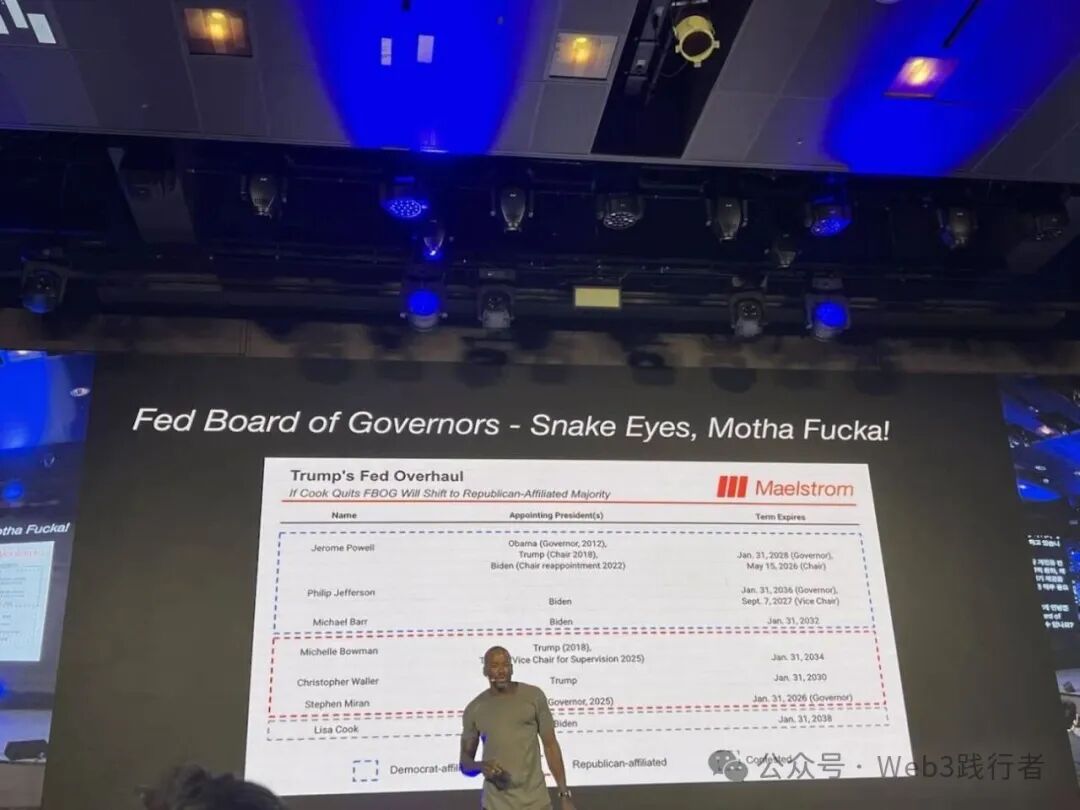
The FOMC has 12 members, of which 7 are board members, and 5 are rotating presidents from regional banks. Among them, the New York Federal Reserve Chairman holds a permanent seat due to his huge influence on the US financial ecosystem. So what is FOMC for? We know they're responsible for setting the federal funds rate, they meet monthly or almost every month, and they manage the Systematic Open Market Account (SOMA). They decide on the size of quantitative easing, how quickly to buy bonds, and what kind of bonds to buy, which are extremely important.
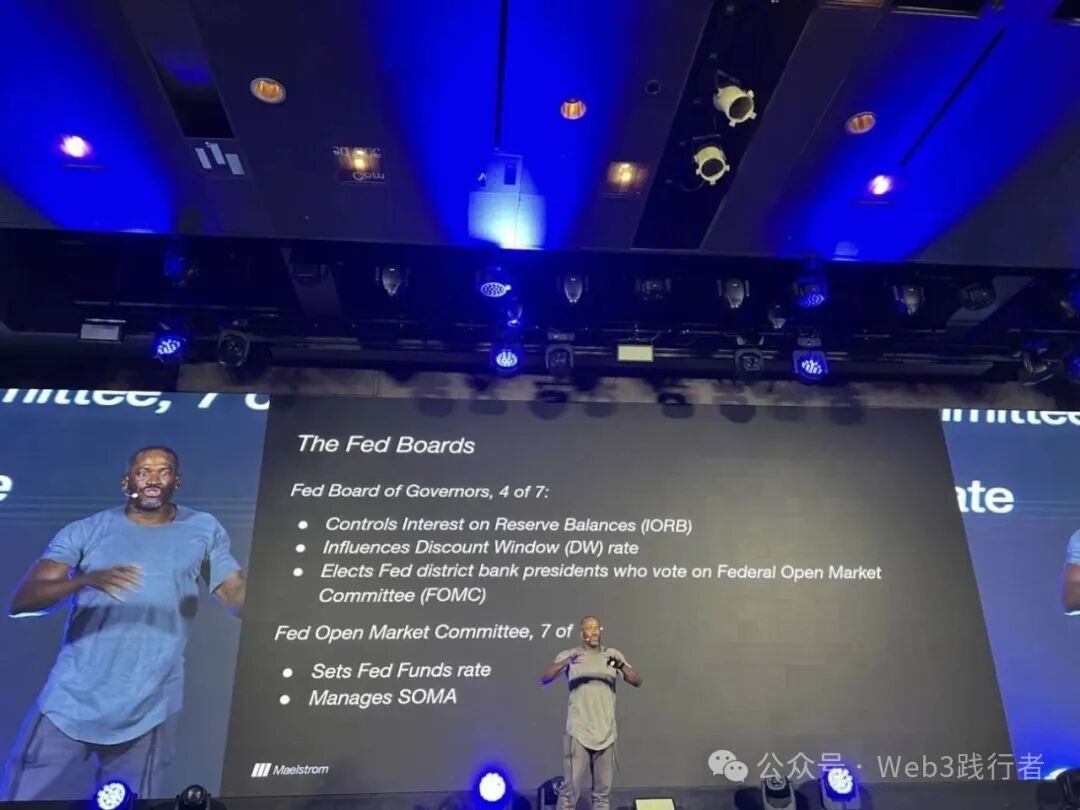
So how did Trump gain control of the Federal Reserve Board of Governors? You need to throw “Snake Eyes” and “Lao Qian” like rolling dice. Here's a really interesting chart. We're basically seeing a situation where Trump has two Senators Bowman (Bowman) and Waller (Waller), and we know they want to be members of the Federal Reserve. They are in opposition during the July meeting, they want to cut interest rates, and Jerome Powell and most people want to keep interest rates. They have publicly expressed their allegiance to Trump.
Cook is the one who recently left the Federal Reserve. She left her job abruptly in August. Rumor has it that her husband carried out unscrupulous insider trading during the Federal Reserve meeting, and she quit her job herself in order not to be forced to resign by an angry Trump. That's why Steven Moran was able to get in. Trump now has three out of seven votes. The fourth one is Lisa Cook (Lisa Cook). If you've been following the media, she's a member recently appointed by Biden. There are allegations that she was involved in mortgage fraud and that she misrepresented her primary home to get lower mortgage rates. Her case has been referred to the Ministry of Justice for possible criminal investigation. Currently, she is very stubborn and refuses to leave and resign. But I think that by the end of the year, she'll get the kind of political guarantees she wants, and then she'll quit. In this way, Trump has four votes and controls the council.
The first thing they want to do is speed up the decline in short-term interest rates. There is an interesting act of arbitrage that can force the FOMC — even if Trump doesn't have full control — to lower interest rates faster than expected. If the Board reduces interest rates on excess reserves and interest rates on discount windows, large amounts of money will pour into the federal funds market. This opens up an arbitrage opportunity for large commercial banks. What would they do? Commercial banks collateralize assets at a discount window, borrow funds at a price below the federal funds rate, and then lend at an interest rate of around 4%. This is a great arbitrage opportunity for storing funds. This kind of arbitrage is basically carried out by the Federal Reserve, which now has to print money and hand it over to the bank, which is completely ridiculous, and why it essentially forces the FOMC to lower interest rates.
I saw Steven Moran's recent interview, which I think was yesterday or this morning on Bloomberg. He said the Federal Reserve's monetary policy was too tight by 2%. It basically gave you the direction where they wanted to go. They want the federal funds rate to drop to around 2%, and they want it to happen yesterday. In fact, if Trump gets Lisa Cook out, he can execute this arbitrage before the end of the year and probably cut the federal funds rate below 2% soon.
How does controlling the Federal Reserve Board bring control of the FOMC?
As I said, all members of the Federal Reserve Board of Governors are permanent voting members of the FOMC. Meanwhile, the Board of Governors approved the Regional Federal Reserve Chairman as a rotating voting member of the FOMC. In addition to the New York Federal Reserve, I believe Philadelphia, Cleveland, and Minneapolis will be the other four voting Regional Federal Reserve Presidents in 2026. And all 12 regional Federal Reserve presidents will face “re-election” in February next year.
How did this happen? Each regional bank of the Federal Reserve (12 in total) has its own board of directors. This method of establishment dates back to the past, when every region in the mainland of the United States had different interest rate requirements in terms of agricultural product taxation. The board of directors of each regional Federal Reserve consists of three categories of members. Among them are six Class B and Class C board members, who jointly elect the bank's chairman. So, what kind of people are the board members of these regional Federal Reserve? Here's a list, and all of this information will be posted online later. You'll notice that the board chairman of these Federal Reserve banks is either a banker or an industrialist. What do bankers and industrialists always want? They want cheap money. They want lots of money. So how can these people oppose Trump's policy of lowering interest rates and increasing the amount of capital? This will increase their wealth. Since we are all self-interested, I think they are likely to vote for presidents who will follow Trump's wishes to adopt a more relaxed monetary policy. If they don't, the Trump-controlled council would basically suggest that if you don't vote for a dovish president, we won't approve him.
So now that Trump has seven votes, he will gain control of the FOMC sometime in the first half of 2026. So what can they do once they get a majority of votes in the FOMC? They can go back to quantitative easing. They can stop participating...
We are now in a period of quantitative easing because the Ministry of Finance has a large amount of debt to be issued. Now, the Ministry of Finance is afraid to issue long-term debt. They are afraid, just like during the Great Depression, of long-term debt. So what is being issued now is short-term debt, which is why clever action against excessive regulation is so important because they need a buyer with inflexible prices who can buy these treasury bonds or treasury notes at any time. But if they control the FOMC, and the FOMC agrees that yield curve control is necessary to achieve the Trump administration's political-industrial goals, they will invest trillions of dollars in debt. The Federal Reserve will buy most of these bonds because FOMC members have relaunched quantitative easing.
So with this control of the Board and the FOMC and progress on the timeline, Trump can basically create the yield curve I showed from 1942 to 1951.
Why should we as crypto investors care?
Of course I have a question. There are a lot of math questions about the money market in it. I know this is a bit like a map of the currency market; you can take a look at the situation in Japan. But guys, we're here for that. So how much can Bitcoin's price reach with the upcoming yield curve control implemented by the US? This figure, you know, is clearly ridiculous, $3.4 million. I'm standing in front of you today, do I believe we'll get $3.4 million in Bitcoin by 2028? I'd probably say no. But what I'm interested in is where it's going, and what potential scale it might reach. So I'm hoping we can reach 1 million, and others want to reach it, which is great, but I'm very skeptical about it.
This is not just an adaptive figure in terms of thinking, but based on the number of treasury bonds to be issued. What will happen when Trump and his team leave office at the end of 2028? I looked at my Bloomberg terminal and looked at how many treasury bonds would expire in order to lower interest rates for these people, and then I added the estimated $2 trillion federal deficit from now until 2028. This is roughly the US Congressional Budget Office's estimate of the fiscal deficit. This gives us a figure: $15.3 trillion in new treasury bonds must be issued over the next three years.
How much did the Federal Reserve buy during the COVID-19 pandemic? The Federal Reserve buys about 40% to 45% of the treasury bond issue. I think this ratio will be higher in this period because foreigners are less likely than before to buy US Treasury bonds, especially considering Trump's actions. He tends to increase debt for America's reindustrialization by devaluing the dollar, which would make others uneasy. So why am I doing this? I don't know, I wouldn't do that. So we effectively got $7.5 trillion in credit creation. That's how much our balance sheet will grow between now and 2028.
The second part is “fake” credit creation. How many loans will be issued to small and medium businesses across the US? That's a hard number to predict. So I said, OK, look what happened during the COVID-19 pandemic. This was the last time they successfully implemented this policy, basically the high point from February 2020 to the end of 2021. If you look at the Federal Reserve's weekly statistics on the balance sheet of the US banking system, this is a good measure of credit and loan growth. I estimate we've grown by $3 trillion over the past few years. So we have 3 years, multiplied by 3, and we get a total of about $15.2 trillion in credit creation.
OK, what does this mean for the rise in Bitcoin's price? Going back to the COVID-19 pandemic experience, I measured it with a very rough slope, the relationship between the percentage increase in the price of Bitcoin and the amount of credit per dollar created based on this framework. This slope is 0.19. You multiply this slope by $15.2 trillion in credit growth, then by Bitcoin's benchmark price of $11.5 million. That's how we came to the conclusion that Bitcoin's price will be around $3.4 million by 2028, and I'm almost 100% sure this won't happen. But I think this is a thinking framework for understanding the credit creation that flows from the Federal Reserve to the Treasury and then from the banking system to finance America's re-industrialization. We know what happened during the COVID-19 pandemic when this policy was only being pursued for a year. What if it lasts for three years? When the Federal Reserve and the Treasury work together to print money and, in their words, send the US economy into “Valhalla” (the mythical Hall of Valhalla), we'll see Bitcoin in excess of $1 million.
That's why I'm so confident that the four-year cycle doesn't apply in this particular cycle. We are in the midst of a “military religion” realignment. If they can take control of all monetary policy leadership and believe they are highly motivated, this is what will happen. Thank you all.
Twitter:https://twitter.com/BitpushNewsCN
Compare the TG exchange group:https://t.me/BitPushCommunity
Compare TG subscriptions:https://t.me/bitpush
