


Galaxy Digital In-depth Research Report: The Ultimate Truth About the Meme Coin Economy
Source:Galaxy Digital
Author: Will Owens
Compiled and organized by: bitPushNews
introduction
Meme coins have become a mainstay of the cryptocurrency market, but they often have negative stigma and ongoing controversy. Since most memes go to zero over time or are outright scams, skeptics think they are worthless. To be fair, most do.
Like all trading, the meme coin market is ultimately a zero-sum game: one trader's profit comes from another trader's loss.
But unlike assets with underlying cash flow or utility, memes have almost nothing but cultural value, which makes losses more common and often more serious. We outlined these developments in our 2024 Galaxy Research Report and believe that memes should not be completely denied. After a year, this field will only become more complex and important.
Although joke tokens have been around since the early days of cryptography (Dogecoin was launched in 2013, and the long-forgotten Coinye West launched the following year), the modern meme coin era began with DOGE's rise in 2017. Then came Shiba Inu coins, followed bySolanaBonk and Dogwifhat on the blockchain, and finally in early 2024Pump.fun. This launch platform gave birth to MOODENG,Pnut, TROLL, and millions of other memes.
Pump.fun changed everything. For the first time, the entry threshold for starting a meme coin was almost zero.
For just a few dollars and no coding skills, anyone can create a token that can be instantly traded, liquid, and deployed through a bound curve. This marks a structural shift in the meme coin. Token creation has surged, and launching platforms has become the new normal.
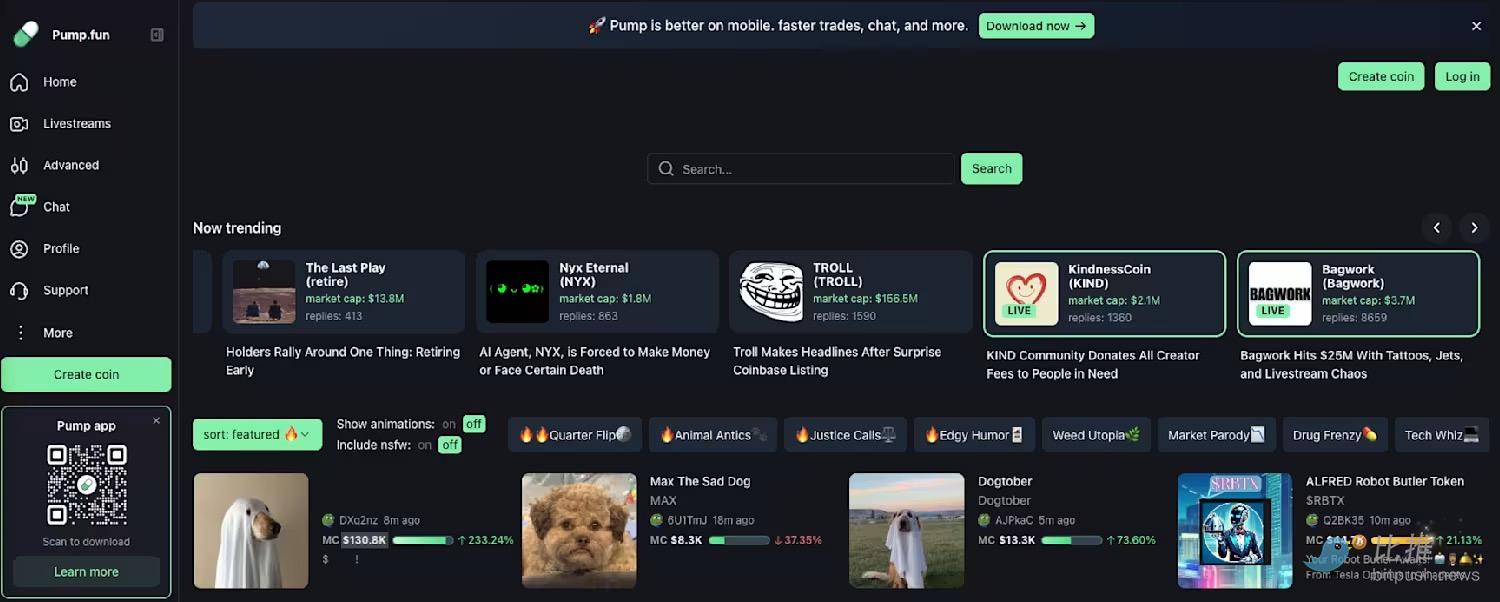
Pump.fun homepage, the epitome of “Degen”
Unlike altcoins that usually claim some form of “utility” (governance rights, fee revenue, access to services), memes have no utility by definition. Other than as cultural tokens, ideological carriers, and symbols of friendship and collective identity, they are actually useless.
Trading meme coins is less about fundamentals and more about what can be described as “cultural arbitrage”: predicting or preempting cycles, such as buying tokens associated with viral TikTok trends before the market is aware.
In the long run, the vast majority of market participants end up losing money when trading memes, and in many ways, this is pure gambling. But it is lazy to completely deny this field and ignore its importance.
The ecosystem faces challenges, particularly on Solana, which dominates the total transaction volume of meme coins.
Snipers and “bundlers” capture most of the supply at the initial moment of the coin's launch, causing future selling pressure. The median holding time for memes is calculated in seconds as traders mine new trading pairs to make quick profits.
However, memes are here to stay. In an increasingly digital world, the existence of pure cultural assets makes sense. Crucially, memes also act as an entry point into the crypto space: they pull new retail participants who wouldn't otherwise use these products into wallets and decentralized exchanges. For many, meme coins are their first step into crypto-native infrastructure, opening the door to deep participation in DeFi.
Key Takeaways
* Meme coins currently account for ~ 30% of Solana DEX trading volume, down from 60% in January
* Of the approximately 12.8 million Pump.fun tokens, only 12 tokens (0.00009%) account for > 55% of the platform's total fully diluted market value
* The total fully diluted market value of Pump.fun tokens exceeds $4.8 billion
* This is more than 85% of the total fully diluted market value of Solana's launch platform tokens. No other platform can compare to it.
* Since its launch, Pump.fun has captured a significant share of the Solana launch platform market. It has only been surpassed by another launch platform twice, and each time for a short time.
* The most recent competitor to temporarily surpass Pump was Bonk.fun this summer.
* The median holding time for tokens on Solana is around ~100 seconds, down from ~300 seconds previously.
* This utilitarian act highlights the increasingly scaled and PvP nature of transactions.
* There are now over 32 million tokens on Solana, up from less than 8 million before Pump.fun launched in January 2024.
* This is an increase of over 300% in less than two years.
* Meme coins are a powerful entry point into the crypto space, introducing new users to wallets and DEXs.
* The ecosystem shows a power-law distribution, with a few tokens capturing most of the value.
Market size and activity
Since the beginning of 2024, the meme coin market has expanded at an astonishing rate. On Solana alone, over 32 million different tokens have been created. This scale was unimaginable before Pump.fun launched. A simple user experience change — removing the technical expertise required to launch a token — fundamentally reshaped the ecosystem. Previously, starting a token required manual management of liquidity pools and significant capital investment. Today, anyone with an internet connection can instantly deploy tradable tokens at a fraction of the cost.
Solana's high throughput and low fees make it a natural hotbed for token creation, dwarfing other chains in terms of startup numbers. However, the BNB Smart Chain captured most of the Meme Coin spot trading volume, which was fueled by launch platforms such as four.meme. Recently, Aster DEX's explosive token generation event has catalyzed broader interest in the BSC ecosystem.
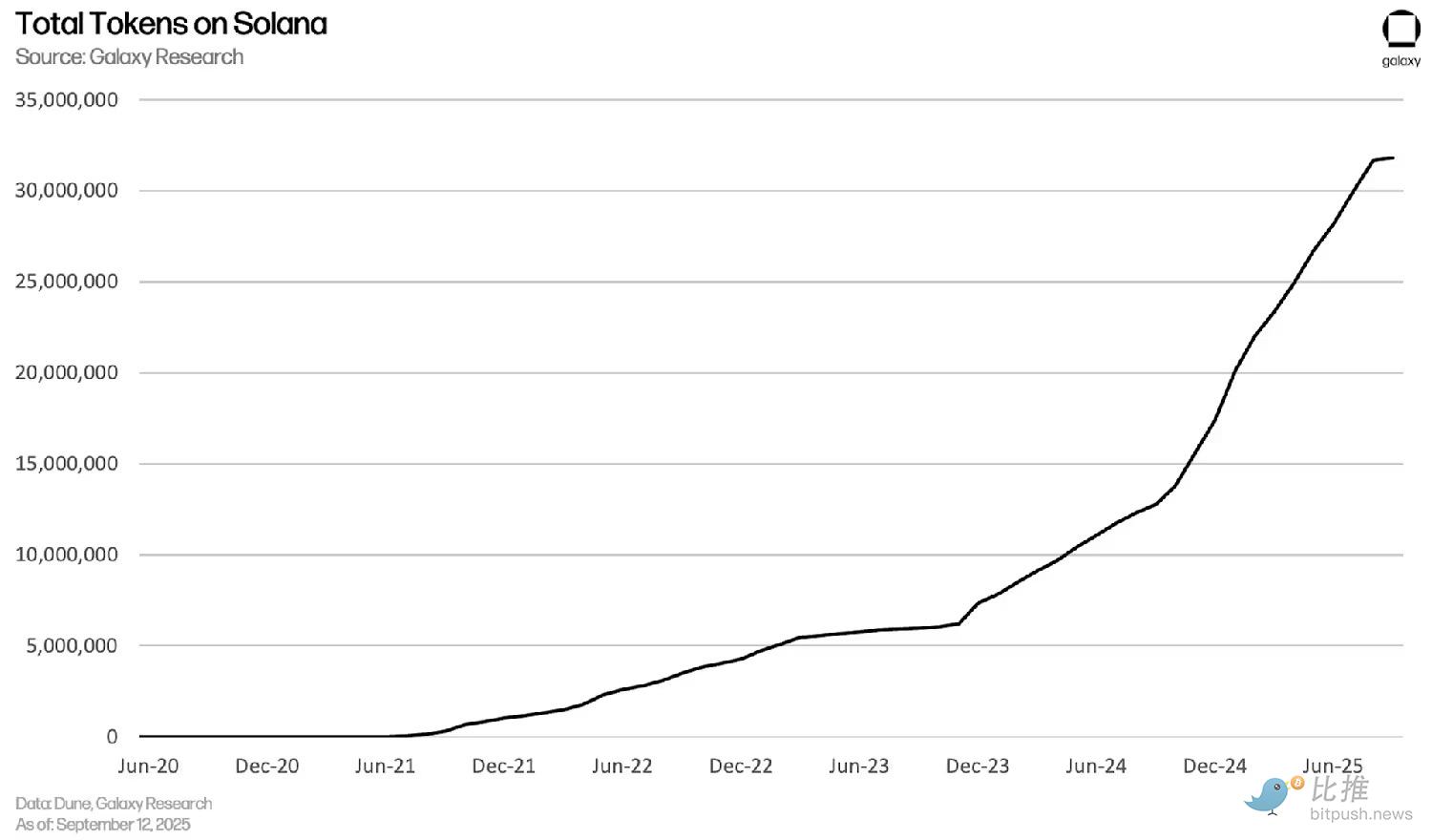
Total number of Solana tokens
Even if we expand our horizons to include Ethereum,Coinbase的BASEWith BSC, this trend is also consistent. Together, these chains have created over 57 million tokens, of which Solana dominates (56%). Ethereum is home to more traditional/cult memes such as PEPE, MOG, and SPX6900. Base continues to grow, particularlyZoraand other SocialFi-style memes. Simply put, Solana is the first choice for the hottest meme coins and cultural trends. Ethereum is home to more mature meme coins, while Base does a better job of capturing niche startup platform markets, particularly in the AI (Virtuals) and social (Zora) vertices.
Notably, the Base team recently announced that it is building a bridge from its Ethereum L2 to Solana, which will allow liquidity to flow between chains.
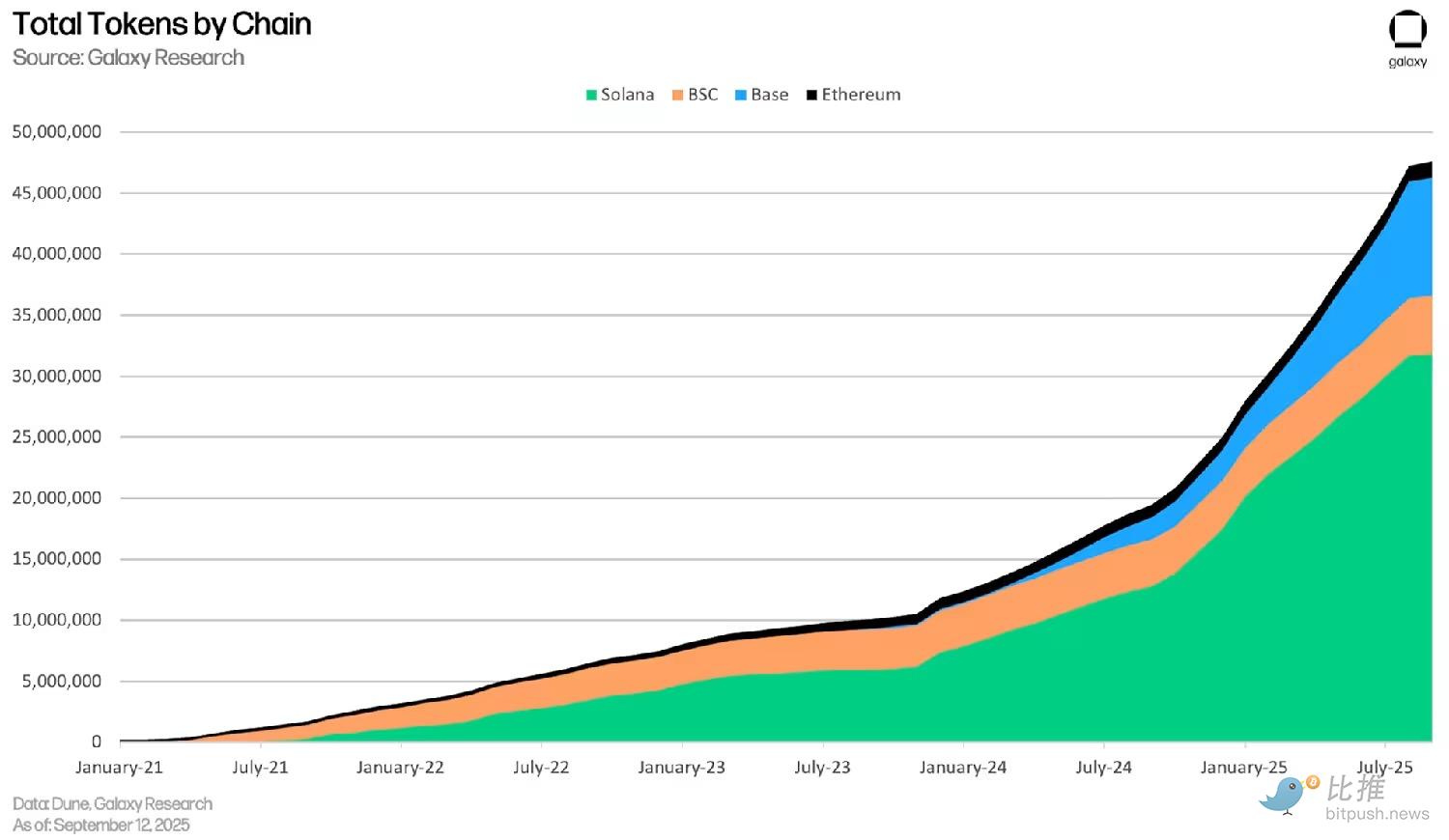
Total number of tokens per chain
Now let's analyze the different meme coin launch platforms. Pump.fun re-established its full dominance in the Solana token launch market after a brief loss to Bonk.fun's share in the summer. The startup platform space is fiercely competitive, and bright new players are constantly trying to differentiate themselves through incentive adjustments or brand building. However, these rivalries are often short-lived.
Sometimes, new players manage to grab attention for a short time by introducing niche innovations. Heaven DEX, for example, experimented with novel tokenomics and quickly attracted liquidity and users, but its market share evaporated just as quickly. This is the norm in the crypto space. Traders quickly rotated to the next “runner”, and everyone scrambled to be the fastest actor.
Despite Solana traders' attention spans as short as TikTok, Pump.fun's entrenched position has proven to be resilient. As it stands, the token launch platform appears to be a winner-take-all market.
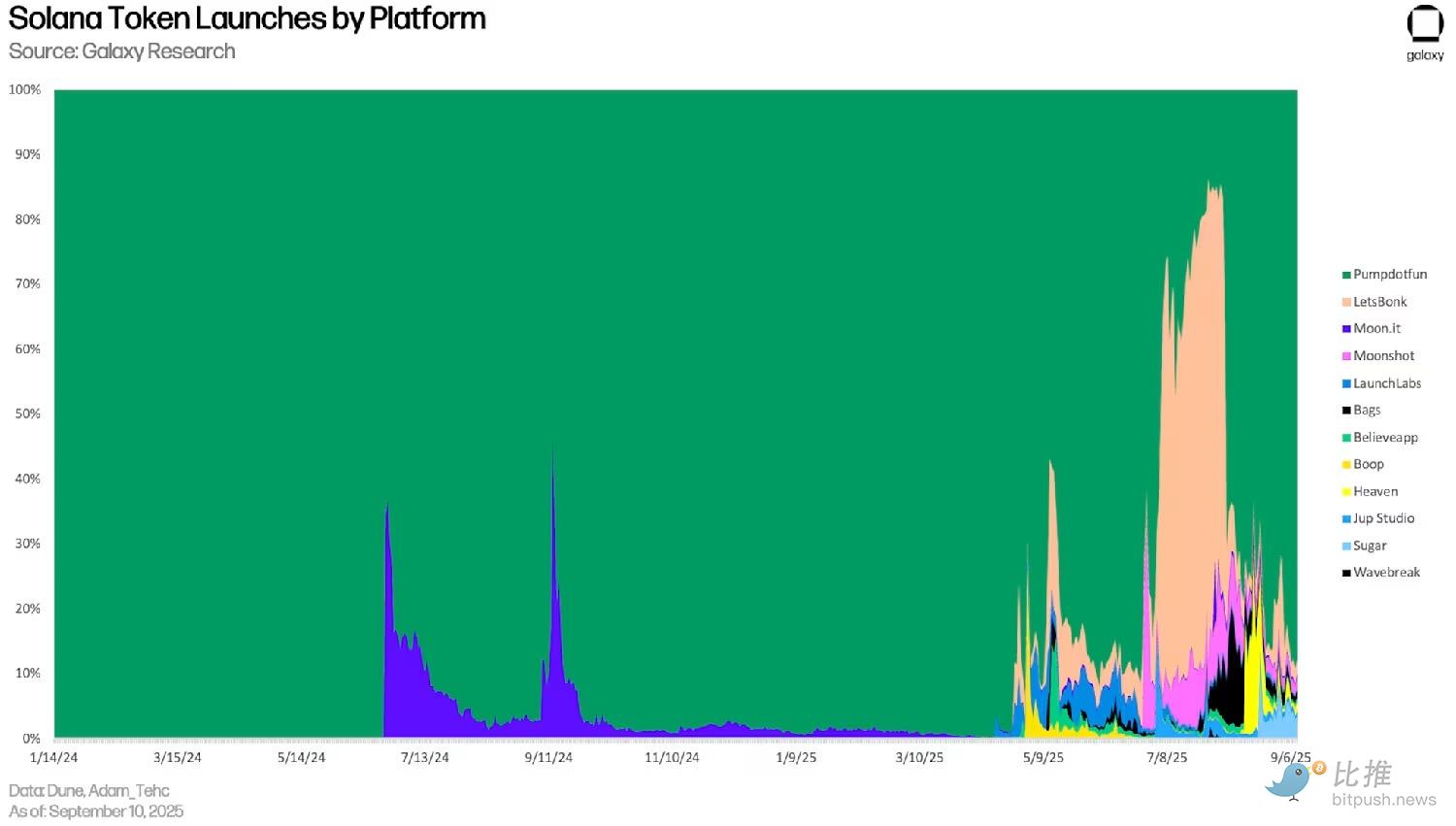 Solana token launches by platform
Out of a total of approximately 32 million Solana tokens, approximately 12.9 million are solely derived from Pump.fun. The platform simply industrialized the production of tokens on Solana. No other platform can compare, and its launch share is larger than all competing launch platforms combined.
Readers may also remember celebrity startup projects such as Kanye West's $YZY or Donald Trump's $Trump. The launch team didn't use a typical launch platform for these highly hyped tokens. Instead, they are directly partnering with Meteora, a Solana-based DeFi protocol that acts as a dynamic liquidity infrastructure. It allows them to manually configure liquidity pools and manage token distribution. This gave the team more control and reduced the risk of bots or snipers getting large amounts of tokens “cheaply” in the early days.
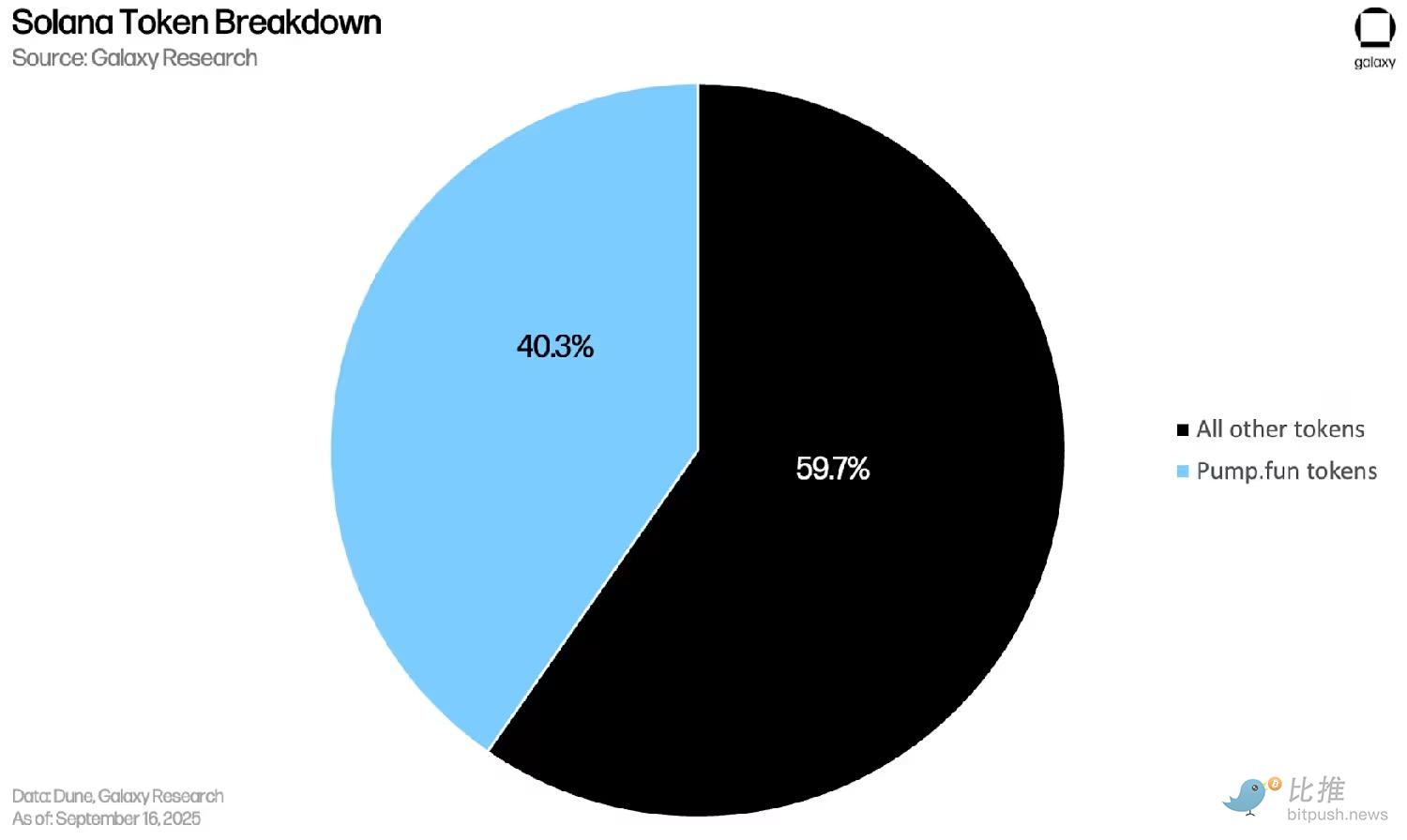
Solana token segmentation
The distribution of values is similar. The total fully diluted market value of Pump.fun tokens is now over $4.8 billion, several orders of magnitude higher than its closest competitor. In the image below, Pump.Fun's total FDMC is shown in black, while Bonk.Fun's FDMC is shown in blue. The former peaked in January at over $10 billion.
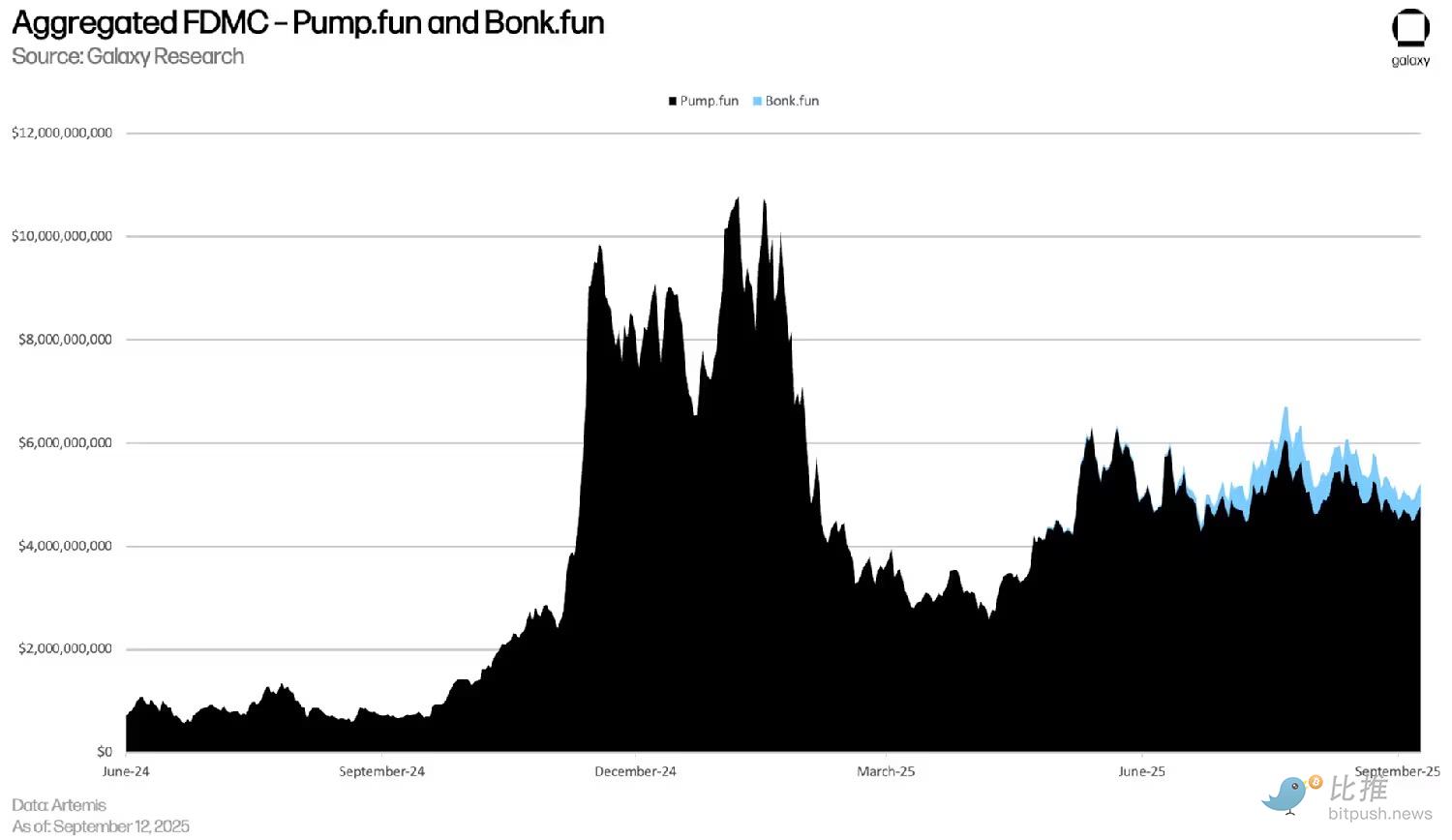
Total FDMC for Pump and Bonk.fun
The size of this market reveals two things. First, memes have reached a size that cannot be ignored: tens of millions of tokens and billions of dollars in value. Second, the field is characterized by centralization. Solana dominates other chains; Pump.fun dominates Solana; and in Pump.fun tokens, a very small percentage of tokens account for most of the value.
While the volume of Solana DEX transactions this cycle was impressive, it is also interesting to see the specific percentage of this coming from memes coins. According to Blockworks data, meme coin trading volume as a percentage of total DEX transactions has been declining over the past year, but there was a sharp peak when President Trump launched $TRUMP.
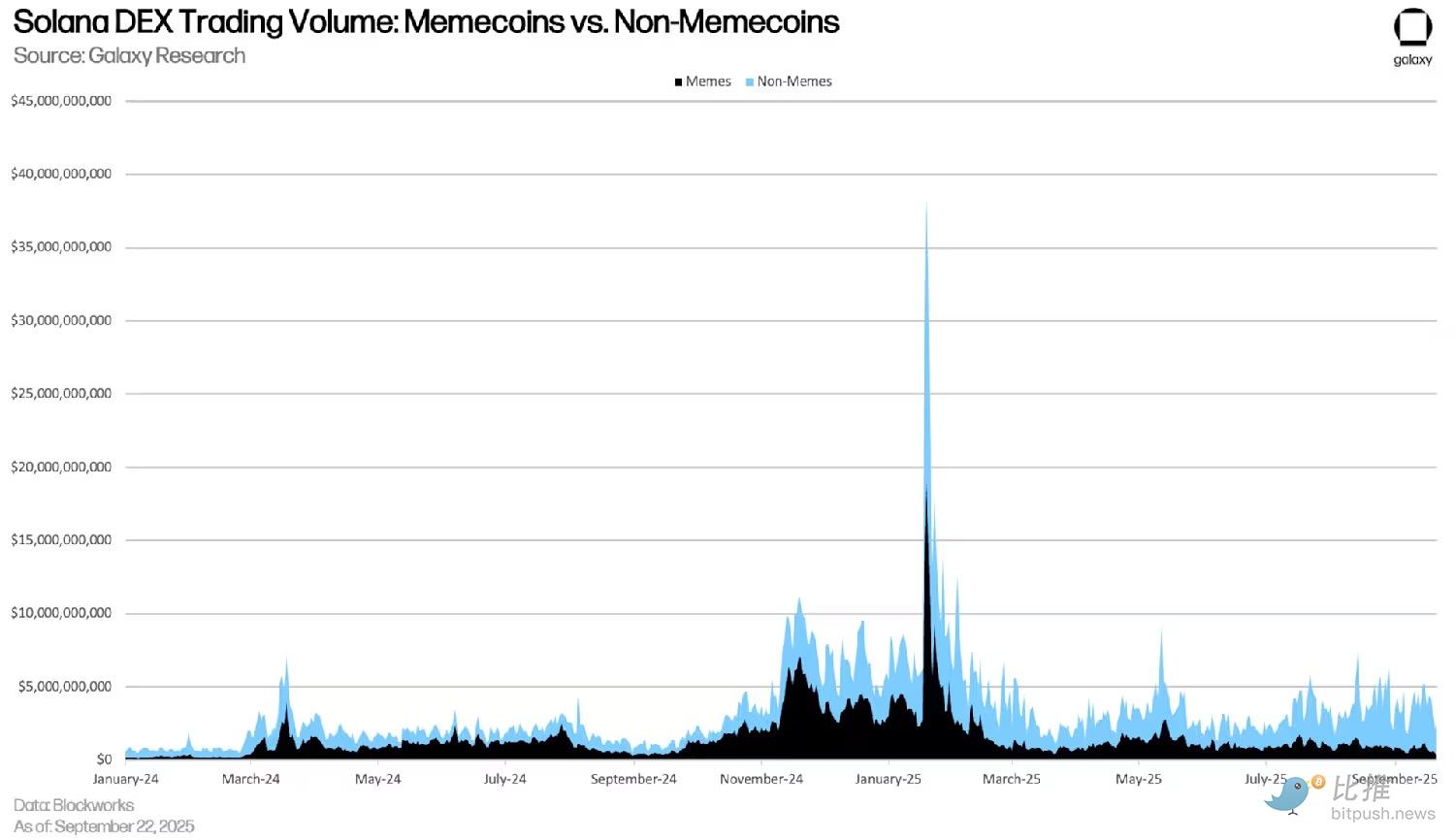
Solana DEX trading volume: meme coins vs others
Looking at the 100% stacked area chart below, memes generally accounted for > 50% of all Solana DEX transactions in the fourth quarter of 2024, but since then it has declined to only 20% to 30%. This means that SOL/USDC, stablecoin swaps, and other DEX swaps have begun to surpass meme coin activity. Although Pump.Fun makes starting meme coins easy for everyone, it has also accelerated the “maturity” of the meme coin market in a sense. Endless launches have led to fragmented liquidity and competition, making it harder for individual coins to enjoy parabolic price appreciation like the best-performing memes in late 2023 to early 2024. This, along with the advent of competitive on-chain trading applications, particularly Hyperliquid's perpetual futures products, has contributed to a reduction in total trading volume.
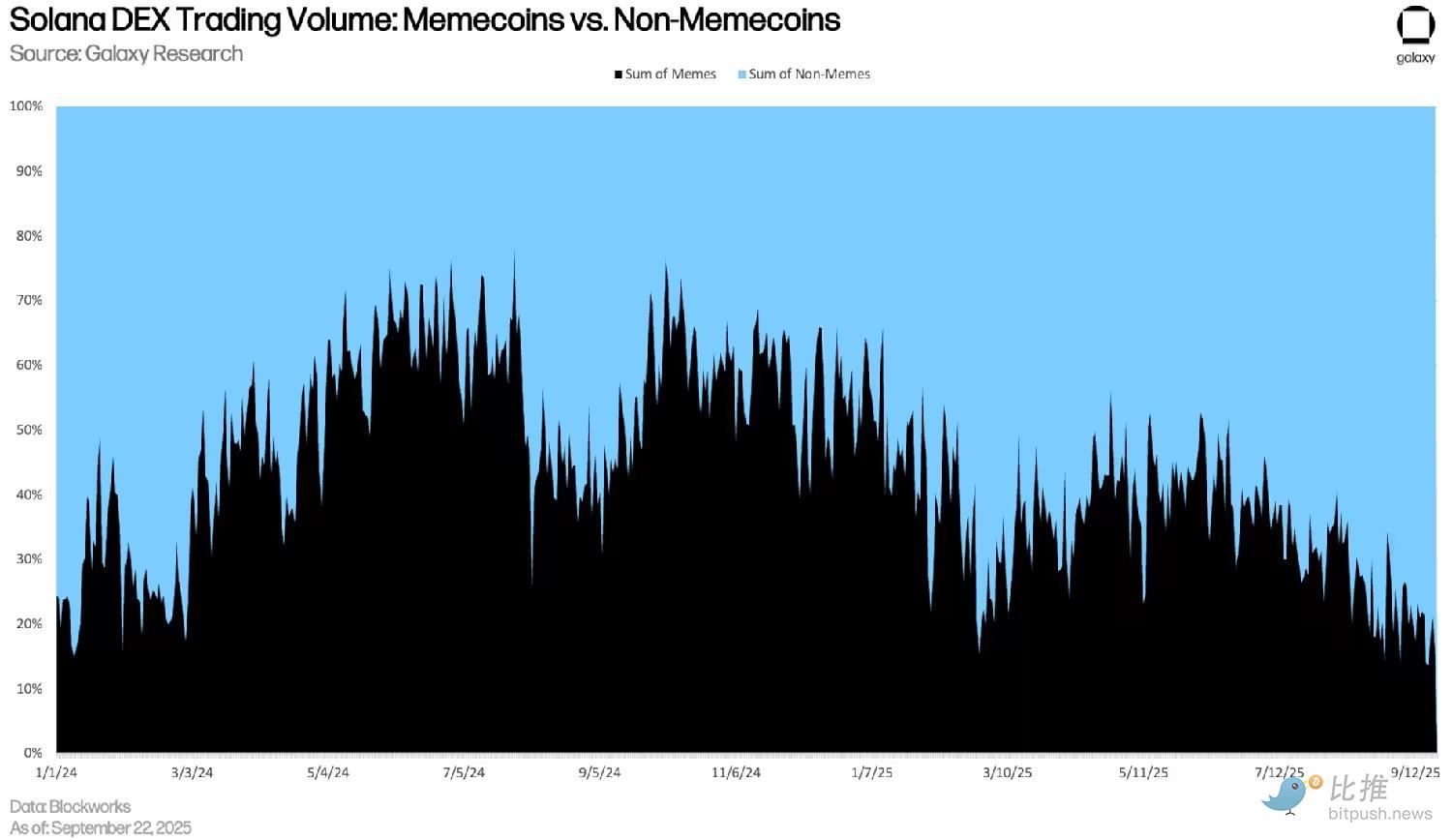
Solana DEX Volume: Memes vs Others (Stacked Chart)
On-chain dynamics
The size of the market shows us how big the meme coin system has become. Users' on-chain activity helps to understand how these assets behave. Most prominent are the short-term, scalar, and power-law-driven nature of trading behavior.
The first indicator is the holding period. The median holding time for Solana memes (for wallets bought and fully sold within seven days) has crashed to around 100 seconds, down from nearly 300 seconds a year ago. This means that regular participants won't “hold” tokens for hours, let alone days. Instead, they're rapidly rotating their profits by a few percentage points to compete against other traders; this is essentially a PvP trading game.
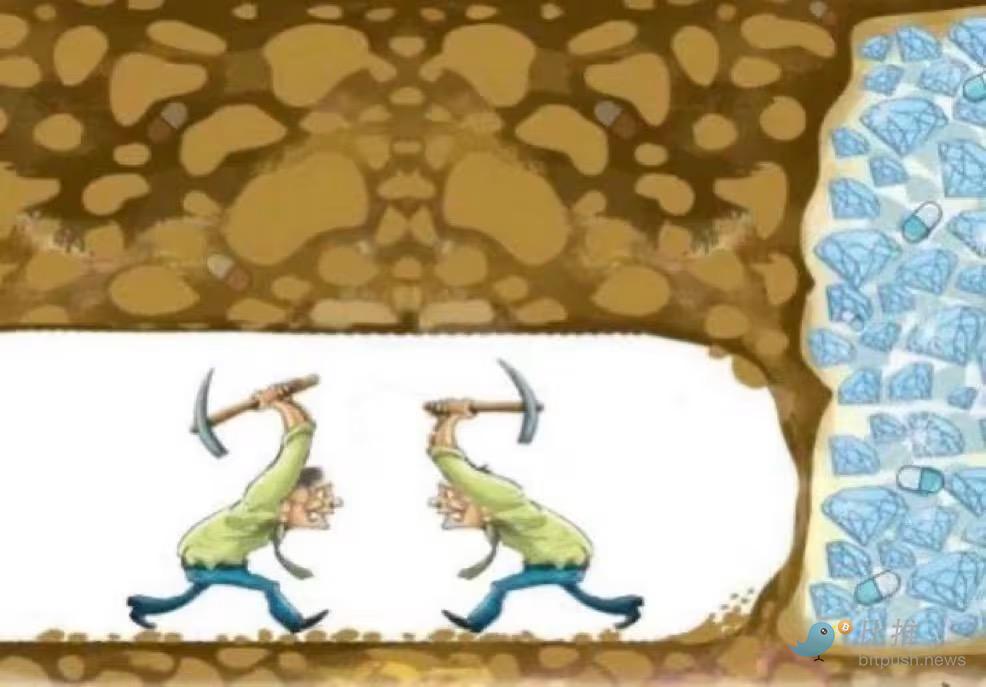
Solana “trench”
The underlying infrastructure reinforces this pattern of behavior. Axiom is a platform that provides a feature called instant trading, which allows traders to instantly place orders with the click of a button. It's easy to get a deal on the K line in a second, which has led to an ultra-scaled environment. Especially when you consider human nature — most market participants are more likely to panic sell at the bottom rather than end profitably after a pull-up — the game's expectations are deeply negative for almost everyone (with the exception of token deployers, insiders, and “KOLs” — more on that later).
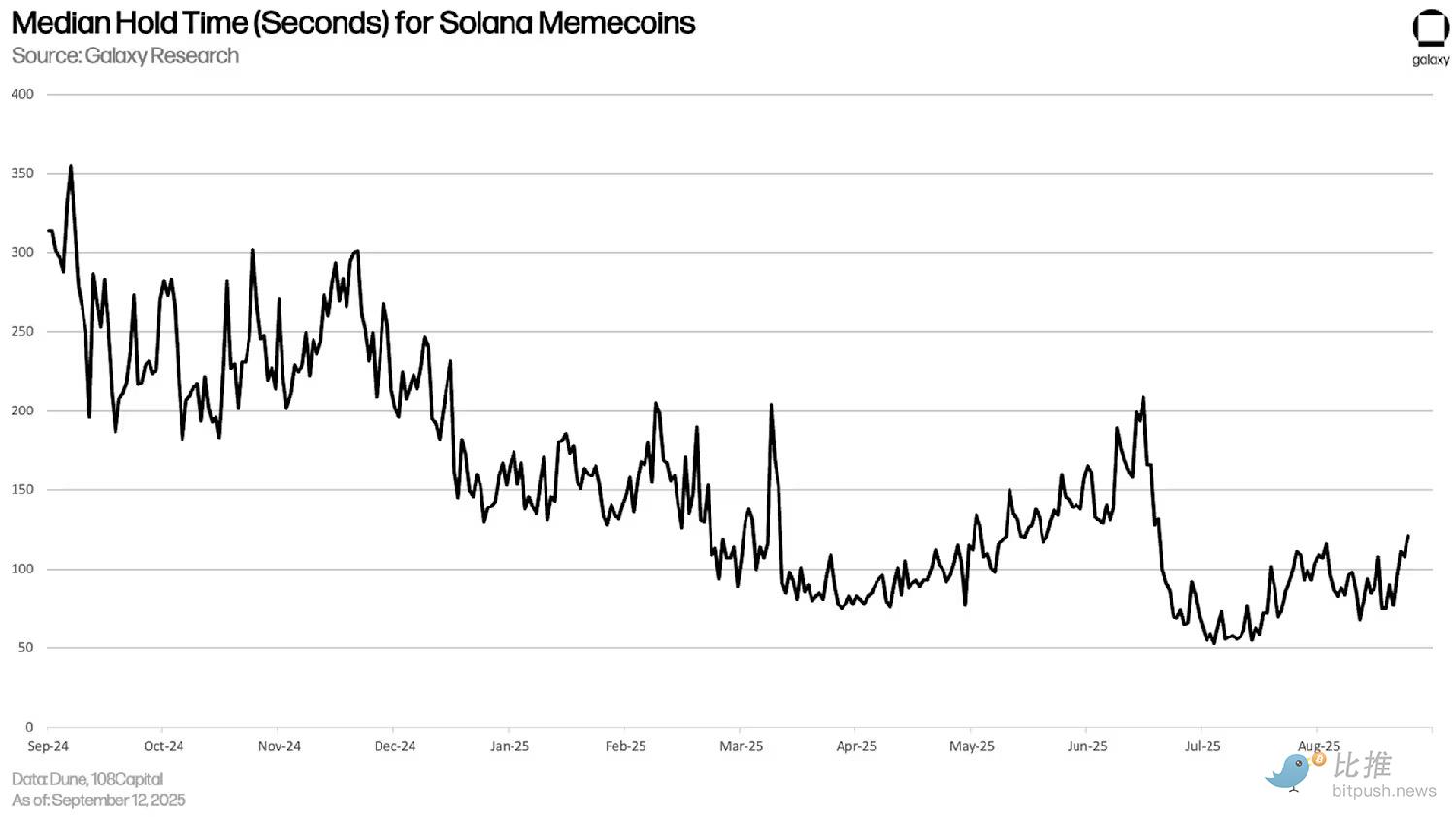
Solana meme median holding time (seconds)
The next chart is a snapshot of the holding time over the past year, broken down by number of daily transactions. Addresses with fewer than one transaction per day show a holding time of more than 200 seconds. As the number of transactions increased, the median holding time shrank sharply to the 80-120 second range. The holding time is only slightly extended for the most active wallets (>50 transactions).
Overall, addresses at all levels only hold tokens for a few seconds.
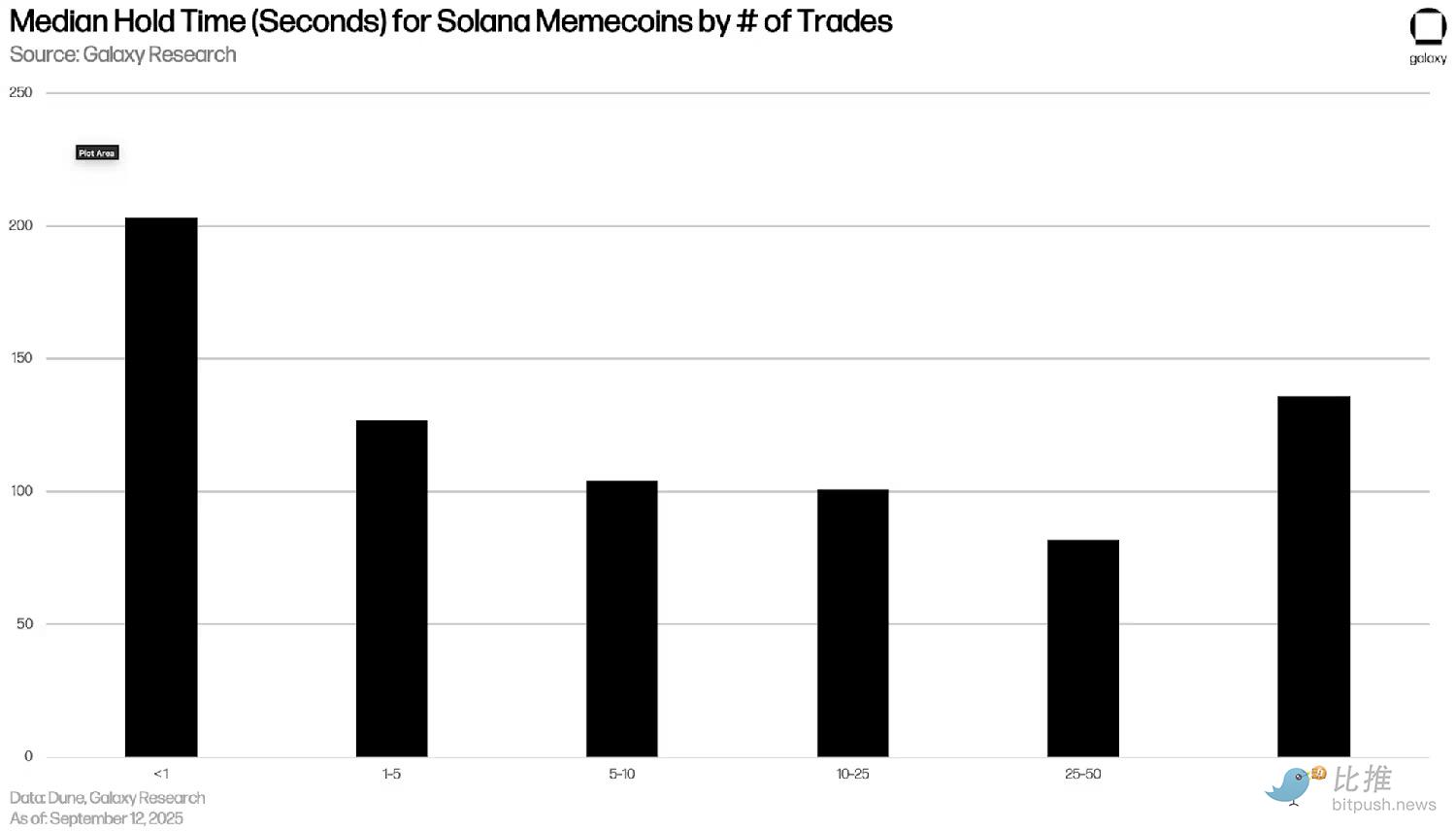
median holding time by number of transactions
The power-law distribution of Pump.fun token values is shocking. Of the nearly 12.9 million tokens launched on the platform, only 12 account for more than half of all fully diluted market capitalization. The dozen or so tokens represented $2.69 billion, or 56% of the total FDMC of $4.8 billion, while the other 44% was shared by the remaining millions of tokens.
In other words, 0.00009% of Pump.fun tokens control most of the value.
The ecosystem is structured almost like a lottery. Nearly every newly launched project is doomed to collapse within a few hours, and very few manage to grab enough attention to break through the encirclement. For the vast majority of traders, memes are structurally a game of negative expectations, yet the presence of these outliers continues to fuel speculation and “gambling in a casino.”
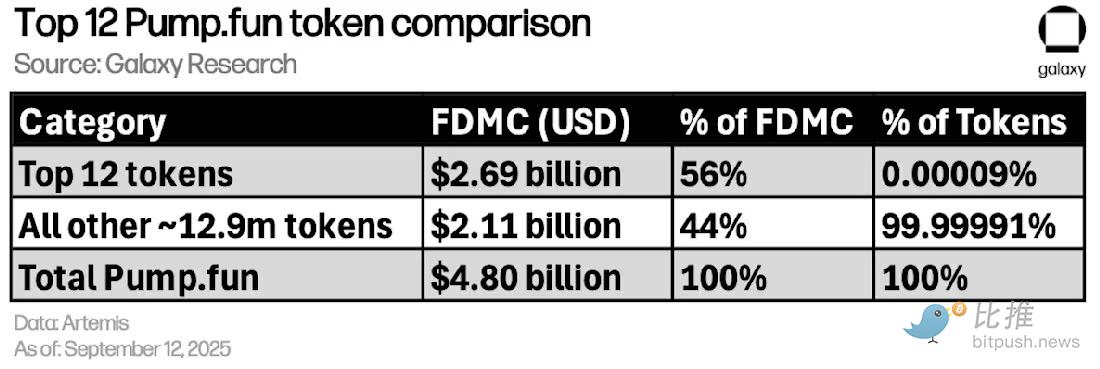
Top 12 Pump Tokens vs Remaining Tokens
While most meme traders are losing money, infrastructure owners have captured significant value. The chart below compares the revenue of Pump.fun (launch platform), Axiom (trading platform), and Hyperliquid (a perpetual futures exchange, not a meme coin, but included for comparison). Notably, Axiom is run by a very small team (less than ten people) and has expanded to millions of dollars per month by charging fees to meme traders.
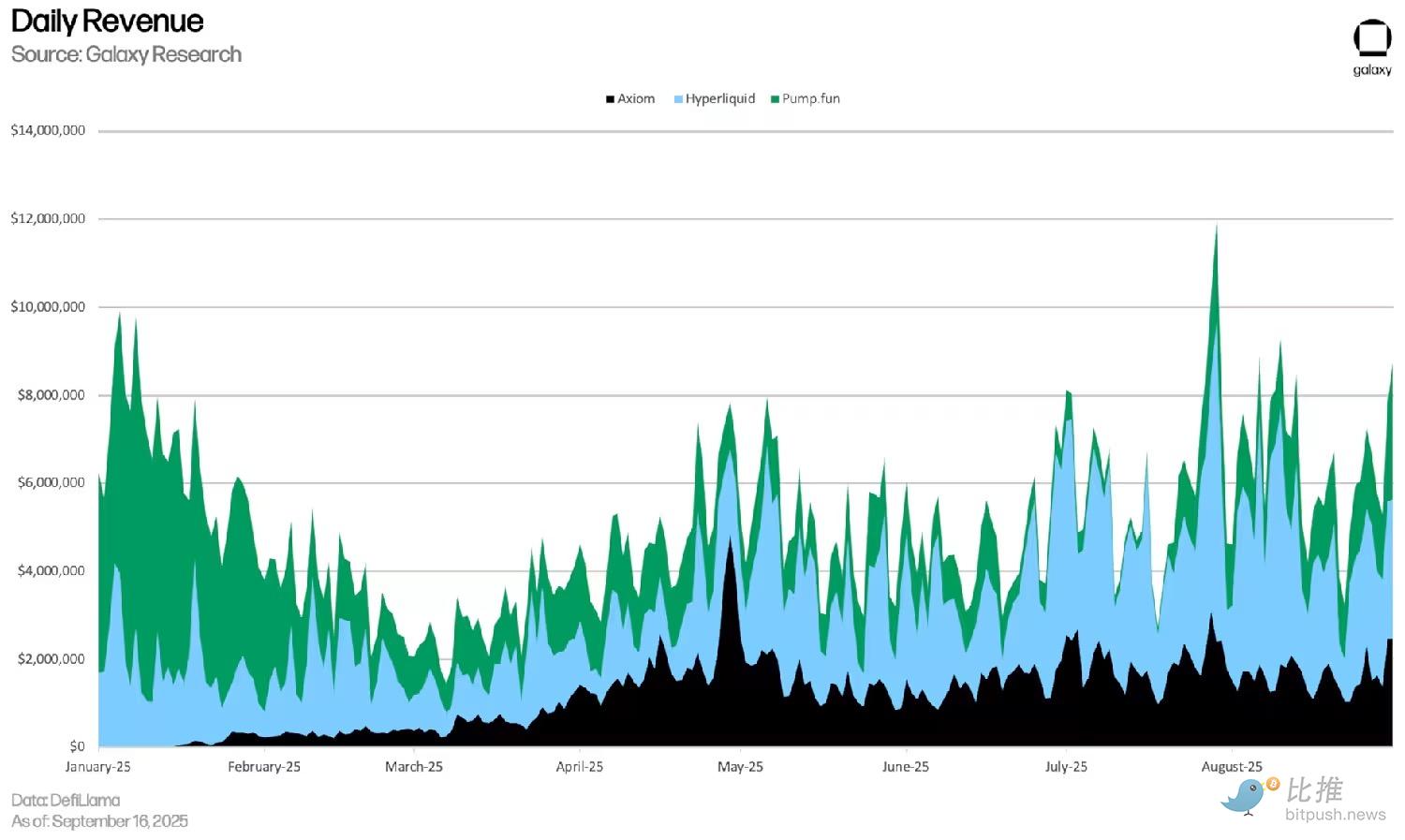
Daily income
Value does not accumulate in the token itself, but rather in the platforms and tools that support its creation and trading.
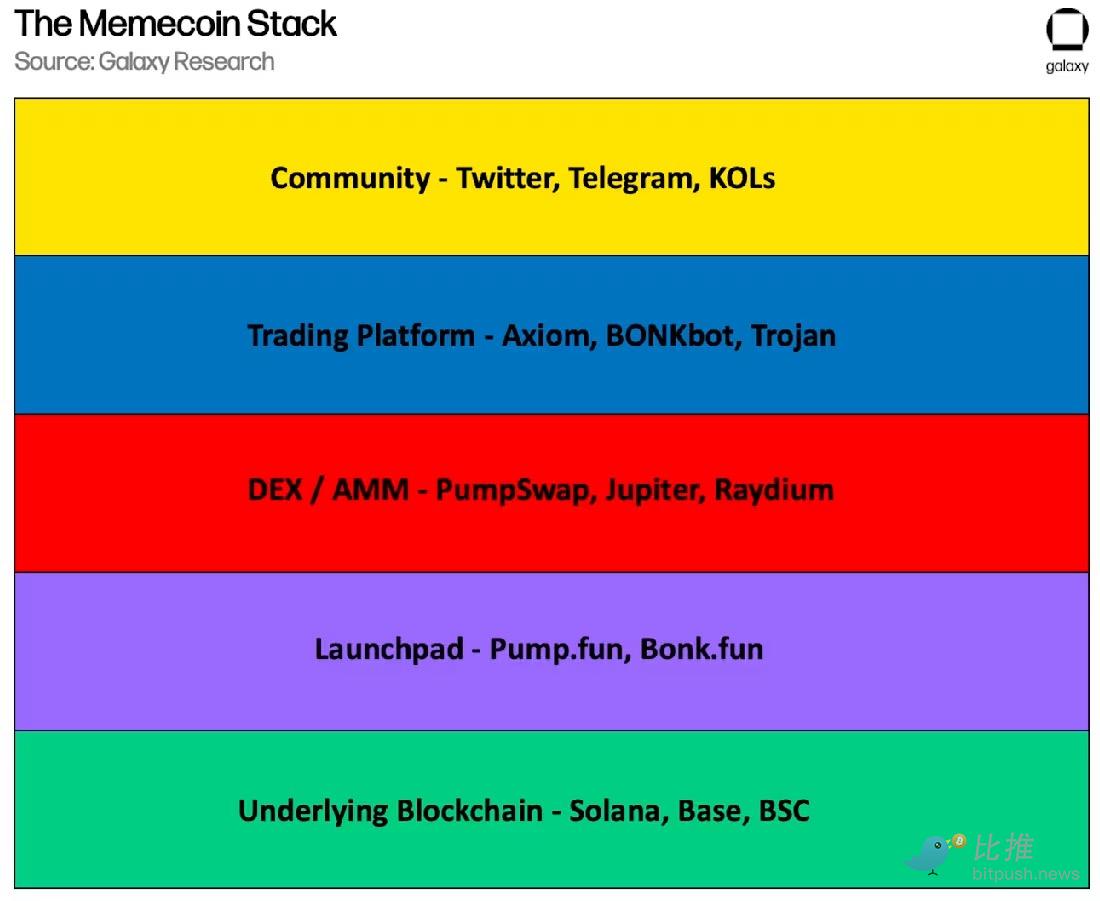
meme coin stack
The meme coin ecosystem is best understood as a hierarchical “stack”. Each floor is built on top of the next.
The underlying blockchain
Most meme coin activity is concentrated on Solana, where low fees, high throughput, and a culture suited to hyperspeculative gambling make it the dominant chain for PvP transactions.
Base and BSC also host important activities, while Ethereum hosts larger tokens and a less competitive culture.
Launch the platform
Pump.fun lowers entry barriers and allows anyone to easily create tradable tokens. Its binding curve model guarantees fluidity at startup.
Competitors such as Bonk.fun, Believe, and HeavenDEX have emerged, but none have maintained significant market share. The data shows that the launch platform is a market where winners take most of it.
DEX Aggregator/AMM
Once launched, tokens are traded on automated market makers. Pump.fun operates its own in-house AMM PumpSwap to preserve liquidity, while broader price discovery is carried out through Jupiter, Raydium, Orca, etc.
This layer ensures that tokens can be instantly traded by anyone, anywhere, anytime.
Trading robots and automation
The speed of execution dominates meme coin transactions. Bots such as Axiom, BonkBot, and Trojan help users snipe newly launched tokens (buy them as soon as they become tradable) and trade them instantly.
This infrastructure has led to a reduction in median holding time and transformed the market into a hyper-PvP environment where it is almost impossible for new traders to meaningfully profit.
neighborhoods
X (formerly Twitter) community and Telegram groups amplify memes and coordinate call for orders. The community is motivated to push up the price of its tokens, and collective beliefs have taken the place of fundamentals.
This layer distinguishes between PvP “lottery” tokens and PvE-style memes (SPX6900, MOG, TROLL, FARTCOIN, etc.) that can evolve into an enduring cult or cultural movement.
KOLs are an important part of this layer...
Because KOLs (key opinion leaders) play an excessive role in amplifying or stifling memes, I've compiled a non-exhaustive list of the most influential and active accounts driving the story on Twitter:
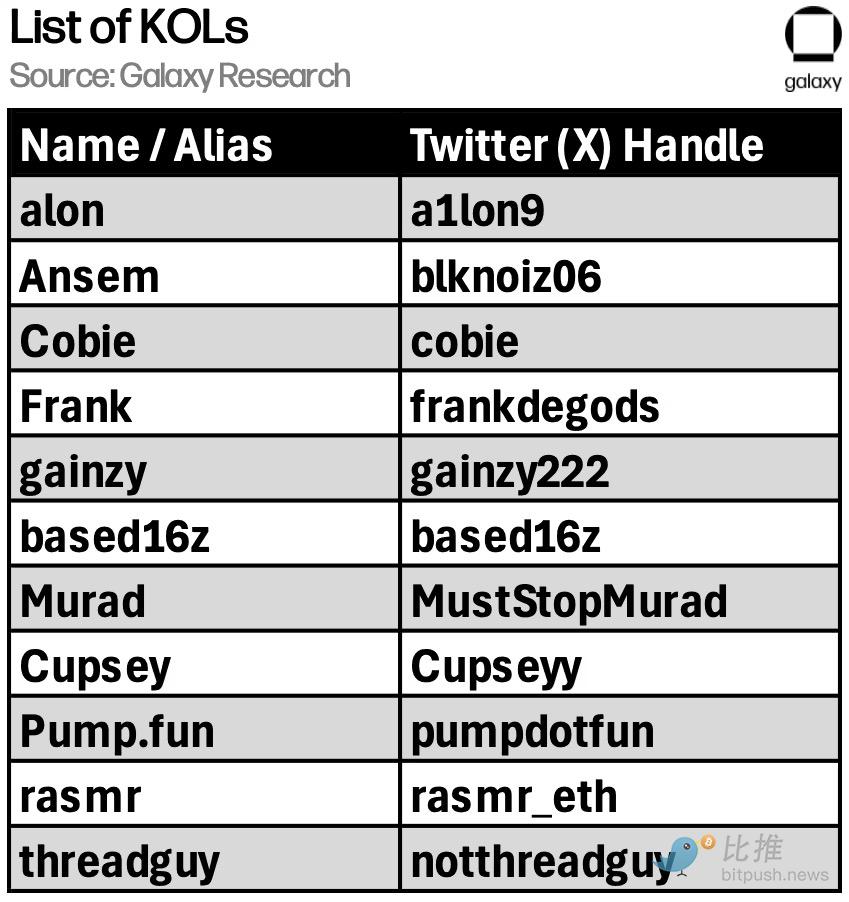
Note: CT stands for Crypto Twitter KOL List (Lite)
'Creator Capital Market'
One of Meme Coin's recent meta-narratives/narratives is the rise of the so-called creator capital market. Pump.fun's latest initiative, Project Ascend, was launched in September and sees tokens as a direct monetization channel for content creators. The system will replace the fixed creator fees usually paid to token developers with a dynamic sliding scale model, which is tied to the token's market capitalization. Small cap tokens pay creators a higher percentage of transaction fees, providing additional resources for new projects to grow, while larger capitalization assets pay less. For example, a token under $300,000 would pay creators significantly more than a $20 million token.
At the same time, a new phenomenon of Pump.fun anchors has emerged. These content creators directly linked the token launch to their live stream on the platform to create an interactive experience around the transaction. This brings three clear benefits:
Early livestream participants will be rewarded. Viewers who first enter the promising live streaming token can see an increase as soon as the anchor gets attention.
Built-in viral transmission incentives. Holders are directly motivated to share the live stream and bring new attention, as price performance is linked to wider awareness. Sometimes they take extreme measures.
The creator economy is changing. Streamers may earn much more from token transaction fees than from traditional platforms such as Twitch or Kick, making tokenized live streaming a powerful alternative to monetizing traditional ads or subscriptions.
Whether this pattern lasts remains to be seen. Linking live streaming to token speculation can quickly go wrong because traders only care about tokens and not live streams. But in the short term, the consistency of incentives between creators and traders makes Pump.fun seem like a native financial platform for the attention economy.
risks
Memecoins carry a unique set of risks that set them apart from other assets in the crypto space. Ultimately, these risks reinforce why most market participants tend to stay away from memes.
Many tokens launched outside of standardized launch platforms face basic smart contract risks. The most common is the Honeypot Trap: a type of token that can be bought but not sold. On the price chart, Honeypot showed a series of stepped upward green K lines, giving ordinary traders the illusion of explosive gains until they realized they couldn't exit their positions. Once the developers have extracted enough value, the price will crash.
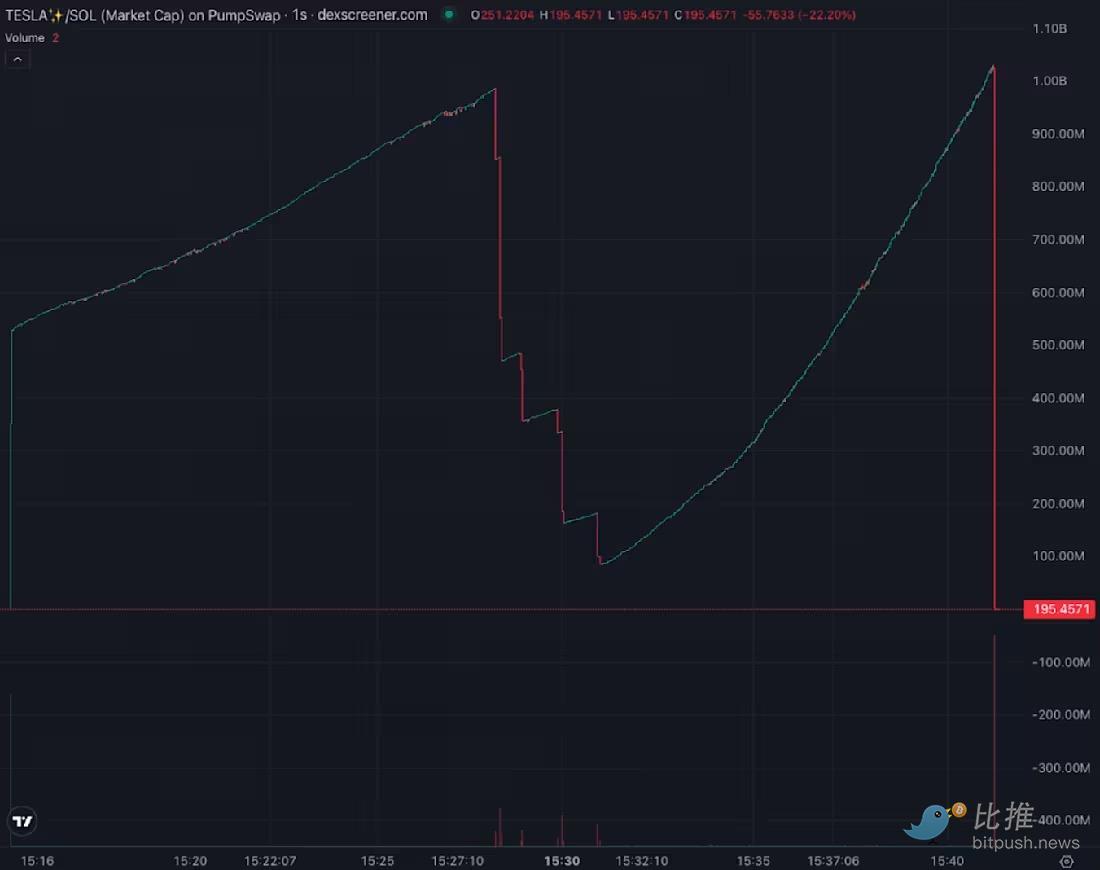
Honeypot scam chart example. New buyers can push up the price but can't sell.
Another ongoing danger is the Rug Pull scam. Even coins that appear to be in good standing usually collapse after the initial hype has subsided. Developers and insiders usually hold most of the supply (usually on hidden “side wallets”) and can sell to retail liquidity. Similarly, for tokens with manually controlled liquidity pools, providers may suddenly withdraw liquidity. This means that even a small sell can destroy the chart. Traders sometimes find out too late, when the trading pair's liquidity is taken away, showing only a few dollars or less of actual liquidity.
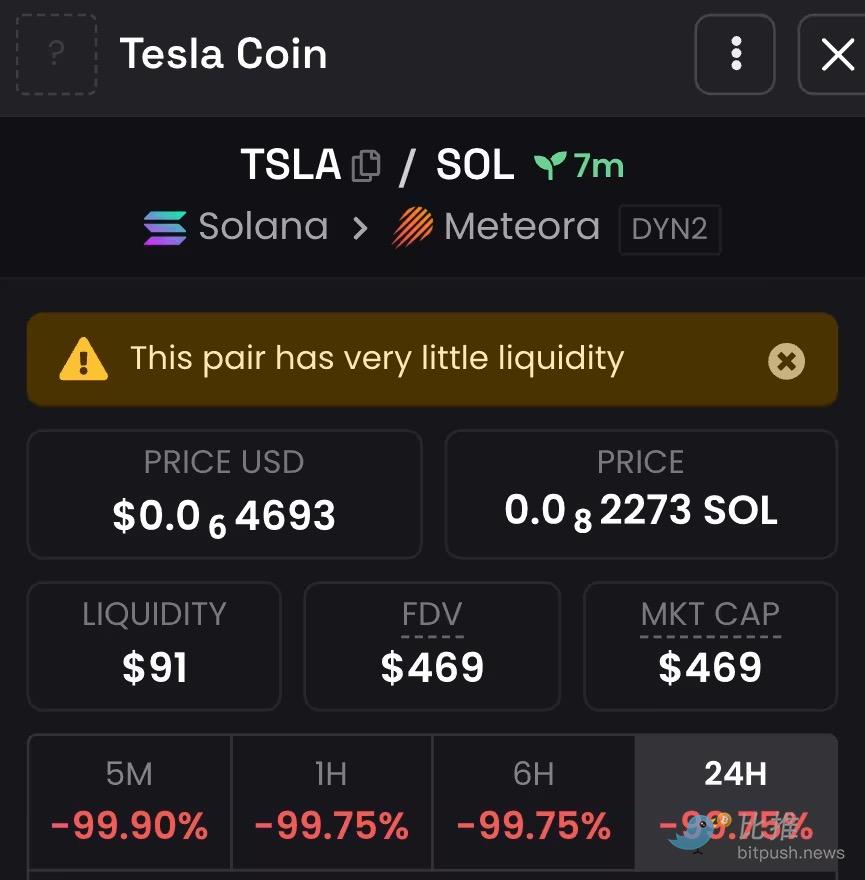
What the trading pair looked like on Dexscreener when liquidity was taken away. It's actually not tradable. Note: This token has nothing to do with Tesla.
Meme coins are also susceptible to “vampire attacks.” This means that a counterfeit token surpasses the original token by capturing more attention, usually with the help of small internal groups or paid KOLs. For example, a token like “67" may have successfully launched on Bonk.fun, but was later surpassed by nearly the same version with stronger support on Pump.fun. Even if a good trader enters the market early and correctly predicts the trend, they may have bought the wrong “version” of the token.
Finally, regulatory risks loom. Although US regulators have mostly ignored memes recently (other than stating that they are not securities), their fine line between “harmless gambling” and “retail exploitation” makes them easy political targets. The crackdown could drastically reduce trading volume. A great example is the $LIBRA token, which was promoted by Argentinian President Javier Millay on social media, but it crashed soon after launch. Traders lost millions, while insiders including Hayden Davis netted millions. Cases like these fuel similar narratives.
outlooks
Meme coins aren't just a fleeting fad. They are a long-lasting fixture in the crypto attention economy. Their significance lies more in the cultural x financial infrastructure they have created.
As an influencer named Murad points out, the ecosystem resembles a pyramid of attention and persistence. The pedestal is millions of one-time tokens. These are PvP gambling chips whose lifespan is measured in minutes or hours, and are dominated by bots and scalpers. In the middle are dozens of “cult” tokens, such as TROLL and MOODENG, which maintain sticky communities and can survive for months or years. At the top are the few tokens that have surpassed transactions into cultural movements or “almost religious” tokens. These tokens have achieved multi-cycle durability, including DOGE, PEPE, SPX6900, and possibly MOG.
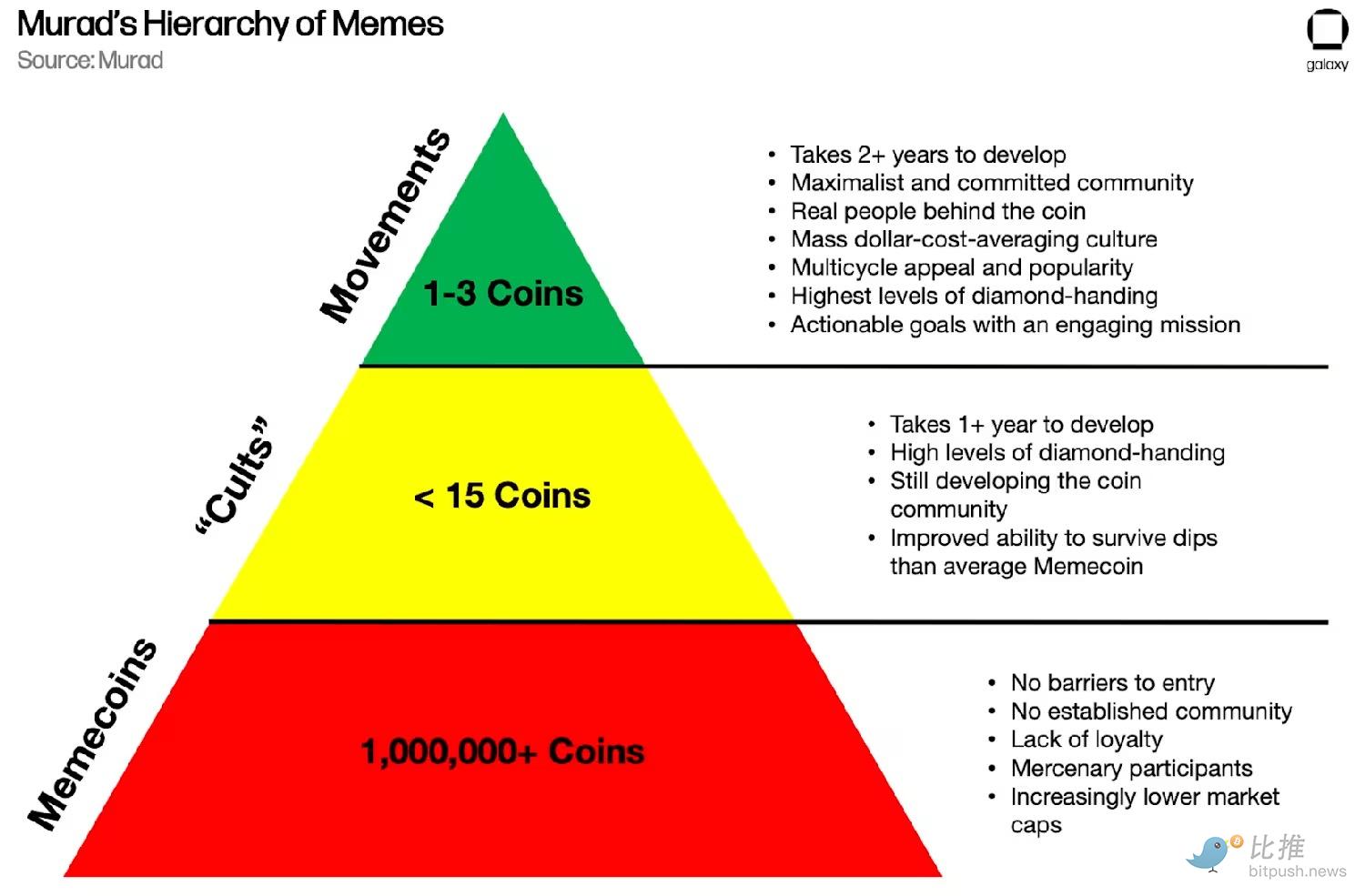
Murad's hierarchical structure of memes
Each cycle brings about some cross-border listings, attracting mainstream capital inflows and legalizing the sector. These events reset the meme stack: imitators poured in, fees soared, and new power law winners emerged. Celebrity and political tokens (YZY and TRUMP) will remain cyclical, have high variance, and huge media dissemination effects.
Daily meme trading remains a negative expectation for most participants. The advantage lies in the distribution owners. Having a casino is better than being addicted to gambling in it. For example, Axiom's cumulative revenue has surpassed $200 million and a team of less than 10 people. For institutions, the clearer risk exposure is infrastructure and a few cult assets with multi-cycle persistence, rather than the long tail of a newly launched token.
But memes also play a broader role in the evolution of the digital asset market. The first interaction of many users with blockchain is buying memes on DEX. From there, they gradually evolved to bridging assets, exchanging stablecoins, and even experimenting with lending agreements. Meme coins reduce the “psychological friction” of cryptography by making speculation feel social and friendly.
Furthermore, meme coins are a stress test for blockchain infrastructure. There are few use cases that test blockchain as drastically as the meme coin craze. For example, during the launch of the $TRUMP token, the trading platform Jupiter recorded more than 42 million failed transactions over a weekend.
The bottom line is that the meme coin sector is an infrastructure-supported flywheel for user acquisition and cultural speculation. More noise, faster rotation, and a small group of platforms are expected to steadily emerge and achieve compound interest growth.
Twitter:https://twitter.com/BitpushNewsCN
Compare the TG exchange group:https://t.me/BitPushCommunity
Compare TG subscriptions:https://t.me/bitpush
