


China's Liquidity Drives Crypto Market, Asian Capital Reshapes Bull Market

Author: Marvellous
Compiled by AidiiaOJP, Foresight News
Original title: China's Liquidity Wave and the Crypto Market
This article re-examines GCR's forecast for 2023 in the light of the 2025 bull market and future prospects.
In early 2023, anonymous investor GCR made a bold prediction: “The next cryptocurrency bull market will be dominated by Asia.” Two years later, market data supported this argument. The surge in Asian liquidity, driven by China's indirect capital flows, nationally linked easing cycles, and a revival of domestic risk appetite, has redefined the cryptocurrency market.
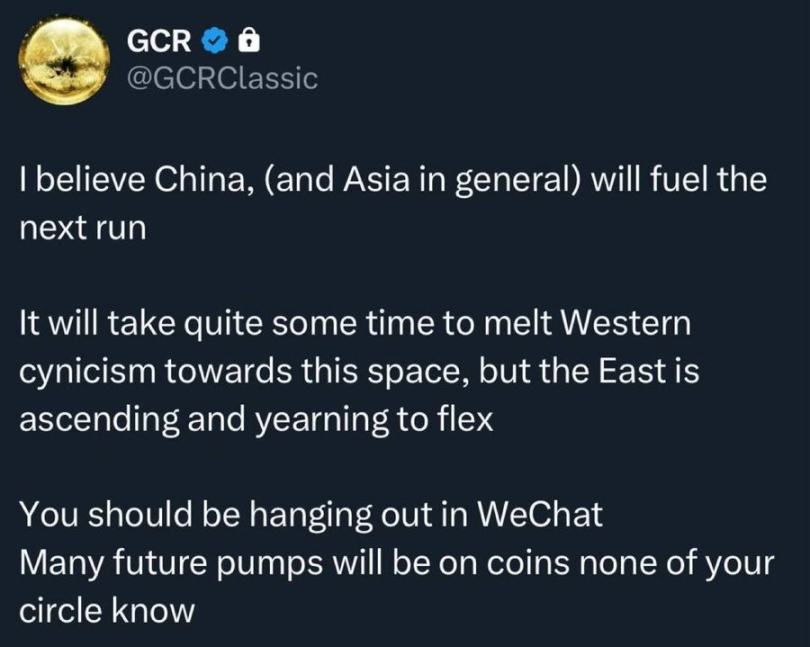
This article examines China's changing liquidity situation, its impact on global cryptocurrency flows, and how tokens such as BNB, CFX, and CKB are the weather vane for a new round of Chinese liquidity trading.
From liquidity depletion to regional differentiation
Western markets actively tightened liquidity between 2022 and early 2023. The US Federal Reserve's interest rate hike pushed real returns to decades-long highs and removed liquidity from risky assets.
Meanwhile, in Asia, and China in particular, it is moving in the opposite direction. The People's Bank of China cut the 1-year medium-term loan facility rate from 2.95% to 2.50% between 2023 and 2024.
Local governments have increased infrastructure spending and technology subsidies to offset pressure on the real estate industry.
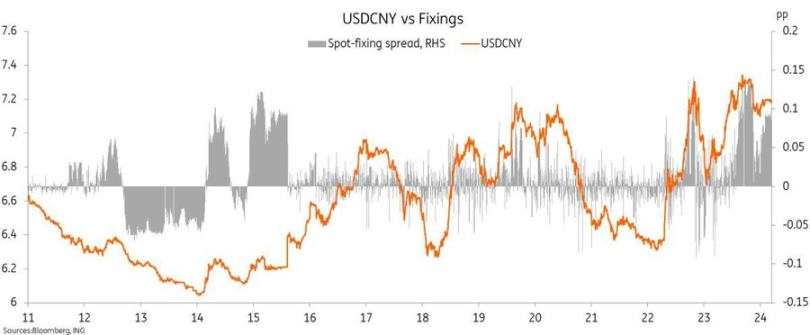
While China maintains capital controls, offshore instruments in Hong Kong and Singapore have seen increasing inflows of capital from mainland-related entities seeking exposure to digital assets.
This fragmentation lays the foundation for GCR's argument that when Western liquidity shrinks, marginal buyers shift.
The data behind the story
Liquidity is the key to the cryptocurrency market. To verify the “Chinese-dominated cycle” narrative, the following indicators are useful:
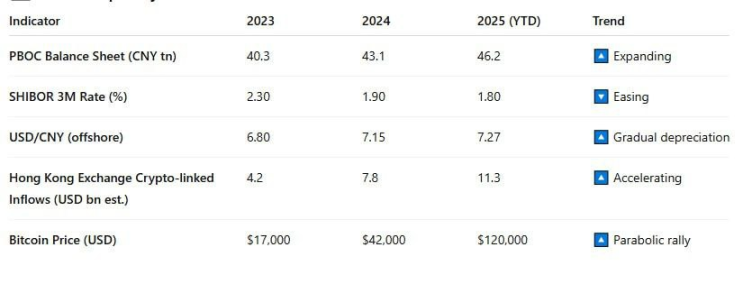
While Western liquidity remains limited throughout 2024, Asian liquidity is quietly expanding. Hong Kong's pilot approval of spot ETFs and the Shanghai Free Trade Zone's fintech initiatives further demonstrate the region's willingness to tolerate controlled cryptocurrency exposure.
The BNB Effect: Why China's Liquidity Flows to Binance
Among all the tokens associated with China, BNB has become a factual index of optimism in the East Asian market. Several structural and behavioral factors explain this:
Exchange dominance: Binance remains the main trading venue for retail and institutional players in Asia, especially after OKX and Huobi faced regulatory restrictions.
Onshore to offshore path: Funds from Chinese OTC platforms usually go through a CNY → USDT → BNB conversion before diversifying into altcoins.
Reversibility: The appreciation of BNB enhances the value of Binance's treasury, allowing it to make more active repurchases and inject liquidity into the ecosystem's tokens.
Empirical data shows that as of the fourth quarter of 2025, BNB's performance so far this year is about 45% higher than ETH, while its volatility is 20% lower than Solana. This stability makes it a liquidity agent, similar to the way Tether represents the health of the dollar market.
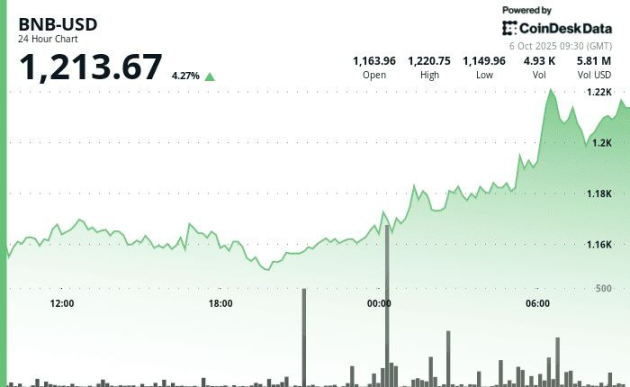
The sharp rise of Chinese tokens: a repeat of the 2017 market?
The recent general rise in CFX (Conflux), CKB (Nervos), and MEW (CAT-in-a-box) is similar to the early stages of the 2017 “China Season.” Each cycle shows the same characteristics:
Narrative ignited: Rumors about local policy relaxation or “giving the green light” to Web3 pilots.
Exchange concentration: Liquidity is concentrated around listed tokens linked to Binance, Gate, and the Hong Kong Stock Exchange.
Retail re-entry: OTC platforms report increased demand for USDT trading pairs denominated in RMB.
National narrative control: Media signals suggest blockchain innovation is tolerated, but speculation is not.
For 2025, the rise began with the People's Bank of China injecting RMB 1.4 trillion in liquidity in the second quarter and reports that Hong Kong regulators may open ETF approval channels for altcoins. Although this is not an official endorsement of policy, these actions have created a sentiment that China is not prohibiting, but rather balancing.
Comparative Macro Perspective: US Austerity vs. China's Easing
To understand why Asian-led mobility matters, it is necessary to compare global policy cycles.
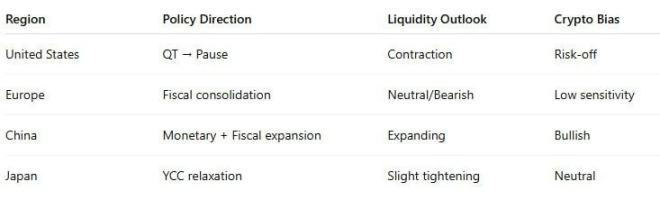
The impact on the cryptocurrency market
China's mobility wave has three structural effects:
Expanding market breadth: Altcoins linked to the Asian ecosystem have shown greater correlation with China's macro-easing cycle.
Liquidity cycle: Offshore stablecoins (USDT, USDC) are increasingly intermediated through Asian OTC trading platforms, increasing circulation speed and ability to absorb slippage.
Decoupling narrative: Asian-driven increases usually occur independently of Western macro-catalysts, implying regional price leadership.
This part explains why while Bitcoin recently broke through the $120,000 mark, the US stock market's performance was relatively lackluster. This is a typical characteristic of asymmetric liquidity sources.
Risks and limitations
Although GCR's argument remains largely verified, three risks dampen the long-term view:
Regulations are not transparent: China's capital controls are still strict; excessive enforcement may suddenly stifle cross-border mobility.
Overreliance on Binance: If Binance were to suffer a regulatory crackdown, it would significantly weaken the momentum cycle led by BNB.
Narrative fragility: The “China Season” cycle often subsides when speculation exceeds actual liquidity creation.
conclusions
Two years have passed, and the data is in line with GCR's predictions: the 2025 bull cycle was indeed dominated by Asia. Despite regulatory restrictions, China's liquidity has found effective offshore channels. Tokens such as BNB and CFX have become a barometer of this flow of funds, reflecting the optimism and fragility of financial experiments in the region.
