


MegaETH public sale = chance to collect money? V God is already on the bus
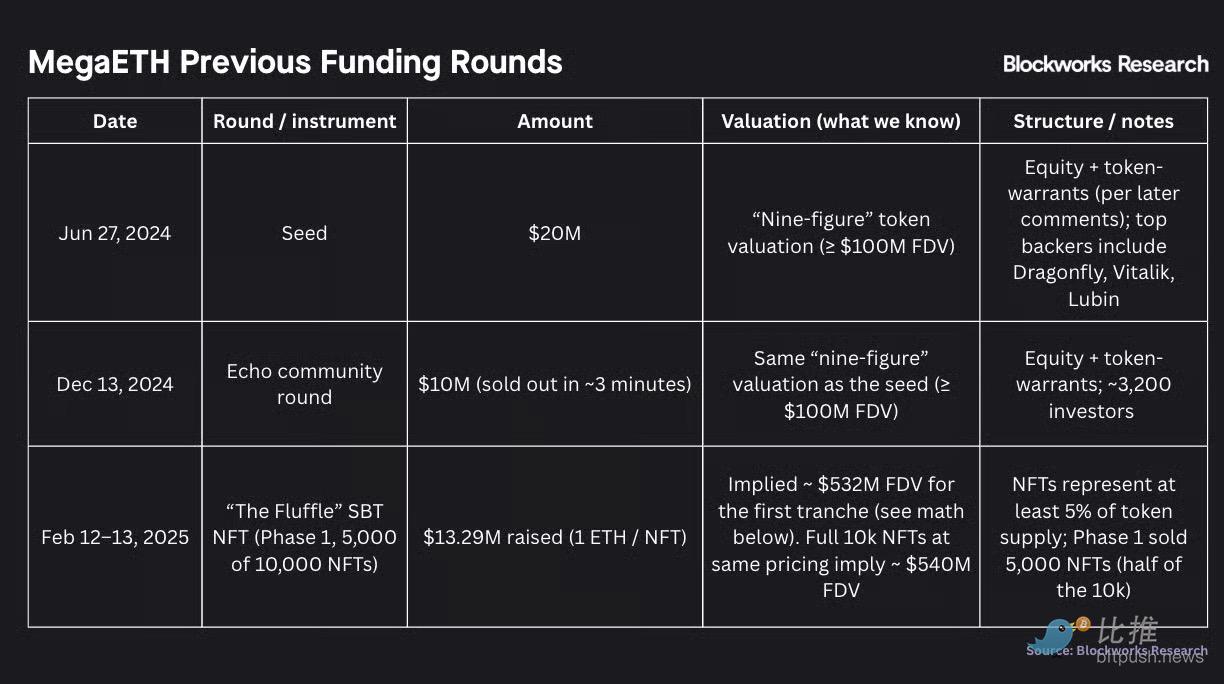
“Real-time Ethereum-compatible chain”MegaEthThe public sale will begin on October 27 — this is the third round of funding for the project open to the community. In the previous two rounds, the Echo community round included Dragonfly andVitalik ButerinThe Fluffle NFT round even reached a fully diluted valuation of $532 million, including top venture capitalists entering the market at the same price.
Currently, this project, which is regarded by the industry as a “Layer 2 upstart”, is about to enter the most critical public sale moment.
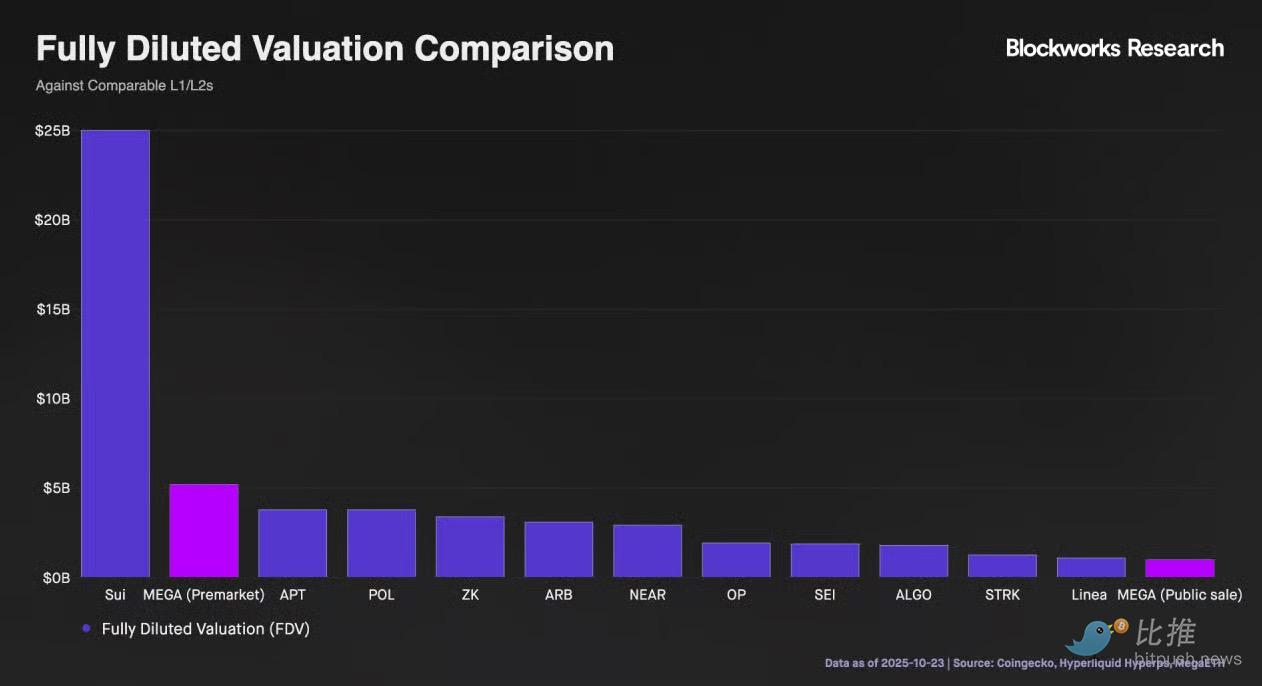
在HYPERLIQUIDIn the pre-market, the implied valuation of $MEGA has been speculated to $5 billion, whilePolymarketAccording to predictions, the chances of it breaking through the $2 billion valuation after listing are as high as 89%.
From VC fundraising to community buzz, why is MegaETH favored? Will this high-profile public sale become a new tipping point for the Layer 2 circuit?
According to information released by the project party, the distribution amount for this open round is 5%, or 500 million of the 10 billion MEGA tokens. Investors are required to participate using USDT on the Ethereum mainnet. The auction is in the form of a British auction, with bids ranging from $2,650 to $186,282. US investors are required to lock up their positions for one year and enjoy a 10% discount. Non-US investors can choose whether to lock up their positions.
Notably, prior to the public sale, MegaEth had repurchased approximately 4.75% of the shares and token-related warrants from early pre-seed investors. This move was interpreted as a sign that it wanted to further optimize the equity and token structure and strengthen the community share.
Build a “real-time Ethereum”
MegaEth byMegaLabsLaunched by the team in 2023, the core vision is to enable blockchain interaction to reach the speed of Internet applications. The project claims that its block confirmation time can be as low as 10 ms, the theoretical throughput exceeds 100,000 transactions per second (TPS), and maintains full compatibility with the Ethereum Virtual Machine (EVM).
This level of performance far exceeds current mainstream Layer 2 solutions. Although Arbitrum, Optimism, etc. have improved the efficiency of parallel execution and rollup, there are still seconds of delays. MegaEth is trying to achieve “sub-second settlement” by redesigning the execution layer architecture, so that DeFi, games, AI agents, social applications, etc. can achieve a true real-time experience.
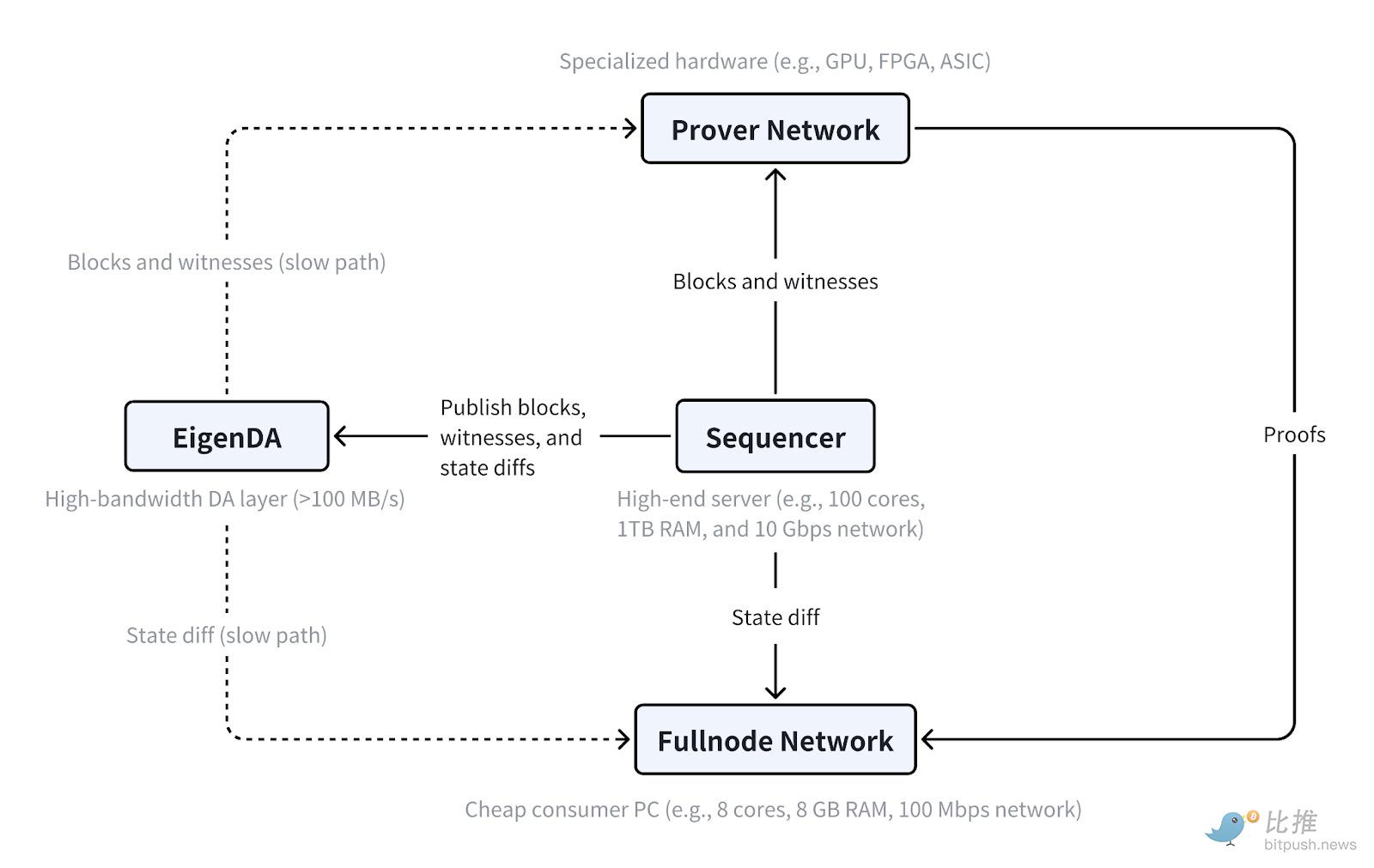
In terms of architecture, MegaEth uses a “modular node” design, which splits block sequencing, state calculation, and verification tasks into different roles: Sequencer is responsible for sequencing execution, Prover generates zero-knowledge proofs, and Replica Node is responsible for state replication. This “dedicated division of labor” is seen as the key to breaking through performance bottlenecks. Meanwhile, MegaETH plans to connect with EigenLayer's data availability layer (eiGenda) to further enhance system scalability.
The core idea of MegaEth is to exchange performance for the expansion of trust boundaries, by sacrificing partial decentralization in the early stages in exchange for real-time transactions and qualitative changes in the user experience. As the team wrote in their technical white paper, “For blockchain to become a true internet infrastructure, it must have Web2 speed.”
Team and financing
MegaEth's team members come from the core development circle of the Ethereum community and traditional high-performance systems engineering backgrounds. CEO Yilong Li, CTO Lei Yang, and COO Shuyao Kong are all active members of the early Ethereum and StarkWare communities.
At the financing level, the project completed a seed round of approximately $20 million in June 2024, led by Dragonfly and supported by Vitalik Buterin. In December of the same year, another round of funding of about $10 million was raised through the Fluffle NFT community. Its ecosystem program “MegaMafia 10× Builders Program” has attracted more than ten projects, including DeFi, AI, social networking, and on-chain gaming.
According to RootData, MegaETH's cumulative financing amount is over $30 million. In addition to Dragonfly, its main investors include well-known institutions such as QCP Capital, GSR, SevenX Ventures, and Delphi Ventures. This capital lineup provided stable financial and technical support for the project, and also increased the market's trust in its fair valuation.
Market expectations
Judging from the market reaction, MegaETH was already considered a potential “explosive asset” before it was officially launched. Hyperliquid's MEGA-USD perpetual contract pre-sale market currently prices MEGA's implied fully diluted valuation at around $5 billion, with a 24-hour trading volume of $17 million; on Polymarket, traders give $MEGA an 87% chance of breaking through $2 billion in FDV within 24 hours of going live, and a 40% chance of breaking through $4 billion.
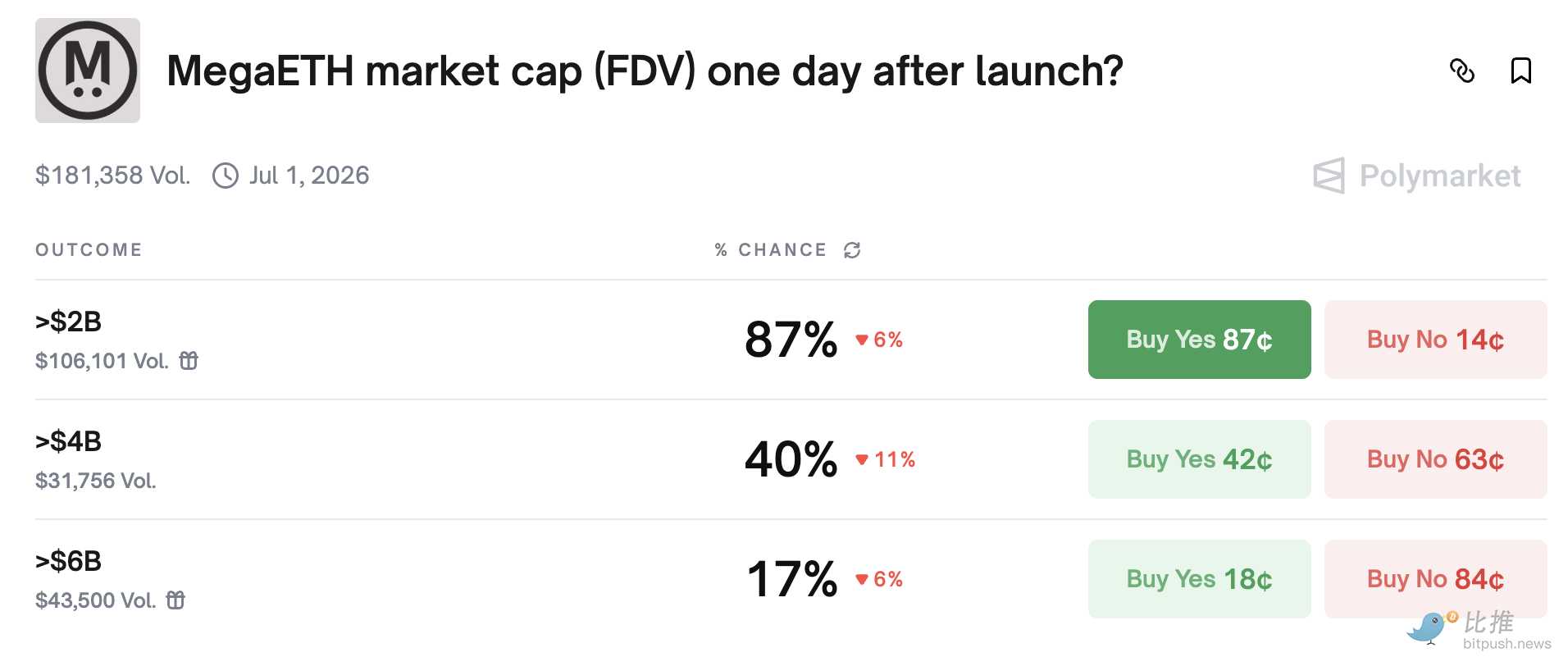
Faced with such popularity, MegaETH chose to open the public round with a valuation far below market expectations.
BlockWorks Research analyst Shaunda pointed out that this is a deliberate “contrarian pricing” strategy. The project side knows that English auctions and Dutch auctions often cause “marginal buyer pricing” problems: that is, the sales price falls exactly at the psychological price of the last willing bidder. Once the secondary market opens and the buying pressure disappears, the token often falls rapidly.
In order to avoid the embarrassing situation of “overvalued opening and liquidity collapse”, MegaETH drew on recent examples such asplasmaThe practice of other projects — open up sales to the community at an undervalued price in exchange for higher participation and long-term belief. As Shaunda wrote, “If a token's fair value is $5 billion, then it's much healthier to revalue from 1 billion to 5 billion than to fall from 20 billion to 5 billion.”
This type of strategy is called “community tax” (Community Tax) by some industry insiders: a cost of sacrificing the size of short-term financing in exchange for long-term public opinion and trust.
Summarize
Although the market has high expectations for MegaETH, it is also controversial. Some analysts believe that its “single sequencer” architecture may affect the degree of decentralization. The project side responded that the primary goal at this stage is to verify performance limits and developer experience, rather than pursue perfect decentralization. The team promised to introduce multiple sequencer mechanisms after the architecture is stabilized to gradually achieve a balance between performance and security.
From multiple perspectives from technology, capital, and market expectations, MegaETH's public round is undoubtedly one of the most noteworthy events in the current crypto market. It represents not only a project's financing node, but also a real test of the blockchain world's “balance of speed, trust, and decentralization.” Now that Layer 2 is so competitive, MegaETH's trick is quite clever: using low prices to attract early users, it can not only save popularity, but also test water. This is not just a question of the success or failure of a project; it is also exploring a new way for blockchain to be both fast and secure.
Author: Forge
Twitter:https://twitter.com/BitpushNewsCN
Compare the TG exchange group:https://t.me/BitPushCommunity
Compare TG subscriptions:https://t.me/bitpush
