


How can cryptographic privacy be a key barrier to defending user freedom?

Author: Blocmates.
Compiled by Deep Wave TechFlow
Original title: In the crypto world, betting on privacy is betting on freedom
If history can be used as a reference, freedom will always find a way to win. And in this field, betting on privacy is, at the end of the day, betting on freedom.
hey! I'm telling you, if you have ZachXBT-level on-chain investigation capabilities (plus a little patience), crypto transactions can be traced — but you already knew that, didn't you?
Today, we can find out if your 78-year-old grandmother emptied your wallet or if North Korea-linked hacker groups are threatening every agreement.

Yes, these so-called “bad” cases do exist, but they only appeared because on-chain activity was publicly visible to everyone. Surprised or not? The public chain ledger is indeed public.
Encryption and privacy
Perhaps today's young people don't understand it, but those veteran players (Uncs) know that the journey of Bitcoin and today's cryptocurrency as a whole began with the cypherpunks' vision of building an open society based on privacy.
It was this idea that gave birth to David Chaum's private digital currency Digicash (based on blind signature technology), and B-money, an anonymous decentralized payment system proposed by Wei Dai (sounds like a rapper's name, right).
Satoshi Nakamoto, on the other hand, went one step further and embedded a degree of privacy protection into a completely transparent ledger. Bitcoin's design relies on fake addresses and cryptographic hashes rather than real names or identities, creating the illusion of anonymity.
However, this illusion of anonymity did not last long. With the rise of smart contracts, attention gradually shifted from privacy to on-chain programmability.
Today, as the popularity of cryptocurrencies accelerates again, we're back where it all began — the first principle of privacy.
In the field of encryption, privacy is becoming an important topic. Its scope extends beyond sending and receiving funds on the public chain to the privacy protection of on-chain applications.
In today's article, we'll explore what privacy means in the field of cryptography, its various aspects, products built around privacy, points to focus on, and our thoughts on the future of cryptographic privacy.
Fasten your seatbelts and get ready to go!
What exactly does privacy mean in cryptocurrencies?
The best way to understand privacy is through the perspective of traditional finance (TradFi).
In traditional finance, the meaning of privacy is simple: personal data is protected, not disclosed to the public, and only visible to authorized entities. This includes the user's personal information such as biometric data, transaction history, account balance, etc.
When we introduced this concept to the field of cryptography, the core of privacy was the protection of personal data in on-chain transactions. True privacy means that only users themselves or designated recipients, as authorized entities, can view or understand their own data.
In the field of encryption, people often confuse privacy with anonymity. Although the culture of anonymity stems from the concept of privacy, there are technical differences between the two.

For example, privacy focuses on hiding the details of a transaction, such as the transaction amount from one person to another, the counterparty, and other information; while anonymity is more concerned with hiding the identity of the user in the transaction.
An example of a clear distinction between privacy and anonymity is Zcash and Monero. The former mainly relies on encryption technology and uses zk-SNARKS (zero-knowledge, simple, non-interactive knowledge verification) to hide transaction amounts; the latter uses hidden addresses and ring signature technology to fake and anonymize user identities.
However, for the purposes of this article's discussion, we are considering privacy as an overall phenomenon that includes anonymity.
Why is privacy an important topic in the field of encryption?
As mentioned earlier, the foundation of the crypto industry stems from the cryptopunk spirit, which pursues privacy and decentralization to achieve freedom from national-level control.
However, as private surveillance companies rapidly expand and show strong influence in the financial sector, as well as concerns about data misuse brought about by AI technology, alarm bells are sounding louder than ever before.
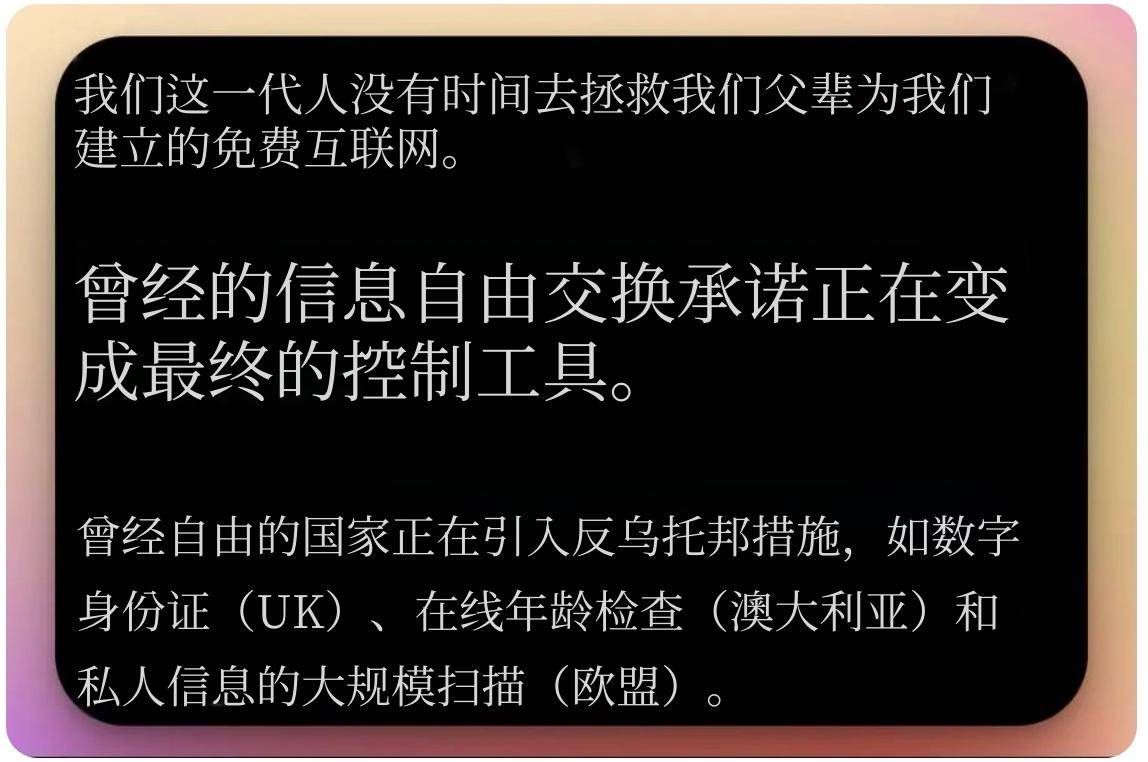
Without privacy, data on the blockchain may reveal information such as users' spending habits, wealth distribution, political donations, and counterparty relationships. If this data falls into the wrong hands, it can be used for extreme control or exploitation.
Another reason why privacy is critical in the field of encryption is that cryptocurrencies cannot truly be censorship-resistant without the support of privacy technology. Privacy protects individuals and organizations from coercion, enabling truly permissionless participation in the on-chain financial system.
Furthermore, privacy can also ensure the safety of users in real life and the safety of assets on the chain. Especially in public transaction maps, high-value targets are easy targets for hacking, extortion, or even personal threats — there have been many cases of this recently.
Privacy-Enhancing Technologies (PETS)
Privacy-enhancing technologies can be implemented in a variety of ways, each designed for specific use scenarios, but their ultimate goal is the same: to provide privacy and security for end users.
Different technology paths have advantages, disadvantages and scope of application. Below, we'll cover some of the main privacy-enhancing technologies and how they work in non-technical language.
Zero-Knowledge Proofs (ZK)
As the name suggests, the core of this technology is to prove something as true without revealing the underlying details or data.
Zero-knowledge proof involves two key players:
Prover (Prover): Proving that a statement is true.
Verifier: Confirms the authenticity of a statement without access to the underlying data.
As a privacy-enhancing technology in the field of cryptography, zero-knowledge proof comes in two main forms:
zkSNARKs (Zero-Knowledge Succinct Non-Interactive Arguments of Knowledge, Zero-Knowledge Concise Non-Interactive Arguments of Knowledge)
zkStarks (Zero-Knowledge Scalable Transparent Arguments of Knowledge, Zero-Knowledge Scalable Transparent Arguments of Knowledge)
Zero-knowledge proof supports a variety of privacy-preserving application scenarios, including but not limited to:
Confidential transactions: hide transaction amounts to protect financial privacy.
Proof of assets: Proving solvency without revealing addresses or sensitive data.
Privacy-Preserving Authentication: Suitable for decentralized identity systems (DIDs).
Private smart contracts: enable privacy-protecting on-chain contract interactions.
Ring Signatures and Ring Confidential Transactions: Strong Backing for Anonymity
If you've heard of privacy coins with built-in or default privacy features, most of them use ring signature technology. A typical example is Monero, a cryptocurrency known as the “veteran player in the privacy coin industry.”
Ring signatures work by allowing users to sign transactions within a group without revealing the identity of the specific signer. By obfuscating the origin of the transaction, ring signatures effectively conceal the identity of the sender.
This technology is particularly useful for anonymity, enabling users to transact on-chain without having to worry about on-chain analysts like ZachXBT tracking their identity.
Seen from this perspective, it's easy to understand why Monero faces so many compliance challenges, such as being removed from exchanges or other regulatory issues.
In contrast, Zcash offers two options: transparent address (t-address) and privacy-protected address (z-address). Centralized exchanges can choose to only support fully transparent ZEC transactions to meet compliance requirements.
Fully-Homomorphic Encryption (FHE): The Ultimate Weapon for Privacy Protection
Remember that scene when you were in school secretly handing out small notes? If you use an encrypted mixture of letters and numbers to convey information on a note, and only your friends can decipher it, then you've actually come across the concept of fully homomorphic encryption.
FHE is a cryptographic privacy-enhancing technology that allows computation on encrypted data without decrypting it. This means users can securely deliver sensitive information without worrying about data being viewed by verifiers.
Although FHE favors privacy protection rather than addressing anonymity issues, it is certainly one of the strongest technologies for protecting privacy on the chain.
Trusted Execution Environments (TEEs)
If you're a loyal reader of Blocmates, you probably already know about TEEs. If needed, you can review our previous article dedicated to TEEs.
Simply put, a trusted execution environment (TEE) is a hardware-based privacy-enhancing technology (PET) that uses cryptographic keys to protect the confidentiality and integrity of data within a secure area (also known as a secure enclave) within a processor or network.
A common example is the face recognition feature on a smartphone. When you set up face recognition, the device captures your facial features through the camera, encrypts the data, and securely transmits it to the TEE for processing. Captured biometric data never leaves the TEE without protection.
Within the TEE, the original face data is converted into a template, a mathematical representation of your unique facial features, and stored securely in a secure enclave for future authentication.
Multi-Party Computation (MPC)
In the field of cryptography, certain activities require collaborative computing, and multi-party computing (MPC) is a cryptographic privacy-enhancing technology designed specifically for such scenarios.
For example:
An artificial intelligence product that relies on multiple AI inferences to optimize output.
A decentralized autonomous organization (DAO) conducts governance voting without disclosing individual decisions.
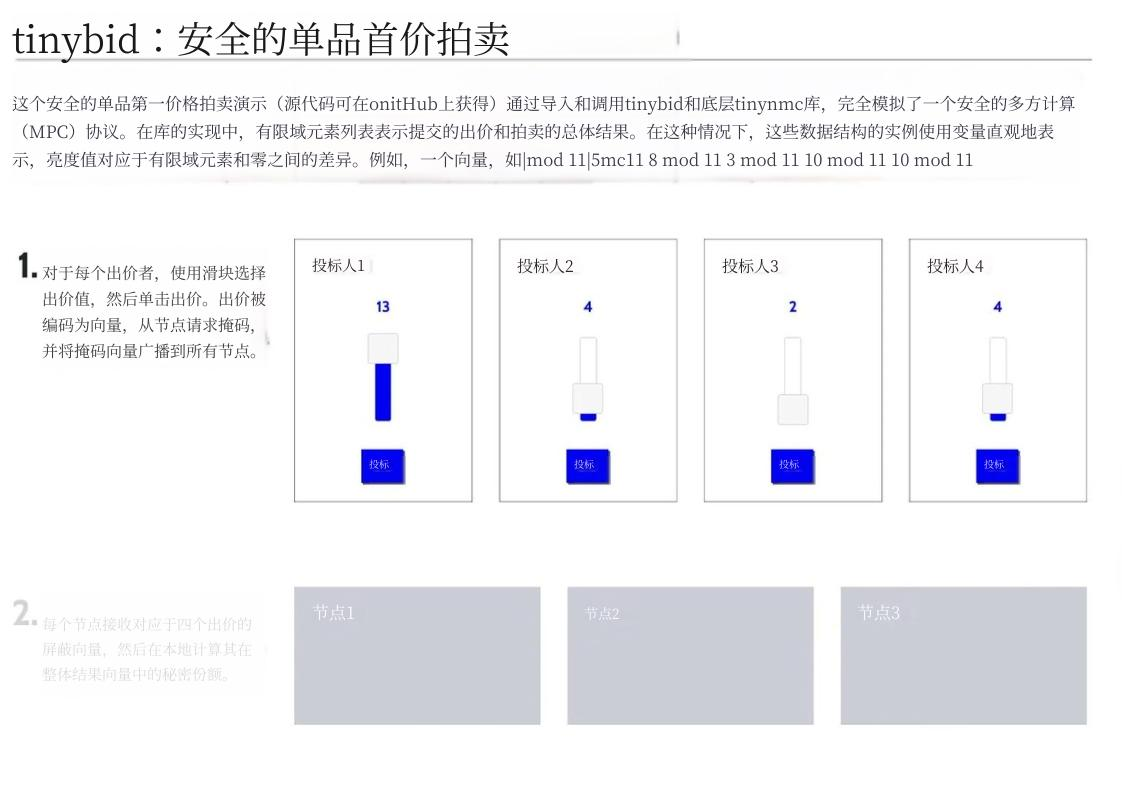
An on-chain auction, such as Nillion's trial case.
MPC allows multiple participants to jointly calculate a function (such as signing a transaction or verifying a balance) without disclosing their respective inputs. This technology ensures the privacy of data from all parties while achieving the goal of collaborative computing.
In addition to the privacy-enhancing technology (PETS) we have already mentioned, there are other technical means, such as coin mixers (coin mixers), homomorphic encryption (homomorphic encryption), and composable privacy (composable privacy). These technologies provide greater protection by combining multiple privacy tools.
In the field of cryptography, some projects focus on directly developing products based on these cryptographic techniques, while others focus on building the underlying privacy infrastructure to support cryptographic applications.
Key projects to build a privacy infrastructure
In the field of encryption, privacy protection is not a “one-size-fits-all” solution. Different projects and teams usually focus on specific aspects of PETS to support specific application scenarios and needs.
Here are a few notable projects in the area of privacy infrastructure.
Nillion
We've previously discussed Nillion's technology in detail and its application scenarios; if you want to learn more, check out the related articles.
Simply put, @nillion's infrastructure is focused on enabling decentralized trust for sensitive data.
Nillion's core technology, “Blind Computer” (Blind Computer), protects sensitive data through various privacy-enhancing technologies (PETS), including:
Multi-party computing (MPC): Used for its NilDB database.
Trusted Execution Environment (TEES): Used for AI inference (such as nilAI and niLCC).
Additionally, Nillion has developed a number of innovative consumer apps based on its infrastructure, which we'll cover in more detail in later sections.
Succinct
@SuccinctLabs's airdrop campaign has delighted some and left others disappointed, but the technology itself is definitely worth watching.
Succinct Labs is dedicated to promoting ZK Proofs (ZK Proofs) through its technology and has built a technical framework that can verify any software. Although the technology isn't entirely privacy-centered, its flagship product, the SP1 ZK virtual machine, can be used to provide client-side privacy protection. For example, in Hibachi's case, the public order flow was hidden, but the central operator (Hibachi) was still fully visible.
Zama
@zama_fhe is a leader in technology based on fully homomorphic encryption (FHE) and is committed to supporting the development of confidential applications.
Zama has built a technology that supports confidential blockchain protocols and can be integrated with Solidity-based networks to enable the following privacy applications:
Privacy-based decentralized exchanges (DEXs) are used for token swaps.
Confidential loan agreement.
Asset tokenization with built-in privacy features.
Zcash
Frankly speaking, thanks to her efforts to successfully promote @Zcash (ZEC), Mert was able to run for Opinion Leader of the Year (KoL).
As an OG project in the privacy field, Zcash is a pioneer in peer-to-peer private payments using zero-knowledge encryption (ZK Encryption).
Zcash uses zkSNARKS technology to enable optional, transparent, and private transactions. Although the technology seems relatively simple, combined with its token economy model that mimics Bitcoin, it's easy to understand why it has become an alternative to Bitcoin in the eyes of those who still believe in the cryptopunk mentality in the context of rising privacy needs.
Monero
In addition to attracting an avid following due to its token (XMR), @monero is also a privacy technology project worth watching.
Monero enables complete transaction privacy through three cryptographic techniques:
Ring Signatures: Hides the identity of the real sender by mixing the signature of the real sender with a set of disguised signatures extracted from the blockchain.
Stealth Addresses (Stealth Addresses): A unique one-time public key address is generated for each incoming transaction, thereby preventing any connection between the recipient wallet and the payment.
Ring Confidential Transactions (RingCT): Using cryptographic promises and scope proofs to hide transaction amounts, while allowing the network to verify that input equals output, ensure no tokens are generated out of thin air.
Unlike Zcash, Monero's privacy features aren't optional; they're mandatory. This means that all of Monero's transactions are completely hidden, and there is no concept of “selective privacy” or “blocked transactions.”
However, this enforced privacy has also sparked hostility from regulators, leading to Monero being removed from many compliant centralized exchanges.
Arcium
Remember when we mentioned that some products understand privacy isn't “one size fits all”, particularly at the infrastructure level?
Yes, @Arcium is a great example.
Arcium is a multi-party computing network based on which multiple protocols have been built, including:
Cerberus Protocol: A generic protocol with a unique security model.
Cerberus uses a “dishonest majority” trust model, equipped with fraud detection and identifiable suspension mechanisms.
This means that as long as one node is honest, privacy can be guaranteed.
If a node is found to be dishonest, it will be identified, kicked out of the network, and penalized (reduced rights).
Notably, protocols like Cerberus generally operate under an “honest majority” trust model, where 51% or more of the nodes are required to be honest, while Cerberus' model is more flexible and reliable.
Manticore Protocol: Designed to support AI use cases.
Although Manticore's security assumptions aren't as unique and powerful as Cerberus, it still has an important role in specific scenarios.
Manticore is suitable for permissioned environments and supports AI training in trusted environments to meet specific needs.
Similar to Nillion, Arcium's technology already supports some impressive consumer applications, which we'll explore further in later sections.
Core consumer projects driven by privacy technology
The beauty of cryptographic privacy is that we don't need to talk abstractly about complex technical backends, especially since we can't directly “play” with these underlying technologies like developers.
But the end product—consumer products built on that infrastructure—is something we can experience firsthand. Here are a few apps built on privacy technology:
Hibachi: Privacy-enabled perpetual contract transactions
Not everyone wants their positions or balance records to be disclosed to the public.
If you remember the case of James Wynn (whether it was a pawn in a larger plot or something), he was “hunted” and rounded off for his open positions on Hyperliquid. This situation shows that in on-chain perpetual contract transactions, privacy is indeed necessary.
@hibachi_xyz is addressing this by using Succinct's Zero-Knowledge Proof Technology (SP-1) and Celestia's Data Availability (DA). It uses a new architecture that combines on-chain and off-chain components, where Succinct validates central limit order books (Clobs) in Celestia's blob data.
As an application in the field of privacy, Hibachi also optimizes transaction execution speed, with latency as low as 5 ms. No tokens have been issued yet, so this is a project worth watching.
nILGPT: Privacy-enabled AI chatbot
Truth be told, AI can be “creepy” sometimes, especially when it describes itself with personal pronouns.
However, the AI technology itself is really cool, especially the various innovative experiments people have made in terms of reminders.
However, many people overshare when interacting with AI chatbots, forgetting that behind these inferences there may be hidden prying eyes from centralized software. Products such as ChatGPT, Gemini, and even Grok are built on this foundation.

@nilgpt_ is an AI chatbot focused on privacy protection, built on Nillion's confidential computing infrastructure to keep users' conversations and data safe without collecting or revealing personal information.
NilGPT uses Nillion's Blind Compute (Blind Compute) layer to encrypt and process data on distributed nodes to ensure that no single entity can access plaintext input or output data, thus achieving true privacy protection.
Railgun: an on-chain ecosystem based on privacy technology
If you want anonymity on the blockchain, @RAILGUN_Project is a project worth watching (quietly, this is a Vitalik-supported privacy solution).
Railgun is an on-chain ecosystem based on zero-knowledge (ZK) privacy. As a smart contract system adapted to the Ethereum-compatible chain, Railgun allows users to conduct private transactions and DeFi interactions without sacrificing security and composability.
Railgun is fully decentralized, governed by Railgun DAO, and uses zk-SNARKS technology to implement on-chain cryptographic balances, transactions, and smart contract execution, supporting multiple chains including Ethereum, Polygon, BSC, and Arbitrum.
Note that unlike traditional mixers, Railgun provides complete anonymity through zero-knowledge cryptography while seamlessly integrating existing decentralized applications (dApps) and liquidity protocols.
Privy Home: wallet infrastructure
Honestly, Privy is arguably one of the products in the crypto space that best fits the needs of the market. Its product, Privy Home, is a secure control layer and unified management center for managing embedded wallets in cryptographic applications. Built by @privy_io, Privy Home is a wallet infrastructure that provides strong support for the on-chain experience, helping users easily and securely manage multiple wallets and apps.
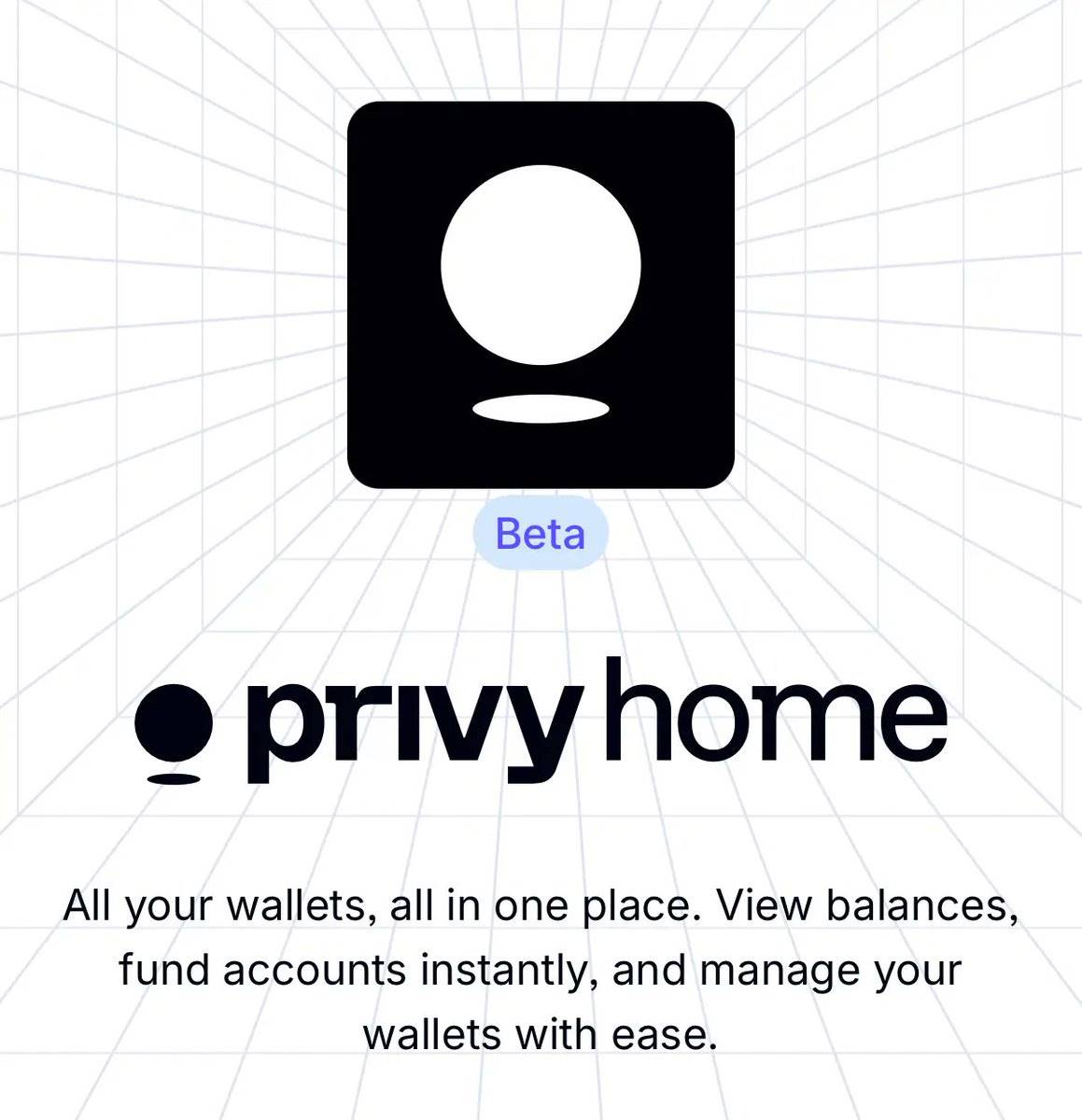
Privy enables users to track, manage, and monitor assets from multiple apps on a single platform. By providing security through key sharding and trusted execution environments (TEEs), Privy enables enhanced self-hosting and interoperability, making wallet management more convenient while avoiding key exposure to applications.
Umbra
This year, Solana has become the de facto home for on-chain entertainment, where users have earned a lot of revenue while also attracting more attention and monitoring.
That's why products like @UmbraPrivacy are particularly important.
Umbra is a privacy protocol that provides a “stealth mode” for Solana transactions, enabling private on-chain transfers through Arcium's confidential network, bringing true financial privacy to users.
Currently, Umbra has launched a private transfer feature and plans to continue building a more complete Solana privacy DeFi hub. Private Swaps (Private Swaps), Solana-Zcash bridges, and SDKs for natively integrating privacy features into wallets and other applications will be launched in the future.
If you're an “watcher” who likes to spy on your wallet, you might be disgusted by Umbra; but if you're a crypto player yourself, then Umbra might excite you.
Zashi App
If you've been “enlightened” to start buying $ZEC, and privacy issues are becoming increasingly important, then what next?
Why not download and use @zashi_app directly! This is a mobile wallet designed specifically for Zcash, by Electric Coin Co. (ECC) Development — the team behind Zcash's launch in 2016. Zashi focuses on shielded, privacy-preserving transactions.
Zashi is a self-hosted app that allows users to send, receive, and use $ZEC without intermediaries, government, or corporate monitoring.
By default, Zashi's transactions are shielded, and Zcash's zero-knowledge encryption technology is used to achieve end-to-end privacy protection, providing the most convenient entry point for peer-to-peer payments.
To be honest, I downloaded the app myself and it felt really smooth. So maybe you could try it out?
Although there are many consumer products based on privacy technology to explore, to take care of our short-attentive readers, this is the end of the day. Next, we'll share our thoughts on all this.
epilogue
The walls of traditional systems are gradually collapsing, and the chain era has already set sail.
Although the pace of adoption may seem slow, the process from scratch is always the hardest, and the leap from “one” to “ten” is often much faster.
I mean, as on-chain technology continues to advance, and even your grandmother may start using on-chain services, privacy issues — be it hers or yours — will become critical.
We strongly believe that privacy is not just an “icing on the cake” feature, but an essential core. It should not be used as an afterthought; it should be an important cornerstone of your short- and long-term plans.
The infrastructure is already being built, some of which are already online, and with the advent of apps, these products are proving the potential of privacy.
To keep up with this trend, you need to focus on solutions that enable deep integration, find the “ultimate fix” like AWS, or at least make you a real “anonymous John Doe” on-chain.
If history can be used as a reference, the power to pursue freedom will always win out. In the blockchain world, betting on privacy means betting on freedom.
Twitter:https://twitter.com/BitpushNewsCN
Compare the TG exchange group:https://t.me/BitPushCommunity
Compare TG subscriptions:https://t.me/bitpush
