


How to make money in the crypto market avoid KOL traffic traps

Author: Weisman Notes
Original title: Want to make money in the crypto market? Don't be a KOL
Today, I'll write an off-topic comment. By the way, I'd like to thank the big V in the community for the recent retweet.
I personally have an X account, but I have no plans to seriously operate on X. It wasn't a whim decision; it was a weighed choice over and over. Today's article starts here, and then we get to the point. I've also been working on this self-media for a number of years. My readership is mostly old friends who have been through a few bulls and bears together, and most of the fans I follow have also watched my content for many years, so I'm not going back and forth and talking about some serious things.
Why am I not running X
To explain this problem, let's first talk about the monetization logic of Web3 KOL.
From the perspective of individual KOLs, it's actually very difficult to “rely only on the content itself” to monetize. As far as I know and see so far, there are probably very few people like Liu Jiaochain who can survive by paying for pure content.
In my eyes, this circle can be roughly divided into two categories of people:
Coin trading users
Web3 users
The first type of coin trading users. They don't pay for “content”; they only pay for “traffic.” A typical example is to post a yield of a few hundred points on X or Square, and then teach you how to fry. I don't think of this type as paying for content; essentially, they use yield screenshots to attract traffic, then convert and harvest.
The second category is Web3 users. They may be practitioners or entrepreneurs, or people who really have a complete idea about Web3 and are willing to think deeply. This type of user does pay for quality content, but a very small percentage. Excluding all types of transactions from the entire coin market, I subjectively estimate that this group of people may be less than 20%.
More importantly:
This type of person has one characteristic in common — they can think for themselves.
The more someone who thinks for themselves, the harder it is for you to use simple marketing rhetoric to lure him out of money. This is far more difficult than “fooling a bunch of people who just want to trade coins into a paid group.” Therefore, if you want to “monetize content” for X's large market traffic, it's not very appealing to me.
KOL's most common way to monetize: promotion
In addition to paying for the content itself, the more common way for KOL to monetize is various promotions.
From single promotions and promotions to so-called KOL agency joint promotions, they are essentially serving Party A. In the vast majority of industries, this business logic makes sense and is legal. But this is the coin circle—a place where “fraud” can be packaged into a “story.”
I personally don't want to take on too many uncertain legal and moral risks for money, let alone end up in “exile in a foreign country” because of a few promotions. So over the years, I haven't participated in this kind of promotion at all. To put it more realistically, this type of promotion is not a steady profit without compensation; the probability of falling on lightning and losing money is not small.
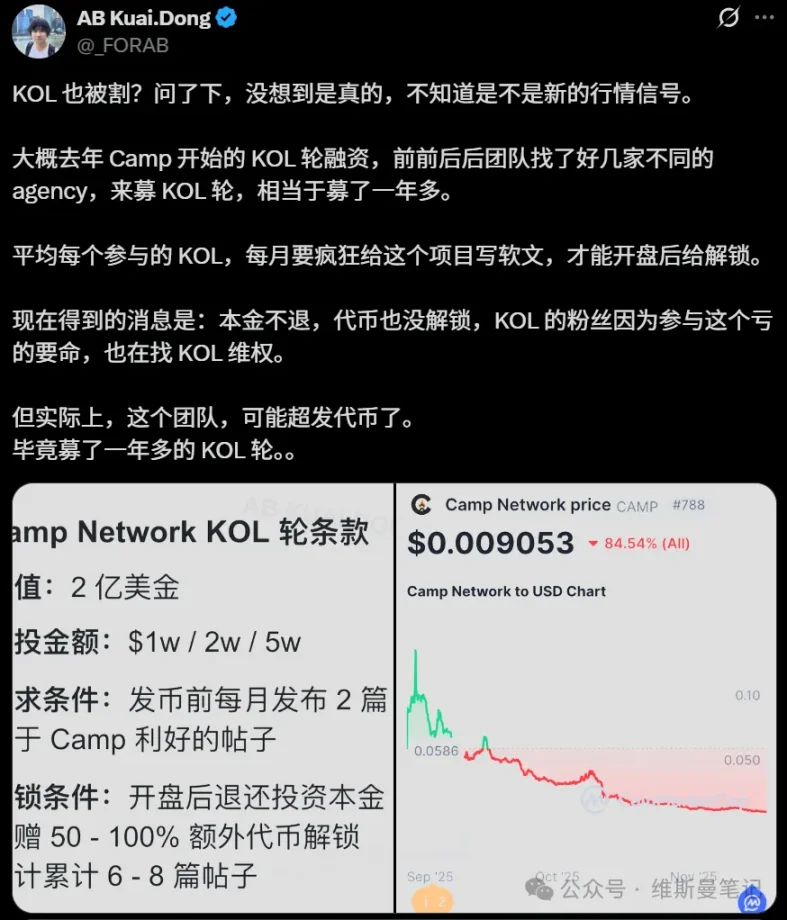
What's more, today's Web3 KOL has been completely industrialized.
Several MCN organizations are already mass-producing Web3 KOLs:
From X, Xiaohongshu, and Douyin to distribute content in batches, collect people to private domains and then convert them uniformly — some sell courses, others take orders with rebates, and others directly induce people to buy coins. And my self-media doesn't have any of these actions, so I don't consider myself a “KOL.”
I'm more like a self-media writer who writes about experiences in a circle and occasionally shares my opinions, but that's all. Over the past two years, my main focus has actually been on “incubation and services related to industry and research.” Let's talk about some personal experiences in this area, which are very subjective and probably completely different from your understanding. If you don't agree, that's normal, because everyone takes a different path in the first place.
Experience 1: Use “reverse thinking” to make money
I'm half a product manager, and in the process of working and collaborating, I've seen a very common pattern:
The starting point for most people is:
“I have a great idea → turn the idea into a product or service → find users, sell it, and do it on a large scale.” If you look at it from a “product methodology” perspective, of course this is something to talk about. But if you only look at it from the perspective of “making money,” I prefer to think in reverse:
First, think clearly: Whose money do I want to make?
→ Then design products and services around these “people who are willing to pay”
Instead of making things first and then looking for users everywhere. Among the projects I've collaborated on, there are those that smash pots and others that make money.
I did an RWA related business with a team last year, and their logic was very clear: they already have clear buyers for this batch of assets
Buyers need a compliant and legal RWA plan
That's why it was deduced in reverse: an RWA project is needed to meet this batch of “existing needs”
This is a standard “buyer first, product later” route.
And I saw more projects like this:
There is no clear picture of the buyer, and there is no real demand
Keep chasing hot spots in the market, cut stories, and restart hype
I hope to catch a little “fish that slipped through the net” from the public domain traffic in the coin industry
In my opinion, there's a lot of uncertainty here.
The probability of a project failure was more than half right from the start. Let's take another specific example, “How can reverse thinking help make money”.
Previously, I had a content-related collaboration with a friend, and I am responsible for providing a batch of high-quality content.
And his logic is very simple and realistic: he has a bunch of real Solana community resources (both at home and abroad)
Various community mods have been opened, so you can join groups to post content without getting kicked
I am responsible for exporting a batch of high-quality content and posting it to these real communities
Naturally, people in the community will be attracted to the content and take the initiative to chat privately
He then introduced this group of people into the new community and carried out a second time sedimentation
Wait until the meme market explodes, insert a CA into this new group that has already “gone through a round of screening” and let everyone rush
As it turns out, he did make a lot of money in this round of pump.fun craze.
The key to this case is:
He first had buyers: a real, accessible user community
Then come to me to provide services: high-quality content for these users
Only in the end can we talk about monetization
Why do I think “reverse thinking to make money” is easier to succeed?
This brings me to the second experience.
Experience 2: First, think clearly about the “cost of sinking”
In the money-making circuit, “ideas” are the least valuable asset.
Everyone has their own idea and path to making money. You can think of an idea that others are likely to think of, even earlier and more mature. So here's the question: when everyone has an idea, what do we need to do to break the game?
The answer: execution.
Ideas are always subject to execution. There are many people who have ideas. People who have ideas and actually do it don't survive.
The vast majority of people stop at “watching how others make money” and back off as soon as they get to do it themselves. Take a more universal example — food.
Many people have thought of a similar route in their hearts:
“Whenever I have some start-up capital, I open my own store.” But when it comes to actually starting a store, he often chooses a more “safe” method: join.
We hope to use external forces to eliminate the cost of starting from scratch. The result was:
He completely handed over the most important supply chain capabilities and pricing power to others.
In the end, it became the kind of “join the pit story” we often see on the news. This example illustrates two things:
Execution is scarce
Execution is essentially limited by “cost”
Why would so many people rather pay a franchise fee than start from scratch on their own?
Because execution costs money: learning costs (such as understanding the supply chain)
Communication costs (connecting with suppliers, managing employees, fighting wits with property)
Time and effort costs (you have to actually stay in the store instead of being a cashier)
I'll call all of these together: sunk costs.
Execution, on the other hand, is “stuck” by sunk costs. So, when you're actually planning to start a business and do something, I'm sure your starting point is mostly to make money. Well, before you get started, one order is very important:
What do I have to pay to prioritize the cost of sinking? Time, money, contacts, energy, reputation, the cost of various dimensions. Can I bear these costs, even if I lose money, step on lightning, or ruin it?
If you think the cost of sinking is acceptable, then consider: the ability to execute is based on your current resources, abilities, and manpower. Do you have a chance to do this well?
And finally: can you add your own “ideas and ideas” to differentiate yourself in this set of business logic?
If the order is wrong, it's easy to turn it into:
Idea → Passion → Execution begins → Discovers halfway through the cost is unbearable → Discard halfway
Not only did they not make any money, but they also found themselves in a dilemma.
epilogue
If you think of the coin industry as a huge casino, then most people talk about “how to play cards” every day.
Few people seriously think: Who started this casino?
Who designed the chips?
Who wrote the rules?
Are you a player or a chip?
Not running X and not actively making traffic games is just a choice for me:
I'd rather spend my time on projects that serve real needs and deal with people who are willing to think for themselves and pay for value. If you happen to be thinking about how to make money, start a business, and transform in this industry, then I want you to keep in mind at least two things: find a “buyer” first, then make a product.
Don't expect to catch “fish that slip through the net” from public domain traffic; it's a KOL and organization game, not an ordinary person's game. First calculate the “sunk cost”, then talk about execution and creativity.
Unbearable costs. Any idea, no matter how beautiful it is, is an illusion. As for how to find one's own group of “buyers” and how to assess the cost of sinking that one can bear,
Maybe I'll have a chance to write slowly later.
Twitter:https://twitter.com/BitpushNewsCN
Compare the TG exchange group:https://t.me/BitPushCommunity
Compare TG subscriptions:https://t.me/bitpush
