


Bankless | Hyperliquid 2025 Battle of the Gods, can it hold in 2026?

Source: Bankless
Author: David Christopher
Original title: Hyperliquid & The Year Perps Caught Fire
Compiled and organized by: bitPushNews
The perpetual contract exchange boom continued throughout 2025, andHYPERLIQUIDIt is in a leading position. Can it continue to stay ahead as competition intensifies?

Looking back at the crypto industry's growth in 2025, Hyperliquid is an unavoidable focus.
The exchange ended 2024 with an epic airdrop and price performance, drawing a large number of crypto Twitter users to once again follow the product.
By the end of 2025, it had completely transformed — it became a groundbreaking platform, ranking fourth in revenue in the entire crypto ecosystem, with total revenue of over $650 million, and at one point accounting for 70% of perpetual contract trading volume.
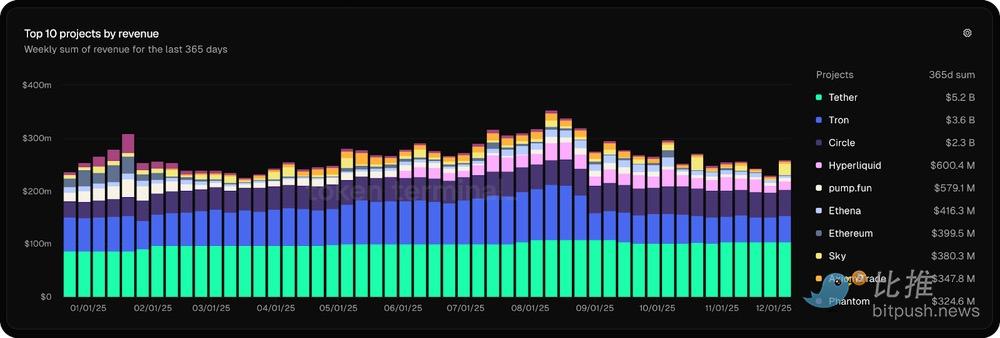
(Data source: Token Terminal)
This groundbreaking success might seem like something out of thin air if you don't keep following Hyperliquid every step of the way. But TA's path to conquest was the product of careful design, unconventional growth strategies, and well-deserved external recognition.
Here's a full review of Hyperliquid's evolution in 2025 (and why it'll really be tested in 2026):
Q1 2025: Crypto-native advantages
Hyperliquid's year of rapid growth began with a profound reminder to “really keep up with the pulse of the industry.”
当 TRUMPWhen the token was launched in January, Hyperliquid launched a perpetual contract almost immediately, getting ahead of other exchanges and starting its winning streak as the “preferred place to trade pre-issued tokens.”
Of course, part of the reason it can act quickly is that it isn't hampered by the “corporate fences” of large exchanges that protect users and companies.
But one important factor is its firm “insight” — because its team is closely intertwined with on-chain dynamics, can identify opportunities and recognize the advantages of being the first to launch these tokens. This solidifies Hyperliquid's reputation as the go-to place to trade new assets before existing giants respond.
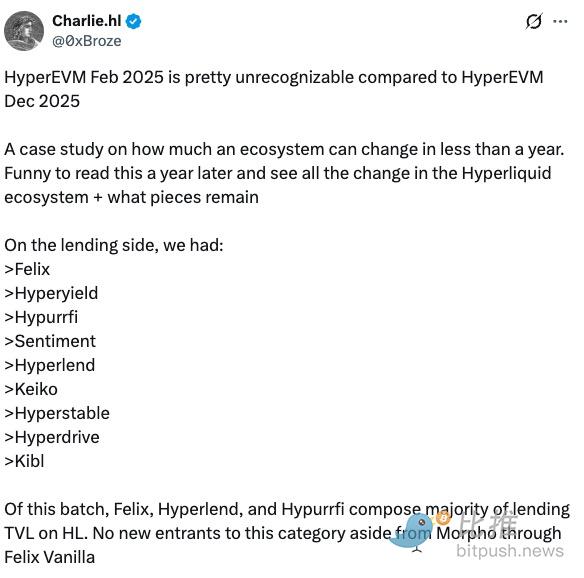
In February, HyperEVM was released — a generic smart contract layer built on HyperCore (Hyperliquid's exchange engine). Although it took some time for it to find a foothold, there was no top-down incentive plan for its success. This means that by the time it got on track in Q2, it had built a core user base that stayed there not to “jerk off” rewards, but because they believed in the chain's vision and wanted to take advantage of its unique features (such as interoperability with HyperCore) rather than just to extract incentives.
Second quarter of 2025: full outbreak
The market's attention came faster than most people expected. In addition to HYPE tokens rising nearly 4x from their April low, Hyperliquid accounted for 70% of all on-chain perpetual contract trading volume by May — an astonishing number for a platform with zero VC support and zero token incentives.
The high point of the HYPE token, the explosive growth of HyperCore activity, and the development of the HyperEVM ecosystem are spreading the Hyperliquid story.
As the market came back to life, Hyperliquid's smooth user experience (UX) and deep liquidity captured massive order flows, and total trading volume climbed to $1.5 trillion.
As mentioned, HyperEVM is also on track, with its total locked value (TVL) growing from $350 million in April to $1.8 billion in mid-June, thanks to the launch of projects (such as Kinetiq, Felix, and Liminal) and users' exploration of new earning opportunities — all of which continue to burn HYPE tokens in the background.
Amid this rapid growth, Hyperliquid seems to be everywhere.
It appeared on a national TV show, was reported by Bloomberg, and became the focus of the CFTC policy conversation. This exchange has become impossible to ignore.

Third quarter 2025: peak of momentum and beginning of differentiation
Beginning in the third quarter, there was a sign that Hyperliquid's infrastructure was becoming essential outside of its own ecosystem.
The Phantom wallet bypassed the Solana-based perpetual contract platform and chose to integrate Hyperliquid through builder codes (builder codes). The builder code is Hyperliquid's mechanism that allows external platforms to earn fees by routing transactions to HyperCore.
RabbyFollowed closely. Then there'sMetaMask。
A large number of mobile trading apps are launched through builder codes.
All in all, through these integrations, “partners” have earned nearly $50 million in fees and routed $158 billion in transaction volume.

(Data source: Hyperscreener)
Then, in September, a bid battle for USDH broke out — which revealed just how valuable and well-known Hyperliquid had become.
The problem is simple: Hyperliquid holds about 8% of Circle's USDC supply in its cross-chain bridge to direct competitors every year (Coinbase) About $100 million of revenue was leaked, and Hyperliquid's own ecosystem was unable to recover those proceeds. Issuing a native stablecoin could solve this problem, potentially redirecting $2 billion in annual revenue back to Hyperliquid.
Proposals to issue stablecoins were invited, and many heavyweight players participated in the bidding.
Ethena provided $75 million in growth commitments and institutional partnerships.PaxosI threw it outPayPal 和 VenmoThe integration even made PayPal mention Hyperliquid on Twitter.
But in the end, Native Markets won the bid—a team led by respected HYPE contributor Max Fiege, former Uniswap Labs COO MC Lader, and Paradigm researcher Anish Agnihotri.
Why can a smaller, less capitalized team beat these giants? Because they're more popular, and more in line with Hyperliquid's ethos: they are self-propelled, have the same goals, and are ready to build something truly organic — just like when Hyperliquid itself was built.

The ripple effect extends beyond Hyperliquid itself.MegaEthIts native stablecoin program was announced soon after.SuiIt also followed suit in November.
However, USDH also marked the peak of the HYPE token in mid-September — the moment competition began to unfold. Both Aster (a CZ-supported Binance exchange) and Lighter (an Ethereum L2 perpetual contract platform) were launched through aggressive airdrop campaigns. Trading volume continued to diverge, and Hyperliquid's market share split, accounting for only 17.1% at the time of writing.
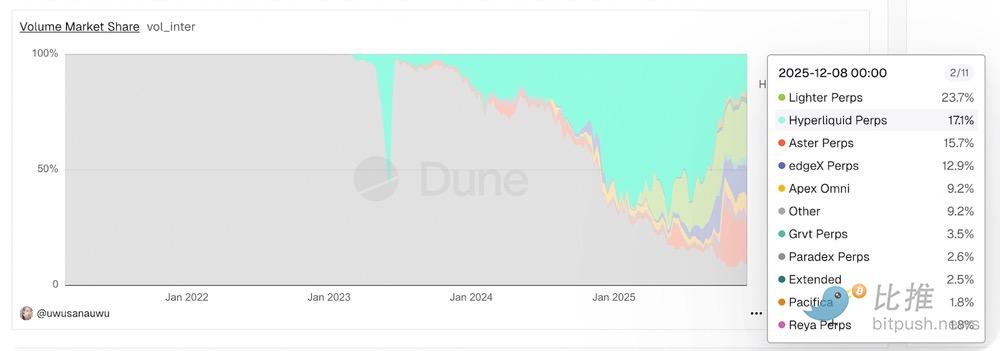
(Data source: @uwusanauwu | Dune)
Q4 2025: Maturing and growing pains
In October, the long-awaited HIP-3 was launched, opening up permissionless listing on HyperCore, which promoted the expansion and decentralization of the exchange.
Anyone who stakes 500,000 HYPE can now deploy custom marketplaces, such as:
Stock perpetual contracts from Unit's Trade.xyz and Felix Protocol
utilizedEthenaPerpetual contract market for interest-bearing collateral (such as SusdE)
A marketplace that provides synthetic exposure to unlisted companies such as SpaceX or Anthropic through platforms such as Ventuals
However, despite the launch of HIP-3, the HYPE token price has dropped nearly 50% from its peak in September.
What is the reason? In addition to the market environment and competition, two things stand out in particular.
First, this quarter Hyperliquid experienced its first ADL (automatic deleveraging) incident in more than two years. During the October 10 market crash, overleveraged positions ran out of margin faster than the clearing engine and HLP (Hyperliquid Liquidity Provider) could absorb. The agreement triggered more than 40 automatic deleveraging within 12 minutes, forcing the reduction of the most profitable positions to rebalance the ledger. While some argue that the affected positions are still “green liquidations,” others argue that the mechanism clears more than is necessary to repay bad debts. Yes, the system remained solvent, with no external funding involved, but Hyperliquid, like the entire market, may take time to recover from this incident.
Second, in November, team token unlocking began. Although the total number of unlocks was lower than expected, this ownership arrangement may also have contributed to HYPE's poor performance. The sell-off volume was minimal — only 23% went to the OTC counter, and 40% was re-staked — but it's still unclear how fast it will be unlocked in the future. My interpretation is that the core team may still be setting timelines to balance contributor equity with ecosystem health. But for an agreement known for transparency and “honesty,” this uncertainty may cause market unease.
Hyperliquid's first unlock released 1.75 million HYPES after the lockdown period ended, but the speed of future team unlocks has yet to be fully disclosed.
A testing ground for perpetual contracts
Despite the cooling of the market and trading activity, when trying to understand the reasons for Hype's poor performance, we should not overlook that the perpetual contract ecosystem has evolved profoundly as Hyperliquid itself has evolved.
Lighter and Aster are just two examples of on-chain competition. Although their trading volume may be exaggerated due to airdrop hunting, they do provide real options.
In the off-chain sector, Coinbase's perpetual contract products will soon compete with Robinhood's layout in this field. As perpetual contracts continue to become mainstream, more competitors will emerge.
In other words, Hyperliquid is in its trial phase and will continue until 2026.
The question is not whether it actually achieved significant results in 2025 — it did. The question is, as the field becomes crowded, can this exchange prove that it still has an advantage in achieving growth paths through integration methods such as builder code and a HIP-3 like decentralized model.
What brought them to where they are today is building better products and better ecosystems, and not taking shortcuts. What keeps them ahead will be to do it again。
Twitter:https://twitter.com/BitpushNewsCN
Compare the TG exchange group:https://t.me/BitPushCommunity
Compare TG subscriptions:https://t.me/bitpush
