


Can Open Source AI Platform Sentient Really Challenge OpenAI's Dominance
Author: Wenser
Kill OpenAI? Open source AI platform Sentient's ambitions don't stop there
AI is devouring the entire world at an unprecedented rate, yet the world line is quietly unfolding in two fields.
One branch line is the expansion of the AI landscape under the monopoly of tech giants: Nvidia became the world's first listed company with a market capitalization of 5 trillion US dollars with chip and video card resources; Google and Amazon have successively entered chip manufacturing to seek an advantageous position; AI giants such as OpenAI and Anthropic have jumped to hundreds of billions of dollars in valuations; the other branch line is the rapid development of the AI industry at the micro level: Nvidia founder Hwang In-hoon mentioned on CES2025 at the beginning of the year“AI Agent is expected to become the next robotics industry, with a scale of trillions of dollars”It is gradually being tested, and tens of millions of AI agents are gradually penetrating all aspects of human society every day. This also means that tech giants are gradually becoming key players “holding the key to the AI world.” Based on the development history of the Internet industry in the past, many people may wonder: is AI about to become “another game for tech giants?”
In response to this,SentientThe answer is — “No.”
As an open source AI platform adhering to internet fundamentalism, it previously received $85 million in seed funding, with leading investors including Peter Thiel's Founders Fund, Pantera Capital, and Framework Ventures. On the path that AI must take to eat the world, Sentient chose a very different path from the giant companies. And this is the “Open Source AGI Prologue” that the Daily Planet Daily will dismantle the system today.
Exploring Sentient: Holding high the banner of open source AI and facing the 100 billion market capitalization monopoly giant
Last July, SentientpronouncementsA $85 million seed round was completed, and the investment institutions behind it are luxurious — leading investors include Peter Thiel's Founders Fund, Pantera Capital, and Framework Ventures; participants include Ethereal Ventures, Robot Ventures, Symbolic Capital, Delphi Ventures, Hack VC, A series of well-known VC investment institutions in the crypto industry, such as Arrington Capital, HashKey Capital, Canonical Crypto, LD Capital, and Foresight Ventures.
You need to know that seed funding rounds have always been able to obtain this digital cryptographic project, not to mention the strong endorsement of a series of star capital behind this investment. Previously, only a few Tianwang-level L1 public chain projects were able to receive such strong support. For a while, “What made Sentient so popular with capital” became one of the hot topics of discussion in the crypto community at the time. Soon, this question was answered.
With OpenAI, the Sentient team confronts the competition of giants
In the subsequentIn a media interview, a number of partners at Sentient's leading investment agency gave their own answers —
Founders Fund partner Joey Krug said the main reason for investing in Sentient was the technical acumen of his team, co-creators Sandeep (founder of Polygon) and Pramod (professor at Princeton University); Pantera Capital managing partner Paul Veradittakit said that if AI development remains closed source, many key aspects of society will be vulnerable to the concentrated effects of scrutiny and rent-seeking impact. Sentient's open, monetized, and loyal (OML) AI model “has huge potential to disrupt the AI development industry”; Brandon Potts, partner at Framework Ventures, also gave high recognition in terms of team and technology, and bluntly stated that “the Sentient team is the team best equipped to solve the problems of the open source AI economy.”
In Sentient's proud seed funding round, the golden rule of “investing is investing in people” is fully reflected, and the team members behind the Sentient project can indeed be called an “entrepreneurial paradise” (compiled from Grok) —
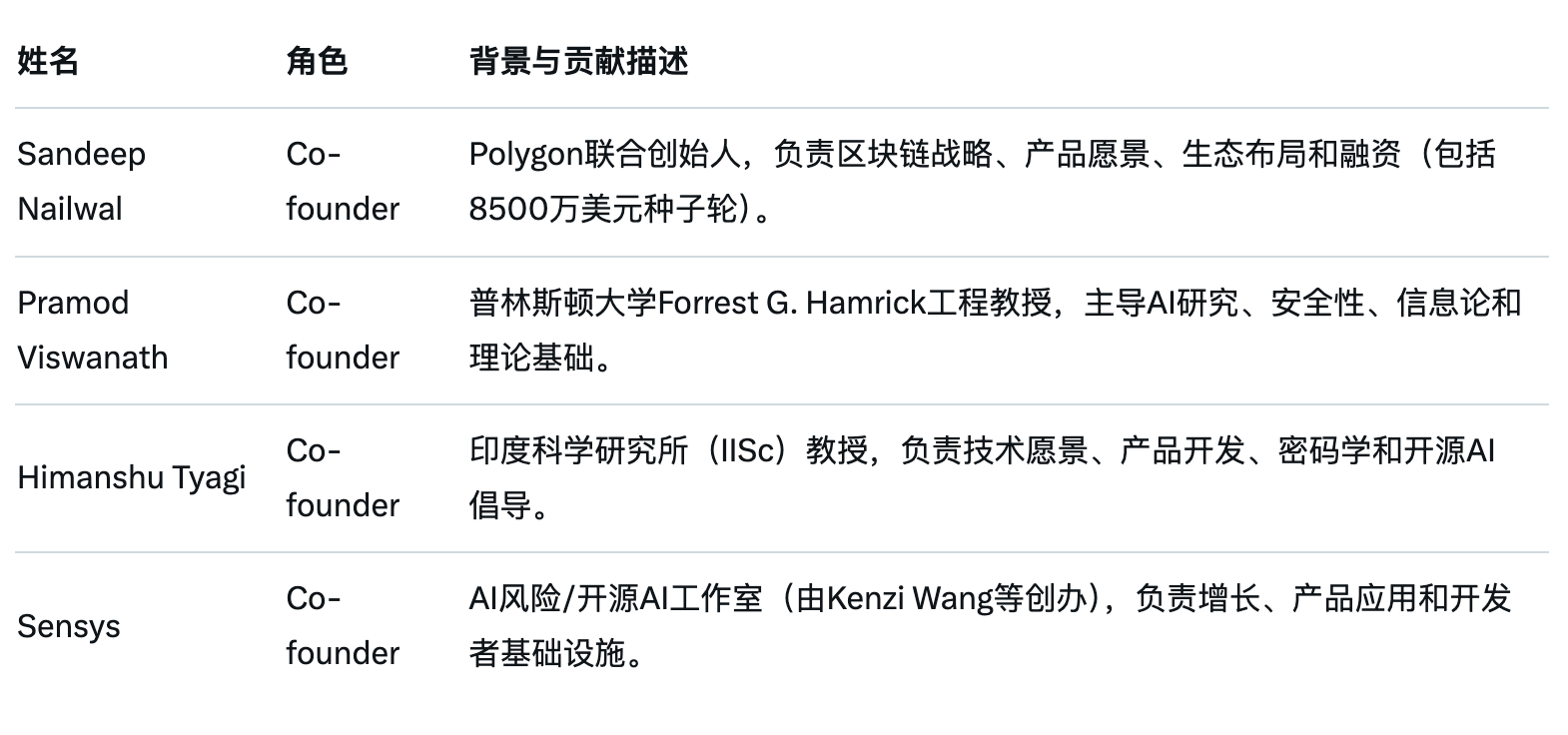
4 Co-founders of Sentient
More importantly, in this interview, Sentient's ambition was once again emphasized — facing competition with AI giant OpenAI, the company behind ChatGPT, and its main competitive method is to use community contributions to build an open source AI model.
Universal values of open source AI platforms: decentralization, censorship resistance, quantification of money
Unlike the closed-source model of AI giants such as OpenAI, Anthropic, and Google, Sentient chose a “difficult and correct” path of AGI—an open source AI platform.
Using “taking a taxi out” as an example, the AI model and application provided by commercial companies such as OpenAI and Anthropic is like a “centralized AI platform” for passengers to wear headgear. As passengers, users don't know the travel route, let alone whether the fee is reasonable; everything can only depend on the commercial company's “black box arrangement”; while Sentient's open source AI route chooses to place driving routes, specific costs, and diverse choices in front of users. Users can freely choose, and even users can “join the platform” for More users provide corresponding “solutions”. Specifically, compared to products related to existing AI monopoly giants in the market, Sentient's open source AI platform has the following advantages:
1. Ensure the diversity and interoperability of AI products. Unlike the single AI model of various giant companies, the Sentient platform has more AI models for users to choose from, and various AI models can have a certain collaborative effect, have certain interoperability, and allow users to enjoy a one-stop AI usage experience.
2. Avoid downtime and abuse of centralized AI applications and models. Previously, the OpenAI model corpus covered issues such as copyright infringement in news media, and it is an indisputable fact that the sensitive information and centralized review mechanism of the development company behind the AI model evasion. The ChatGPT disconnection incident caused by the recent Cloudflare outage also reflected the “vulnerability” of the centralized AI model from the side. In these aspects, Sentient's open source AI can provide certain technical guarantees for censorship-resistant, secure, redundant, and stable services of output content.
Decentralization and efficiency improvements in the 3.AI field. The main advantage of open source AI platforms comes from “coming from the masses to the masses”. Multilateral networks built with decentralized architectures can directly connect developers and users, match supply and demand more efficiently, so that AI models can truly serve real market needs.
A platform tool for monetizing 4.AI applications and development processes. Sentient's OML (Open, Monetization, Loyalty) AI model and GRID, an open source AGI network that has been launched, can help AI models and applications develop, feed back the ecosystem, and quantify growth through SENT token economic rewards. On the basis of ensuring ownership, control, and consistency, Sentient has thus established a network of monetization platforms that balance AI development and commercial operation.
Based on these unique advantages, Sentinet has now established a mature open source AI ecosystem.
Entering Sentient: Starting with an application, not just an application, using ecology to help grow the network
After about a year of development, Sentient has successively launched a series of self-developed products: Dobby, Model Fingerprinting (Model Fingerprinting), and Open Deep Search (Open Deep Search)Open source AGI network GRID(Global Research and Intelligence Catalogue),ROMA (Recursive Open Source AI Agent)andOpen source AI research agency Sera-Cryptoand other diverse web applications.
Furthermore, with the advent of GRID and the construction and gradual improvement of the SENT token economy model, the “AI ecosystem map” built around the Sentient open source AI platform is also in the rapid improvement stage.

据Official news, the open source AGI network GRID now includes more than 110 partners, including
Over 50 professional AI agents;
Over 50 professional data providers;
6 AI models;
Over 10 computing and verifiable AI infrastructure vendors.
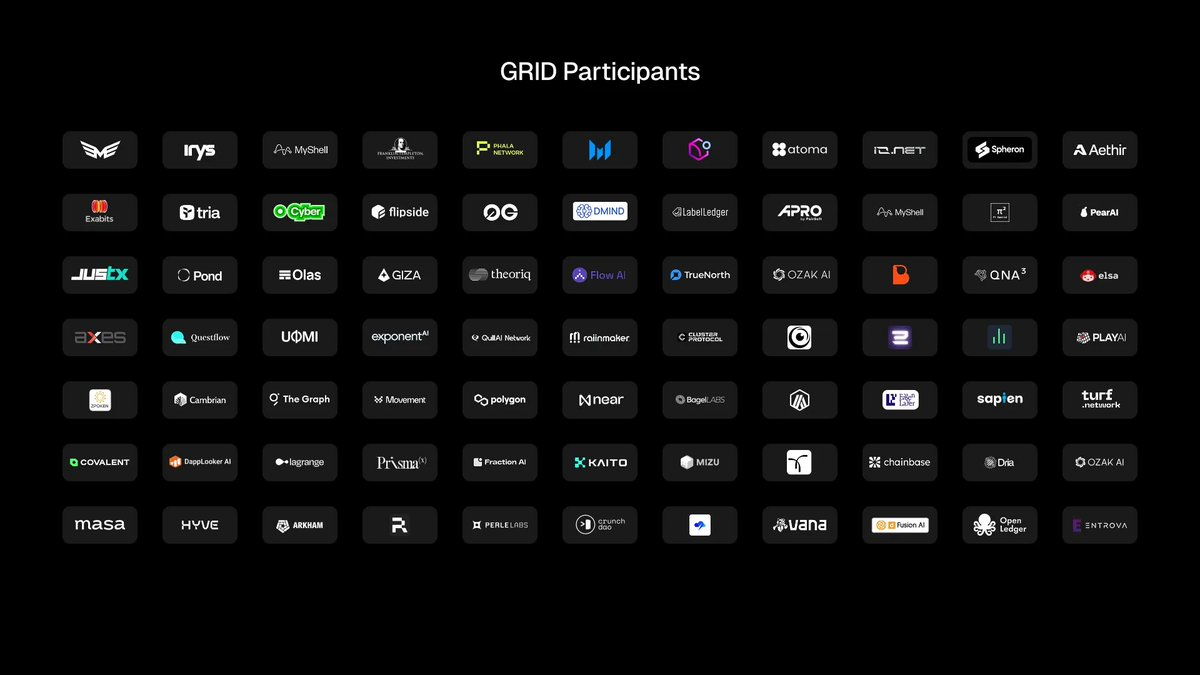
GRID Network Partners List
Representative partners include the following projects: AI chart generation project, LLM (Big Language Model) search engine Exa, AI-driven character search platform Caldo, on-chain data tracking platform Arkham, enterprise decentralized computing power platform Aethir, encrypted social data platform Kaito, cryptographic insight agency platform Messari Co-Pilot, blockchain index data platform The Graph, cryptocurrency exchange Crypto.com, Polygon public chain and Dobby Judge AI arbitration system EigenLayer network, etc. Based on the development of ecological synergy effects, Sentient's value as an open source AI platform is mainly reflected in its ability to attract developers, computing power, data builders, etc. to participate in ecosystem construction; second, it is expected to feed back the development of the open source AI ecosystem through token incentives and staking models. In particular, vertical AI models and applications closely integrated with the relevant needs of the cryptocurrency industry are expected to usher in a blowout period.
Recently launched by SentientOpen source AI research agent SeraCryptoThat's a great example. Here, we need to expand more — combining AI with cryptocurrency market conditions to assist trading decisions has always been a real need for countless people, and it is also an application direction that many developers are working hard to research, but due to the illusion of large models, market data that is difficult to update in real time, and the complexity of on-chain status queries and wallet account operations, “AI agents created for crypto investment research” have always been lacking.
SERA CryptoAs a result, AI Agen, which focuses on “semantic embedding and inference agent architectures,” won the honor of “DMind's No. 1 Open Source Agent” as soon as it was launched; in real-time cryptographic benchmarks including time correlation, data consistency, research depth, and correlation, SERA Crypto ranked first with a score of 34.3, and the overall performance was even superior to mainstream AI such as GPT-5, Grok 4, Gemini 3 Pro, and Perplexity Finance model, and all operations were completed within 45 seconds.
After combining the advantages of route framing, clear data, architecture optimization, and structural reasoning, Sera was able to filter real-time, usable, and instructive reasoning information from the “big but complete but useless” and “small but beautiful but false” information torrent. As a result, the Sentient team successfully created an “AI agent who knows more about cryptocurrencies” rather than a “rigid robotic assistant” that has no ability to think and only sums up statements. Of course, the generation of SERA is also inseparable from the Sentient community's nearly 300,000 users and more than 22 million user queries.
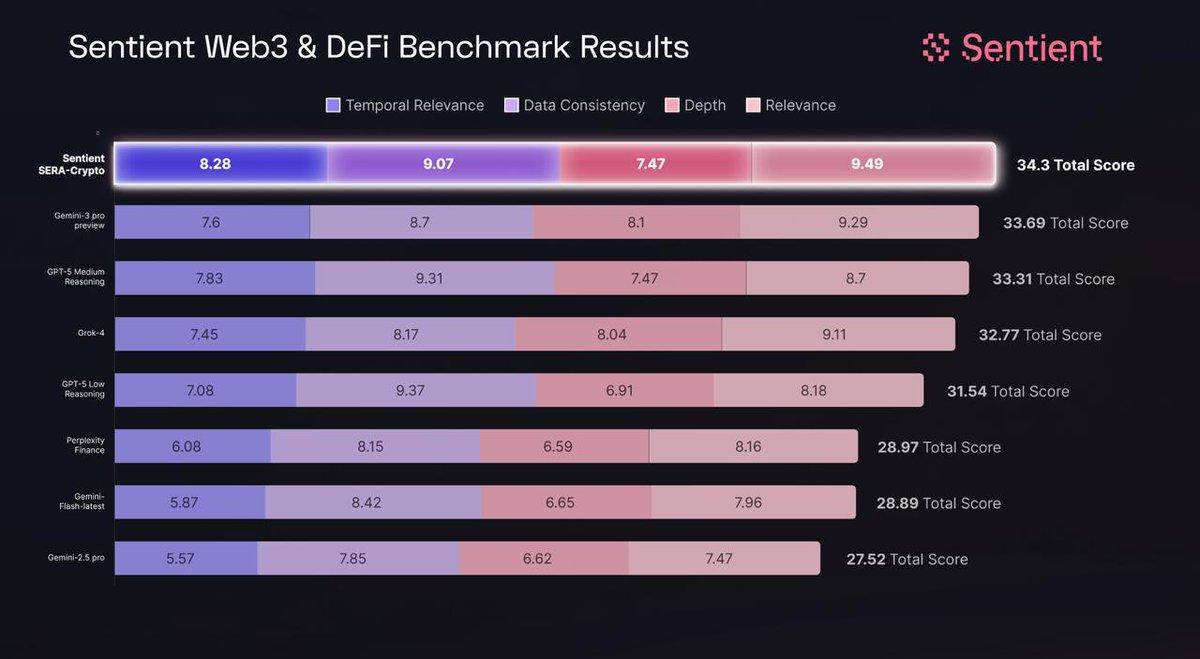
The SERA Crypto model ranked first in overall performance
Since then, users can use SNET tokens to reach various AI applications (including various platform intelligence units) through the Sentient open source platform to meet their real AI application inference needs; Sentient ecosystem developers can obtain SENT token incentives through user payments; in addition, the SENT token pledge model can ensure the smooth operation of the ecological economic cycle system to a certain extent.
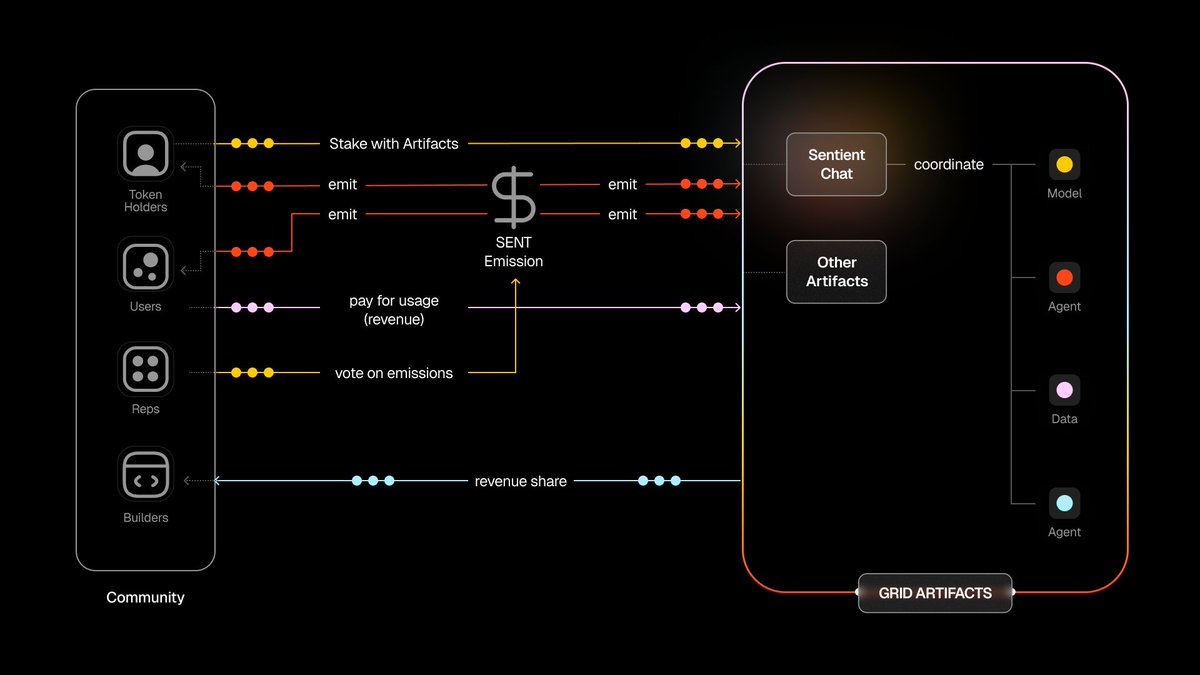
GRID Network and Sentient Community Ecological Flywheel Schematic
Eventually, the monetized AI ecosystem economy built on the Sentient open source AI platform took shape, and the subsequent optimization direction evolved — better AI models and applications attracted more AI users and developers to participate and join. The latter further spawned the production of more high-quality AI models and applications, and jointly built a four-in-one “user-token-developer-product” development flywheel.
Introduction to SENT tokens: the “core energy” driving the operation of open source AI platforms
As an “engine energy” that supports the continuous operation of Sentient's vast ecosystem, the role of SENT tokens is critical.
Previously, SENT tokens were launchedOKX premarket、Binance contract; December 6, Coinbase officialpronouncementsSENT was added to the listing roadmap. Since then, as the core token of the Sentient ecosystem, SENT has successfully achieved the achievement of “landing in the top 3 CEXs”.
Previously, Sentient officially announced the official end of the first quarter of the campaign on November 17. At that time, the token airdrop was mainly aimed at Sentient community members (including Discord community members), AI chat users, crypto KOLs, open source researchers, etc. On November 18, itsOfficial airdrop registration linkOfficially opened. The original planned deadline was November 29. Subsequently, the officialDelayed registration deadline until December 5。
According to the officialInformation to be released later及Official Staff NewsLooking at it, more SENT token incentives for the community will be closely related to social media content contributions such as the X platform and AI mentality share of encrypted social data platforms such as Kaito.
In addition to regular participation in the use of the Sentient Chat platform and application,AI model, AI agent, and application developmentWaiting the path to help the Sentient ecosystem expand publicity and marketing may be the main line of the SNET token airdrop campaign for the second season. For more details, please followOfficial X account或Official websiteCheck it out.
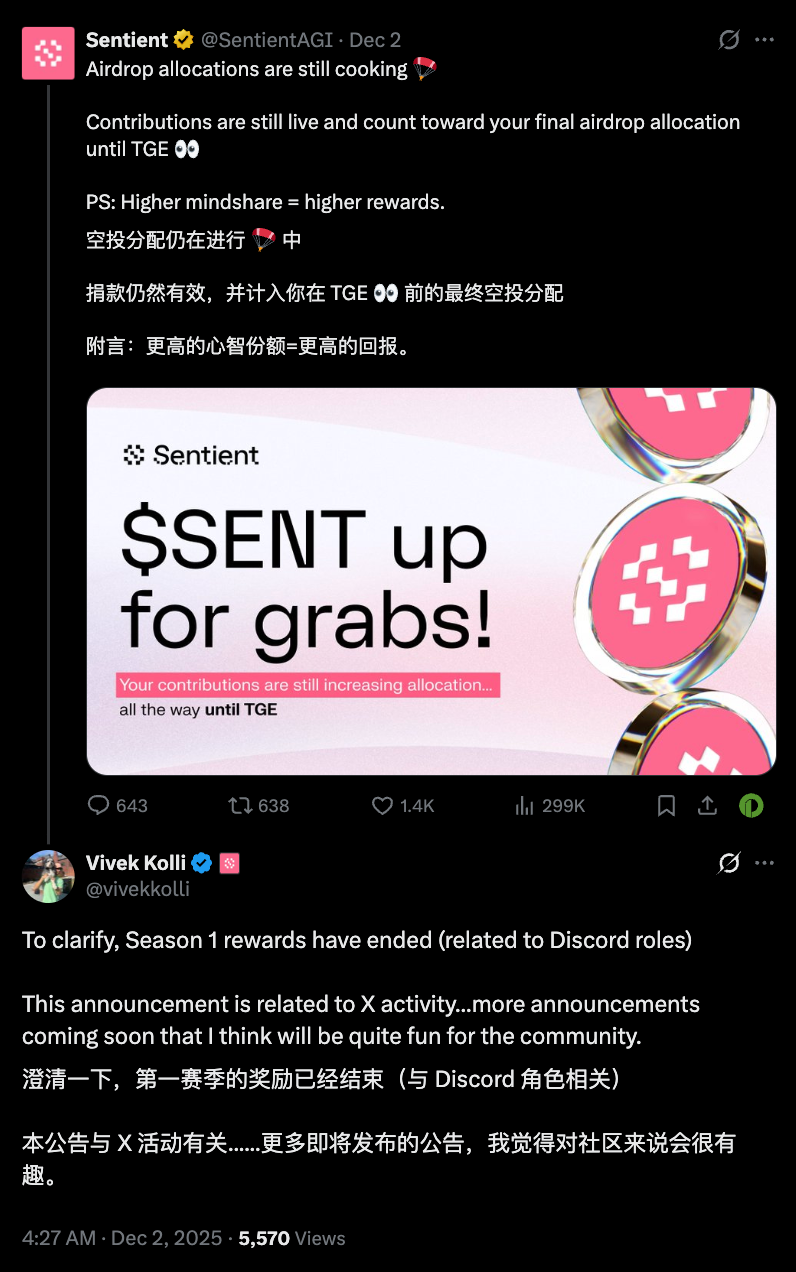
Officials clearly signify
Conclusion: The self-evolving limits of open source AI far exceed human imagination
As the development of the closed source AI model gradually falls into a homogenization impasse, open source AI may become an important force driving artificial intelligence into the deep-water zone. Just as the open source Android system led to the rapid development of smartphone devices and the advent of mobile internet back then, the open source AI platform represented by Sentient is not only an AI chat application, but also a complete open source AI ecosystem — including the underlying protocol, system architecture, and specific models and AI agent applications.
More importantly, unlike closed source AI models and applications, open source AI can “self-evolve” to a certain extent, which is a direction Sentient decided when it first chose this “difficult but correct path.”
While OpenAI was still struggling with new products from competitors and had to shut down Sora, Sentient decided to embark on a more universal AI development path that was in line with the open source community's pursuit. In an era where carbon-based life is the forerunner of silicon-based life, open source AI platforms have brought not only the dawn of an AGI network, but also an open source AI ecosystem that focuses more on loyalty, monetization incentives, consistent service, and fewer “AI illusions.”
Twitter:https://twitter.com/BitpushNewsCN
Compare the TG exchange group:https://t.me/BitPushCommunity
Compare TG subscriptions:https://t.me/bitpush
