

From “dead” explosion to asset “immortality”: How do crypto players set up on-chain wills?
author:Maher, Foresight News
Original title: Is it dead? The app is exploding, how can crypto players “insure death” their assets?
At the beginning of 2026, an app called “Is It Dead?” spread like a virus on social media. This tool, developed by a team of three young post-95 people, went live at a cost of more than 1,000 yuan and a month, but in just a few days it topped the Apple App Store's top ranking of paid apps. The number of paid downloads skyrocketed 200 times, and the valuation soared to 10 million yuan. The core function of the app is simple but it hits the pain point: users need to manually sign in every day to confirm that they are “alive”. If they do not operate for two consecutive days, the system will automatically send an email notification to the pre-set emergency contacts.
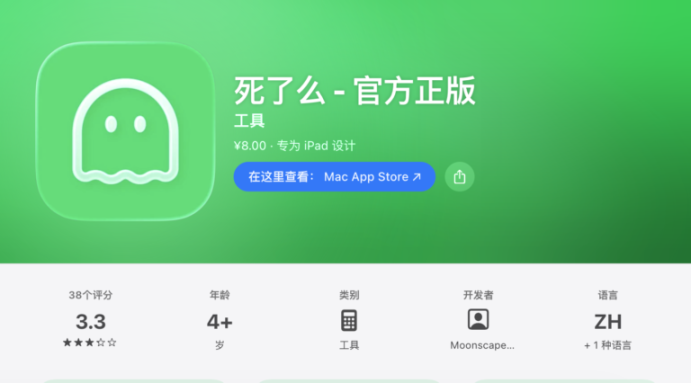
Developer Xiao Guo said in an interview that there were few users at the beginning of the launch, and until after the most recent update, traffic suddenly exploded, even triggering imitators and competition. Officials have announced that it will change its name to “Demumu” in order to go overseas and go global, but the popularity of this app goes far beyond the product itself; it reveals a hidden yet common anxiety in contemporary society — “dying alone.”
Living alone has become a trend, even more so in the field of encryption
Behind the explosion of “are you dead?” is the accelerated expansion of the global trend of living alone. According to 2026 data, China has more than 100 million people living alone, with young white-collar workers accounting for more than 40%. These people who live alone often choose or are forced to live alone due to high work pressure, urbanization, and social fragmentation, but they face the risk of unexpected accidents and unaware of them. Undeniably, it reflects social changes in the post-pandemic era. Around the world, living alone has become a mainstream trend.
According to Euromonitor International data, households living alone will account for 30% of the global total by 2030, especially in Asian, European, and American metropolitan areas. The proportion of young people living alone will continue to rise due to economic independence and diversification of lifestyles. This is not only a life choice, but also a psychological burden: “dying alone” in Japan has become a social issue, and China is also frequently reporting similar news. The popularity of “die?” apps is a collective response to this hidden concern.

This trend of living alone is particularly prominent in the cryptocurrency sector. The crypto industry is inherently endowed with distributed and decentralized genes, and most of the practitioners are younger generations. According to the 2025 Coinbase report, the average age of crypto users is between 25-35, and many are post-95 or post-00. They often work intensively remotely, such as traders, developers, or community managers, where 24/7 tracking, code debugging, and market analysis make the office concept redundant.
According to ZipDo's 2025 statistics, 68% of workers in the crypto industry prefer to work remotely, and 52% of startups report that the remote model has increased productivity. According to LinkedIn's Crypto Work Culture report, 94% of crypto teams plan to keep remote work permanently, which is far higher than 22% in traditional industries.
Although flexible, this lifestyle increases the risk of living alone: workers may be scattered all over the world, lack a fixed social circle, and the intensity of work increases health risks. Imagine a cryptocurrency trader living alone who has a sudden heart problem at home. His crypto assets worth hundreds of thousands or even millions are worth. What will happen?
The explosion of the “Dead?” app has made many crypto investors begin to reflect on what to do if they encounter an accident.
Crypto practitioners need to be fully prepared on exchanges and on-chain wallets
In the face of this reality, crypto practitioners need to be fully insured in terms of exchanges and on-chain wallets.
First, establishing an “inheritance mechanism” is the key. Traditional bank accounts have a testamentary inheritance, but encrypted non-custodial wallets (such as MetaMask or Ledger) rely on private keys, and assets can be permanently lost once the holder dies. To this end, using a multi-signature wallet is basic protection: for example, Gnosis Safe requires multiple keys to jointly authorize the transfer of assets. You can designate a trusted family member or friend to hold a backup key and explain the process in your will.
Second, the “Dead Mans Switch” (Dead Man Switch) mechanism was introduced, which is a smart contract automation tool. If the holder is inactive for a long period of time (such as no login or confirmation), the contract will automatically trigger an asset transfer. Many years ago, the Sarcophagus sarcophagus protocol was developed in response to this need. It is a decentralized “death switch” based on Base+ Arweave that can post files to any Ethereum address or public address at any time. Additionally, a verifiable key introduced by Dfinity in 2025 can also be used as its “disable switch.”
Some mainstream exchange platforms have introduced policies for deceased users to prevent assets from “dying.” Binance and Coinbase require heirs to submit death certificates, identity verification, and court documents, which usually take 3-6 months to process. In 2026, Binance updated its “Designate Beneficiaries” feature. Users can preset inheritance accounts, and the platform transfers assets after death is confirmed, avoiding previous legal disputes.
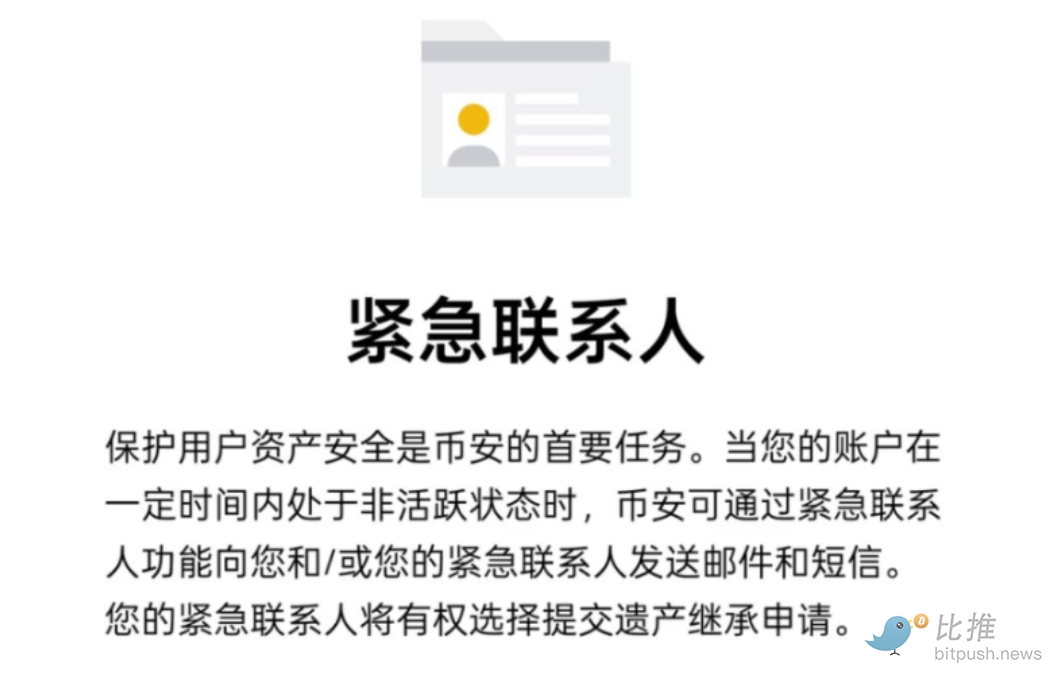
Kraken also provides an “emergency access” option, which allows users to upload encrypted inheritance instructions. DeFi protocols such as Aave or Uniswap are more decentralized, but are also beginning to integrate insurance modules: Nexus Mutual provides “smart contract coverage,” including asset protection in the event of an accidental death. The Global Wealth Protection report emphasizes that using a trust structure is an advanced strategy — placing crypto assets in a “revocable living trust”, controlled by the holder during life, and automatically transferred to the beneficiary after death, without the need for a probate process.
Of course, these methods are not foolproof. Dead Man Switch may be used by hackers (requires regular updates). Exchange policies rely on centralized trust, and once the platform goes out of business or thunderstorms, it is often difficult to recover losses. However, rather than ignoring risk, this is one of the active protection methods that crypto players can participate in. Crypto is more than an investment tool; it's also a mirror image of a lifestyle.
In the age of living alone, protecting assets means protecting the future. As a crypto practitioner, you might as well start setting up your “proof of being alive” today — not just an app sign-in, but a legacy plan that lasts forever on the chain. After all, in this distributed world, no one wants wealth to go with the wind.
Twitter:https://twitter.com/BitpushNewsCN
Compare the TG exchange group:https://t.me/BitPushCommunity
Compare TG subscriptions:https://t.me/bitpush
