


The “Crypto President”'s Annual Report Card: Policy Dividends and the Dual Role in Wealth Disputes
Author: Wenser
Original title: “Crypto President” Trump's Report Card: How many promises has he fulfilled in his first year in office?
On January 20, 2026, Trump will celebrate his first year as the 47th president of the United States. Over the past year, from the crypto market to the global economy, fluctuations and ups and downs often seemed to be tied to him alone — one word was enough to ignite market optimism and drive assets to skyrocket; one phrase could also be a trigger for decline, triggering a series of “liquidation bombs.”
Today, he is known by many as the “President of Crypto.” So, during the year, what key actions did Trump take, not only to defend this title, but also to establish it step by step? Looking back, maybe these 5 major events can reveal the answers for us.
Big deal 1: It was a breakthrough, and the president also issued meme coins
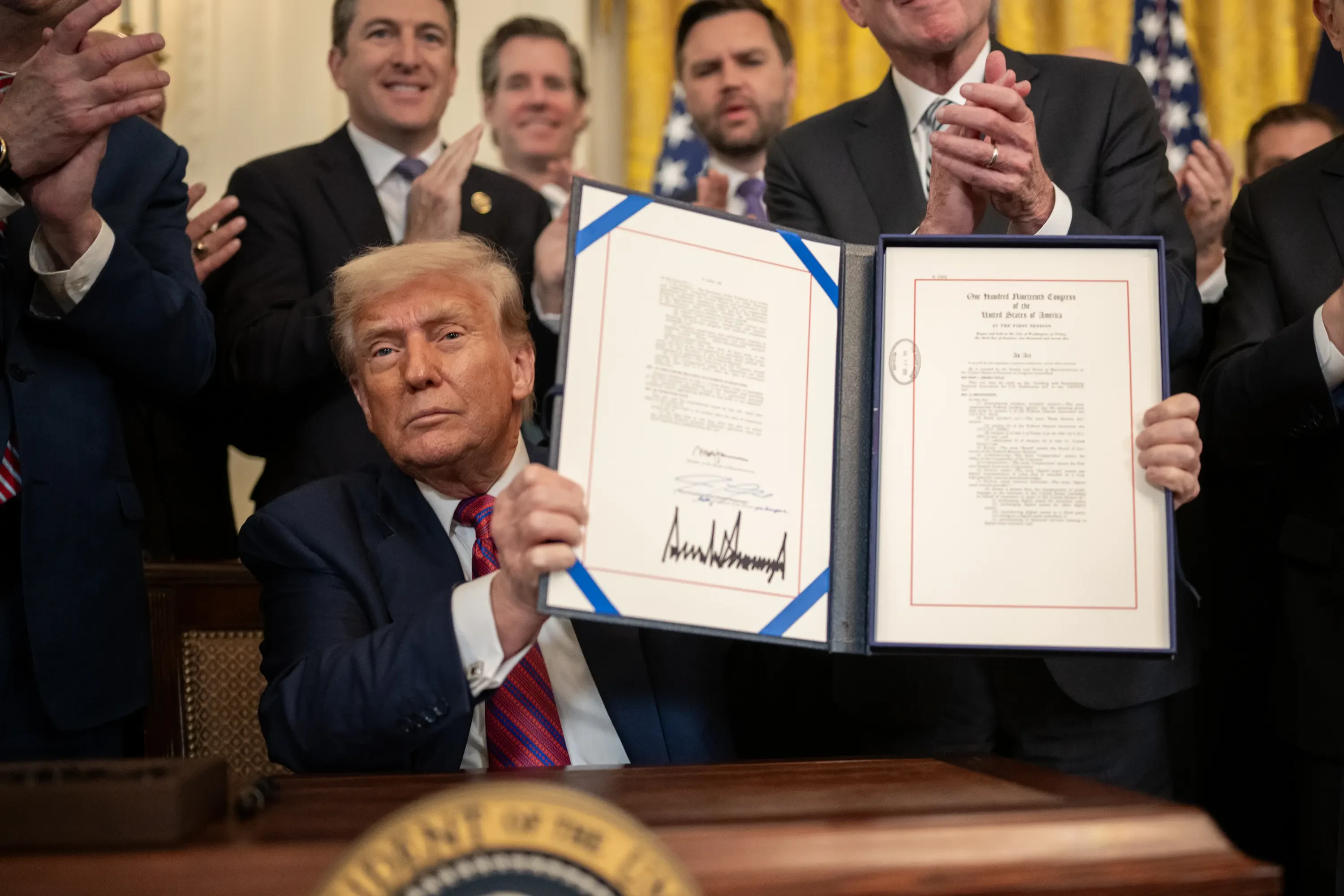
On January 18, 2025, Beijing time, on the eve of taking office as president, Trump's official official meme coin, TRUMP, was officially launched. In just one day, the price of TRUMP quickly rose from $0.5 to around $28. A large number of cryptocurrency traders have earned unimaginable wealth, and some have earned millions or even tens of millions of dollars in profits.
And Trump, as the “center of the eye of the storm,” took advantage of this to soar in value — due to the launch of TRUMP tokens, Trump's worthIt soared more than 400% overnight to an astonishing $28 billion; By comparison, Forbes estimated Trump's net worth at only $5.6 billion in November 2024. Furthermore, in less than three days, the market value of the TRUMP token FDV skyrocketed to nearly $80 billion, and the price was once close to $80 billion.
After experiencing the “meme coin frenzy” in 2024, the crypto market welcomed the “President of the United States” as a heavyweight political player, thus once again opening the “ceiling of influence” of cryptocurrencies, and countless people pinned their hopes of becoming rich overnight on Trump and TRUMP tokens.
After all, “the President of the United States issued a meme coin”, which is the first time in the cryptocurrency industry, it can be called a “groundbreaking first time.”
But the reverse side of becoming rich overnight is a relentless harvest — countless people's pursuit of “presidential meme coins” can only slow its decline, not help it continue to rise.
January 23,Most TRUMP token holders are still in balance or profit/loss is within $1,000; However, by the beginning of February, as TRUMP's trading activity declined and prices plummeted,The number of wallet addresses that have lost positions has reached an astonishing 200,000。
According to Chainalysis statistics, around 810,000 wallets lost money on TRUMP tokens, totaling over $2 billion, and an average loss of $2,500 per person. In contrast, as of May 2025, the issuers of TRUMP tokens (Fight Fight Fight LLC and CIC Digital) only relied on transaction feesRage made over $320 million; Not to mention the tens of billions of dollars worth of TRUMP tokens that it holds.
The advent of TRUMP can be called an expensive and costly “crypto elective course,” and its subsequent impact is not limited to token price performance:
First, after TRUMP, the market's enthusiasm for celebrity coins was once rekindled. Countless people scrambled to buy Mrs. Trump's meme coin MELANIA and the meme coin LIBRA endorsed by Argentine President Millet. Even the President of the Central African Republic wanted to share a share of the pie, but in the end, they also reaped the market with liquidity;
Second, TRUMP has become “irrefutable proof of Trump's corruption” in the eyes of Democrats. This allegation isA report for the second half of 2025It was explained in detail, and it was also the beginning of Trump's demonstration of a “crypto-friendly regulatory attitude,” and the dispute between the two sides over this has continued even now;
Third, the TRUMP token became the “best medium” for Trump to get in touch with people in the cryptocurrency industry. On the one hand, Trump used this to convey his “pro-cryptocurrency political position” to the outside world; on the other hand, TRUMP became a “currency carrier” for Trump's in-depth exchanges with people in the cryptocurrency industry.
In April 2025, for TRUMP's top 220 holdings“Trump Dinner”Registration is officially open, launched in just a few days$2.4 billion on-chain transfersAt one point, the price of TRUMP rose 60%, and on-chain activity surged 200%. Many people did not hesitate to spend millions of dollars just to meet Trump. Ultimately, TRUMP meme coin buyers are in a position raceA total investment of approximately US$148 million,Each person holds nearly $4.8 million in TRUMP, of which,Sun Yuchen ranked first with over 1.43 million tokens。
On the one hand, there are retail traders in the market who pay for “presidential concept meme coins”; on the other, a “crypto dinner” where money is mixed and glasses are exchanged. It can be called a “encrypted version of Jumen wine stinks.” It unravels the harshest and most realistic aspects of all living beings in the crypto market — a few happy and a few sad, only the bookmakers sneer.
Major event 2: “Three fires for new officials to take office”, layoffs, employment, and exclusion of opponents
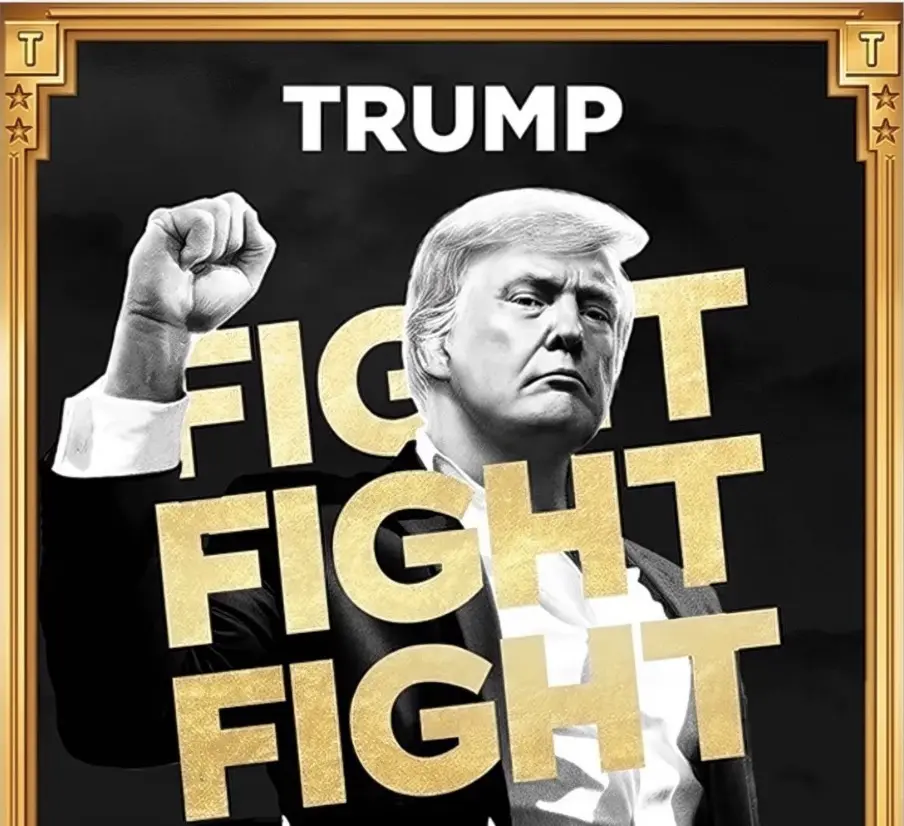
On January 21, 2025, Beijing time, Trump was officially sworn in as the 47th President of the United States, becoming another “twice elected President of the United States” honor after Washington, Roosevelt, and Obama.
Naturally, it was a political drama of “one dynasty, one king, one minister.” Meanwhile, Trump, who has served as the previous US president, is also quite old about personnel appointments:
The first step is to “kill the chicken and watch the monkey.” As Trump previously stated at the Bitcoin conference, on his first day in office, he vigorously fired former US SEC Chairman Gary Gensler, who had previously implemented high-pressure cryptography regulations, and established his strong “pro-cryptocurrency” personality.
The second step is to “settle down”. In just 3 months, Trump quickly sorted out his team of personnel and placed people who are highly consistent with his political opinions, who own cryptocurrency assets or are crypto-friendly, into various key departments of the administration, including White House AI and crypto adviser David Sacks, SEC Chairman Paul Atkins, Treasury Secretary Scott Bessent, and Secretary of Commerce Howard Lutnick.
The third step is “On Protracted Warfare.” As the chairman of the US Federal Reserve appointed by Trump, Powell has always been regarded as the “backbone of the Federal Reserve's policy,” but his hawkish fiscal strategy runs counter to Trump's idea of releasing liquidity and stimulating economic development through interest rate cuts. As a result, the dispute between the two continued throughout 2025 — beginning in April 2025, TrumpFrequent bombardment of Powell should cut interest rates as soon as possible; By December 2025, the nomination dispute for the new chairman of the Federal Reserve will remain a major event affecting the crypto market and even the US economy.
Looking back at Trump's appointments and management of government departments, it's hard to think of him as a well-handled politician who is good at compromise; on the contrary, judging from the end results, Trump always uses various methods to achieve his political goals, and sometimes even harms so-called “overall interests.” The farce of “the longest shutdown in the history of the US government” where the US government shut down for 43 days last year is also one of Trump's own “political masterpieces.”
But on the other hand, the goal of all of Trump's actions is extremely clear — remove the remnants of the Democratic Party from the previous Biden administration and lay the political foundation for crypto-friendly regulation. Thanks to these people, a series of “old cases” came to an end — judicial investigations on crypto platforms such as Coinbase, Gemini, Robinhood, Ripple, Crypto.com, Uniswap, Yuga Labs, Kraken, and Polymarket have been terminated, and the US Department of Justice's National Cryptocurrency Enforcement Group, which has always carried out high-pressure supervision, has also been dissolved, and the Biden administration's “crypto suppression operations” are over.
After all, just like cleaning a clean house and inviting customers, getting rid of a group of old officials and promoting a new group of “own people,” only then can government agencies operate as efficiently as a machine, and be fully prepared for future crypto-friendly regulation legislation and enforcement.
Major 3: “Using the Ritsuryo Code to Make History”, Establishing BTC Strategic Reserves, and Promoting Legislation of the Three Major Crypto Laws
If the first two major issues are necessary preparations for “crypto-friendly supervision,” then the third major issue is a necessary component of “crypto-friendly supervision” — that is, implementing crypto-friendly supervision at the level of legislation and enforcement through executive orders and laws. And this series of historic breakthroughs is the biggest reason why Trump is called a “crypto president.”
A presidential executive order was issued to use confiscated assets to promote the establishment of the US BTC strategic reserve
In March 2025, Trump issued a presidential executive order to push the US to establish a BTC strategic reserve. Since then, as the world's number one economic power, the US has for the first time used the name of a national government to reserve crypto assets such as BTC, which also means that in a sense, BTC has the same important strategic reserve position as gold. Although Trump chose a more coincidental approach to push the matter (Daily Planet Daily note: building a strategic reserve of BTC through nearly 200,000 BTC previously forfeited by the US government, and stating that it would not use national assets or increase the burden on citizens), the impact was far too far-reaching.
On the one hand, the US BTC strategic reserve has provided an example for many sovereign countries to incorporate crypto assets such as BTC into their own economic systems, further expanding the mainstream and popularization of BTC and other crypto assets; on the other hand, this move also provides a sample example for more DAT treasury companies, and also provides national-level approval for the financial policies of BTC treasury companies such as Strategy and Metaplanet. Subsequent from July to September 2025, a large number of listed companies followed the example of establishing BTC treasury, ETH treasury, and SOL treasury, which was also affected to a certain extent by this incident.
Stablecoin Genius Act “GENIUS Act” signed to consolidate the hegemony of the US dollar
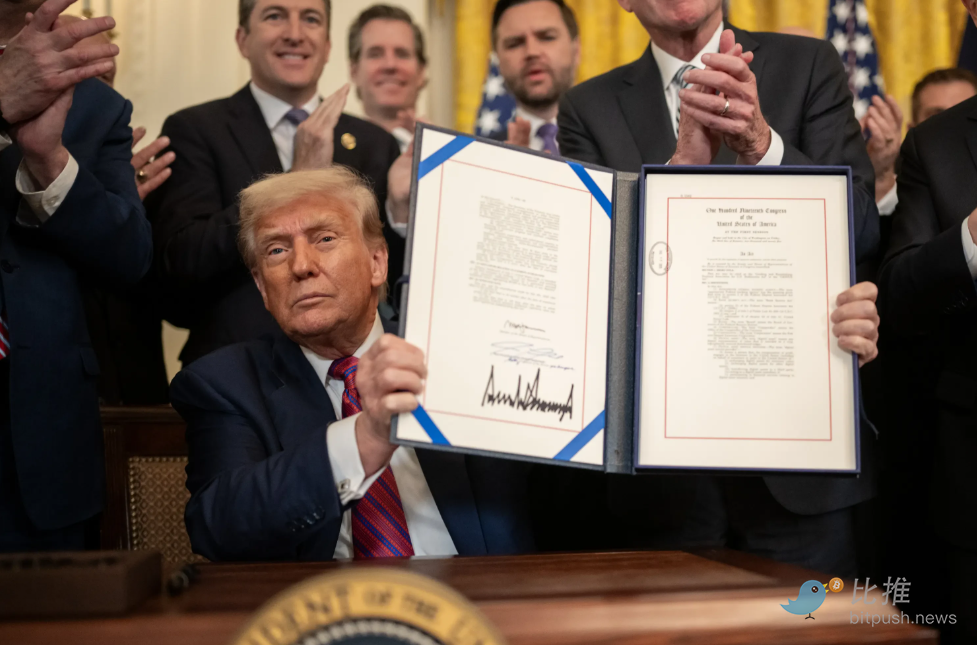
In July 2025, Trump officially signed the stablecoin genius bill “GENIUS Act,” and since then, a golden age of stablecoins has begun.
Specifically, the Act provides detailed regulatory definitions and rules for stablecoins that have previously had vague boundaries and lack regulation in terms of the definition of stablecoins for payment, dual licensing and supervision requirements, mandatory transparency disclosure, anti-money laundering compliance, priority user protection, and clear regulatory ownership.
At the same time, the bill is not only the first federal-level stablecoin bill in US history, but also the first cryptocurrency bill signed by the US president. Its historical status and industry significance are extremely special. Of course, the stablecoin system, which is deeply tied to the US dollar, once again coincides with Trump's “America First” political strategy, further strengthening the US dollar's hegemonic position in the global economic system.
Affected by favorable effects such as the passage of the Stablecoin Genius Act, the BTC price rose to a record high of around $110,000; on the other hand, the Stablecoin Genius Act also added fuel to Circle's crypto IPO, helping its stock price skyrocket tenfold from around $30 at the time of the IPO to nearly $300. As a result, this major benefit alone has led to the rapid development of the US stablecoin sector, the Hong Kong stablecoin circuit, and even stablecoin, PayFi, and crypto payment circuits around the world.
Furthermore, under Trump's strong impetus, the other two major crypto bills, the “CLARITY Act” and the “Anti-CBDC (Digital Dollar) Act,” also passed the House of Representatives one after another, and cryptocurrency legislation has taken a solid step forward. Just like the promises made before, Trump once again set an example, clarified the classification and regulatory ownership of digital assets, and promoted the development of the DeFi industry; he refused to establish a central bank digital dollar to protect the digital asset self-custody rights of US citizens.
Today, although the CLARITY Act has stalled in stages due to Coinbase's opposition and the blocking of Senate approval, it is now a historic moment for many breakthroughs at the legal level compared to the “historic gap” in the past.
Perhaps Trump, who served as US President twice, also understood that compared to various law enforcement activities when he came to power, using legislation to fix his own policy agenda and political will in the form of a law is a longer-lasting and more effective political method.
Big 4: Waving the tariff stick, the market soared and fell, and the crypto market became an insider stage
If the above events show the side where Trump plays a role and is beneficial to the crypto market, then I believe it's hard for many crypto people, including me, to laugh when it comes to the “big tariff stick.”
There is no reason for this, simply because every time Trump launches a foreign tariff trade war and sends hawkish signals, the crypto market and even traditional financial markets fall in response, and blood flows. No wonder people lament that Trump initiated a tariff trade war, but in the end, it was the wallets of our crypto users that paid for it.
In April, August, and October 2025, the three large-scale tariff trade wars initiated by Trump all dealt a heavy blow to the crypto market —
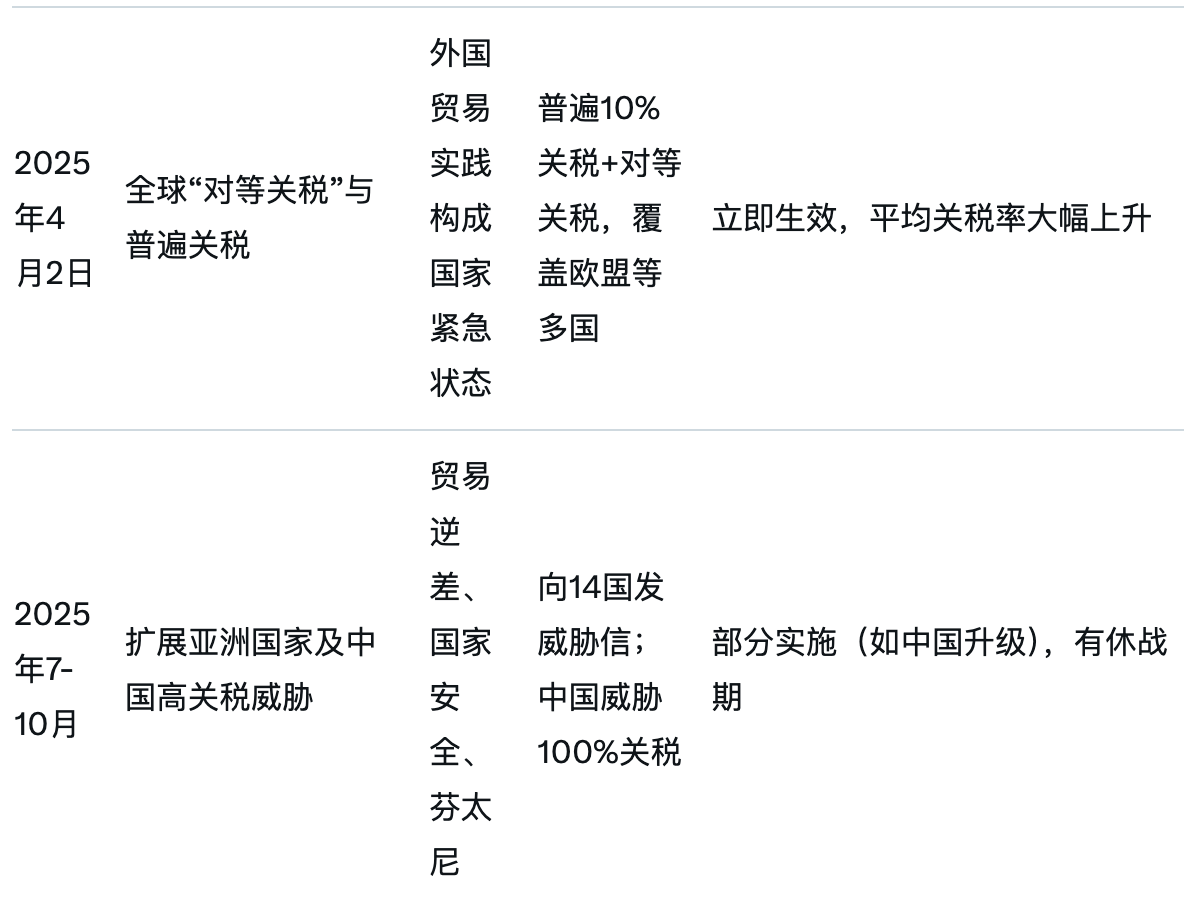
In April of last year, Trump initiated global equal tariffs and universal tariffs. The tariff level was increased by more than 10%, covering many countries in the European Union; he even proposed raising tariffs on China to 125% and suspending tariffs on friendly countries. Affected by this, the cryptocurrency market capitalization once fell by as much as 10% in a single day. At one point, the market value of the US stock market fell to 6 trillion US dollars within a few days, and countless individual stocks were bloodshed;
In August of last year, Trump signedLatest Tariff Executive OrderIt was decided to impose tariffs of 15% to 41% on imported goods from 67 trading partners, raising the overall tax rate to the highest level in more than a century. Affected by this, the overall cryptocurrency market suffered a setback. The three major currencies of BTC, ETH, and SOL fell by about 5% in a single day, falling sharply from their all-time high; subsequently, the tariff order came to an end with a 90-day suspension;
In October of last year, Trump once again initiated a tariff war, and the trade relationship between China and the US became cold again.affected by this messageAt one point, BTC fell more than 13%, ETH once fell by more than 17%, and countless altcoins fell by more than 30%; combined with factors such as the flash liquidation of exchanges, the crypto market's capital settlement scale reached 20 billion US dollars in a single day, and the actual volume of liquidated funds is estimated at 30 to 40 billion US dollars.
According to statistics, in 2025, the average effective tariff rate in the US rose to 27%, the highest level in nearly 100 years, triggering policy retaliation by major global economies and supply chain disruptions in the global economic system.
Tariff trade wars over and over again have brought about not only panic in the crypto market and traditional financial markets, but also a series of declines caused by panic. Moreover, in the midst of sharp market fluctuations caused by tariffs, insiders with insider information used this long and short trade to obtain huge financial returns, which also cast a shadow over the normal order of the crypto market.
It is worth mentioning that the rampant insider trading and Trump's erratic tariff policy have also contributed to the crypto market with the buzzword “TACO-style trading” (Odaily Planet Daily: Trump Always Strikes Out, meaning that they start tough for profit, then soften their attitude and turn dovish). Countless crypto giant whales use this expectation to reap their share of wealth from the crypto market.
Today, the “10.11 Insider Whale” Garrett Jin is still active in the market, and he is also regarded as an insider in the Trump family or Trump faction. In addition to its operations in the contract market, its early bet on “Trump's amnesty for CZ” was also viewed as evidence of “insider trading.”
Big 5: Family wealth skyrocketed, Binance founder CZ pardoned
Compared to the slightly rampant insider trading, Trump's other criticised sticking point is his family's crypto project WLFI and a series of highly controversial crypto business layouts. Furthermore, Trump's amnesty for CZ in October of last year sparked widespread discussion in the market.
Trump's “Getting Rich”: Family Wealth Skyrocketed by $1.4 Billion a Year
According to BloombergOver the past year, crypto assets have increased the Trump family's wealth by about 1.4 billion US dollars. Currently, the share of cryptocurrencies in the Trump family's total net worth of about 6.8 billion US dollars has jumped to about one-fifth for the first time.
During Trump's second term, the Trump family received significant benefits through new projects such as the crypto platform World Liberty Financial (WLFI), the meme coin (TRUMP) named after it, and the Bitcoin mining company Bitcoin American Corp. (ABTC). Among them, World Liberty's platform coin WLFI and stablecoin USD1 business are valued significantly.
Meanwhile, Trump Media & Technology Group's stock price fell 66% over the past year, partially offsetting gains from crypto assets; members of its family have also invested in companies such as SpaceX through venture capital firm 1789 Capital and expanded the Trump Group's global real estate licensing business.
As for Mrs. Trump's meme coin of the same name, MELANIA, which was issued after the TRUMP coin, it didn't even count as a bonus. Furthermore, according to a personal financial document disclosed by Trump in June 2025, as of January 2025, Trump himself still holds about 15.7 billion WLFI tokens, which are still worth about 2.6 billion US dollars at current prices.
One year after coming to power, Trump and his family obtained billions of dollars of wealth through business development, political donations, and various well-named events and dinners, which made people sigh: they are worthy of being a family of US presidents born in real estate companies.
Trump uses presidential prerogatives to pardon CZ: a handshake between crypto regulation and government power
Another thing worth mentioning separately is Trump's amnesty for Binance founder CZ.
On the evening of October 23, 2025Wall Street Journal newsAllegedly, Trump pardoned Binance founder CZ, and recently indicated to advisers that he sympathizes with the political persecution rhetoric associated with CZ and others. White House press secretary Caroline Levitt said in this regard that Trump “exercised his constitutional powers to pardon Mr. Zhao, and CZ was prosecuted during the Biden administration. “The Biden administration's war on cryptocurrency is over,” she added. ” Since then, CZ's previous 4-month prison sentence and Binance's $4 billion fine have ushered in a moment of redress.
Of course, due to Binance's previous in-depth business dealings with WLFI (Daily Planet Daily Note: Previously, Binance received an investment of US$2 billion from MGX from the UAE sovereign fund, in the form of USD1, a stablecoin issued by WLFI, the Trump family's crypto project), and Binance had hired Trump Jr., the oldest son of Trump. Close-knit lobbyist Ches McDowell helps seek pardon, the crypto market and evenSome US Democratic senators are questioning whether there is bribery or corruptionOutsiders generally question whether amnesty for CZ or the existence of political favors.
Today, the matter has come to an end, but speculations and criticism about Trump's use of power for personal gain and family profit are still rampant.
Conclusion: Trump has never changed; he has always been a businessman type politician
No matter what the outside world says, Trump, as the president of a country, is still sitting on Diaoyutai, carrying out his duties and enjoying his power. Over the course of his nearly 80 years of life, his personality has probably never changed—he has always been a businessman who believes in value exchange and puts profit first.
As for the title of “Crypto President” and his vision of “building America into the crypto capital of the world,” they are nothing more than Trump's appendages to maximizing the role of crypto assets.
For this old man in his eighties with pure ancestry, “America First” is still the philosophy of survival he believes in.
Twitter:https://twitter.com/BitpushNewsCN
Compare the TG exchange group:https://t.me/BitPushCommunity
Compare TG subscriptions:https://t.me/bitpush
