


Meta is betting big on AI: Is Zuckerberg worth spending $135 billion in 2026?

Strong cash flow is underpinned, 100 billion dollars are being added to AI, and the market also seems to be applauding “throwing money”. Will this time be different from the metaverse?
By Frank, Maxwell MSX
$135 billion, this is Meta (METAM) The money planned to be spent in 2026.
The 2025 Q4 results and 2026 Q1 guidelines both surpassed expectations, leaving many shareholders suffering from “falling behind” questions. At the same time, capital expenditure (CapEx) for the full year of 2026 is rushing to 135 billion US dollars, almost double that of last year, and it's hard not to worry if this will be another aggressive gamble?
Surprisingly, however,The market seems to have chosen to buy. Meta's stock price once surged more than 10% after the market, and continued to rise in night trading.
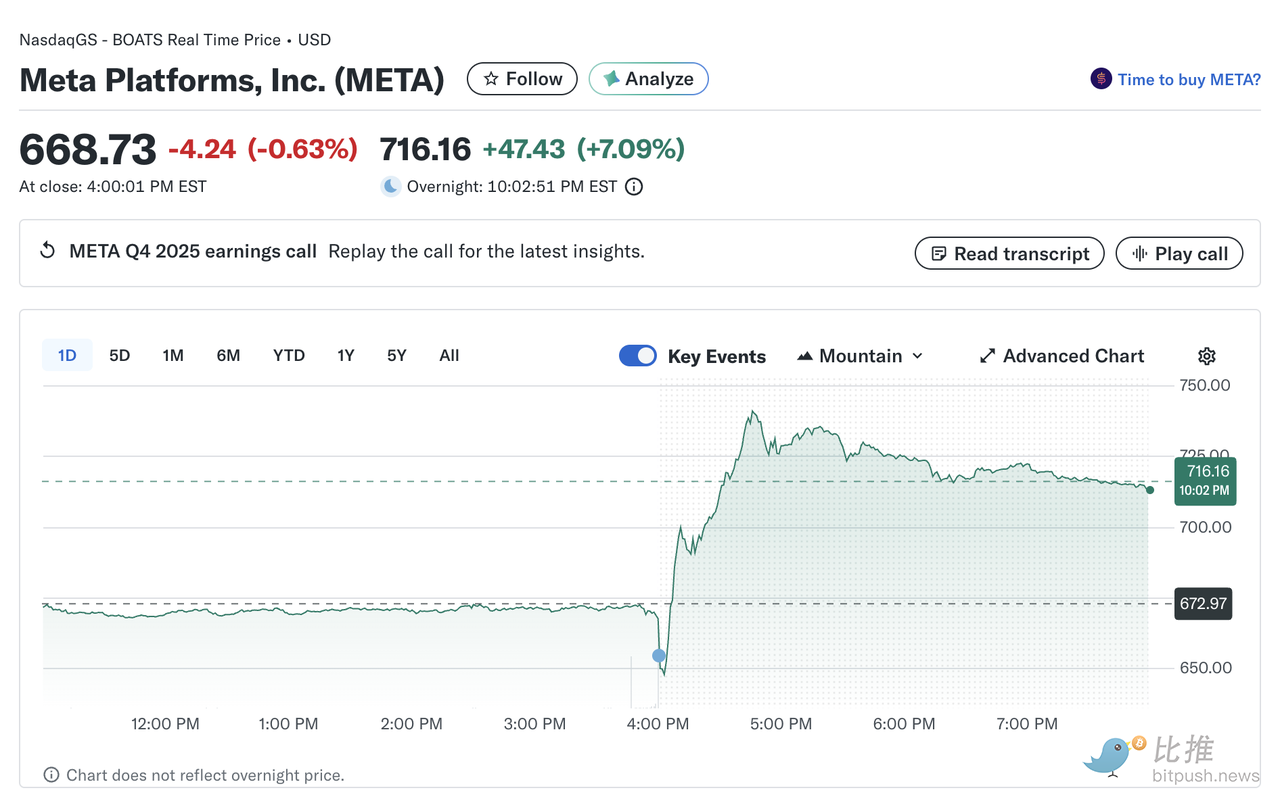
Meta stock price data source: Yahoo Finance
The answer is hidden in this financial report: at least at this stage, it has shown the market that AI investment is not limited to future visions, but has actually improved the current core cash cow — the advertising business, so Wall Street is betting on Meta's narrative reversal and is willing to pay for this super investment plan.
At the end of the day, “dare to smash money, dare to stud” has always been the undertone of Meta and Zuckerberg.This also means that winning may be a huge narrative reversal; losing, at least under the current financial structure, is unlikely to turn into an uncontrolled disaster.
I. Financial Report Quick Reading: Performance & Guidelines “Both Exceed Expectations”
Judging from the results, this is a financial report that is enough to change market sentiment.
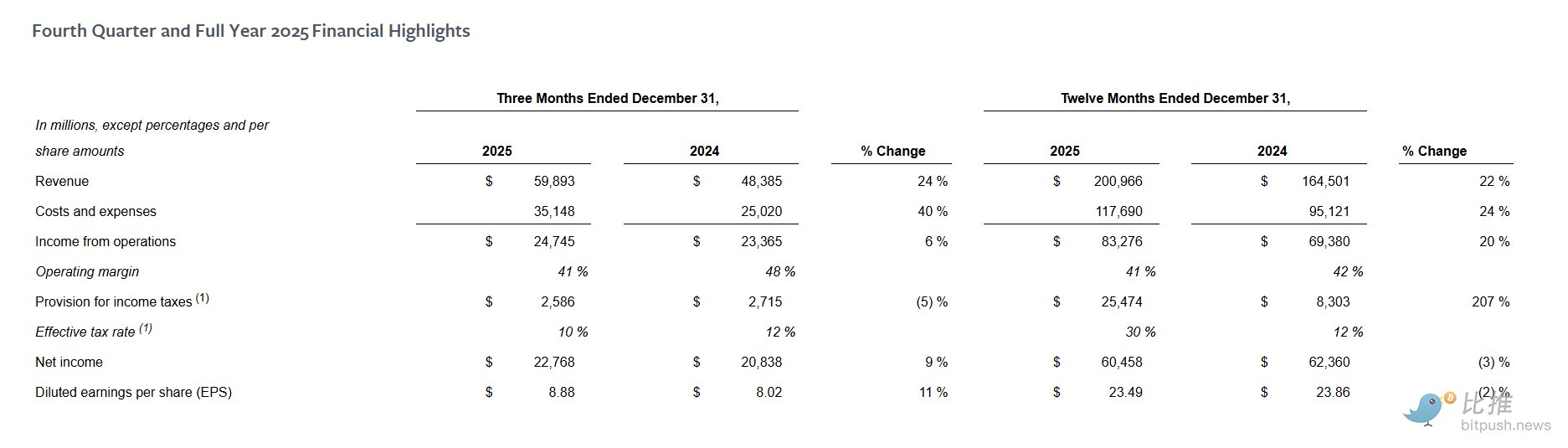
Among them, the core financial indicators for Q4 2025 almost all exceeded expectations: revenue of $59.893 billion, up 24% year over year, higher than market expectations of $58.6 billion; net profit of $22.768 billion, up 9% year on year; and diluted earnings per share (EPS) of $8.88, up 11% year over year, higher than market expectations of $8.23.
It can be said that Meta handed over a solid and stable Q4 report card regardless of the resilience of growth on the revenue side or the pace of release on the profit side.
Extending the perspective to the whole year, the growth logic is also valid: revenue for the full year of 2025 was US$200,966 billion, up 22% year on year; operating profit was US$83.276 billion, up 20% year on year, and the core indicators continued to expand by double digits.
The only thing that appeared to be “retrograde” was that net profit for the year recorded $60.458 billion, down 3% year over year, but this change was not a major deterioration, but was mainly due to one-time tax factors — affected by the Big and American Act, the company confirmed about $16 billion in one-time non-cash income tax expenses.
If this factor is excluded, net profit and EPS will actually achieve considerable growth for the whole year, which explains the apparent contradiction between full-year data and strong quarterly performance.
Source: Meta
At the same time, operational-level indicators also showed typical “sharp rise in volume and price” characteristics:
The number of daily active users (DAPs) of family apps reached 3.58 billion, an increase of 7% over the previous year, in line with market expectations;
Ad display volume increased 18% year over year; average price of a single ad increased 6% year over year;
Average revenue per user (ARPU) was $16.73, up 16% year over year;
Together, this set of data points to a conclusion thatMeta's ad engine not only hasn't stalled, but it continues to evolve in terms of efficiency and monetization capabilities.
Furthermore, what really further stimulates the shift in market sentiment is not only the performance that has already been fulfilled, but also the management's optimistic guidance for the future: According to Meta, revenue for the first quarter of 2026 will reach $53.5-56.5 billion, corresponding to a year-on-year increase of 26% — 34%, which is significantly higher than the market's previous expectations of about 21%. This pricing suggests that management's judgment that Reels's boom will continue. At the same time, the commercialization of Threads is progressing better than the market's previous cautious expectations.
Under the premise that the advertising base is stable, this guidance also directly strengthens the market's confidence in the continuous improvement of AI-driven advertising efficiency.
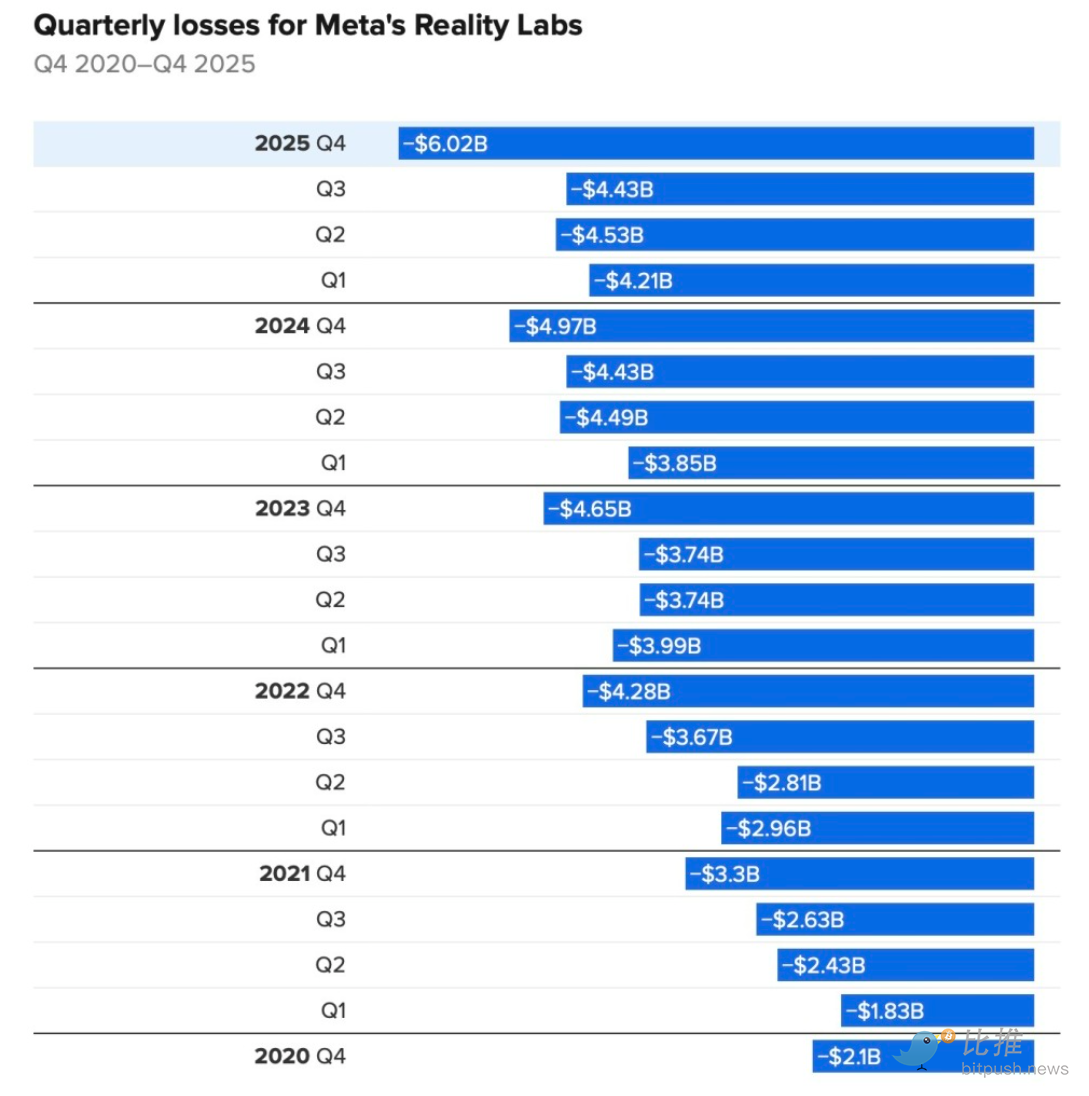
Details of Reality Labs' losses over the past five years
Of course, it is worth mentioning that the “metaverse” is still Meta's bloodbath. Reality Labs, its metaverse division, recorded an operating loss of 6.20 billion US dollars in Q4, an increase of 21% over the previous year, and revenue of 955 million US dollars, an increase of 13% over the same period. Since the end of 2020, the division's cumulative operating loss is close to 80 billion US dollars.
However, unlike in the past, Reality Labs' role in current earnings reports is no longer a core variable influencing the company's overall narrative, and is gradually being marginalized.
2. The social infrastructure is stable, and AI deepens the “moat”
At least at the main business level, AI has indeed begun to become Meta (METAM) The commercialization of real money creates value.
Arguably, to some extent, with Google (GOOGL.M) or Microsoft (MSFT.M) Unlike, Meta is currently the most direct “AI investment directly rewards main cash flow” player that has been verified by financial reports.
First, it is reflected in the systematic improvement of advertising efficiency, thanks toAI is directly embedded in recommendation systems and ad delivery systems, causing Meta to increase the average price of a single ad by 6% year over year in Q4, and the number of impressions increased by 18%.Management has also emphasized many times that the upgrade of AI recommendation algorithms and delivery systems has significantly improved ad conversion rates and delivery efficiency.
Among them, Instagram Reels increased the viewing time in the US market by more than 30% year-on-year, and became the core engine driving advertising inventory and monetization capabilities.
The second is the acceleration of WhatsApp commercialization.Meta plans to fully introduce advertising in WhatsApp news within this year, which is seen as the company's next potential ten-billion dollar revenue growth point.It is also a key step in the expansion of AI recommendation and advertising systems to more traffic scenarios.
Overall, in a context where external competition such as TikTok continues to exist, Meta's social infrastructure has not loosened. Instead, it has further deepened its moat through AI embedded deep into recommendation systems and advertising systems.
Source: Meta
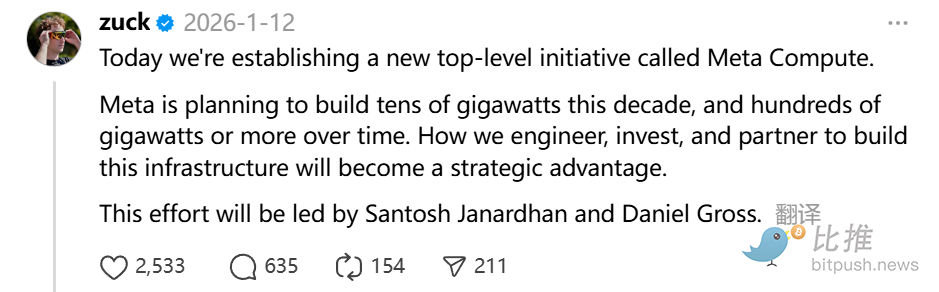
Looking back at the past year, Meta's actions in the direction of AI cannot be described as unaggressive — from spending 10 billion dollars to acquire shares in Scale AI and inviting Alexandr Wang to lead the “Super Intelligent Laboratory (MSL)”, to continuing to earn high salaries and restructure the AI organizational structure, to spending billions to acquire Manus, and launch Meta Compute, and planning to build tens of GW of computing power and power infrastructure within this decade...
This series of actions reminds many people of the familiar script: aggressive investment, grand storyline, and long payback period. In other words, we seem to have seen “Zuckerberg in the Metaverse Era” again.
However, unlike the metaverse period, management has given clear expectations this time, sayingEven with a significant increase in infrastructure investment, operating profit in 2026 will still be higher than in 2025.Furthermore, the cost growth path of the huge investment in 2026 is highly transparent, mainly focusing on computing power, depreciation, third-party cloud services, and high-end technical personnel.
Simply put, in Meta's strategic framework, AI is not just a technical narrative betting on the future, but a realistic tool that is continuously improving the cash flow of the main business. The logic is not complicated: when AI is deeply embedded in recommendation systems and advertising systems, even marginal improvements of a very small margin, such asAllowing 3.6 billion users to stay for tens of seconds more every day, or increasing the ad conversion rate by 1%, will rapidly expand into a significant and repeatable increase in cash flow on top of Meta's current traffic volume and ad base.
It is also under this highly leveraged structure that the efficiency improvements brought about by AI are actually hedging and even covering annual capital expenditure of up to 135 billion US dollars. In other words, Wall Street is no longer afraid of Meta burning money, in part because it has already seen the real money brought by AI.
What's interesting is that from a broader perspective, in the AI arms race in Silicon Valley,In addition to being busy exporting computing power, models, and tools to the outside world to the mainstream path of “selling shovels and tools,” the other is the Meta model——Internalize AI as the heart of your own business system and directly amplify existing traffic and monetization engines.
It is this model that does not rely on selling new products to foreign countries, but instead achieves returns by improving its own monetization efficiency, making Meta's AI investment path clearly different from the monetization logic of other large technology companies that focus on big models or cloud services. Because of this, the market is beginning to re-examine Meta's pricing basis:
AI is not a long-term story waiting to be realized here; rather, it has been able to continuously and quantitatively feed back realistic variables in the main business cash flow through advertising systems.
This is probably the root reason the market is willing to reprice Meta.
3. Violent Stud, a war you can't lose?
“Superintelligence (superintelligence)” has become one of the most frequently appearing keywords in the mouths of Zuckerberg and Meta management.
During this earnings call, Zuckerberg made no secret of his ambition: “I look forward to advancing personal superintelligence for global users,” which also became Meta's long-term strategy covering talent, computing power, and infrastructure.
First, in terms of capital expenditure figures, as described above, Meta has begun an uncompromising violent stud. Operating expenses for the full year 2026 will reach US$162-169 billion, an increase of 37% to 44% over the previous year, which is significantly higher than the previous expected range of about US$150-160 billion by market buyers.
At the same time, Meta is also using actions to send a “trade-off signal” to the market. Just this month, the media revealed that it plans to cut Reality Labs employees by about 10% again, involving about 1,500 people. This means that metaverse-related businesses are being further compressed to free up resources for AI and core businesses.
More strategically, Meta's reclassification of computing power and infrastructure. Zuckerberg personally posted on January 12, stating that “a new top-level strategic project called Meta Compute has been launched”. According to the disclosed information,Meta plans to accumulate at least $600 billion in data centers and related infrastructure in the US by 2028.
However, Meta Chief Financial Officer Susan Li later clarified this figure, saying that the investment was not simply for AI server procurement, but covered data center construction, computing power and power infrastructure in the US, as well as the additional staff and supporting costs required to support US business operations.
Objectively speaking, whether judging from the density of talent, the scale of computing power, or the strength of infrastructure, Meta's investment in AI is no less than that of its major competitors in some dimensions.
Naturally, this path is also a double-edged sword.Once revenue growth, advertising efficiency, or progress in new models cannot continue before costs expand, market tolerance will rapidly decline, and valuations and profit expectations may reverse.
In other words, this is not an experiment that can be repeated through trial and error; it is a strategic war that is difficult to return to once it starts.
Write at the end
As early as September 2025, Zuckerberg said bluntly that it would be very unfortunate if hundreds of billions of dollars were to be wasted in the end, but on the other hand, assuming being left behind in the AI wave, the risk to Meta might be even higher.
“For Meta, the real risk is not whether the investment is too aggressive, but whether it will hesitate at a critical moment.”In today's context, this statement can almost be viewed as a footnote to all of Meta's strategic actions over the past year.
Of course, history won't be easily forgotten. In the next-level cosmic narrative, Zuckerberg also chose to bet ahead and push forward. It was just the end result, which did not meet the initial expectations of the market.
The difference is,This time, Meta has the world's most dense and commercializable user traffic portal; and AI is also directly reshaping the efficiency of human-to-content, human-to-business connections in an unprecedented way.
As for $135 billion, whether this is a historic strategic rush or another costly lesson, the answer still needs time to be given.
