


From the wild path to the table: Why compliance is the way to go
Author: Grandpa Cho
Original title: Compliance is the coming-of-age ceremony of the underground economy
Binance quickly became number one in the world through regulatory arbitrage in 2017, but the freer Hyperliquid only accounts for 15% of Binance's share in 2025, and does RWA, as the source of DeFi's underlying asset, have room and scale for regulatory arbitrage?
Compliance became the main theme in 2026. The offshore company Binance officially went to ADGM in the UAE, Coinbase joined the Genius Act and the Clear Act, and even the Eastern Powers tested the waters of RWA regulation “in principle”.
We are at a clear inflection point. Blockchain will not replace the Internet. Web3 is just a self-righteous scam. The coin listing effect ended when Binance bought Bitcoin, but Hyperliquid is gaining strength in the precious metals and prediction markets, and it is right time for RWA represented by coins (stablecoins), stocks (US stocks), bonds (US bonds, subordinated bonds), and foundations (hedging, active) to go online.
In this context, compliance transcends the simple ceremonial role of “holding a small national card and seizing big national interests” and evolves into a real framework for the separation of transactions, clearing, and escrow. When the industry breaks through scale limits, regulatory benefits will be profitable.
In silence, compliance not only means the end of the last wild era. There is always room for arbitrage on racetracks to evolve and change in scale.
Start with the exchange and get a glimpse into economic considerations other than compliance.
Civilized Wall Street, crazy barbarians
The barbaric conquerors, according to an eternal law of history, were themselves conquered by the higher civilizations of the subjects they conquered.
In 2022, FTX collapsed in a dramatic manner, and Wall Street also developed the idea of seizing the exchange circuit. Citadel Securities, Fidelity, and Carson collaborated to launch EDX Markets in Singapore, which operates under the Singapore MAS compliance framework in accordance with the principle of separation of trading and escrow.
As SEC, headed by Gary Gensler, attacked Binance, Coinbase and Kraken were limited to shrinking into the US spot market and were slow to enter high-end markets such as contracts and options. At the time, the market also had high expectations for EDX Markets.
If there are no surprises, we should witness the fall of Binance, just like BitMEX after March 12, 2020, but history never repeats itself. Hyperliquid is the real winner. The deteriorating Binance and Coinbase, which continues to shrink the US market, are not the protagonists of the next scene.
To know the experiences of those who have succeeded, we must understand the lessons of those who have lost.
Since it was founded in 2017, Binance has done at least two things right:
While actively embracing going overseas, we continue to accept users from mainland China. The volume of transactions and the size of users are mutually seesaw;
The launch of IEO (initial exchange offering) in 2019 created a real wealth effect before DeFi Summer.
After the 9.4 ban, the provision of trading services to mainland Chinese users was in a “grey area”. The third one was set up directly for trading platforms, requiring them not to provide services such as quotation, matchmaking, and settlement. If you refer to any response to Sister Mu Tou, then Binance will respond by “not providing services to mainland Chinese users.”
From 2017 to 2019, Binance became the number one offshore market in the world. From 2020 to 2022, Binance filled the contract market after BitMEX. From 2022 to 2024, Binance dominated the global altcoin market, and the coin listing effect was equivalent to the Binance effect.
After entering 2025, Binance officially assumed the ADGM compliance framework in Abu Dhabi, UAE, dividing itself into three entities: trading, clearing, and OTC, but this still retains Binance's characteristic arbitrage.
In particular, compliance has not prevented Binance from listing meme coins. Secondly, ADGM and the entire UAE financial system have no ability to monitor such a giant as Binance at all. You can take a look at the Bahamas' inability to do anything about FTX's global website.
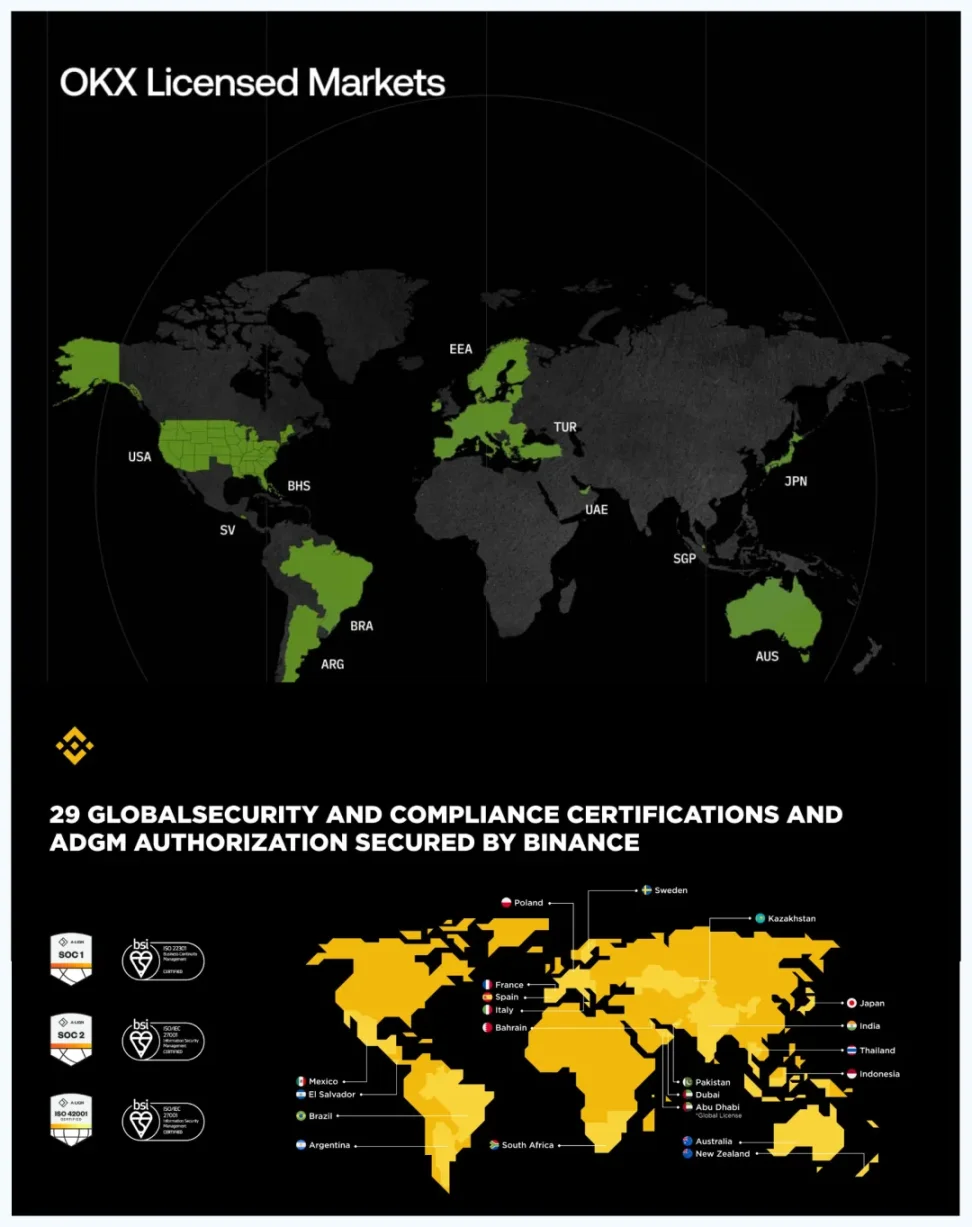
Photo caption: Only “Kao Gong” can go ashore. Image source: @binance @okx
Coinbase was most compliant after the collapse of FTX, but this compliance stemmed from continuing reforms to the SEC, CFTC, and OCC after Trump came to power, requiring them to adopt more crypto-friendly regulatory measures.
Broadly speaking, the SEC is responsible for reviewing whether a token meets the definition of securities. The CFTC is responsible for derivatives trading, the OCC is responsible for bank licenses to carry out custodial business, and the US does not have a “crypto exchange license” similar to ADGM; it only has the scope of regulation by type of business.
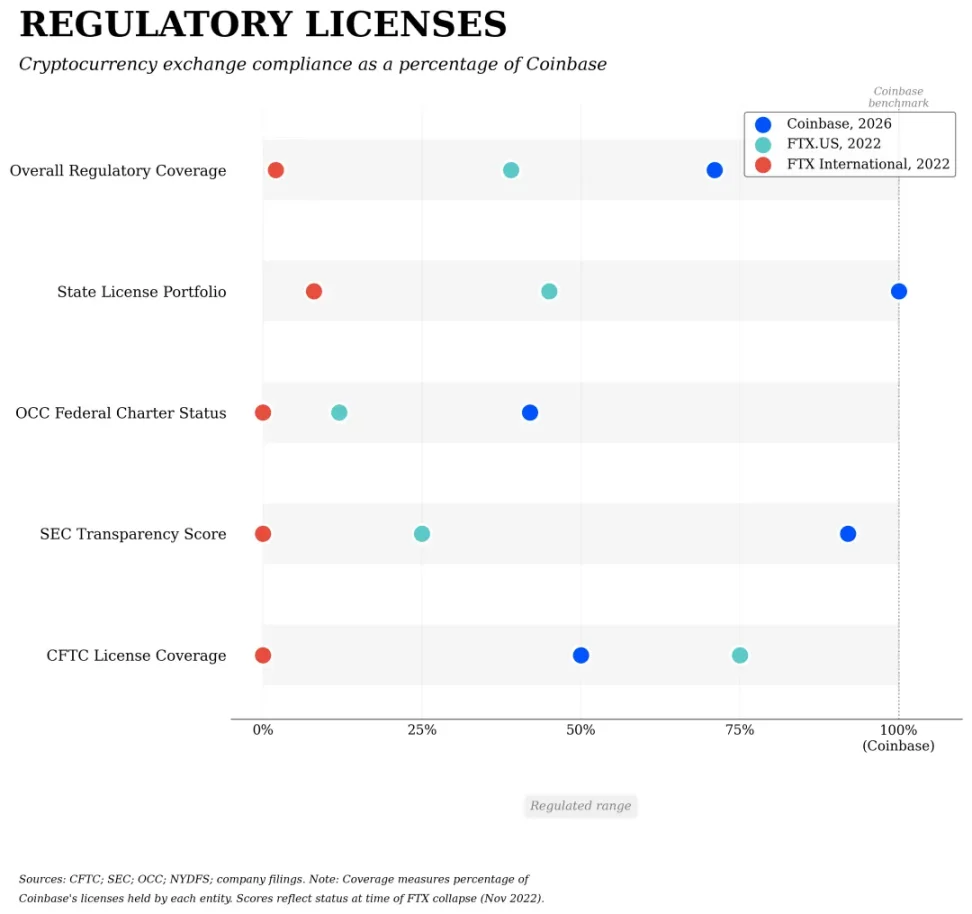
Photo caption: Regulatory progress, image source: @zuoyeweb3
The construction of this regulatory framework is still ongoing, but it is certain that Coinbase will shape the US compliance framework, covering all aspects of listing (spot, contract), trusteeship (retail, institutional), liquidation/settlement (fiat, crypto), auditing (technology, assets) /insurance (fiat, crypto).
Binance's license under ADGM and Coinbase's license in the US are not a concept at all; the latter license will actually fall under the control of the regulatory authorities.
Regulation is about clarifying rules rather than protecting the interests of retail investors. For example, institutional clients enjoy bankruptcy quarantine protection in the Coinbase escrow business, and the corresponding entity is Coinbase Custody Trust Company.
However, the corresponding entity for the funds that ordinary retail investors deposit into Coinbase is Coinbase Inc. If it is fiat currency, it may also be protected by the corresponding bank's FDIC deposit insurance, but crypto assets are likely to suffer the fate of FTX.
For example, FTT buyers of FTX tokens are identified as equity owners and are not strictly protected against claims. Coinbase is similar. The only good news is that Coinbase has not experienced a crowding crisis.
Hyperliquid enters the RWA space “without a license”
Human progress will stop being like fearsome pagan gods; you can only drink sweet liquor by using the head of a murdered person as a wine glass.
Regulatory arbitrage still exists. In the field of crypto asset trading, EDX's American hometown Hyperliquid also started in Singapore and is encroaching on Binance's global market and Coinbase's US market.
It can be called “second-order arbitrage,” the benefits of Binance's global regulation, and the Hyperliquid package of Binance's benefits.
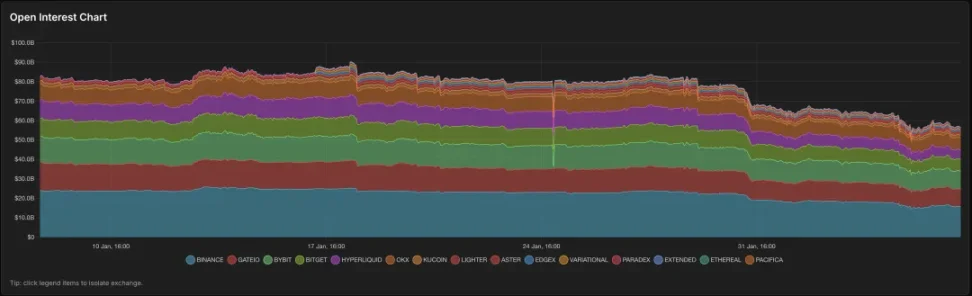
Photo caption: CEX and DEX are hard to tell apart, Image source: @LorisTools
Hyperliquid blocks US IP addresses, but this ban has no practical effect. For comparison, it is almost impossible for US users to open an account on Binance; they can only use Binance US.
Coinbase initially allowed contract business for US users, but its business volume was about the same as no such person. As a result, in a strange space, Hyperliquid seized some European and American users outside of Binance and Coinbase to launch derivatives business.
Note, however, that Hyperliquid's arbitrage cannot perform Binance's growth miracle, nor can it learn that Coinbase occupies the US compliance market; it probably only accounts for 15% of Binance's market share.
As Hyperliquid gains strength in non-traditional businesses such as precious metals and prediction markets, the impact on global financial markets is gradually increasing. If the US can regulate Binance and Tornado Cash, then actions against Hyperliquid will not be resisted by Singapore.
At the end of the day, most “underground economy” models cannot enter large-scale fields. Taking USDT as an example, it is becoming more strict in terms of issuing reserves and circulation bans, as evidenced by the attack on Bybit hackers to let go of USDT and the black U freeze after the Huiwang incident.
HSBC can support the entire underground economy of Cambodia and even Southeast Asia, but Cambodia cannot afford to be included in the FATF's “gray list” for money laundering.
Binance can support the BNB on-chain economy, which is dominated by altcoins, but the squeezing effect between China and the US has prevented Binance from reaching higher quality trading assets.
This is essentially America's advantage of low regulatory costs. The core of US foreign economic sanctions is not the US dollar and the US military. The US is the world's largest single consumer market and the most important financial market. Once Cambodia and Binance are cut off from the US, the end will be North Korea.
So Binance also has to pay a high price to comply, so it's only a matter of time before Hyperliquid becomes compliant.
An extended question was discussed in this regard, namely whether RWA can replicate the trajectory of the crypto asset trading circuit, that is, preserve itself in regulatory arbitrage and develop business volume within a compliance framework.
This is based on the dual premise that Hyperliquid is almost impossible to surpass Binance in the field of cryptocurrency trading, and almost impossible to surpass Coinbase in terms of the degree of compliance.
If it were to stand in 2017, CZ itself probably wouldn't believe that CEX is the future. Looking ahead, postcards, P2P, O2O, and ofo are all gusts of wind; looking backwards, DeFi mining, NFTs, GameFi, and SocialFi all came to an end.
Therefore, both Binance and BNB should be understood as a project system. Their aura is constantly being extended by the wealth effect, which should have ended hastily, like one financial bubble after another.
However, under the network effect, the network effect of transactions breaks free from the constraints of cryptographic assets and enters all financial fields. Thus, it meets RWA in the broad sense of the word. Stablecoins have an impact on CBDC, and asset-based securitization will sooner or later have to be tokenized.
For example, the current Tokyo University regulatory guidelines are essentially spillover of America's shock in the financial sector, and will rewrite on-chain finance in a peculiar way.
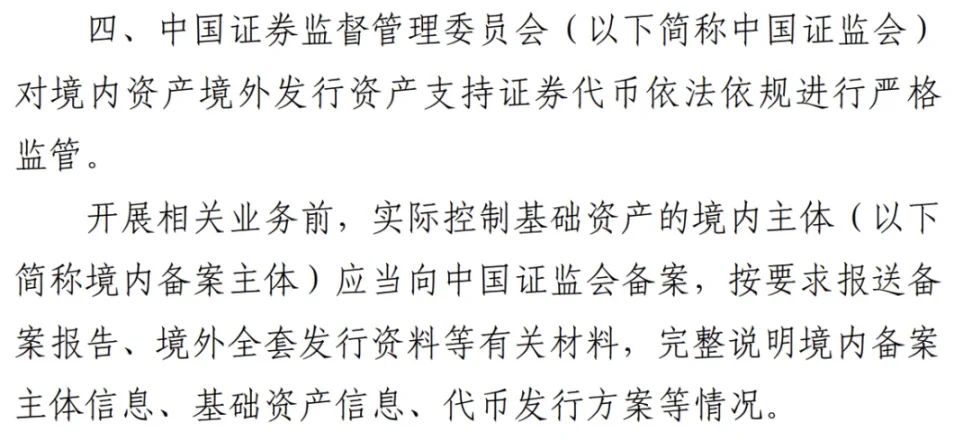
Photo Caption: Flowers in the wall, fragrance outside the wall
Regarding Dongda's new regulatory measures, Caixin's interpretation is that it is divided into four categories: foreign debt, equity, asset securitization, and others. However, in my opinion, the only meaningful one is the approach to tokenizing securities, which is in line with the reform direction of “securitization of all assets”.
Make it clear that the competent authority is the Securities Regulatory Commission
Issued after approval by the Securities Regulatory Commission
Only domestic to overseas distribution is permitted
Furthermore, the current securities tokenization guidelines make it clear that both equity and income must be compliant. This corresponds to the SEC's evolutionary process of encouraging native “stock tokenization,” and the situation of overseas RMB stablecoins, foreign debt, and funds is quite special.
Overseas offshore RMB stablecoin business has always existed, and USDT issuer TEDA is also involved, but it lacks practical use, and the business volume is very small;
The issuance of overseas bonds and the introduction of funds on the chain have in fact been carried out. They have been completely isolated from domestic assets and issued to overseas customers, and have nothing to do with this guide.
This regulation involves the overseas issuance of domestic assets. Essentially, it emphasizes this kind of isolation. Overseas returns and domestic returns only need to enter the supervisory process when the two intersect.
In the current RWA field, China and the US have in fact launched a horse racing field. This kind of liquidity spillover onto the chain is enough to rewrite the current financial landscape.
epilogue
Of course, the fate of an industry depends on self-struggle, but it is also necessary to take into account the course of history.
CZ probably doesn't believe that CEX is the future; even Bitcoin is only a stage in a new form of MLM, and will quickly become a historical term for P2P, artillery loans, etc. that will die out with the wind.
However, no one expected that CEX would survive until 2026, and Hyperliquid would go to new forms such as precious metals and prediction markets, yet it still hasn't flipped Binance.
If Hyperliquid were to add RWA, could it go the other way this time around?
Twitter:https://twitter.com/BitpushNewsCN
Compare the TG exchange group:https://t.me/BitPushCommunity
Compare TG subscriptions:https://t.me/bitpush
