


The rise of Agentic AI, an approaching global intelligence crisis
Author: Alap Shah
Original title: The Global Intelligence Crisis, Part One—The Rise of Agentic AI
Compiled and organized by: bitPushNews
Bitpush note:
Alap Shah is a veteran expert with 20 years of open market investment experience (working for Viking Global and Citadel) and 15 years of AI entrepreneur background, who founded the AI financial search platform Sentieo. In this article, he stands on the dual perspective of investors and developers, and warns how the rise of “intelligent AI” (Agentic AI) will fundamentally impact the job market and trigger a global economic crisis.
preface
After several years of exponential growth, AI's recent leap forward towards “agentic” (Agentic) is destined to disrupt the world we know from 2026.
This is an unsettling fact:AI is no longer just a tool for economic growth; it has become an almost immediate replacement for human cognitive labor. In the short term, it will replace white-collar workers much faster than the new market can absorb these workers.
In this three-part series, I combine my 20 years of experience investing in the open market with 15 years of building AI companies to outline my views on the impending economic storm.
Our entire economy is built on a single premise: human intelligence is a scarce and expensive resource. It is a critical input needed to transform raw materials into goods and services that determine our standard of living. In 2026, as intelligent AI matures, this basic assumption is falling apart. AI is no longer just a tool or aid; it is rapidly becoming a direct replacement for human cognitive labor. This shift fundamentally devalues white-collar work. Driven by advances in AI and a surge in capital, this substitution will inevitably accelerate, creating an economic shock that could dwarf the industrial revolution, the global financial crisis, and COVID-19. If urgent policy action is not taken, this could trigger a serious financial crisis within the next two years.
In this article, I'll discuss the fundamental threat intelligent AI poses to employment and current economic models.
Part 2:2028 Global Smart Crisis Warning — A thought experiment from the future of financial history with my friend Citrini.Read the instructions: “The End of AI” post on the extranet: Will the S&P 500 plummet and white-collar jobs disappear?!
In the upcoming “Part 3: The Way Forward,” I will propose a policy path to overcome the crisis.
Please don't misunderstand me as an “AI destroyer” because of my warning. AI is the human Promethean moment — it was the fire that was eventually stolen from the gods. Its power leaves us less than a generation away from a prosperous life for all, unlimited clean energy, and the elimination of most diseases. Our challenge is not the technology itself, but how to survive the severe economic shocks caused by its arrival and how to restructure our financial system as necessary.
Agentic AI
The era of AI as a simple conversational chatbot is over. Over the past six months, we've crossed a critical threshold and entered the age of intelligent AI — systems that can operate autonomously to perform complex multi-step workflows. The pace of this evolution is astonishing.
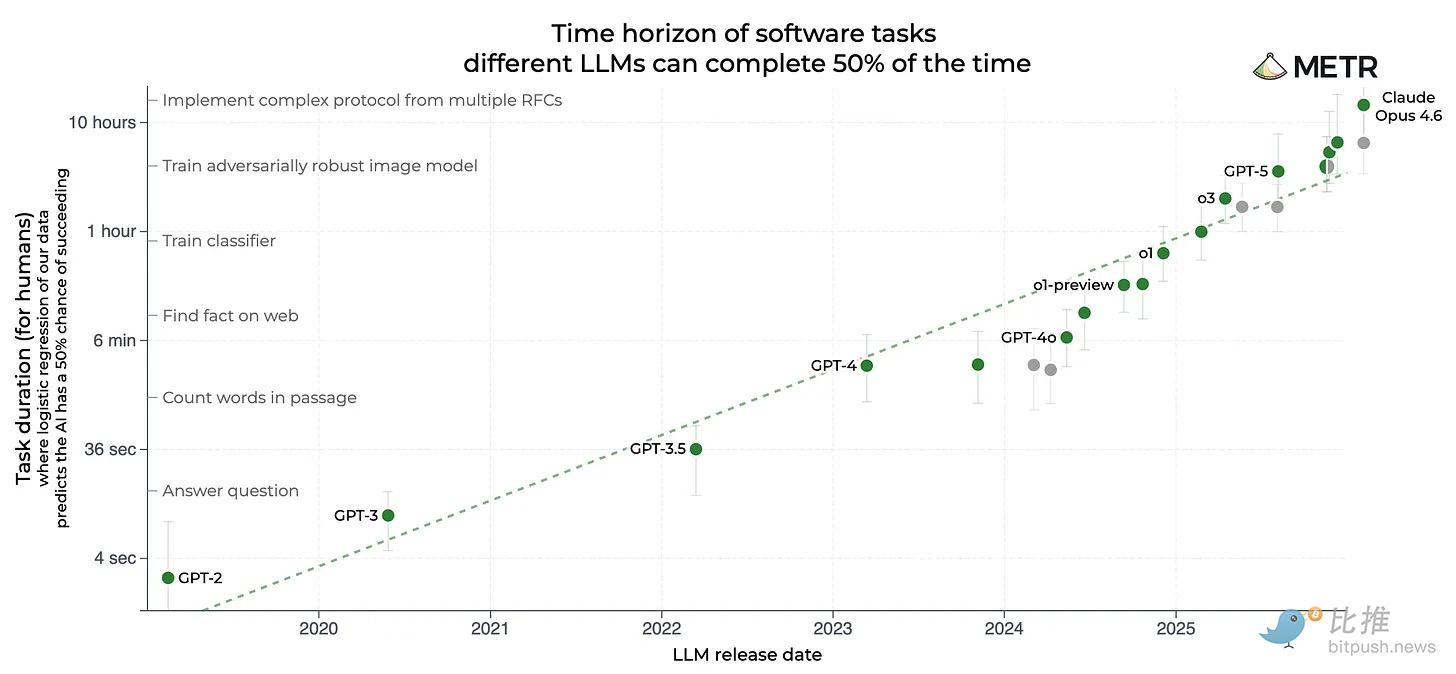
According to data from METR, a third-party agency that assesses autonomous AI capabilities, the duration for models to complete tasks without assistance doubles every six to seven months, and recent cases have even shown a further acceleration of the trend. Today, the leading model can perform 14.5 hours of continuous autonomous work. The chart from METR shows trend lines over time since 2019. We can clearly see a trend line that has been running for a long time and has recently accelerated. Note that the Y axis is a logarithmic scale, which means that the linear trend represents exponential “hockey stick” growth.
To show the power of index trends, the table below represents Citrini's predictions of model capabilities and release dates if the current trend line continues.
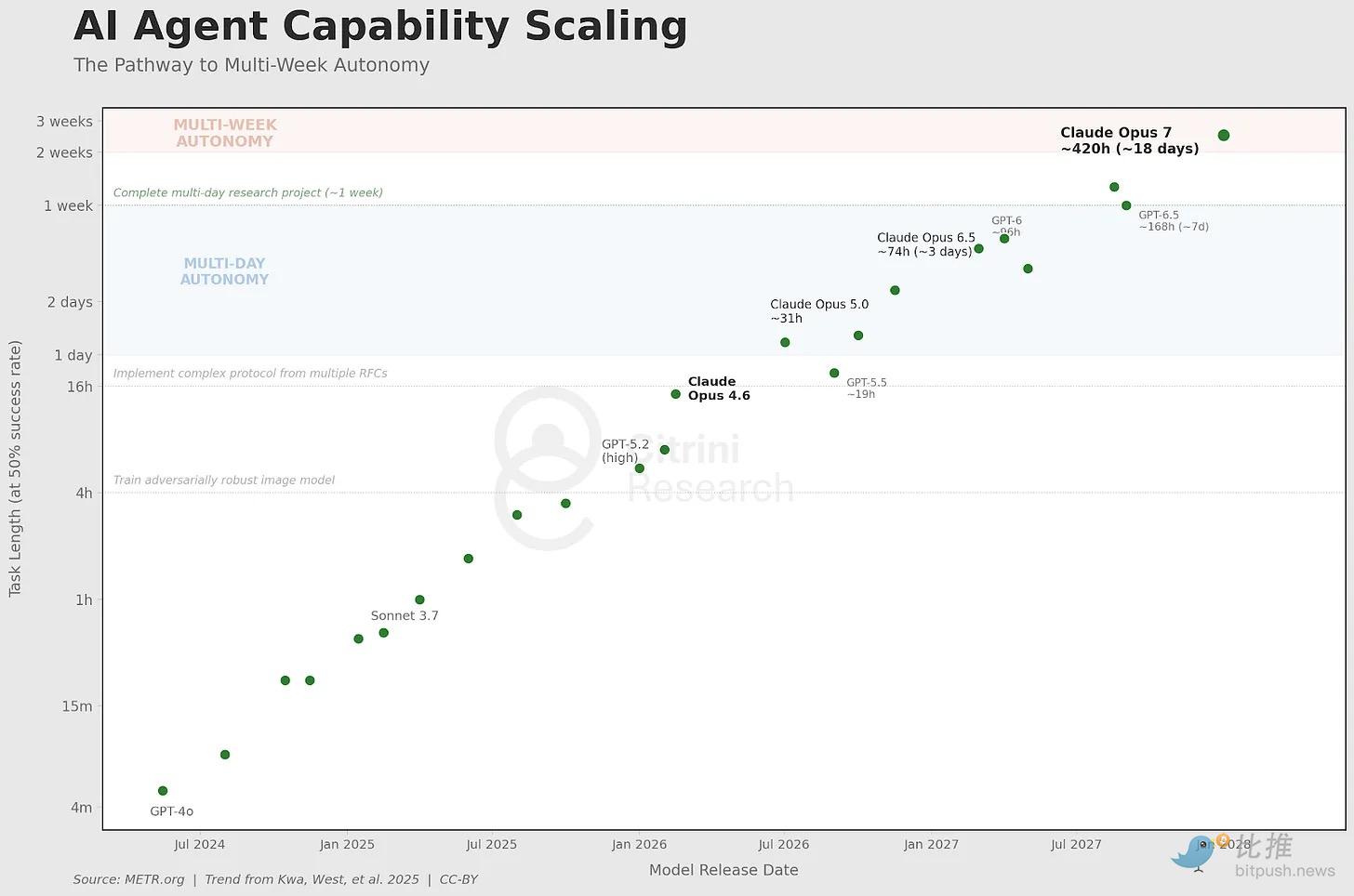
Trend line pointing: By mid-2028, AI will be able to complete unassisted work for up to a month.
My point of view
I began my financial career as a consumer industry analyst at two major hedge funds, Viking Global and Citadel, where I experienced the global financial crisis and its aftermath. In 2011, I left and started my own fund LOTUS. During that time, I realized that the factor limiting my performance was my ability to process the growing volume of market-driving information. My workflow is scattered across Bloomberg, S&P Capital IQ, Excel, Outlook, OneNote, and various financial apps and websites.
To centralize these scattered workflows, my brother Naman and I built Sentieo, an AI financial search engine. The results were astonishing — I was able to see the world more clearly, run faster with a smaller team, and generate better investment results. Eventually, we grew Sentieo to over 1,000 investment management, banking, and corporate clients, and sold it to a competitor for over $200 million in 2022.
Since selling Sentieo, I've been running LOTUS, personal AI company Littlebird, and startup incubator Studio Management. Building Sentieo fundamentally changed my view of the world. I realized AI was the ultimate power multiplier, and I began to seek to use it at every level of my company and in my life.
Our use of intelligent AI
At my company, we're not just watching the trend of intelligent AI; we've actively restructured our organization to run on this technology.
This transformation is most dramatic in software engineering. In the past, prototyping a new feature required a week of design specifications with a product manager and designer, followed by a week of engineering iterations with a team of engineers. The intelligent coding interface now allows me to write detailed prompts and generate functional prototypes within minutes. Although it usually falls short of production standards when first tried, it largely removed others from the initial build process and significantly increased the efficiency with which we delivered the finished product.
We've seen a similar trajectory at LOTUS. A year ago, AI models performed well in answering basic financial structure and valuation questions. Today's intelligent AI is fully connected to Factset and S&P Capital IQ's financial and document databases. Under the old model, if I wanted to work on a new idea, I would assign it to an analyst. Analysts spend days reading relevant documents, studying key debates and data, then preparing financial models and sending emails with key findings. Then we'll iterate on that for a few more days. Today, an intelligent AI can synthesize documents and key discussion points, build financial models, and generate a comprehensive memorandum of nearly equal quality in minutes. This quick turnaround means I can quickly cut to critical issues and make investment decisions a few days earlier than before.
The cost of delivering the work of such intelligent agents is less than 1% of the cost for humans to perform the same work. Agents don't need to sleep, don't take vacations, and can create (or destroy) clusters of agents at any time as needed.
Perhaps the most profound change, however, is the way we coordinate in agent-driven organizations. Human coordination is the biggest and most exponential cost in any business. The pioneering paper “The Nature of an Enterprise” published by economist Ronald Koss in 1937 can be paraphrased as: The reason companies exist is because the cost of internal coordination is lower than the cost of market transactions, but there is a limit to this existence. A business stops growing when the marginal cost of an organization's additional internal transaction is equal to the cost of going through the market.
Passing instructions from founder to product manager to engineer is an information-impaired “microphone” game requiring endless messages, meetings, and briefings to keep pace. In fact, we can think of the entire Microsoft Suite (Outlook, Word, PowerPoint, and Excel) as human coordination technology. However, AI agents share an almost perfect, continuous context. Where possible, replacing humans with smart bodies has eliminated this huge “coordinated tax,” eliminated friction, and greatly increased output.
We are currently not actively reducing the size of our team because we are running a business that is in the early stages of rapid growth and is seizing market share. However, we have significantly slowed the pace of recruitment and need far fewer employees than in the past. Every employee can do more and is expected to actively use AI to exponentially increase output and impact. We've come to the conclusion that certain roles are better performed by the intelligence body as a whole than by humans. These roles include data analysis, data migration, some design roles, some operations (DevOps) roles, and some customer service roles. This list is growing every month as AI capabilities improve.
What AI CEOs are saying about employment
The threat of AI to jobs is nothing new or original. Over the past year, warnings from AI labs about white-collar jobs being replaced have continued unabated. Unsurprisingly, CEOs have been cautious in linking “risk of layoffs” to “downstream economic consequences.”
Last May, Anthropic CEO Dario Amodei warned in an interview with Axios:
AI could eliminate half of entry-level white-collar jobs and push unemployment to 10-20% over the next one to five years.
While Amodei is likely exaggerating Anthropic's potential, his predictions seem extremely predictable today. The whole storywritingsThey are all worth reading.
After nine months, Microsoft AI CEO Mustafa Suleyman is acceptingFinancial TimesAt the time of the interview, the “unspeakable secret” seemed to be revealed without disguising it:
White-collar jobs, where you sit in front of a computer, whether as an attorney, accountant, project manager, or marketer — most of these tasks will be fully automated by AI over the next 12 to 18 months.
Current state of the labor market
Smart AI is clearly improving its ability to perform white-collar jobs, and AI CEOs seem very concerned about layoffs. It is necessary to examine the current state of the white-collar job market before entering the rise of intelligent AI.
In the figure below, the white dotted line represents core white-collar employment, excluding sectors driven by government spending (specifically, government departments, health care — half of which is covered by the government, and private education — where government loans and guarantees drive a large portion of the market).
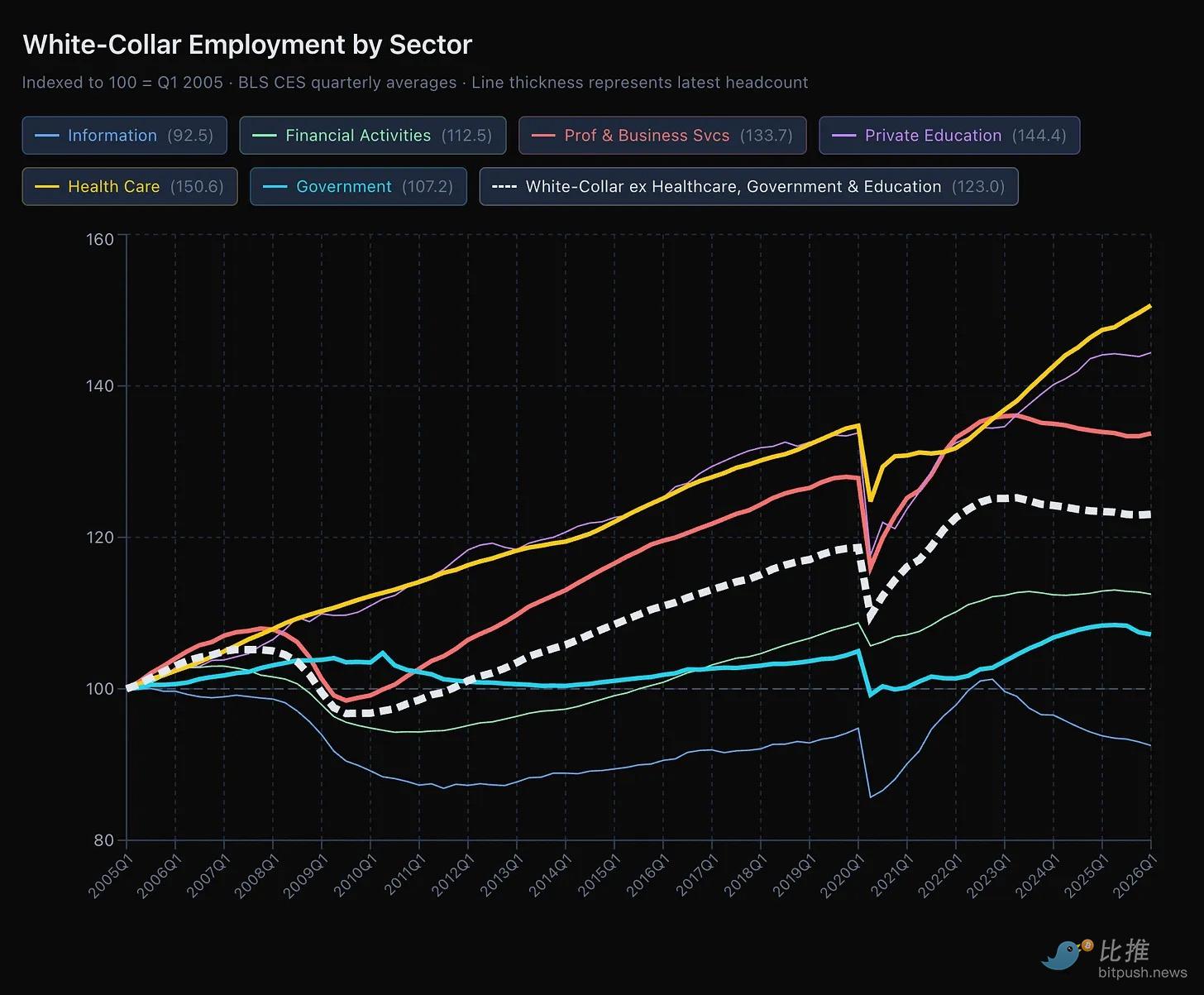
We can clearly see that since 2023, core non-government white-collar employment has stagnated and declined. Although it is true that there is a “hangover period” of 12-18 months brought about by the crazed recruitment wave in the post-pandemic era, data from the past 18-24 months revealed a tenuous balance. These core white-collar jobs grew by only 4% over a six-year period compared to before the pandemic, while the population grew by 5% during the same period, and real GDP grew by 11%. The information sector (Information sector) — which is supposed to be the epicenter of unemployment caused by AI — has shown an 8% decline from its peak, and current levels are even below pre-2020 levels. Even before the advent of intelligent AI, businesses were already doing more with fewer people.
Balance between supply and demand in the labor market
The previous article shows the adoption of intelligent AI by a typical startup. Such companies benefit more from rapid revenue growth than labor cost savings. This approach provides a blueprint for how large companies will adopt intelligent AI next year.
However, large enterprises have higher coordination costs, more legacy processes that can be automated, and most importantly, due to the large and stable scale of the business, there is limited room for revenue growth and more opportunities for cost savings. This ultimately means that corporate layoffs, which have characterized the white-collar labor market since 2023, have a higher potential to occur. The combination of a weak white-collar labor market and smart AI adoption suggests that the risk of a white-collar employment crisis is increasing.
Smart AI will accelerate these trends, and market forces will magnify them exponentially. Critics are justified in thinking that large companies are slow to act, but most companies operate in a competitive market. Any company that is slow to adopt intelligent AI will be at a cost disadvantage and in a damaged competitive position with respect to its peers. CEOs understand this dynamic and are almost universally making AI adoption a top priority in 2026, with corresponding budget support.
Only a small number of layoffs can break the already fragile balance between supply and demand for white-collar workers. Imagine if we faced 5% white-collar unemployment in 12-24 months, which seemed much milder than Dario or Mustafa suggested. As AI advances continue to accelerate, these positions are unlikely to return. These unemployed workers will be forced to find blue-collar and gig economy jobs, putting downward pressure on the wages of all workers in the economy. Employees who keep their jobs are also keenly aware of the increasing risks, leading to a sharp decline in consumer confidence and spending.
Risk of contagion
I'm with CitriniPart II: 2028 Global Intelligence CrisisThe forecast timeline for how the crisis might evolve is detailed in. Instead of repeating the details, here's our high-level perspective on what we think the crisis is happening:
The 5% unemployment estimate above assumes that the economy is a closed system close to balance. This is not the case. The economy is highly reflective, and the engine that drives unemployment — AI intelligence itself — accelerates every quarter.
First, there is no natural braking mechanism. AI capabilities have improved, companies have reduced employee demand, unemployed employees have reduced consumption, companies with impaired operations have increased AI investment to maintain profits, and capabilities have further improved. Each company's individual response is rational, but the collective result is a self-swallowing negative feedback cycle.
Second, the damage to spending was very disproportionate to the number of unemployed people. The top 20 percent of people with the highest income drive around 65 percent of personal consumption spending in the US. And these are the white-collar groups most vulnerable to AI replacement threats. A slight drop in the percentage of white-collar employment would translate into a huge blow to non-essential consumer spending, severely damaging businesses that rely on such consumption, and in turn triggering further layoffs.
Third, AI agents will disrupt the huge intermediary layer of the US economy. Over the past five decades, we've built trillions of dollars of corporate value on human limitations: things take time to process, patience runs out, and most people accept terrible prices to avoid a few more clicks. Intelligent AI removes this friction. Software, consulting, financial services, insurance, travel, real estate, and payments — all of these industries are built on monetizing the complexity that smart bodies consider mediocre. As these industries experience a sharp drop in revenue, they will drastically lay off workers and increase the wave of unemployment.
Fourth, the financial system is a long chain of correlation games about white-collar productivity growth. More than $2.5 trillion in private credit has been invested in leveraged buyouts, and the underwriting is based on income assumptions that are no longer valid. The $13 trillion mortgage market is based on the assumption that borrowers will maintain roughly their current income levels for three decades. These people are not sub-prime borrowers, but elites with a credit score of 780 and a 20% down payment. The loans were of high quality the day they were issued; only after they were issued, the world changed.
Fifth, the government's fiscal position was reversed at the worst possible moment. Federal revenue is essentially a tax on human labor. As white-collar income declines and total wages shrink, tax revenue will dry up, and demand for transfers (social benefits) is surging at this time. The government needs to distribute more money to households while collecting less taxes.
What aspects of my judgment may be wrong
There are several important possibilities for this prediction to fail:
Path 1: Unemployment is slow and progressive, enabling AI-driven productivity to accelerate and boost GDP growth. A booming economy with nearly stable employment will allow society to transition smoothly into the AI world. This is the current market's benchmark expectation. While this is certainly possible, wage trends in the information industry since 2023 have dealt a heavy blow to this theory. Furthermore, this may require a significant slowdown in AI advancements, which seems like a lose-lose bet based on current trends.
Path 2: Compare AI to the balance revolution of the past. According to this view, in every previous cycle, technology and automation replaced old jobs while creating more new jobs in segmented fields. While this is true, all previous technology was a supplement to human labor rather than a near direct and complete replacement. Every technological revolution in the past has also been accompanied by a period of strong employment growth; while white-collar jobs in the US have been shrinking for more than three years, they have long since broken away from the pre-pandemic trend line.
Path 3: Decisive policy action prevented the crisis from occurring. I don't want to predict that probability today, but I do believe there is a reliable path that can reach agreement between most voters and business, the AI community, and political stakeholders on this future. I hope to start this conversation seriously in the upcoming “Part 3: The Way Forward”.
Disclosure of information
Thanks to littlebird co-founders Alex Green and Naman Shah, as well as David Shor, Citrini, and Josh Constine for their feedback and proofreading of the views.
As a fund manager and entrepreneur, my job is to anticipate the future and allocate capital and resources accordingly. Because I think this AI-driven replacement is a highly likely path, my portfolio and company are ready for it. If my arguments are realized, my company will benefit financially.
I'm being honest about this for full transparency, but I'm not writing this post to “promote my own holdings” or create panic. The social risks of this transformation are too great to be ignored. Even if this particular crisis is only 10% likely to occur, the downside risks are so serious that we must begin a society-wide dialogue starting today.
Twitter:https://twitter.com/BitpushNewsCN
Compare the TG exchange group:https://t.me/BitPushCommunity
Compare TG subscriptions:https://t.me/bitpush
