


How does China's AI model use tokens to “export” electricity?
By Black Lobster, Deep Wave TechFlow
Original title: Token goes overseas to sell China's electricity to the world
In the summer of 1858, a copper cable crossed the Atlantic Ocean, connecting London to New York.
The significance of this matter has never been the transmission speed, but rather the power structure. Whoever lays undersea cables can pump water from the information flow. The British Empire relied on this global telegraph network to get hold of colonial intelligence, cotton prices, and war news.
The strength of an empire was not only a fleet, but also that cable.
More than 160 years later, this logic is being repeated in an unexpected way.
In 2026, China's big model is quietly eating up the global developer market. According to the latest data from OpenRouter, the Chinese model alone accounts for 61% of the token consumption of the platform's top ten models, and the top three are all from China. Every day, API requests from developers in San Francisco, Berlin, and Singapore are crossing the Pacific Ocean submarine cable to the Chinese data center. Computing power is consumed there, electricity is flowing there, and the results are sent back.
Electricity never left the Chinese grid, but its value was delivered across borders through tokens.
The great migration of AI models
On February 24, 2026, OpenRouter released weekly data: the total token consumption of the top ten models of the platform was about 8.7 trillion yuan, and the Chinese model had an exclusive share of 5.3 trillion yuan, accounting for 61%. MiniMax M2.5 topped the list with 2.45 trillion tokens, followed by Kimi K2.5 and Smart Spectrum GLM-5, and the top three came from China.
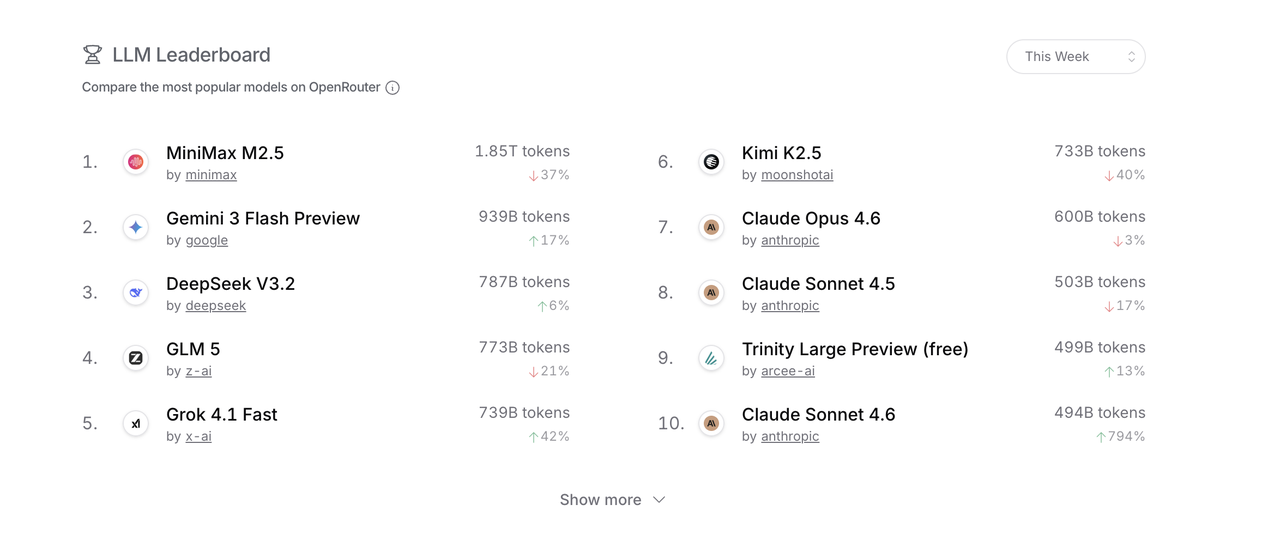
Latest data as of February 26
This is no accident; a spark ignited everything.
At the beginning of this year, OpenClaw came out of nowhere. It is an open source tool that allows AI to actually “work”. It can directly control computers, execute commands, and complete complex workflows in parallel. The GitHub star rating surpassed 210,000 in a few weeks.
John, a financial practitioner, immediately installed OpenClaw and connected to the Anthropic API, and began automatically monitoring stock market information and reporting trading signals in a timely manner. After a few hours, he stared at the account balance for a few seconds: tens of dollars, and it was gone.
This is the new reality brought about by OpenClaw. In the past, when chatting with AI, there were thousands of tokens at a time, and the cost was negligible. After OpenClaw is connected, the AI runs more than a dozen subtasks at the same time in the background, repeatedly calling the context and iterating repeatedly. Token consumption is not linear; it is exponential. The bill is like a car with the hood speeding up, the gas meter is falling off, and I can't stop.
A “trick” immediately spread in the developer community: using an OAuth token to directly connect an Anthropic or Google subscription account to OpenClaw, and turn the “unlimited” amount of the monthly fee system into free fuel for AI agents. This is also an approach adopted by many developers.
An official countermeasure was imminent.
Anthropic updated the agreement on February 19, explicitly prohibiting the use of Claude subscription credentials for third-party tools such as OpenClaw. To access Claude's features, you must go through the API billing channel. Google has also broadly banned subscriptions to Antigravity and Gemini AI Ultra through OpenClaw.
“The world has been suffering for a long time,” and Jhon immediately fell into the arms of a big domestic model.
On OpenRouter, the domestic model MiniMax M2.5 scored 80.2% on software engineering tasks, and Claude Opus 4.6 was 80.8%. The gap is almost negligible. However, prices vary widely. The former input end is 0.3 dollars per million tokens, and the latter is 5 dollars, which is about 17 times different.
John has cut through the past, the workflow is still working, and the bill has shrunk by an order of magnitude. This migration is happening simultaneously around the world.
Chris Clark, COO of OpenRouter, put it bluntly. The reason why the Chinese open source model has gained a large share of the market is because they account for an unusually high share of the proxy workflow run by US developers.
Electricity goes out to sea
To understand the nature of a token going overseas, we must first understand the cost structure of a token.
It looks very light. One token is about 0.75 English words, and a normal conversation with AI consumes no more than a few thousand tokens. But when these tokens are stacked in trillions, the physical reality behind them becomes heavy.
Apart from the cost of tokens, there are only two core items: computing power and electricity.
Computing power is the depreciation and amortization of the GPU. If you buy an Nvidia H100, it costs about 30,000 US dollars. Its lifespan is converted to every deduction, which is the depreciation cost. Electricity is the fuel for the continuous operation of a data center. Each GPU consumes about 700 watts of electricity when fully loaded. Coupled with the cost of the cooling system, the electricity bill for a large AI data center can easily exceed hundreds of millions of dollars per year.
Now, plot this physical process on a map.
An American developer makes an API request in San Francisco. The data departed from California and arrived at a data center somewhere in China via the Pacific Ocean submarine cable. The GPU cluster began work. Electricity flowed from China's power grid to those chips. The inference was completed, and the results were transmitted back. The whole process probably only took a second or two.
Electricity has never left China's grid, but the value of electricity has been delivered across borders through tokens.
Here's an amazing thing that ordinary trade can't reach: Tokens have no physical shape, don't need to go through customs, aren't hit by tariffs, or even within any current trade statistics. China exports a large amount of computing power and electricity services, but it is almost invisible in official commodity trade data.
Tokens have become derivatives of electricity. Tokens are essentially going overseas with electricity.
This is also due to the relatively low electricity prices in China. The comprehensive electricity price is about 40% lower than in the US. This is a physical cost difference, and competitors can easily replicate it.
Furthermore, China's big AI model also has algorithms and “internal volume” advantages.
DeepSeek V3's MoE architecture allows only some parameters to be activated during inference. Independent tests showed that its inference cost is about 36 times lower than GPT-4O. MiniMax M2.5 also activates only 10B of 229B parameters.
The top level is internal volume. Ali, Byte, Baidu, Tencent, Dark Side of the Moon, Smart Spectrum, MiniMax... More than a dozen companies stomped on each other on the same track. Prices have long since fallen below a reasonable profit range, and losing money to profit is already the norm in the industry.
Take a closer look. This is the same as Chinese manufacturing going overseas. Using the advantages of the supply chain and the internal volume of the industry, the token price is being hit hard.
From Bitcoin to Token
Before Token, there was one more time that electricity went offshore.
Around 2015, power plant managers in Sichuan, Yunnan, and Xinjiang began welcoming a strange group of guests.
These people rent an abandoned factory building, install dense machines, and run electricity 24 hours a day. The machine doesn't produce anything; it just keeps on doing a math problem. Occasionally, it will calculate a Bitcoin from this endless math problem.
This is the first-generation form of electricity going overseas: cheap hydropower and wind power are hashed by mining machines, exchanged for digital assets that circulate globally, and then converted into dollars on exchanges.
Electricity has not crossed any borders, but the value of electricity, using Bitcoin as the carrier, flows to the global market.
In those years, China's computing power once accounted for more than 70% of the world's Bitcoin mining computing power. China's hydropower and coal power are participating in a global capital redistribution in this roundabout manner.
It all came to an abrupt end in 2021. The heavy burden of regulation fell, miners scattered, and computing power migrated to Kazakhstan, Texas, and Canada.
However, this logic itself never disappeared; it was just a matter of waiting for a new shell until ChatGPT came out of nowhere, big models fought, the former Bitcoin mining farm was transformed into an AI data center, the mining machine became a computing power GPU, and the bitcoins that were once produced became tokens; the only thing that remained the same was electricity.
Bitcoin going overseas and Token going overseas are the same in terms of underlying logic, but tokens currently have more commercial value.
Mining rig mining is a pure mathematical calculation. The Bitcoin produced is a financial asset. Its value comes from scarcity and market consensus, and has nothing to do with “what was calculated.” Computing power itself isn't productive; it's more like a by-product of a trust mechanism.
Big model reasoning is different. GPUs consume electricity and produce real cognitive services: code, analysis, translation, and creativity. The value of a token comes directly from its utility to users. This is a deeper type of embedding. Once a developer's workflow relies on a model, the cost of switching will increase over time.
Of course, there is another key difference: Bitcoin mining was banished by China, while Token went overseas was actively chosen by global developers.
Token wars
The undersea cable built in 1858 represents the British Empire's sovereignty over the Information Highway. Whoever owns the infrastructure can define the rules of the game.
When Token went overseas, it was also a war without a declaration of war, and there was a lot of resistance.
Data sovereignty is the first wall. An API request from an American developer is processed through a Chinese data center, and the data physically flows through China. For individual developers and small apps, this isn't a problem, but scenarios involving sensitive corporate data, financial information, and government compliance are a serious problem. This is why the Chinese model has the highest penetration rate in development tools and personal applications, and has almost no presence in enterprise core systems.
The chip ban is a second wall. China's AI development faces export controls on Nvidia's high-end GPUs. MoE architecture and algorithm optimization can only partially offset this disadvantage, and the ceiling still exists.
However, the immediate resistance is only a prelude; a larger battlefield is taking shape.
Tokens and AI models have become a new strategic game dimension between China and the US, no less than 20th-century semiconductors, the Internet, and even closer to an older metaphor: the battle for supremacy in space.
In 1957, the Soviet Union launched Sputnik 1, and the United States was shocked. It immediately launched the Apollo program, throwing away resources equivalent to hundreds of billions of dollars today, and never lose in the space race.
The logic of the AI battle for supremacy is strikingly similar, but it will be far more intense than the space race. After all, space is physical space. Ordinary people can't feel it. AI penetrates the capillaries of the economy. Behind every line of code, every contract, and every government decision-making system, it may run on a big model of a certain country. Whose model becomes the default infrastructure option for global developers, who has invisibly gained structural influence on the global digital economy.
This is exactly what makes Washington really uneasy about China Token going overseas.
When a developer's code base, agent workflow, and product logic are all built around a Chinese model API, migration costs will increase exponentially over time. At that time, even if US legislation restricts it, developers will boycott it with their feet, just as no programmer can abandon GitHub today.
Today's token going overseas is probably just the beginning of a long game. China's big models don't claim to disrupt anything; they just deliver services to every developer with an API Key in the world at a lower price.
This time, the cables were being laid by a team of engineers writing code in Hangzhou, Beijing, and Shanghai, and a GPU cluster running day and night in a southern province.
There is no countdown to this battle for supremacy; it goes on 24 hours a day. The unit is a token, and the battlefield is every developer's terminal.
Twitter:https://twitter.com/BitpushNewsCN
Compare the TG exchange group:https://t.me/BitPushCommunity
Compare TG subscriptions:https://t.me/bitpush
