


Has Jane Street “manipulated” BTC? Dismantle the AP system and understand the pricing power game behind the ETF redemption mechanism

It's not a question of a “villain,” but rather every AP has the ability to use the redemption mechanism to influence BTC liquidity.
By Eddie Xin, OSL Group Chief Analyst
“They Were Fcking Us The Whole Time (They Were Fcking Us The Whole Time)”.
This rude phrase, which spread on Reddit and CT (Crypto Twitter) after the lawsuit, was accompanied by an epic bear squeeze with over $240 billion in liquidation, directed the anger of the market towards the same goal: Jane Street Capital (Jane StreetCapital).
10 AM, the freezing point of liquidity in the Asian market over the past few months, finally lifted the tip of the iceberg with a lawsuit from the US Department of Justice. It all stemmed from Jane Street Capital (Jane Street Capital), a top Wall Street market maker founded in 2000, which was chargedBy targeting the market through ETF arbitrage, a “barrier method” was implemented over several months using the spot ETF redemption mechanism (Creation & Redemption) between the spot and derivatives markets.
Until a lawsuit brought the dispute to the public eye, discussions around ETF arbitrage mechanisms and price discovery structures quickly heated up, and the market rebounded violently, resulting in an epic short squeeze (Short Squeeze) with a liquidation scale of over $240 billion.
But is Jane Street really the one who pressed the suppression button? This is a question worth at least $1 billion.
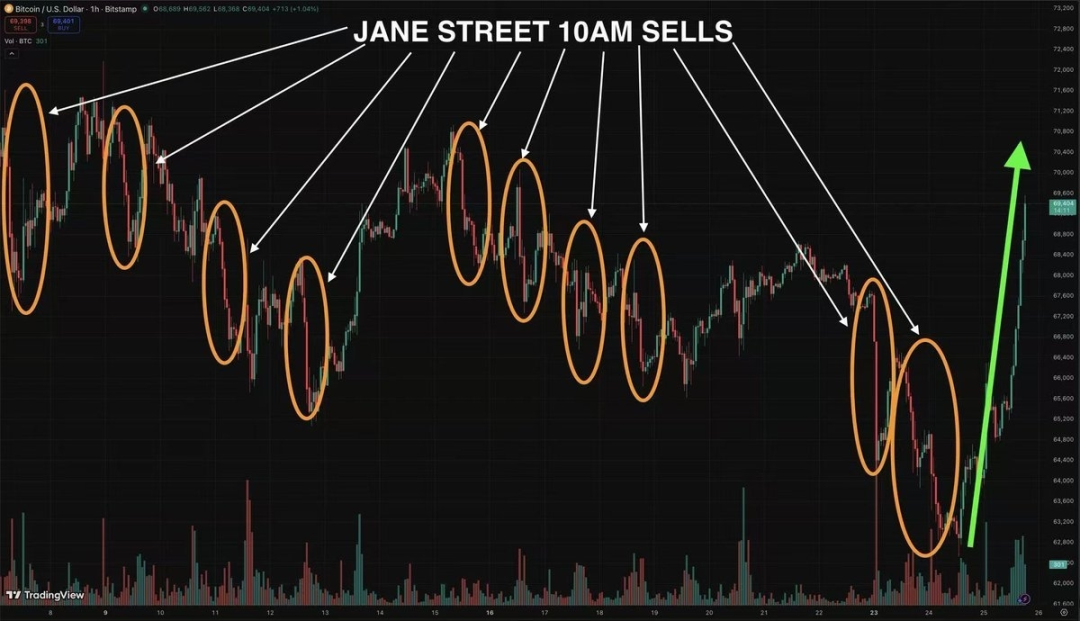
1. Has Jane Street (Jane Street) really suppressed the BTC price?
This question deserves an accurate answer. The first and most important thing to understand is that this is actually not just a question about Jane Street.
This is a question about the structural features of the Bitcoin ETF architecture, which applies equally to every authorized participant (AP) in the ecosystem. As far as BlackRock's IBIT is concerned,This list includes Jane Street Capital, J.P. Morgan Chase, Macquarie, Virtu Americas, Goldman Sachs, Citadel Securities, Citigroup, UBS, and ABN AMRO.
The role of these agencies is indeed deeply misunderstood by the outside world, even among seasoned industry veterans, and this misunderstanding is worth rectifying before any conclusions are drawn.
The first thing to know about APs is that they occupy a marginal exception in the regulatory framework of Reg SHO (US Securities Regulatory Commission's Rules for Naked Short Selling). For example, Reg SHO requires short sellers to finance securities (locate stocks) before shorting, but AP was exempted by virtue of its contractual right to participate in subscription and redemption.
Although this sounds procedural, the actual consequences are significant, meaning that any AP can create shares at will — no borrowing costs, no capital usage tied to shorting in the traditional sense, and no hard deadline for closing positions other than a reasonable commercial period.
This is the grey area:A regulatory exemption designed for orderly ETF market-making, structurally, it is indistinguishable from regulatory arbitrage of unparalleled duration. This exemption is not unique to any one company. It is a prerequisite for membership in the AP Club.
II. What does this AP exemption mean?
Normally, if IBIT's transaction price is lower than its net asset value (NAV), you would expect arbitrage buyers to step in, redeem the Bitcoin with their share, and smooth out the difference. But any AP itself is that arbitrage buyer, and they control the pipeline, which means that their motivation to smooth out the price difference is different from a third-party trading desk that doesn't have the right to redeem.
Sounds complicated, but it's easy to understand with a simple analogy:
Level 1: What is a normal “smoothing out price difference”?
Assuming there is a blind box on the market (this is an IBIT ETF), everyone knows that the blind box contains a real Bitcoin exchange voucher worth 100 yuan (this is the net asset value NAV). However, people are panicking in the market today, and the list price of this blind box has dropped to 95 yuan.
According to the logic of normal people, smart merchants (arbitrage buyers) would definitely spend a crazy 95 yuan to buy a blind box, then go find the official one to unpack it and sell it in exchange for 100 yuan in Bitcoin, making a 5 yuan difference in price in vain.
It is also because everyone is snapping up blind boxes to arbitrage, and the price of blind boxes will soon be boosted by buying and returning back to 100 yuan. This is called “bridging the difference.”
Tier 2: “Monopoly Channel” AP
However, in the real world of Bitcoin ETFs, ordinary trading companies and retail investors are not eligible to go to the official “teardown box” (that is, they have no right to redeem).Only a few privileged Wall Street Investment Banks (APs) in the entire market can do this; in other words, the AP has a monopoly on the only channel for exchanging ETFs for real bitcoins (they control the pipeline).
Level 3: Why doesn't AP play cards according to arbitrage?
If it were an ordinary third-party merchant, seeing this 5 yuan risk-free difference, they would definitely do it right away, but APs are not the same; they would calculate a smarter account: “Anyway, only I can break the blind box, what am I in a hurry? If I deliberately don't pull the price back to $100, but use the illusion of the current low price of 95 yuan and go short or long at another casino (such as the Bitcoin futures market), I might be able to make 20 yuan!”
To sum it up in one sentence, the market originally had an automatic error correction mechanism (if it falls too much, people will buy arbitrage to raise the price), but since the “only switch” to implement this error correction mechanism is in the hands of the AP, and the AP finds that “not correcting errors and maintaining the price difference” allows them to earn more money elsewhere, they have no motivation at all to bring prices back to normal levels.
Retail investors are waiting for the arbitrage army to save the price, but they don't know that the only arbitrage force (AP) is using this difference on the sidelines to make money in other markets.
3. The problem is not Jane Street, but the AP architecture
IBIT's shorting risk exposure can in principle be hedged by going long on Bitcoin spot, but this is not necessary, as long as the chosen instrument remains closely correlated.
The obvious alternative is BTC futures, especially given their money efficiency. This actually means that if the hedging instrument is futures rather than spot, then spot is never bought, and since natural arbitrage buyers choose not to buy spot, this price difference cannot be closed through a natural arbitrage mechanism.
Notably, the spot/futures base spread itself is the subject of an entire community of spread traders who are committed to maintaining this close relationship. However, every separation between hedging instruments and underlying assets introduces dirty basis risk (dirty basis risk), which is continuously superimposed throughout the structure — and under stressful conditions, basis risk is where the market is misaligned.
The final piece of the puzzle involves in-kind creation and redemption (in-kind creation and redemption) recently approved by the SEC. Under the previous cash-only (cash-only) system, the AP was required to deliver cash to the fund, and then the custodian used this cash to buy Bitcoin spot. This buying act is a structural regulator — it acts as a mechanical consequence of the subscription, forcing the purchase of spot.
Physical redemptions have completely eliminated this, and now any AP can directly deliver Bitcoin, and it is up to them to choose when to obtain the source and counterparty: OTC desks (OTC desks), negotiate pricing, and minimize market shocks.
The broadest interpretation of this flexibility is that APs can maintain derivatives positions with the aim of collecting capital rates or volatile profits within the time window between short establishment and physical delivery — while ensuring that every single step remains within the definition of legitimate AP activity.
And this is exactly the crux of the problem. The beginning looks like normal market-making behavior, and the end also looks like normal market-making behavior; it is precisely the middle process that is difficult to clearly categorize. This is not a complaint against any single company.Every AP on the IBIT list, and thus every AP in every Bitcoin ETF, operates within the same structural framework, enjoys the same immunity, and therefore has the same theoretical capabilities.Whether any of them have exercised this ability in a way that wanders on the edge of collaborative activity falls entirely within the scope of the “monitoring and sharing agreement” required by the SEC when approving ETFs.
Whether these agreements are sufficient to capture actions that simultaneously span the spot, futures, and ETF markets (even across offshore trading sites) remains a real open question.
In a nutshell, Jane Street has only been pushed into the spotlight. The real problem lies deep in the underlying structure of the Bitcoin ETF, designed by Wall Street veterans themselves.No AP is clearly suppressing the Bitcoin price. What the AP structure can suppress is the integrity of the price discovery mechanism itself, which may have a far more profound impact than the former.
So, the question really worth asking is not whether a particular company is a villain, but is a regulatory framework established for traditional 20th century finance suitable for hosting an emerging 21st-century asset “whose value is not controlled by regulators”?
This is probably the tuition fee that the crypto market must pay when entering the “era of big institutions.” After all, although we desire Wall Street's liquidity irrigation, we don't want to passively accept the black box games they have built using regulatory exemptions.
This is not only an answer about Jane Street, but also the ultimate question about the Bitcoin ETF era.
Twitter:https://twitter.com/BitpushNewsCN
Compare the TG exchange group:https://t.me/BitPushCommunity
Compare TG subscriptions:https://t.me/bitpush
