


8 billion monthly trading volume was exchanged for an airdrop backlash. What did Opinion do wrong?

By ChandlerZ, Foresight News
Original title: The biggest backlash at the beginning of the year? Opinion airdrop causes controversy
Opinion, a rising star on the market circuit, is about to usher in its own TGE moment, but the long-awaited token release brought not joy, but rather a large list of users' anger and losses.
According to OPN tokenomics published by it, the airdrop in the first quarter accounted for only 3% of the total number of tokens, which is far different from the market's previous expectations; the pre-market price of Opinion points plummeted from a maximum of 45 US dollars/min to 6 US dollars/cent; bloggers such as @daidaibtc publicly stated that they burned 200,000 dollars to participate in the accumulation of points, and eventually only exchanged 2000 OPNs, equivalent to about $1,000.
This is one of the most controversial TGEs for the beginning of 2026.
Pre-market prices rose by more than 30% in a short period of time, but airdrop users cried
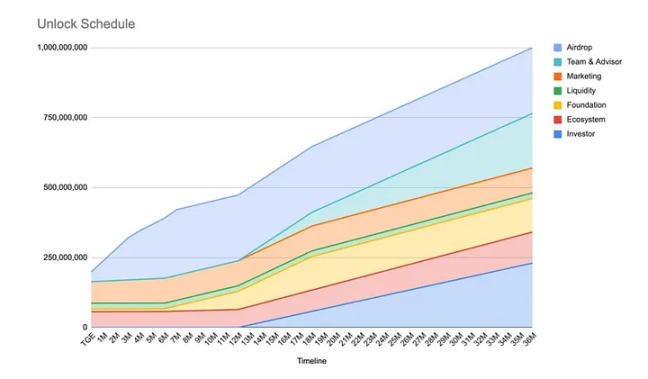
On the evening of March 2, the Opinion Foundation officially announced the tokenomics and roadmap for the native token OPN. OPN has a total supply of 1 billion and an initial circulation of 198.5 million, which will be deployed on Ethereum and BNB Chain. In terms of token distribution, airdrops accounted for 23.5% (235 million units), TGE released 3.5%, and the rest were owned within 7 months; investors accounted for 23% (230 million units), and teams and advisors accounted for 19.5% (195 million units). Both had a 12-month lockdown period and a 24-month linear release period.
Foundations accounted for 12% (120 million units), TGE released 1%; ecosystems and incentives accounted for 11.1% (111 million units), TGE released 5.65% (including 3.5% locked airdrop rewards and 2.15% traceability incentives); marketing accounted for 8.9% (89 million units), TGE released 7.7%; liquidity and market making accounted for 2% (20 million units), and TGE released 2%.
Binance's pre-market price briefly rose more than 30% to break above $0.57 after Opinion published news from the airdrop inquiry website.
Some bloggers said that before the announcement of tokenomics, the OPN points secondary market once offered $45 per cent. Following the official disclosure that the first-quarter airdrop released only 3% of the total amount of tokens, the pre-market price quickly dived to $6/cent, with a cumulative drop of more than 85%.
What is even more strange is that the trend of the currency price itself is the exact opposite of what airdrop users experienced. Precisely because the initial circulation volume was extremely low, the OPN coin price briefly rose before the market. The logic of low circulation and high control funding worked temporarily at the price level, but point holders were already cleaned out of the pre-market crash. According to feedback from several well-known studios, the cost of credits ranged from 5 to 20 US dollars/cent. In terms of airdrop value after TGE, almost none of them achieved positive returns.
The blogger “Bandobitte” also publicly published his loss details, invested 200,000 US dollars to brush points, and eventually got 2,000 OPN, which is equivalent to about 1,000 US dollars at the current price. “200,000 dollars was exchanged for 2,000 coins. Yes, you read that right.” This statement quickly went viral in the Chinese crypto community.
According to Polymarket data, the probability of “FDV exceeding $500 million a day after OPN goes live” is 64%, and market expectations are not pessimistic. But most of the anger of airdrop users lies in the distribution logic itself.
“Belt and Band Bit” said, “Of course I accept that jerking is being rejected. Who says jerking will definitely make money? Willing to lose the gamble. The point that made me angry was the backstabbing. You can learn Lighter, just don't distribute points, don't distribute points, see if there are brushes to help you make data? But you sent out points, told everyone to get me quickly, make data, use up the community, and then at TGE, tell you that I sent you the score to play, and now it doesn't count, so does that make sense?”
The project party used a credit mechanism to actively summon users to use data and voice, but it unilaterally reset the implicit contract during execution. Losses themselves are currently the norm, but the “throw away when used up” operation logic touches the bottom line of the community's basic trust relationship.
The founder of a number of well-known capital betting companies and a background on Wall Street in the Hong Kong region
Opinion (Opinion Labs) is an on-chain forecasting market agreement. Unlike the binary settlement mechanism of mainstream platforms such as Polymarket and Kalshi, Opinion focuses on continuously predicting market models. Users do not need to wait for events to be settled, and can trade and adjust positions at any time as topics evolve, and market prices continuously reflect changes in collective expectations. The bottom layer of the platform uses a CLOB (central price limit order book) architecture, and also introduces an AI-assisted market creation function to support any user to launch a structured prediction market. The coverage extends from macro-financial events to special content in the Asia-Pacific region such as e-sports, entertainment, and regional politics.
In terms of the founding team, Opinion CEO Forrest Liu graduated from Columbia University and worked as a corporate finance consultant for CMB International Capital (CMB International Capital). He has a background in traditional financial institutions, and is also a former JPMorgan member in the co-founder team. The project is aimed at filling the gap of Western platforms (Polymarket, Kalshi) in the Asia-Pacific content market. It is currently one of the few on-chain agreements in the forecasting market with Asian users as the core audience.
Opinion has completed two funding rounds, totaling more than $25 million. In March 2024, Yzi Labs announced 13 early projects selected for the 7th quarter of the MVB Accelerator Program, including Opinion. In March 2025, Opinion announced the completion of a $5 million seed round led by Yzi Labs. Other investors include angel investment community Echo, Animoca Ventures, Manifold Trading, Amber Group, etc.
YZi Labs' endorsement meant that Opinion directly obtained the Binance ecosystem's channel resources and then joined the Binance Launchpool and Binance Wallet Booster program as scheduled. Zhao Changpeng once tweeted in October 2025, “YZi Labs is only a small number of investors in predicting the market Opinion, but it will do its best to help increase strategic value.”
In February 2026, Opinion once again announced the completion of a $20 million Pre-Series A round, co-led by Hack VC and Jump Crypto, with Primitive Ventures, Panasonic, and Continue Fund participating.
On the other side of high growth, OI/Vol anomalies and data are being questioned
However, Opinion's fast-paced narrative never escapes the question of whether the transaction volume is real?
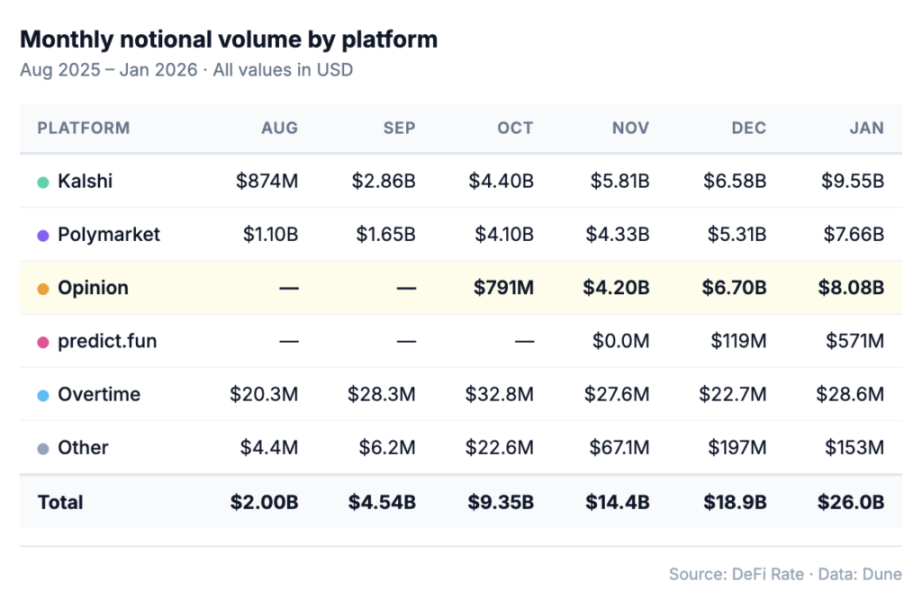
According to the DeFi Data report, Kalshi's monthly trading volume increased 11 times from $884 million in August to $9.55 billion in January, mainly driven by sporting events. Polymarket's trading volume also increased sevenfold from $1.1 billion to $7.66 billion, and its business structure is more diversified, covering sports, cryptocurrencies, and politics.
Opinion went live on October 23, and achieved a trading volume of 791 million US dollars in the first month (less than a month), reached 4.2 billion US dollars in November, and reached 6.7 billion US dollars by December, surpassing the trading volume of Kalshi and Polymarket in the same month.
Although transaction volume is the main indicator, the actual number of transactions shows a different situation. In January 2026, Opinion's transaction volume was $8.08 billion, with 3.2 million transactions, with an average transaction volume of approximately $2,525 per transaction. In the same month, Kalshi traded $9.55 billion, with 54.5 million transactions (an average of $175 each). Polymarket's trading volume was $7.66 billion, with 52 million transactions (an average of $147 per transaction).
With less than 3% of the total number of transactions in the industry, Opinion supported 31% of the industry's total transaction volume. An average of $2,525 per transaction is 17 times that of Polymarket and 14 times that of Kalshi.
This kind of deviation is almost impossible to occur due to organic user behavior. The report further pointed out two other anomalies: first, Opinion's active users fluctuated sharply by up to 6 times over a few weeks, while the organic growth platform user base generally stabilized; second, as the platform expanded, Opinion's per capita trading volume not only did not decline, but continued to rise. This is the opposite of the rule of almost any normal growth platform.
The root of the problem points highly to Opinion's Credit Incentive Design (PTS). PTS distributes 100,000 points on a fixed basis every week, distributed proportionately among users across the network according to their contribution, and the core calculation weight of “contribution” includes three items: transaction size, position length, and proximity of pending orders to the middle price of the market. Among them, the size of the transaction directly affects the score. The larger the single transaction, the higher the point weight.
DeFi Rate concluded that these transaction volumes actually occurred on-chain, and the incentives created a data pattern that deviates highly from organic demand. Opinion's data isn't necessarily false, but it probably records credits-driven funding behavior rather than actually predicting market demand.
TGE was launched, and the point incentive came to an end. The fuel that drives the $8 billion monthly transaction volume has run out. Whether this part of the capital will remain on the platform will directly determine how thick Opinion's real user base market is.
Two suspense
Opinion has emerged at an excellent racetrack point. User education to predict the market has basically been completed, the regulatory attitude is becoming clear, and the potential market size in the Asia-Pacific region is huge. However, choosing to complete TGE during the downturn of the market using a set of tokenomics that triggered a large-scale community rebound. This combination of timing and attitude is bound to cause user retention in the post-airdrop era to face higher friction costs.
Opinion currently has two unanswered questions: how much is left in the 8 billion monthly transaction volume after removing the credit incentives; and how many of those early “repulsed” users will choose to stay, and how many have left for good. The answers to these two questions will together determine how much real value OPN will have before the token unlock wave arrives.
Twitter:https://twitter.com/BitpushNewsCN
Compare the TG exchange group:https://t.me/BitPushCommunity
Compare TG subscriptions:https://t.me/bitpush
