


Hong Kong Web3 Carnival Debate: Sun Yuchen Predicts AI May Crack Bitcoin by 2029, Wave Field TRON Seizes Quantum Blockchain
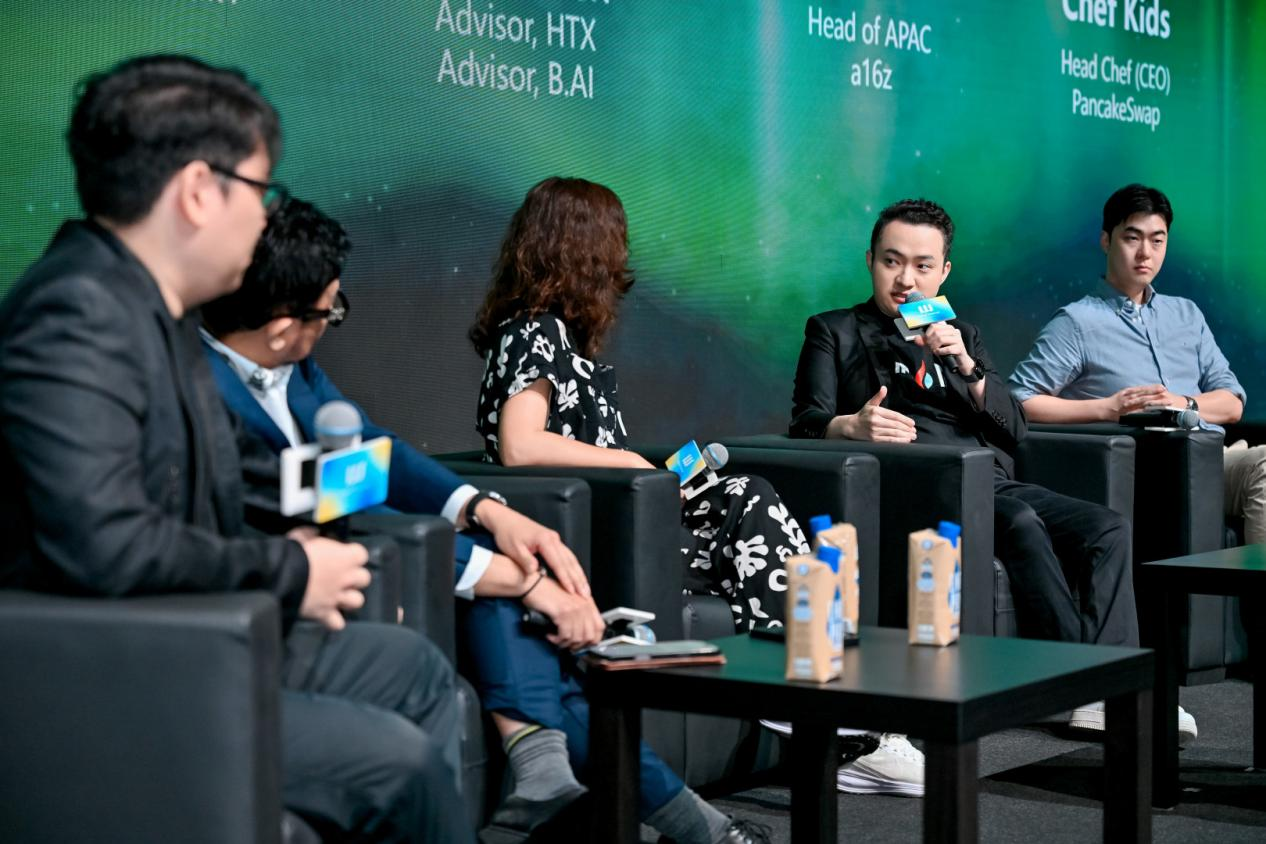
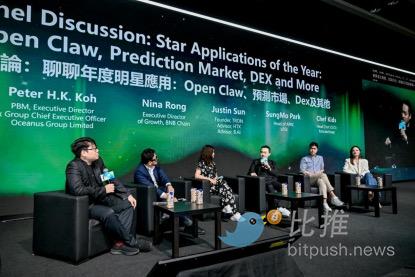
On April 21,hongkongWeb3CarnivalDuring the round table discussion on “Talking about Star Apps of the Year: Open Claw, Predictive Markets, Dex, and More” at the main venue, Sun Yuchen, founder of Bochang TRON, presented a series of opinions and made extremely forward-looking judgments on topics such as AI agents, blockchain infrastructure, stablecoin security, and post-quantum cryptography.
The round table was presided over by AltLayer founder YQ Jia, Oceanus Group Executive Director and Group CEO Peter H.K. Koh, BNB Chain Growth Executive Director Nina Rong, PancakeSwap CEO Kids Chef, and A16z Asia Pacific Head Sungmo Park, and many other heavyweight guests participated in the discussion.
During the conversation, Sun Yuchen used the core narrative of “Blockchain Is Born for AI” throughout the conversation, which not only outlined B.AI's complete product matrix from the cloud to the “brain”, but also brought topics such as post-quantum cryptography, AI governance, and agent economy to the forefront of the industry agenda. At the inflection point of an era where AGI is approaching and quantum shocks can be expected, the sense of strategic urgency and acceleration shown by Sun Yuchen and the TRON ecosystem is becoming a pole that cannot be ignored in the global Web3 industry.
“Blockchain is an infrastructure created for AI”: Sun Yuchen presents a strategic blueprint for B.AI
Faced with the host's first question, Sun Yuchen clearly stated that the combination of AI and blockchain is still the greatest opportunity now and in the future.
He cut in from an insightful perspective: AI can't open human bank accounts, so blockchain is the only viable path for payment, settlement, and collaboration between AI agents.
“In this sense, blockchain is essentially a startup engine prepared for AI. Everything we're building today, ostensibly for humans, is actually for AI.” Sun Yuchen emphasized.
Based on this judgment, B.AI founded by Sun Yuchen is building a two-way bridge between AI and blockchain: connecting mainstream global models such as Claude, Gemini, ChatGPT, Kimi, and MiniMax on the AI side; connecting all mainstream EVM networks such as BNB Chain, Tron, Ethereum, and Arbitrum on the blockchain side.
He said bluntly that the Chatbot era has come to an end, and the Agent era is beginning. The key proposition is how to make AI “complete 100% or even 1000% of output with 1% investment”.
Redefining the “country”: 10 billion agents will rewrite the national power pattern
Sun Yuchen shared the news of his recent visit to Kyrgyzstan at the round table. He expressed a bold idea to the Kyrgyz president: the future concept of a “nation” will be completely reshaped by AI.
“Today, the standard for measuring a country is population and territory, but in the future, a small country with a population of only 1 million may become the largest country in the world if it continues to have hundreds of billion AI agents working for it. Conversely, even a country with a population of 300 million may become a small country if it lacks AI computing power layout.” Sun Yuchen called for every country to take AI trends seriously, because AI already has the ability to complete a large number of complex tasks, and may even hack Bitcoin in 2029.
B.AI Brain will be released soon: Let everyone have a “clonable brain”
While talking about the pace of implementation of B.AI, Sun Yuchen revealed in public for the first time that B.AI Brain will be officially released soon. The product allows users to clone their own “brain” and superimpose arbitrary large language models (such as Kimi, Claude, etc.) to handle all kinds of tasks. Sun Yuchen himself will be the first tester and then open to all users.
In terms of security architecture, B.AI Brain ensures the privacy of user data through on-chain address signature verification, and only the signed authorized user can call their own “brain” data.” In the future, people will hope to use their own brains and big models to decide what to do. It's going to be revolutionary.”
At the same time, he also issued a security warning to the industry: “Hackers used to stare at your wallet; in the future, hackers will stare at your brain.”
Recently, $300 million worth of theft in the crypto industry is still occurring, and if users misauthorize AI in the future, the risk of brain-level intrusion should not be underestimated.
Talking to the Age of AGI: DeFi's History Is Repeating on the AI Circuit
Faced with the host's question “Will the next generation of cryptographic users be agents?” Sun Yuchen gave a more aggressive judgment: The progress of AGI far exceeded expectations, and it is likely that it will be realized next year. He believes that the current state of crypto+AI is just like the scene when DeFi started five years ago. At that time, hackers were frequent, but the industry still chose to move forward irrevocably, eventually spawning a $200 billion DeFi ecosystem.
“In the future, users will increasingly authorize AI to execute transactions and manage assets. Methods to attack AI are bound to occur, and risks are unavoidable. But at the same time, someone who really knows how to use AI can do 100 times more work alone than before.”
Sun Yuchen also shared an interesting internal management practice: his company has begun tracking each employee's daily token consumption data to reverse analyze work efficiency and AI usage patterns to help the team learn to use AI more efficiently.” If an employee consumes 100 million tokens every day, he is either highly productive or stuck in a bug over and over again, and the data will tell us the truth.”
Security boundaries: open source innovation to GitHub, large-scale services to the cloud
When asked how to ensure agent security and accountability in the AGI era, Sun Yuchen proposed a clear hierarchical architecture: “Innovation always happens on GitHub, but real commercial services must run in the cloud.”
He pointed out that open source solutions such as Open Claw are essentially sandbox environments, suitable for developers to explore freely; however, production-level services for consumers and enterprises must be architectures for cloud hosting, data encryption, and address-level permission verification. B.AI Cloud is based on this concept, providing AI × blockchain cloud services that are cheaper and faster than AWS, while ensuring that data cannot be accessed without authorization.
The end of stablecoins: post-quantum is the next race
Faced with a topic from Peter H.K. Koh, representative of the traditional financial world, about the future of stablecoins, Sun Yuchen revealed the latest strategic direction of Wavefield TRON, comprehensively promoting the launch of NIST post-quantum cryptography standards, and competing for “the world's first post-quantum blockchain.”
He revealed that the current volume of assets carried on the TRON chain is around 190 billion US dollars, and protecting these assets before AI computing power gets out of control is a top priority task.
“Google's research paper gives a conservative timeline: quantum technology could break Bitcoin by 2035. But if AI continues to accelerate, that day may come next year. We only have three years left, and we must deploy post-quantum technology to the chain as soon as possible”
Sun Yuchen said that he is a firm believer in technological accelerationism — after the implementation of quantum NIST standards, he used stablecoins to unleash the freedom of AI agents and build a three-in-one architecture of “stablecoin security, blockchain security, and agent security.”
2026 bets: AI, B.AI, and Claude
When the host asked each guest to predict “the direction of star applications within the next year and a half,” Sun Yuchen gave three keywords: AI, B.AI, and Claude.
He spoke highly of Claude's speed of iteration. “Every new release can cause competitors' stock prices to drop 20%. This is the real energy of AI.” He believes the market is not overreacting and is really underestimating the pace of AI development.” AI is running faster than anyone thought, which is why predicting the future is so difficult.”
