


For every $1 OpenAI earns, how did Anthropic take the lead in turning a loss into a profit?

Author: Su Yang, Tencent Technology
Original title: OpenAI “earns one dollar and loses one dollar two”, Anthropic has begun to make money
In mid-May, the two AI giants revealed their bottom cards at the same time — OpenAI secretly submitted an IPO application, and Anthropic came up with financial forecasts for the first profitable quarter.
According to the data, OpenAI's revenue for the first quarter was $5.7 billion, but for every dollar it earned, it lost $1.22. Anthropic's revenue for the same period was 4.8 billion US dollars, which is nearly 1 billion dollars behind. However, the forecast for the second quarter was a sharp increase in the month-on-month growth rate, reaching 10.9 billion US dollars, and achieving operating profit of about 559 million US dollars.
This difference gives the outside world the impression that the family is a trillion-dollar superstar whose valuation is still demanding patience with the market. The other one is a former catcher and has quietly reached the threshold of profit.
01.57 billion vs 4.8 billion
People familiar with the matter revealed to The Information that OpenAI generated about 5.7 billion US dollars in revenue in the first quarter of this year. This figure is nearly 1 billion US dollars higher than its old rival Anthropic's revenue of 4.8 billion US dollars during the same period.
Looking at these two numbers alone, it seems clear that OpenAI's leading edge is clear.
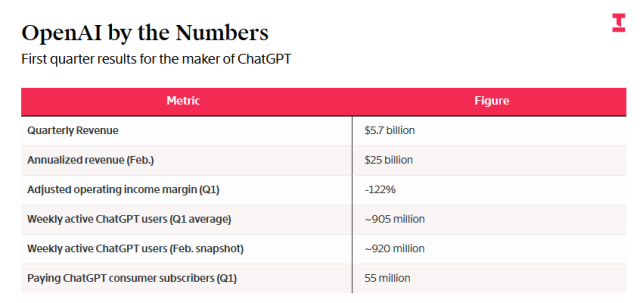
OpenAI's first quarter financial results, source: The Information
People familiar with the matter mentioned above revealed that there were three main factors driving OpenAI's growth in the first quarter, namely the explosion of the programming agent Codex, an increase in corporate sales, and ChatGPT test ads.
The explosion of Codex shows that the developer community is in high demand for tools that can work directly. This actually overlaps with Anthropic's customer base. Testing the waters of the advertising business revealed OpenAI's anxiety about finding monetization exports in its huge pool of free users.
OpenAI had an average of 905 million weekly active users in the first quarter, and peaked at 920 million in February.
When users hit a very large benchmark, growth began to stall. Although it has 55 million paying consumer subscribers, up from 47 million at the end of last year, the conversion rate is still very low compared to its more than 900 million active weekly users.
Moreover, this portion of the corresponding inference cost is also a huge black hole for OpenAI.
On the other hand, Anthropic's first-quarter revenue of $4.8 billion came almost entirely from what it does best: selling AI models to businesses and developers. It doesn't have a huge free consumer base that needs huge subsidies like ChatGPT. This difference may be a key factor for it to surpass its old rivals in the future.
02. The fastest counterattack in history
According to financial data disclosed to investors by Anthropic obtained by the Wall Street Journal, the company expects second-quarter revenue to reach $10.9 billion, more than double that of the first quarter.
Moreover, its revenue growth rate has surpassed that of Google and Facebook before the IPO.
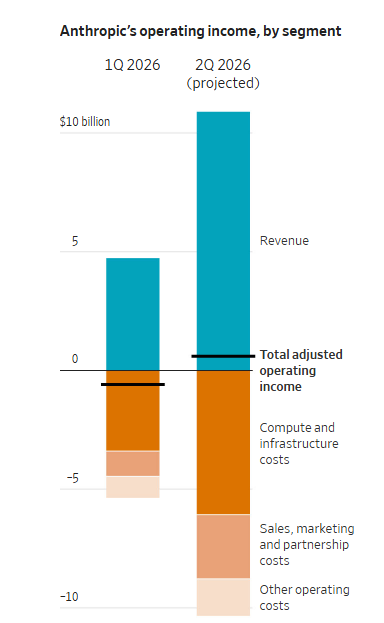
Anthropic's operating profit by business, source: Anthropic
According to The Information, Anthropic's annualized revenue was over $30 billion by April 2026, while OpenAI's annualized revenue was around $25 billion.
At the May 2026 developer conference, Anthropic CEO Dario Amodei joked that their recent revenue growth had reached the point where it was “hard to handle.”
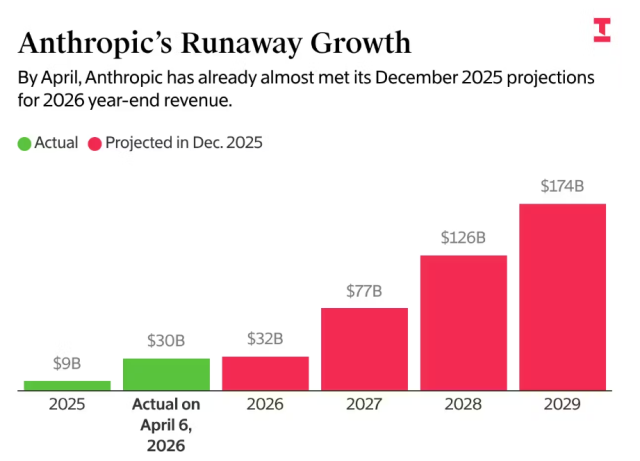
Anthropic revenue growth, forecast in red for December 2025, Source: The Information
Anthropic is forecasting an operating profit of approximately $559 million in the second quarter, which is also a landmark event. Last summer, the company shared predictions with investors that it won't be profitable for the whole year until at least 2028.
However, operating profit excludes equity incentive expenses, and considering subsequent huge computational expenses, Anthropic may not be able to maintain profits throughout the fiscal year, but it proves one thing: AI model companies, with enterprise customers at the core, can run through the profit model in the short term.
Looking at OpenAI, although its expectations for the second quarter are yet to be known, a data shown to investors shows that the company's adjusted operating margin for the first quarter was -122%. In other words, for every $1 in revenue generated, a loss of $1.22 is required.
OpenAI is not expected to achieve positive cash flow until 2029 or 2030, and until then, it will need to continue to fill a huge funding gap.
HSBC analysts estimate that OpenAI has a $207 billion funding gap relative to its growth plans. OpenAI CEO Sam Altman (Sam Altman) hinted at the company's all-staff meeting that even if the IPO documents are submitted, the actual listing may be delayed because submitting an application and “being ready to go public are two different things.”
The financial pressure behind this is self-evident.
03. One AI, two destinies
Why is the financial situation of the two companies so drastically divided due to the same wave of AI?
The answer lies in a diverse customer structure.
According to Forbes analysis, approximately 85% of Anthropic's revenue comes from enterprise and developer customers. More than 500 companies already spend more than $1 million a year on the Claude platform, and 8 of the Fortune 10 companies are customers.
Enterprise customers have a clear intention to pay, the inquiry model is more predictable, the service cost is lower, and the contract is more sticky. It's a healthy, sustainable business model.
For every dollar Anthropic earns in the first quarter, it spent 71 cents on computing power; by the second quarter, this figure is expected to drop to 56 cents, and the increase in efficiency is immediate.
In contrast, OpenAI accounts for approximately 85% of its revenue from ChatGPT consumer subscriptions. Although it has 55 million paid subscribers, it has more than 900 million weekly active users behind it, with no corresponding revenue to cover, resulting in a structural loss.
OpenAI isn't unaware of this.
Under the leadership of executives such as app business CEO Fidji Simo (Fidji Simo), the company has begun cutting back on money-burning projects like the video-generating app Sora in an attempt to shift its focus to businesses and commercial customers that directly generate revenue. However, the shipwreck made a U-turn, and reversing the business model centered on free consumers is not a one-day success.
Of course, directly comparing the two companies' revenue figures requires taking into account one key difference in accounting treatment.
The Information explains this in detail: Anthropic counts all of its technology sales through Amazon, Google, and other cloud partners as revenue. OpenAI, on the other hand, has exclusive rights to use its intellectual property due to its long-term special partnership with Microsoft, so OpenAI will only recognize 20% of the revenue from the Microsoft Azure sales model as its own revenue.
However, it is important to note that the two accounting standards are slightly different, and their revenue is somewhat “inflated”: Anthropic takes the full revenue from reselling its models from Amazon, Google, and other cloud vendors in the ledger, without deducting a share; OpenAI does not include sales generated through cloud partners at the time of disclosure because 20% of the revenue needed to be distributed to Microsoft by 2030 (which may reach 6 billion US dollars this year).
However, even if OpenAI's switch to Anthropic's caliber would increase annualized revenue by billions of dollars, it would not be able to bridge the gap that has reached tens of billions of dollars between the two.
04. Behind the IPO race
On the way to the IPO, all financial secrets will be spread out under the sun.
OpenAI, Anthropic, and Elon Musk's SpaceX (Elon Musk) are all competing to go public, and the valuation of all three companies is likely to exceed trillion dollars.
Currently, OpenAI has received $122 billion in financing from vendors such as Amazon and Nvidia, and is seeking to go public as early as September 2026. Anthropic, on the other hand, is continuing a round of financing that could surpass OpenAI's valuation and is considering going public as early as October. Ultraman said privately that he would like to go public first.
What Anthropic now has in its hands is quarterly data that has proven to be profitable.
Even if future losses will occur again due to astronomical computing infrastructure investments, such as paying SpaceX $1.25 billion to rent data center capacity every month, and newly signed big computing power orders from Broadcom and Google, it also proved to the market that its business model can work. Its story is that of an enterprise-grade software company that can be compared to Salesforce or ServiceNow.
What OpenAI gave to open market investors is a story that requires stronger conviction. It needs to convince the market that AI agents, image generation, and future huge advertising businesses will eventually turn their massive consumer traffic into profit.
According to Ultraman's plan, ChatGPT's advertising business could generate about 102 billion US dollars in revenue by 2030.
But it will also take time, and time is exactly what OpenAI is most scarce when trading losses for growth.
OpenAI just launched more than two gigawatts of computing power, more than SpaceX's entire Colossus cluster combined, all of which cost money.
So for investors, when the S-1 document is made public, should we trust a company that has already found a profit model, or a giant that asks the market to give it another few years and hundreds of billions of dollars to explore profit possibilities? The answer will determine the fate of both companies.
Twitter:https://twitter.com/BitpushNewsCN
Compare the TG exchange group:https://t.me/BitPushCommunity
Compare TG subscriptions:https://t.me/bitpush
